

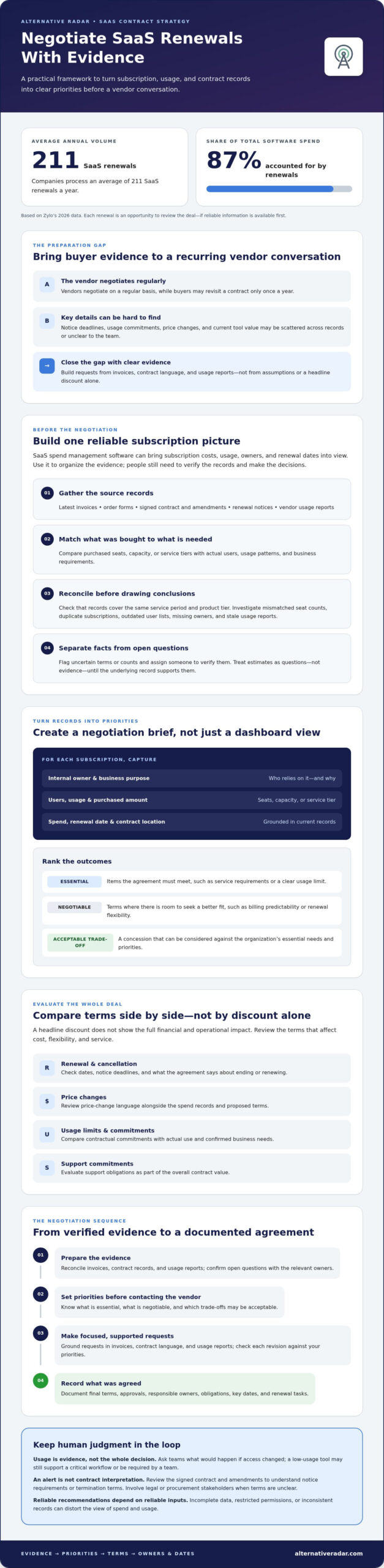
Companies process an average of 211 SaaS renewals a year, accounting for 87% of total software spend, according to Zylo’s 2026 data. Each renewal is an opportunity to review the deal, but only if you can find reliable information first. SaaS spend management software can bring subscription costs, usage, owners, and renewal dates into view, giving you a stronger starting point than scattered invoices and calendar reminders.
It’s difficult to negotiate confidently when contract terms hide notice deadlines, usage commitments, or price changes, and your team can’t quickly confirm whether a tool still earns its place. Vendors negotiate regularly; buyers may revisit a contract only once a year. Clear evidence can help close that gap.
This guide shows you how to build a fact-based position before contacting a vendor, compare the financial and operational impact of contract terms, and avoid renewal surprises. You’ll learn what spend and usage data to gather, which clauses to review, and how to document agreed obligations, owners, and key dates. The result is a structured negotiation with requests grounded in your organization’s needs.
Key Takeaways
- Use saas spend management software to connect subscription records with usage, ownership, and renewal details before approaching a vendor.
- Compare purchased seats, capacity, or service tiers with actual users and business requirements to identify specific negotiation priorities.
- Evaluate contract terms side by side, including renewal, cancellation, price changes, usage limits, and support commitments, rather than judging value by the headline discount.
- Make focused requests backed by invoices, contract language, and usage reports, then check every revision against your priorities.
- Record the final agreement, approvals, responsible owners, and renewal tasks so negotiated terms carry through to the next contract cycle.
What SaaS Spend Management Software Reveals Before Contract Negotiations
Before asking a vendor to change a price or term, establish what your organization buys, who uses it, and when the agreement can be changed. SaaS spend management software brings subscription inventory, ownership, usage, renewal dates, and spend records together to support informed purchasing decisions. It can help you prepare to negotiate, but it doesn’t make the decision for you.
This category overlaps with other business systems, but each has a different primary purpose. Accounting tools record financial transactions; procurement tools manage purchasing processes and approvals; vendor-management tools organize supplier relationships and related records. SaaS spend management focuses on visibility into software subscriptions, costs, and usage. It can complement these systems rather than replace them. As part of the broader discipline of Software asset management (SAM), it helps teams track software assets and consider cost and risk across their lifecycle.
Which SaaS data matters before a negotiation?
Build a clear record for each subscription. Start with the internal owner, business purpose, users, usage patterns, renewal date, and current spend. Compare the recorded commitments with invoices, order forms, and vendor usage reports. If invoices show more seats than your internal record, investigate the discrepancy before treating it as a basis for changing the contract.
Check the evidence before relying on it. Flag missing owners, duplicate subscriptions, outdated user lists, and stale usage reports. Confirm that the records cover the same billing period and product tier. These checks help distinguish a genuine negotiation opportunity from a data gap, and identify questions to resolve before contacting the vendor.
What spend management software cannot decide for you
A dashboard can surface low usage or rising spend, but it can’t determine whether a tool is essential to a critical workflow, required by a team, or replaceable. Ask the people who rely on it what would happen if access changed. Their operational context matters as much as the usage trend.
Keep alerts separate from contract interpretation. A renewal reminder can flag a deadline, but it can’t establish what a notice clause requires or whether termination is permitted under the agreement. Review the signed contract and amendments, and involve the appropriate legal or procurement stakeholders when terms are unclear.
Recommendations are only as reliable as their inputs. Incomplete data, restricted permissions, or inconsistent records can distort a view of spend and usage. Use saas spend management software to organize evidence, then apply stakeholder judgment and contract review before setting negotiation priorities.
Build a SaaS Contract Negotiation Position from Usage, Risk, and Renewal Data
Turn subscription records into a negotiation brief before contacting the vendor. Gather the latest invoices, order forms, signed contract and amendments, renewal notices, and vendor usage reports. Check that each record covers the same service period and product tier. Then compare what you purchased with what teams use and need.
Map users and business requirements against purchased seats, capacity, or service tiers. If a subscription includes more seats than the team needs, for example, confirm whether those seats are contractually committed, available to reassign, or simply unused. Separate verified facts from questions that still need an owner’s confirmation. SaaS spend management software can help organize these records, but you still need to reconcile them to build a reliable position.
Create a reliable SaaS inventory for negotiation
For each vendor, record the internal owner, business purpose, renewal date, contract location, and relevant spend details. Reconcile the information with finance invoices, procurement records, and business-owner input. If seat counts or terms don’t match, mark them as uncertain and assign someone to verify them. Treat estimates as questions, not evidence, until the underlying record supports them.
Set priorities and a defensible target
Rank each outcome as essential, negotiable, or an acceptable trade-off. Essential items might include service requirements or a clear usage limit; negotiable items could include billing predictability or renewal flexibility. Put optional features in a separate category so they don’t distract from core needs. Before speaking with the vendor, agree on approval limits, fallback positions, and who can authorize a concession.
Make each request measurable and tie it to evidence. Instead of asking generally for a better deal, explain which commitment no longer matches usage, what capacity the business needs, or which renewal term creates uncertainty. If you’re considering another vendor, compare features, pricing, and pros and cons through software alternative comparisons. Alternative Radar earns revenue through affiliate referrals, so recommendations or referral links may involve an affiliate relationship.
Preparation rule: “Verify usage, confirm the business need, then make a specific contract request.” This keeps your position evidence-based and gives the vendor a clear issue to address.
Compare SaaS Contract Terms That Change Total Cost and Flexibility
A headline discount doesn’t show the full value of a SaaS agreement. Compare each vendor against the same requirements, including the length of the commitment, how costs can change, and what happens when the service no longer fits. A saas spend management software record can help identify the spend under review, but the contract determines the obligations.
Use this comparison table to capture terms that affect cost, flexibility, and operational fit. Record the clause or document reference beside each finding so reviewers can verify it.
| Term | What to compare | Question to resolve |
|---|---|---|
| Term length | Initial commitment and any extension period | Can the business commit for this long? |
| Renewal | Renewal date, notice deadline, and notice method | Who must act, and by when? |
| Cancellation | Termination rights and steps to change subscription scope | What options exist if needs change? |
| Price changes | Price-adjustment language, billing frequency, and minimum commitments | Which costs can change, and when? |
| Usage limits | Included seats or capacity, overage rules, and measurement method | How is excess use handled? |
| Support and service | Support scope, service-level commitments, remedies, and escalation | Do these commitments meet operational needs? |
| Security and exit | Data obligations, access, export, deletion, and transition terms | Can the organization manage data and exit cleanly? |
Renewal, termination, and pricing-change language
Read the full renewal process, not just the date in a calendar. Check the required notice method and deadline, along with the steps and timing for reducing seats or changing tiers. Review clauses covering price increases, overages, minimum commitments, and billing frequency. If wording is unclear, ask the vendor to explain it in writing, then route interpretation questions to counsel. Deadlines and rights depend on the specific agreement.
Service, security, and data obligations
Compare service levels, support scope, remedies, and escalation paths with the business’s actual requirements. Have security and privacy specialists review applicable security and data-processing documents rather than assuming general vendor claims meet internal standards. Before signing, clarify data access, export formats, deletion responsibilities, and transition expectations. These terms can affect operational effort and exit flexibility, even when the subscription price looks attractive.
Don’t treat any clause as universally standard. Language and enforceability can vary by contract and jurisdiction. Compare equivalent requirements across vendors, note exceptions, and involve legal, security, or operational reviewers where needed. A strong comparison shows not only which offer costs less, but also which commitments the organization can accept and manage.
How to Negotiate a SaaS Contract: A Practical Step-by-Step Process
A clear process keeps the discussion focused and prevents verbal concessions from getting lost. Use your saas spend management software records alongside the contract and stakeholder input, then follow these five steps:
- Prepare evidence. Assemble the current agreement, invoices, renewal notice, and verified usage details. Note any gaps that need confirmation.
- Set priorities. Separate essential service needs from preferred commercial changes and acceptable trade-offs. Confirm your target, fallback position, and approval limits internally.
- Contact the vendor. Share the renewal timeline and make specific requests tied to business requirements or verified data. Avoid broad demands and competitor claims you can’t substantiate.
- Review revisions. Compare each proposal with your priorities. Check the financial and operational impact, including any new commitments or changed usage limits.
- Confirm approvals. Route open legal, privacy, security, and financial questions to the right reviewers. Ensure approved changes appear in the final contract documents before signing.
Open the discussion with a clear business case
Set the context first: identify the renewal decision timeline, describe the operational reason for each request, and explain what outcome would address it. For example, link a request to adjust capacity to a verified usage report and a confirmed business requirement. Share only the information the vendor needs to assess the request. Ask for a written response to each proposed change so the terms, assumptions, and open questions remain clear.
Keep a negotiation record as you go. Log proposals, agreed changes, open questions, and internal approvals in one accessible place. After each discussion, send a concise written recap and ask the vendor to correct any misunderstandings.
Evaluate counteroffers and finalize the agreement
Assess every revision against your team’s approved priorities, not just the headline concession. A lower price, for instance, may come with a longer commitment or less flexibility. Consider the effect on usage, billing, operations, and exit options. Have the appropriate internal specialists review terms within their areas, and resolve questions before treating a proposal as final.
Before signing, compare the final order form and contract with the written record of agreed changes. Confirm that no requested term is missing or contradicted by another document. If renewal no longer looks like the best fit, explore software alternatives to compare features, pricing, and trade-offs. Alternative Radar is a discovery and comparison platform, not spend management software; it may earn revenue from affiliate referrals.
After Negotiation: Document SaaS Decisions and Prepare for the Next Renewal
A negotiated agreement only helps if the people managing the subscription can find and follow its terms. Treat the post-negotiation handoff as part of the buying process, not an administrative afterthought. Keep the signed documents, negotiated commitments, approval record, vendor contacts, and renewal date together in an accessible system. SaaS spend management software may help organize subscription information, but people still need to act on it.
Turn negotiated terms into an operating record
Create a concise vendor record summarizing what was agreed, who owns each obligation, how issues should be escalated, and which dates require action. Store the signed contract and order form alongside it. Share relevant terms with finance, procurement, IT, security, and business stakeholders so invoice checks, access decisions, and service reviews reflect the same agreement.
Assign named owners for usage reviews, invoice checks, renewal notices, and the vendor relationship. Set reminders early enough to assess usage and options before a notice deadline, rather than waiting until a renewal decision becomes urgent. Track whether the vendor delivers the agreed service and whether the terms still match the organization’s needs. Record material changes, questions, and decisions as they arise.
Reassess renewal versus switching
As renewal approaches, compare actual usage and current business requirements with the service received and the contract terms. If the fit has changed, consider more than subscription cost: assess transition effort, integrations, data portability, and the needs of teams that depend on the tool. A lower-cost alternative may not be a better fit if migration creates operational friction or fails to meet essential needs.
Use a consistent set of requirements to compare potential providers. Explore comparable software options through Alternative Radar as one discovery input. The platform helps users compare software features, pricing, and pros and cons, including free, open-source, and premium alternatives. It is a software discovery and comparison platform, not SaaS spend management software or a contract negotiation service. Recommendations or referral links may involve affiliate relationships.
Close the review by documenting whether you’ll renew, renegotiate, or switch, along with the rationale and accountable owner. That record gives the next renewal team a useful starting point and helps prevent obligations, deadlines, and lessons from disappearing when responsibilities change.
Make Your Next SaaS Decision with Confidence
A stronger contract negotiation starts with reliable evidence. Use saas spend management software to bring spend, usage, ownership, and renewal details into view, then verify the facts against invoices and contract documents. Compare terms beyond the headline price, and connect requests to specific business needs.
Once terms are agreed, document the commitments, approvals, owners, and important dates. That record helps your team monitor whether the agreement still fits and prepare before the next renewal deadline.
If the current vendor may no longer be the right fit, compare alternatives against the same requirements. Compare software options before your next SaaS decision with Alternative Radar, where you can explore free, open-source, and premium software and compare features, pricing, and pros and cons. Alternative Radar is a discovery and comparison platform, not spend management software. Recommendations or referral links may involve affiliate relationships.
With clear records and a consistent comparison process, you can approach the next decision with greater clarity and control.
Frequently Asked Questions
How do I negotiate a SaaS contract?
Start by reviewing the signed agreement, order forms, invoices, renewal notice, and relevant usage reports. Compare what you purchased with current business requirements, then rank your requests by priority. Contact the vendor with specific, evidence-backed changes and ask for responses in writing. Review each revision against your priorities, route questions to the right internal reviewers, and verify that approved terms appear in the final documents.
What should I negotiate in a SaaS contract?
Review the terms that affect cost, flexibility, and operations. These can include contract length, renewal and cancellation procedures, price changes, billing frequency, minimum commitments, usage limits, support scope, service levels, and data access or exit provisions. Prioritize based on your actual requirements. A discount may not be worthwhile if it requires a longer commitment or adds terms your organization can’t support.
Can SaaS spend management software help negotiate a contract?
Yes. SaaS spend management software can organize subscription, spend, ownership, usage, and renewal information to help you prepare a fact-based negotiation position. Compare its records with invoices, contract documents, and vendor usage reports before using them as evidence. The software can highlight issues, but it can’t interpret contract language or decide whether a tool is essential. Those decisions require contract review and stakeholder judgment.
When should I start negotiating a SaaS renewal?
Start early enough to review the agreement’s notice requirements, validate usage, gather stakeholder input, and compare options before the renewal decision is due. Check the contract for the required notice deadline and method, then set internal reminders ahead of those dates. Don’t assume the calendar renewal date is also the cancellation deadline. Starting early gives you more time to resolve data gaps and evaluate vendor responses.
What if a SaaS vendor refuses to change its contract terms?
Ask which requested changes the vendor can address and whether it can offer alternatives that meet the same business need. Reassess your priorities, fallback position, and the operational impact of accepting the current terms. You can also compare other providers, but avoid unsupported competitor claims. If a term is non-negotiable, document the decision and its rationale, or assess whether renewing still makes sense.
How can I compare SaaS contract offers fairly?
Compare vendors against the same requirements and record each offer’s term length, renewal and cancellation process, pricing changes, usage limits, support commitments, and data exit terms. Look beyond headline discounts to identify conditions that affect total cost or flexibility. Use comparable service tiers and capacity assumptions where possible, and note missing details as questions rather than treating them as confirmed terms.
Should legal counsel review a SaaS contract?
Involve legal counsel when you need help interpreting unclear language, assessing termination or renewal obligations, or reviewing material changes to the agreement. Also route privacy, security, financial, and operational questions to the relevant specialists. Counsel can assess the contract in context, including applicable jurisdiction and related documents. Don’t rely on a spend dashboard, vendor explanation, or informal summary as a substitute for reviewing binding terms.