

The fastest due diligence software workflow is not always the one with the most automation. It organizes documents, assessments, and findings so teams can review risks consistently. Traditional workflows rely more on manual review, while AI-powered tools can help analyze documents and flag information for closer attention.
Software can save time, but speed matters only when teams can understand and verify what it finds. This comparison explains what due diligence software does, how AI-assisted assessment and document analysis differ from traditional workflows, and where each approach fits. It also covers how software can coordinate reviews and track findings, along with criteria for choosing a tool that suits your process. The aim is to clarify the trade-offs: where automation helps and where human judgment remains essential.
Key Takeaways
- Compare AI-assisted document analysis with manual review to see where automation can speed up assessment and where human judgment still matters.
- Identify the types of business records and risk areas a platform can help organize, from compliance and cybersecurity to financial and operational reviews.
- Use workflow needs, document volume, and review priorities to decide whether traditional methods, AI tools, or a mix of both best fits your process.
- Explore software options through clear comparisons of features, pricing, and trade-offs before deciding which tools merit closer attention.
AI-powered assessment and document analysis
AI can help due diligence software sort large document sets, flag relevant passages, and organize findings for review. It can make the first pass more focused by directing attention to potential issues, but users should verify source documents, extracted details, and the tool’s fit with applicable regulations, such as HIPAA or GDPR. Treat generated summaries as review aids, not final conclusions.
Document and contract analysis starts with searchable files. A system may identify clauses, dates, parties, and obligations, then group them for comparison. For example, reviewers can compare termination language across agreements or find documents that mention a particular counterparty. Legal teams still need to interpret context, confirm exceptions, and assess how terms affect the transaction.
Financial analysis follows a similar pattern. A platform can organize financial statements and supporting records, making it easier to compare reported figures and spot inconsistencies that need investigation. Analysts can test assumptions in their models and link each finding to its source. AI can help prepare the evidence, while deal experts assess its significance and report material risks.
The scale can be substantial: a hypothetical data room with 9,200 pages would take 307 hours for a careful first-pass review at 30 pages per hour. Automated screening can help prioritize documents, but coverage and accuracy depend on file quality, search criteria, and human review. According to the National Institute of Standards and Technology, due diligence findings should be checked against multiple sources when possible.
| Option | Document review | Financial analysis | Expert role |
|---|---|---|---|
| AI-assisted platform | Extracts and groups details for review | Organizes figures and flags items to investigate | Checks evidence and interprets findings |
| Traditional workflow | People search and review files manually | Analysts compare records and build models | Reviews and reports findings directly |
Choose based on document volume, the need for traceable findings, financial complexity, and the expertise available to validate results. Prioritize platforms that show the source of each finding and support reviews against relevant regulations.
What is Due Diligence Software?
Due diligence software organizes research, records, and assessments about a company, partner, or investment target. It may stand alone or operate within a broader management or governance, risk, and compliance platform. Teams use it to coordinate screening across financial health, compliance, cybersecurity, reputation, and operational capabilities.
A workflow for private and public business records can combine company-provided documents with relevant public filings and other records. Reviewers can organize results by entity, flag inconsistencies, and link findings to supporting evidence. The best due diligence software for a US task depends on what you need to review: compare record coverage, assessment workflows, reporting, and how clearly findings trace to their sources.
Assess whether a platform supports your organization’s privacy and compliance needs. For due diligence, assess whether a tool supports your organization’s privacy reviews, partner assessments, and documentation processes. Requirements vary by business and jurisdiction, so map applicable regulations, such as GDPR or HIPAA, to the intended use rather than assuming one certification covers every need.
For private equity, the review should test whether a target’s capabilities, technology, and software support the investment thesis and plans to scale. M&A tools tend to focus on transaction workflows and target assessment; real estate reviews prioritize property, ownership, and asset records. Bain’s survey of more than 300 M&A practitioners found 21% used generative AI for M&A. More than 60% of interviewed private equity firms used at least one tool for sourcing, screening, or diligence. Deloitte’s 2025 survey reported that 86% of organisations had integrated generative AI into M&A workflows.
Choose and implement a platform by mapping review steps, users, evidence sources, and reporting needs, then configuring access and training. Free or low-cost options may suit limited workflows, but compare record coverage and controls before relying on them. Security and privacy needs depend on the data handled, so align safeguards and compliance processes with relevant regulations. Pricing is generally provided after a quote request and depends on scope, users, and required capabilities. Risks include incomplete records, missed context, and overreliance on automated flags, so assign people to validate critical findings.
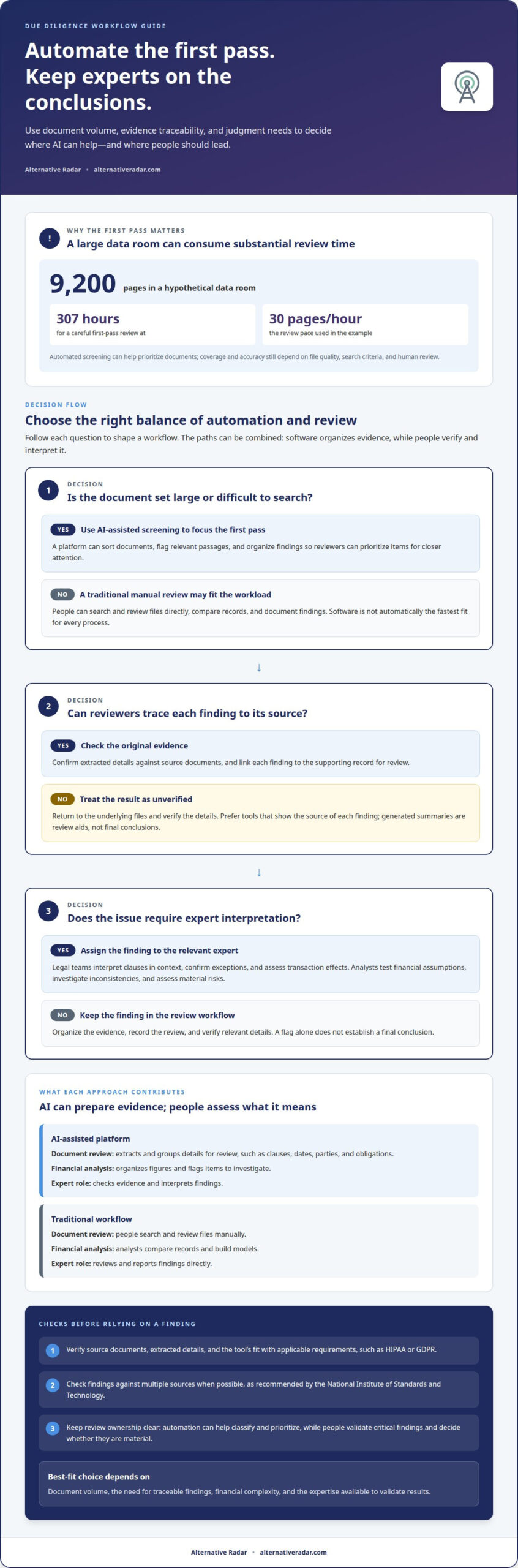
Traditional versus AI due diligence workflows
Traditional workflows assign people to collect records, review evidence, and document findings. In an acquisition, an analyst might compare a vendor’s financial statements with supporting records, then send questions to legal or security teams. AI-assisted workflows can help sort submissions, extract details, and direct reviewers to items that match defined criteria. Both approaches need clear ownership and a record of decisions.
Red-flag criteria should reflect the transaction’s risks. A review may prioritize regulatory compliance, cybersecurity posture, financial health, reputation, and operational capacity. Teams can define triggers, such as missing documentation or inconsistent figures, then assign each flagged item to a reviewer. The National Institute of Standards and Technology says findings should be checked against multiple sources when possible.
Automation can standardize assessment steps across partners and acquisitions. For example, a workflow can request documents, track completion, assign reviewers, and escalate unresolved items. AI can help classify submitted files against a checklist, while people decide whether a finding is material. Keep criteria visible: an unexplained alert is harder to evaluate than one linked to a source and a review task.
Integration with CRM, accounting, and document management systems depends on the platform’s available connections and configuration. Map company and transaction identifiers across systems, decide which records or links move between them, and define access permissions. For example, a CRM entry may identify the vendor, accounting records may support financial review, and a document repository may hold evidence. Test the workflow with sample records before using it for live transactions.
Choose manual review when evidence is limited or interpretation matters most; use automation to coordinate repeatable steps and large document queues. A hybrid workflow often pairs automated screening with expert review of critical findings. Track task ownership, source evidence, and resolution status so the team can see what remains open. Automation should reduce administrative handoffs, not replace the judgment needed to assess context and risk.
Benefits of software-aided due diligence
Software brings documents, tasks, and findings into one review process. A shared workspace can centralize document exchange, track user activity, support compliance, and help teams collaborate in a secure virtual environment. In a corporate transaction, this gives legal, finance, and operations reviewers a shared view of open requests and recorded evidence.
Visibility matters because unresolved findings can change deal decisions. Axial’s Dead Deal Report found that diligence findings other than quality of earnings were the largest cause of broken signed letters of intent, at 25.3%. A structured review helps teams assign each finding, record its status, and escalate material issues before they affect transaction planning.
For software acquisitions, focused analysis can reveal critical flaws before a deal closes. Reviewers can assess code quality, application security, architecture, and third-party code, then document remediation priorities. A separate review of technical debt and maintenance needs helps buyers estimate integration effort and connect technical findings to the investment plan.
Monitoring also helps sellers prepare. Identifying software issues early gives a company time to organize evidence and address concerns before technical review. A practical process links each issue to an owner, supporting documents, and a resolution status. This creates a clearer handoff between internal teams and transaction reviewers and reduces the chance that an open technical question stalls the workflow.
The strongest benefit is not automation alone. It’s a more traceable path from evidence to analysis to decisions. Choose capabilities that fit the transaction: shared document access for collaboration, activity records for oversight, and reporting that surfaces unresolved risks. For software acquisitions, connect technical findings to maintenance and integration plans. To compare software options, focus on the capabilities that improve your review process rather than feature counts alone.
Before an M&A transaction, software due diligence should identify and address critical software flaws, assess technical debt and maintenance requirements, and support efficient integration planning. Sellers should identify potential software issues early to prepare for technical due diligence and reduce the risk of delays or derailment.
Alternative Radar
When you’re ready to turn due diligence criteria into a software shortlist, Alternative Radar helps you discover and compare options. Its platform presents software recommendations with details such as features, pricing, and pros and cons, helping you assess options against your workflow needs and priorities.
Use these comparisons to explore tools that may suit your review process, then weigh their capabilities against your document, assessment, and reporting requirements. Alternative Radar offers sponsored software placements and affiliate-linked software recommendations, alongside programmatic display advertising. These offerings support software discovery; they don’t replace transaction-specific analysis or professional judgment.
Contact Alternative Radar to discuss a software placement or recommendation.
Turn your shortlist into a confident next step
Use your shortlist to define what a successful review should look like for your team. Before choosing due diligence software, map the handoffs between deal, legal, finance, and security reviewers. Then test the workflow against a representative transaction: can your team trace findings to evidence, assign follow-up, and produce a clear decision record? This exercise helps distinguish essential capabilities from features that seem useful but do not fit your process.
Keep the evaluation focused on your next decision, not the most elaborate feature set. Alternative Radar helps readers discover and compare software through sponsored placements, affiliate-linked recommendations, and programmatic display advertising. Use its comparisons to explore options and refine your shortlist around your organization’s needs.
Ready to discuss a software placement or recommendation? Contact Alternative Radar and take the next step with a clearer view of your options.
Frequently Asked Questions
What is due diligence software and what features does it include?
Due diligence software helps teams collect and assess information before decisions such as onboarding a supplier or acquiring a company. A platform may work as a standalone application or as part of broader management software. Depending on the tool, features can include evidence collection, task assignment, searchable records, review tracking, and reporting. Match available capabilities to your process and the people who need access.
What are the best due diligence software platforms in the US?
The best platform depends on the task. Compare record coverage, assessment workflows, reporting, and how clearly findings trace to their sources. OneTrust is an example associated with privacy and compliance management.
What are the best free or low-cost due diligence software options?
Free or low-cost options may suit limited workflows, but compare record coverage and controls before relying on them.
What security, privacy, and compliance standards should due diligence software meet?
Verify that the software and its processes align with regulations relevant to your data and use, such as HIPAA or GDPR. Also assess safeguards for the data handled, access controls, and whether findings can be traced to source evidence.