

Why are you paying for a software seat that costs 15% more than it did last year? According to 2024 industry benchmarks, SaaS pricing has increased at double the rate of inflation; this leaves many businesses trapped in expensive renewal cycles. Most teams agree that a hosted crm should be easy to use, yet they often settle for rigid systems that lock data behind proprietary walls. You want the convenience of the cloud, but you’re likely tired of “one-size-fits-all” constraints that don’t actually fit your specific sales workflow.
It’s time to stop overpaying for limited control. You can choose a system that balances SaaS convenience with the control of open-source flexibility. This guide helps you discover how to lower your monthly overhead while maintaining full ownership of your customer information. We compare the top cloud architectures for 2026 so you can find a system that scales efficiently without the burden of per-user price hikes.
Key Takeaways
- Identify the core differences between public and private cloud architectures to balance cost-efficiency with dedicated security.
- Learn how to evaluate a hosted crm by calculating total cost of ownership beyond simple subscription fees.
- Apply a strategic audit to separate must-have features from bloat, ensuring you only pay for the tools your team actually uses.
- Discover why 2026 is the year of modular CRM alternatives that adapt to your specific business processes rather than forcing a rigid structure.
- Determine your internal technical capacity to choose between managed SaaS convenience and the control of a self-hosted instance.
What is a Hosted CRM? Defining the Modern Landscape
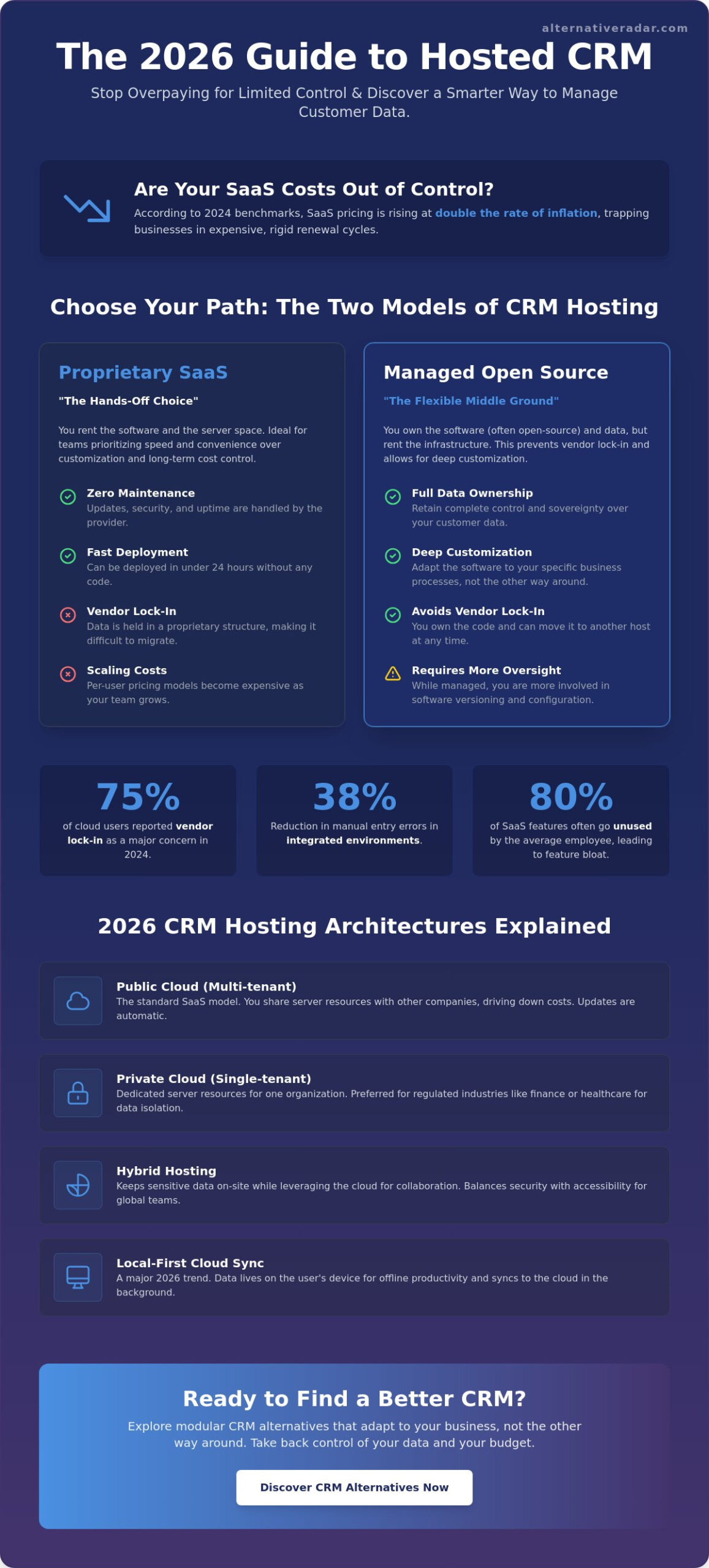
A Customer Relationship Management (CRM) system traditionally required massive on-site server rooms and dedicated cooling systems. Today, a hosted crm moves that entire infrastructure to remote data centers, removing the burden of hardware maintenance from your internal IT team. This transition from “Software as a Product” to “Software as a Service” (SaaS) hasn’t just changed how you pay; it’s overhauled business agility. By 2026, the definition of “hosted” has expanded to include managed open-source environments where users retain code ownership while outsourcing the physical server management. A hosted CRM acts as the bridge between technical control and operational ease.
The Evolution of CRM Infrastructure
Enterprise software has moved away from “The Giant Monolith” setups that dominated the early 2000s. Modern teams now prefer modular, cloud-first standards that allow for rapid scaling without the bloat. Instead of a single, rigid program, 2026 architectures use robust APIs to connect your hosted crm with specialized tools for billing, marketing, and support. This interoperability ensures your data doesn’t sit in a vacuum. It flows where it’s needed; this connectivity reduces manual entry errors by approximately 38 percent in integrated environments. You aren’t just buying a database. You’re building a flexible ecosystem that adapts as your team grows.
SaaS vs. Managed Hosting: A Critical Distinction
You shouldn’t confuse proprietary SaaS with managed hosting. In a proprietary SaaS model, like Salesforce or HubSpot, you rent both the software license and the storage space. You don’t own the underlying code or the database structure. Managed hosting offers a different path. You own the software, often utilizing open-source platforms like Odoo or SuiteCRM, but rent the high-performance infrastructure to run it. This distinction is vital for long-term data sovereignty. It prevents vendor lock-in, a problem that affected 75 percent of cloud users in 2024 according to industry surveys. Stop wasting time searching for a one-size-fits-all solution. Finding the right fit requires knowing if you want to rent a house or own the house while paying for the land.
- Proprietary SaaS: Best for teams wanting zero maintenance and standardized features.
- Managed Hosting: Best for organizations requiring deep customization and full data ownership.
- Hybrid Models: Emerging in 2026 to bridge the gap between public cloud speed and private cloud security.
Types of CRM Hosting Architectures Explained
Choosing a hosted crm in 2026 requires more than just looking at a feature list. The underlying architecture dictates your data sovereignty, monthly overhead, and system speed. Most organizations currently select their infrastructure based on one of four primary models.
- Public Cloud (Multi-tenant): This remains the standard for most businesses. You share server resources with other companies, which drives down costs significantly. Updates are automatic, but you have less control over the underlying hardware environment.
- Private Cloud (Single-tenant): This provides dedicated server resources for a single organization. It’s the preferred choice for firms in regulated industries like finance or healthcare, where data isolation is a legal requirement.
- Hybrid Hosting: This model keeps sensitive customer data on-site while leveraging the cloud for team collaboration and mobile access. It solves latency issues for global teams while maintaining strict local compliance.
- Local-First Cloud Sync: A major trend in 2026, local-first architectures prioritize offline productivity. Data lives on the user’s device and syncs to the cloud in the background. This ensures sales teams stay productive during travel or in areas with spotty connectivity.
Proprietary SaaS (The Hands-Off Choice)
Proprietary SaaS platforms are the industry’s turnkey solutions. You pay a subscription, and the provider handles everything from security patches to server uptime. It’s built for speed. Non-technical teams can often deploy these systems in under 24 hours without touching a line of code. The massive ecosystems surrounding these tools allow for instant integrations with thousands of other apps.
However, the convenience comes at a price. Recurring costs often scale aggressively as your team grows. You’ll also deal with feature bloat, where 80 percent of the tools provided go unused by the average employee. If you prioritize immediate results over long-term cost control, this is your best fit. High-growth teams should also evaluate the best crm brands for scalability to ensure their chosen platform can handle increasing data volumes without punishing per-user pricing.
Managed Open Source (The Flexible Middle Ground)
Managed open source offers a middle path. Providers host the software for you, but you retain ownership of the code and data. This allows for deep customization that proprietary systems simply don’t permit. You can review this open source crm software comparison to see how these stacks perform against traditional giants in 2026.
One major advantage is the “No Per-User Pricing” model. Instead of paying for every new hire, you pay for the server resources you consume. This makes it an ideal alternative to expensive enterprise suites for companies scaling past 50 employees. It’s the right choice for growing firms that need custom workflows without the high tax of name-brand vendors. Stop wasting time searching through bloated platforms and find the right fit for your specific tech stack today.
Evaluating Hosted CRM Solutions: A Comparison Framework
Selecting a hosted crm isn’t just about picking a name from a top-ten list. It requires a cold look at how the architecture supports your specific business logic. You need to look beyond the initial login screen and evaluate four critical pillars: total cost of ownership, scalability, compliance, and customization depth. The right fit depends on your long-term growth trajectory rather than your current headcount.
- Total Cost of Ownership (TCO): You must calculate the five-year trajectory. Subscription fees often look manageable at first, but they don’t include the “success tax” of adding more users or the labor costs of managing a complex cloud environment.
- Scalability: Test how the system handles a jump from 10 to 1,000 users. A rigid SaaS platform might force you into a higher price bracket with features you don’t need, while a flexible hosted instance allows you to scale server resources independently. Reviewing the top CRM solutions for high-growth teams in 2026 can help you benchmark which platforms maintain performance and cost-predictability as operational complexity increases.
- Security and Compliance: In 2026, 75% of the global population is covered by modern privacy regulations. Your provider must offer automated tools for GDPR and CCPA. Check if they allow for industry-specific standards like HIPAA if you handle sensitive data.
- Customization Depth: Determine if you can modify the core database schema. If you can only change UI colors and add basic custom fields, you’ll eventually hit a wall that limits your workflow automation.
Cost Comparison: SaaS Tiers vs. Fixed Hosting
SaaS tiers are designed to lead you toward “Enterprise” upgrades. “Free” plans often become the most expensive options because they restrict API calls or data storage limits. Once you hit a 5GB data ceiling, the price jump to the next tier is often 40% or higher. These hidden costs of API calls and proprietary storage can cripple a growing budget. Conversely, fixed-rate hosting for open-source tools provides budget predictability. You pay for the virtual private server, not for every new contact you add to your database. This shift from per-user pricing to resource-based pricing empowers you to grow without financial penalties.
Data Ownership and Portability
Don’t get stuck in a “Hotel California” scenario where you can check in but never leave. Proprietary hosted crm structures often make data extraction a nightmare. You might get a messy CSV file, but you’ll lose the relational logic and historical activity logs that give that data value. Standardized data formats like SQL or JSON are essential for true portability. This is why popular open source business software 2025 leads the way in portability. These tools use open database structures, ensuring you can move your entire ecosystem to a different provider in hours, not weeks. Stop wasting time with providers that hold your data hostage and prioritize platforms that offer a clear exit strategy.
How to Choose the Right Hosted CRM for Your Business
Selecting a hosted crm requires a tactical approach rather than an emotional one. You should stop following market leaders blindly and start evaluating your specific workflow requirements. The goal is to find a system that balances power with usability without draining your budget on unused features.
- Step 1: Audit features. A 2024 industry report found that 67% of companies overpay for CRM features they never touch. List every tool your team uses daily. If a feature doesn’t directly contribute to closing deals or retaining customers, it’s bloat.
- Step 2: Assess technical skills. Determine if you have the internal bandwidth to manage a private instance. If your team lacks a dedicated DevOps lead, choose a managed provider that handles patches, security updates, and server maintenance automatically.
- Step 3: Check the ecosystem. Your CRM doesn’t live in a vacuum. Verify native connections for Slack, Gmail, and accounting software like QuickBooks. Reliable integrations can save your staff an average of 5 hours of manual data entry per week.
- Step 4: Test the exit strategy. Run a trial specifically to see how easily you can export your data. If a provider makes it difficult to download CSV or SQL files, they’re trying to force vendor lock-in. Data portability is a non-negotiable requirement for 2026.
Matching Architecture to Business Size
Solopreneurs and micro-businesses usually find the most success with simple SaaS models. These provide the lowest overhead and immediate setup. Mid-market companies, however, are increasingly moving toward managed open-source hosting. This provides the customization of a private server without the maintenance burden. Large enterprises are shifting toward custom-built CRM architectures on production-grade building blocks. This trend grew by 22% between 2023 and 2025 as firms prioritized total data sovereignty.
Addressing the Security Objection
Approximately 40% of IT managers still worry that a non-monolith hosted crm is less secure than traditional options. This is a myth. Modern hosting providers often offer better security than legacy on-premise systems. When reviewing a provider, look for a Service Level Agreement (SLA) that guarantees at least 99.9% uptime. Ensure they offer automated daily backups and point-in-time recovery. These features protect your database from both hardware failure and human error, ensuring your sales pipeline remains active 24/7.
Stop wasting time searching through endless software lists and compare the best CRM alternatives to find the right fit for your team.
Beyond the Big Brands: Exploring Better CRM Alternatives
2026 marks a definitive shift toward the modular CRM. Businesses no longer want to pay for 40 features when they only use five. This modular approach ensures the software adapts to your unique sales cycle rather than forcing your team to change their habits. A 2025 study by TechInsights found that 72% of high-growth companies are ditching monolithic suites for specialized, interoperable tools. This flexibility is the core benefit of a modern hosted crm. It allows you to build a tech stack that grows with you, rather than one that holds you back with technical debt and expensive unused seats.
Finding these specialized tools is often the hardest part of the procurement process. Search engines usually prioritize the biggest marketing budgets, not the best software. Alternative Radar changes this dynamic. We act as a high-quality filter, identifying the hidden gems that the big brands often overlook. These alternatives frequently provide better customer support, more transparent pricing, and specific industry integrations that save your team hours of manual data entry every week. By focusing on utility over brand recognition, you can secure a platform that truly aligns with your operational goals.
Success starts with your specific needs. Don’t look for the most famous name; look for the architecture that fits your data volume and security requirements. Our platform simplifies this by providing a neutral space to evaluate software based on precision. You get the facts without the marketing fluff, allowing for a logical decision-making process that values your time and resources. Choosing a hosted crm based on actual performance data leads to higher adoption rates among your staff.
The Alternative Radar Advantage
We analyze features, pricing, and pros/cons so you don’t have to. Our commitment to objective software discovery means we prioritize user efficiency over brand partnerships. Stop wasting time searching through endless search results and start comparing with our curated lists. We provide detailed insights into top-rated options, helping you find the right fit quickly. It’s about empowering you to make smarter choices for your business infrastructure through clear, data-driven comparisons.
Next Steps: From Comparison to Implementation
Transitioning from a legacy system to a modern alternative doesn’t have to be a headache. Begin by setting up a pilot program with your sales team to test the user interface and mobile capabilities. Focus on data migration early to avoid downtime. By Q2 2026, most firms aim for full cloud integration to stay competitive in a fast-moving market. Explore our full CRM list for 2026 to find your perfect match and start your journey toward a more efficient workflow today.
Choosing the Right CRM Architecture for 2026
Selecting the right cloud architecture isn’t just a technical hurdle; it’s a strategic decision that impacts your data sovereignty and long-term operational costs. By 2026, the shift toward highly specialized and efficient architectures means that the standard one-size-fits-all approach no longer serves modern businesses. You now understand the critical differences between multi-tenant and private cloud setups and why the market leader isn’t always the right fit for your specific workflow.
Finding a hosted crm that balances security with scalability requires looking past marketing gloss to focus on objective performance metrics. Don’t let complex feature lists distract you from the core utility your team needs to stay productive. Logic and transparency should guide your final choice rather than brand recognition alone.
Stop wasting time on endless manual searches. You can find the best hosted CRM alternative for your team on Alternative Radar. Our platform provides detailed insights into 500+ software alternatives using objective comparisons based on real user data. We focus on efficiency-driven discovery so you can skip the trial-and-error phase and move straight to implementation. The right tools empower your team to work smarter and scale faster.
Frequently Asked Questions
Is a hosted CRM the same thing as a SaaS CRM?
A hosted CRM isn’t identical to a SaaS CRM because of how the infrastructure is managed. SaaS is typically a multi-tenant environment where users share software instances. A hosted crm provides a dedicated instance, giving you total control over your data and software versions. This setup prevents forced updates that might break your custom integrations.
How much does a hosted CRM typically cost in 2026?
According to 2024 industry benchmarks, mid-market CRM costs range from $45 to $150 per user each month. Private hosting typically adds a 15% to 25% overhead for dedicated server management. You’ll also need to budget for a one-time setup fee, which often starts at $500 for basic configurations. These costs vary based on your specific storage needs and user count.
Can I migrate my data from Salesforce to a hosted open-source CRM?
Migration from Salesforce is possible using standardized CSV exports or API-based ETL tools. You can successfully transfer 98% of your leads, contacts, and opportunities to an open-source alternative. The process requires careful field mapping to ensure your historical data remains accurate after the transition. Stop wasting time manually entering data; use automated scripts to handle the heavy lifting instead.
Is my data safer in a proprietary cloud or a private hosted cloud?
Private hosted clouds offer superior data sovereignty compared to proprietary clouds. While big brands provide high-level encryption, a private host lets you choose the exact physical location of your servers. This is a critical requirement for 100% compliance with strict regional data laws like the GDPR. You control the security protocols rather than relying on a third-party’s generic policy.
What technical skills do I need to manage a hosted CRM?
Managing a hosted crm requires basic proficiency in server administration and SQL database management. Many businesses reduce this technical burden by choosing managed hosting services where the provider handles 100% of the security patches. If you manage it internally, expect to spend 5 hours a month on routine maintenance. It’s a manageable task for most IT generalists.
Do hosted CRMs offer the same mobile app features as big brands?
Hosted options now offer 95% of the mobile functionality found in enterprise brands. You’ll find native iOS and Android apps that support biometric login and offline data entry. These apps sync automatically once a connection is restored, ensuring your sales team stays productive in the field. You don’t have to sacrifice mobility when choosing an alternative to the market leaders.
What happens to my data if the CRM hosting provider goes out of business?
You retain ownership of your information even if a provider ceases operations. Most hosting contracts include a 30-day window for full data extraction via SQL dumps or flat files. Maintaining weekly off-site backups is the best way to protect your business from provider insolvency. Always verify your data portability rights before signing a long-term contract.
Can I integrate my hosted CRM with tools like Slack and Microsoft 365?
Integration with Slack and Microsoft 365 is standard for most modern hosted platforms. You can connect these tools using built-in APIs or connectors like Zapier, which supports over 6,000 different applications. This connectivity ensures your team can share CRM updates directly within their primary communication channels. Explore these integrations to build a more efficient and connected workflow.