

By 2026, programmatic ad spend will exceed $725 billion globally according to recent industry forecasts, yet nearly 60% of digital buyers feel overwhelmed by the technicalities of programmatic display advertising. You probably suspect that a portion of your current budget is vanishing into irrelevant impressions or getting lost in a maze of DSPs and SSPs. It’s frustrating to watch high-intent users slip away because your bidding logic can’t keep up with their search for better software alternatives.
We agree that automated buying should be transparent, not a confusing black box. This guide helps you master the mechanics of the ecosystem so you can deploy automated bidding that actually works. You’ll discover how to reach the right users in real-time while staying ahead of 2026 privacy regulations and the total phase-out of third-party cookies. We provide a clear framework to evaluate if this tech is the right alternative to your current manual strategy and a breakdown of 2026-specific targeting trends to ensure your resources are used with precision.
Key Takeaways
- Understand the shift from manual negotiations to algorithmic execution to streamline your media buying process.
- Deconstruct the roles of DSPs and SSPs to gain clarity on how automated auctions deliver ads in real-time.
- Master the mechanics of programmatic display advertising to ensure your software solutions reach high-intent users with precision.
- Adapt to the 2026 landscape by replacing legacy tracking with AI-driven contextual targeting and privacy-first strategies.
- Discover how to align automated bidding with comparison-based content to connect decision-makers with the right tools faster.
What is Programmatic Display Advertising? The Evolution of Media Buying
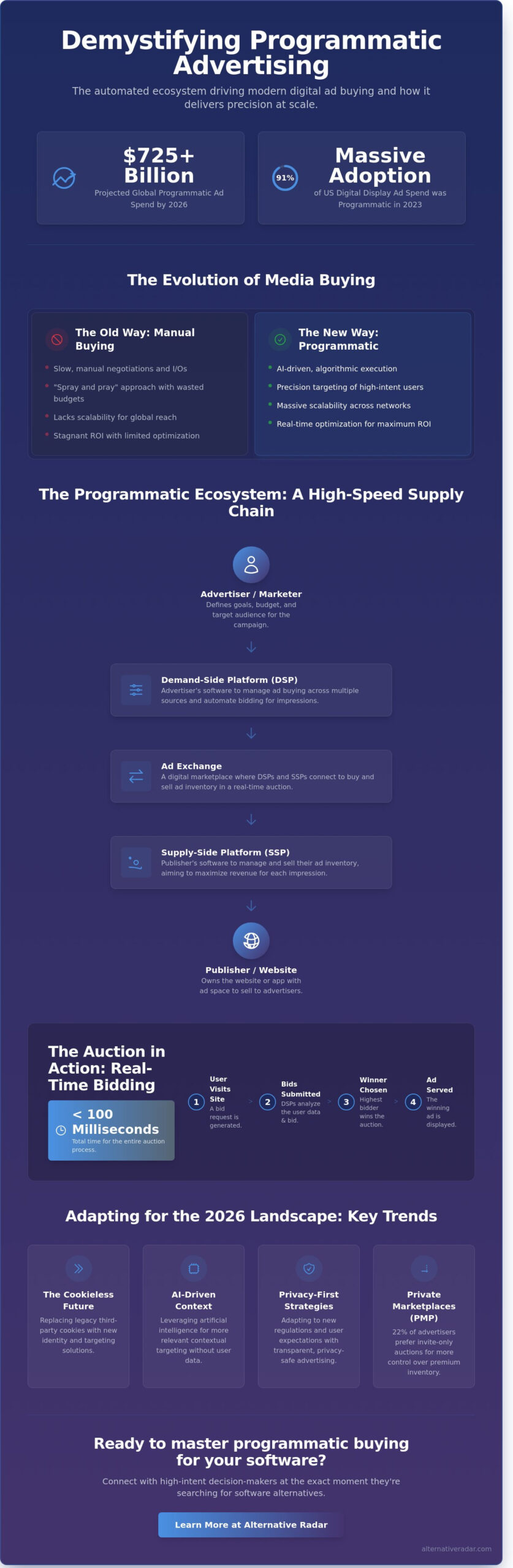
Programmatic display advertising is the automated, AI-driven purchase and sale of digital ad inventory in real-time. It replaces the slow, manual process of human negotiations with algorithmic execution. In 2023, programmatic spending accounted for approximately 91% of all digital display ad investment in the United States, according to data from Insider Intelligence. This shift marks a departure from the era of manual Insertion Orders (IOs) and static contracts, moving instead toward a system where software buys software.
The broader landscape of Online advertising has shifted toward these automated models to handle the sheer volume of global web traffic. For software discovery, programmatic systems act as a high-speed filter. They allow brands to bid on specific impressions based on user behavior, device type, and historical data. The core promise is efficiency; the system delivers the right message to the right user at the exact moment of intent, ensuring that a project management tool is shown to a lead currently researching productivity hacks rather than a casual browser.
This technology serves as the backbone of modern lead generation. By using real-time bidding (RTB), software companies can compete for ad space across millions of websites simultaneously. It removes the guesswork from media planning and replaces it with data-backed certainty. When a user lands on a page, the programmatic ecosystem evaluates their profile and serves an ad in less than 100 milliseconds.
The Problem with Traditional Ad Buying
Traditional ad buying relies on manual outreach and fixed-price negotiations, which creates a massive bottleneck for growing companies. This legacy approach lacks scalability for global software brands that need to reach users across different time zones and niche publications. It often results in a “spray and pray” strategy where budgets are wasted on broad audiences. Manual buying doesn’t allow for the granular adjustments needed to optimize a campaign mid-flight, leading to stagnant ROI and missed opportunities in fast-moving markets.
Programmatic vs. General Display Ads
The distinction between these two categories lies in the execution rather than the format. While all programmatic ads are display, not all display ads are programmatic. General display ads can be bought directly from a single publisher for a set price and duration. Programmatic display advertising, however, uses automation to buy across a vast network of publishers based on specific audience parameters. It functions as a dynamic auction rather than a static billboard.
By leveraging this automation, software buyers find the right fit faster. Instead of hoping the right person sees a banner on a specific tech blog, programmatic logic ensures the ad follows the high-intent user wherever they go on the web. This precision is what allows smaller, innovative software firms to compete with market leaders by spending their budgets only on the most relevant prospects.
The Programmatic Ecosystem: DSP, SSP, and RTB Explained
Programmatic display advertising functions as a high-speed digital supply chain. It replaces manual negotiations with automated protocols that execute trades in the time it takes to blink. To understand how software discovery is changing, you have to look past the automation and see the individual components driving the transaction.
The process starts with the Demand-Side Platform (DSP). This is the advertiser’s primary tool. Marketers use it to set bid prices, define target audiences, and manage multiple ad exchange accounts from a single dashboard. Instead of buying a specific spot on one website, they buy access to specific audience segments across thousands of sites.
On the other side sits the Supply-Side Platform (SSP). Publishers use this to list their available ad space. The SSP’s job is to maximize the closing price for every impression. These two sides meet in the Ad Exchange, a digital marketplace where software brands compete for visibility. It’s a transparent system that ensures the advertiser pays a fair market price while the publisher fills their inventory efficiently.
How Real-Time Bidding (RTB) Works
Real-time bidding is the engine behind the ecosystem. When a user clicks a link, a bid request is sent to the ad exchange. This request contains data about the user’s location, device, and browsing history. Within 100 milliseconds, dozens of DSPs evaluate the data and submit bids. The highest bidder wins, and the ad loads instantly. While RTB is an open auction, 22% of advertisers now prefer Private Marketplaces (PMP). These offer a “first look” at premium inventory before it hits the open market, ensuring higher brand safety for software companies.
The Role of Data Management Platforms (DMP)
A DMP acts as the brain of the operation. It houses and sorts massive datasets into actionable audience segments. This allows a programmatic display advertising campaign to target a “DevOps Manager in Berlin” rather than just “someone on a tech blog.” However, the industry is shifting. By 2026, the reliance on third-party cookies will disappear. Smart marketers are already transitioning to first-party data strategies to maintain precision. This shift ensures compliance with global privacy standards like GDPR and CCPA, which require strict user consent for data processing. If you want to skip the complexity of ad tracking and find the right fit immediately, you can explore top-rated software alternatives through our objective comparison engine.
This ecosystem thrives on precision and speed. By removing the middleman, it allows software buyers to see ads that actually solve their specific pain points. The efficiency of the DSP and SSP framework ensures that marketing budgets aren’t wasted on irrelevant impressions, making the discovery process faster for everyone involved.
Programmatic vs. Manual Placements: A Comparison for 2026
Manual ad buying requires hours of negotiation and static contracts. This approach often fails in the 2026 software market. Programmatic display advertising replaces slow human intervention with algorithmic precision. While manual placements offer a sense of direct control, they lack the agility to adjust to shifting user intent. Programmatic auctions determine the cost-per-thousand (CPM) in milliseconds. This ensures you pay a fair market price based on real-time demand rather than a fixed, outdated rate. Industry data from early 2025 shows that programmatic auctions can reduce effective CPMs by up to 22% compared to direct buys.
Transparency has become a standard, not a luxury. Modern platforms provide granular reporting that reveals exactly where ads appear and how they perform. For high-intent discovery sites like Alternative Radar, this data-driven approach maximizes ROI. It removes the guesswork from the equation. Instead of hoping a placement works, you see the logic behind every impression. This level of insight allows you to stop wasting time on underperforming channels and double down on what converts. By 2026, an estimated 88% of B2B software buyers will interact with at least one programmatic touchpoint before making a final decision.
Efficiency and Scalability
Automation handles the heavy lifting of campaign management. Algorithms now execute over 8,500 micro-adjustments to bids every day. This frequency is impossible for human teams to match. You can scale a software campaign across 20 different global regions without increasing your headcount. This system reduces the 15% budget waste typically caused by human error in ad scheduling and manual budget pacing. It ensures your budget stays focused on the most active search windows, acting as a digital scout that monitors the market while you focus on product strategy.
Targeting Precision
Precision is the primary driver of conversion in a crowded market. You can hyper-target users based on their specific software needs, browsing history, and device habits. If a user explores an “Alternative to” a major CRM but leaves without clicking, retargeting brings them back with a tailored offer for a “top-rated” competitor. Lookalike modeling identifies 30% more high-fit users by analyzing the behavior of your existing customers. This isn’t broad-brush marketing. It’s a surgical tool that categorizes users into groups like “open source seekers” or “premium enterprise buyers,” ensuring your software finds its right fit at the exact moment of need.
The 2026 Landscape: AI, Privacy, and Contextual Relevance
By 2026, the digital marketing industry has successfully decoupled from third-party cookies. Programmatic display advertising didn’t disappear; it evolved into a more precise, privacy-compliant engine. In 2024, the final deprecation of cookies forced a 40% shift in ad spend toward contextual and first-party data strategies. Software buyers now encounter ads that feel relevant because they align with the content they’re reading right now, not because of a site they visited three weeks ago.
AI-driven contextual targeting analyzes the semantic meaning of a page to place ads where they’ll be most useful. If you’re reading a comparison of project management tools, the system understands the “intent” without needing your personal browsing history. Predictive bidding has also matured. Machine learning models now analyze 50 million data points per millisecond to estimate conversion probability before a bid is even placed. This efficiency reduces wasted spend by approximately 22% for software vendors.
Advertisers have also traded simple impressions for “Attention Metrics.” Research from Lumen Research indicates that ads capturing at least 2.5 seconds of active attention generate 10x higher brand recall than those merely meeting the IAB viewability standard. This shift prioritizes high-quality placements on reputable software discovery sites over cheap, cluttered inventory.
Privacy-First Programmatic
Data Clean Rooms, such as those provided by Snowflake or Amazon Marketing Cloud, allow software brands to match their customer lists with publisher data without exposing PII. By 2026, 85% of top-tier advertisers prioritize transparency as their primary currency. They use the Privacy Sandbox to target interest groups while keeping individual user identities anonymous. This ensures that discovering a new CRM or project management tool doesn’t come at the cost of personal data security.
AI Agents and Ad Delivery
Real-time Dynamic Creative Optimization (DCO) allows a single software ad to generate 500 variations instantly. If a user is browsing open source alternatives to Jira, the AI adjusts the headline and feature list to highlight “self-hosted” and “no-cost” benefits immediately. By synthesizing real-time browsing velocity and semantic analysis, AI agents now identify “high-intent signals” and “predictive purchase patterns” 48 hours before a user even types a search query.
Stop wasting time searching through outdated marketing tactics and explore software alternatives that fit your specific workflow today.
Maximizing Software Visibility with Alternative Radar
Alternative Radar operates on a logic of precision. It identifies the exact moment a user decides to move away from a market leader and look for something better. By using programmatic display advertising principles, the platform ensures that your software appears when the user intent is at its peak. This isn’t about broad awareness. It’s about being the right fit at the right time. Most buyers don’t want more options; they want the best option for their specific workflow.
High-intent comparison content creates a unique environment for display ads. When a user searches for an “Alternative to” a major competitor, they’ve already identified a pain point. They’re looking for a remedy. Alternative Radar acts as the digital scout that guides them toward your solution. This synergy between comparison data and ad placement reduces the friction that usually exists in the software buying process.
Contextual Fit: The Alternative Radar Advantage
Placement matters more than volume. Traditional ads often disrupt the user experience, but on Alternative Radar, your presence feels like a helpful suggestion. You’re placing ads where users actively look to switch or upgrade. Being the “Alternative Recommendation” in a programmatic auction allows you to bypass the noise of general search results. According to industry data from 2023, B2B buyers now spend 27 percent of their time researching independently online before ever talking to a sales rep.
Targeted placements on comparison pages drive higher affiliate conversions because they match the user’s current mindset. If a user is frustrated with a tool’s pricing, showing them a “top-rated free alternative” is a logical solution. It’s a functional approach that respects the user’s time. This contextual alignment is why programmatic display advertising on niche comparison sites often outperforms broad-reach campaigns by a significant margin.
Next Steps for Software Vendors
Software vendors should prioritize “Alternative To” placements to capture users who are ready to churn from competitors. To stay competitive, you must move beyond generic ad placements and focus on where the decision-making actually happens. Start by auditing your current strategy for programmatic gaps. If you aren’t visible on comparison pages, you’re missing the most critical stage of the buyer journey.
- Focus on first-party data collection to fuel your demand-side platform (DSP).
- Identify your top three competitors and target their specific comparison pages.
- Use clear, objective labels like “open source” or “premium” to help users filter results quickly.
You can Partner with Alternative Radar to reach high-intent software buyers today. Stop wasting time searching for leads in the wrong places. Integrate your tool into an ecosystem designed for discovery and clear comparisons. Efficiency is the future of software sales, and your visibility depends on being where the decisions are made.
Mastering Your 2026 Media Buying Strategy
The shift toward programmatic display advertising requires a definitive move from manual guesswork to AI-driven precision. By 2026, contextual relevance and privacy-compliant data will define the winners in the digital space. Success hinges on mastering the complex ecosystem of DSPs and SSPs to ensure every automated bid serves a specific business goal. Efficiency isn’t just a goal; it’s the baseline for surviving in a landscape where decisions happen in milliseconds. Stop wasting time searching for the right tools to manage your digital presence. Alternative Radar, owned by Madunet experts in digital ad revenue, simplifies this process by providing objective, efficiency-driven reviews. You can access detailed comparisons of 5,000+ software tools to find your right fit without the marketing fluff. Our platform acts as a digital scout, doing the heavy lifting so you don’t have to. Discover the best software alternatives for your business on Alternative Radar and take control of your tech stack today. Making smarter choices starts with having the right data at your fingertips. You’re ready to build a more efficient, data-backed future for your brand.
Frequently Asked Questions
Is programmatic display advertising the same as PPC?
No, programmatic display advertising isn’t the same as PPC. PPC refers to a specific payment model where you pay for each click, while programmatic is a technology that uses AI to automate the buying of ad space in real time. While most search ads use PPC, programmatic campaigns often use CPM models. This allows you to scale reach across millions of sites rather than just search results.
How much does programmatic advertising cost in 2026?
Programmatic costs vary by industry, but 2026 projections from Statista suggest average CPMs will range between $0.50 and $2.00 for display ads. Software discovery brands often see higher rates due to competitive B2B targeting. You’ll likely spend a minimum of $5,000 to $10,000 monthly to gather enough data for the AI to optimize effectively. This investment ensures your ads reach high intent users searching for software alternatives.
What is the difference between a DSP and an SSP?
A Demand Side Platform (DSP) is a tool for advertisers to buy ad inventory, while a Supply Side Platform (SSP) is for publishers to sell it. Think of the DSP as your control center for managing bids and targeting across multiple exchanges. The SSP allows websites to list their available space and maximize their revenue. These two systems communicate in milliseconds to match your ad with the right software buyer.
Can small businesses use programmatic advertising effectively?
Small businesses can use programmatic advertising effectively by focusing on niche audiences rather than broad reach. Platforms like Choozle or StackAdapt allow for smaller minimum spends, sometimes as low as $500 per month. By targeting specific software categories or competitor keywords, you avoid wasting budget on irrelevant traffic. It’s a precise way to compete with larger brands without needing a million dollar marketing department.
How does programmatic advertising handle ad fraud?
Programmatic platforms use AI filters and third party verification tools like DoubleVerify or IAS to block fraudulent traffic. In 2023, global ad fraud reached $88 billion, which led to the development of stricter ads.txt protocols. These protocols ensure you’re only buying space from verified sellers. Modern DSPs automatically filter out bot traffic and non-viewable impressions to protect your ROI and ensure your software ads reach real people.
What is contextual targeting in programmatic ads?
Contextual targeting places your ads on websites based on the content of the page rather than the user’s past behavior. If a user reads a review of project management software, your programmatic display advertising appears because the topic matches your product. This method has seen a 30% increase in adoption as privacy regulations tighten. It ensures your message remains relevant to the reader’s current intent without relying on invasive tracking.
How do I measure the success of a programmatic campaign?
You measure success by tracking specific KPIs like Return on Ad Spend (ROAS) and Cost Per Acquisition (CPA). Since programmatic often sits at the top of the funnel, you should also monitor view-through conversions. A 2024 survey by Digiday found that 65% of B2B marketers prioritize lead quality over raw click volume. Use these metrics to compare different ad creatives and find the right fit for your software discovery goals.
Is programmatic advertising still effective without third-party cookies?
Programmatic remains effective by shifting toward first party data and universal ID solutions like Unified ID 2.0. Google’s 2024 updates to Chrome privacy mean advertisers must rely on cohorts and contextual signals instead of individual tracking. Brands that leverage their own customer lists see up to a 20% higher conversion rate in this cookeless environment. It’s about using smarter data sources to reach the same high quality audience.