

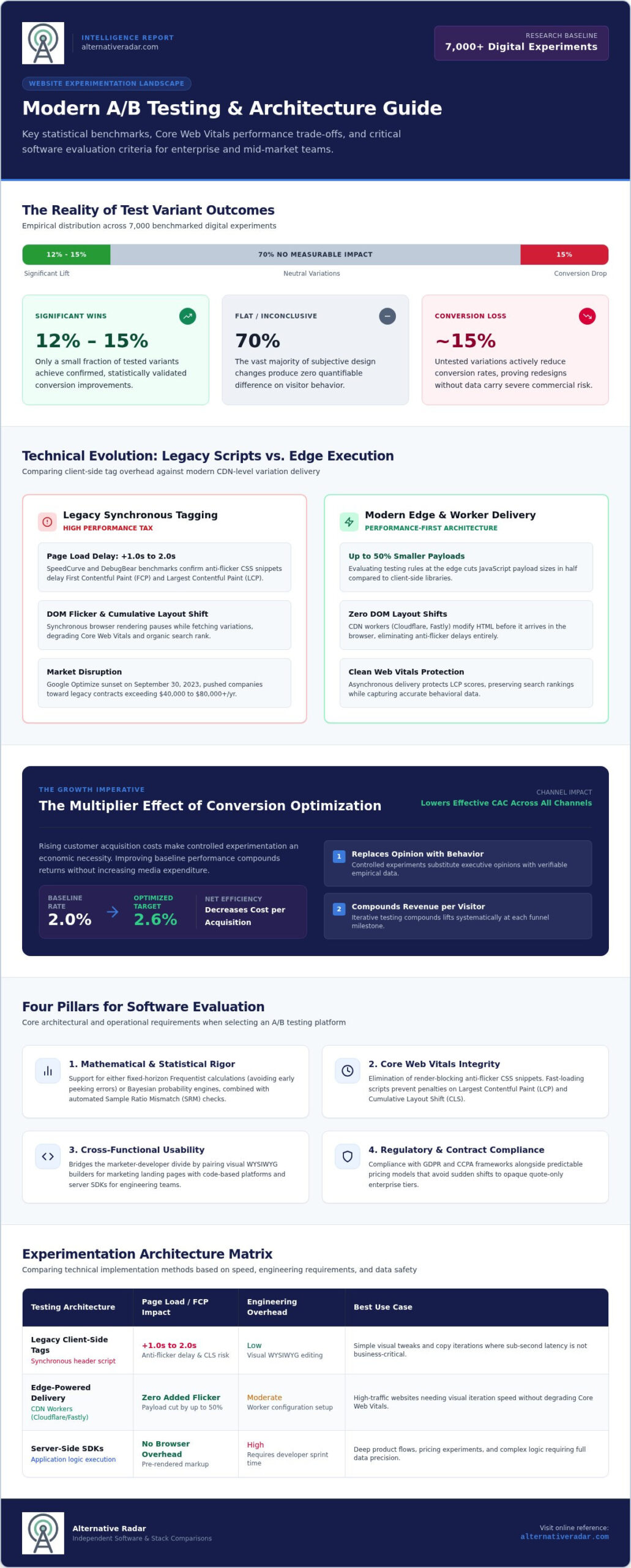
According to benchmark studies across 7,000 digital experiments, only 12% to 15% of A/B test variants generate a statistically significant win. When bulky scripts introduce DOM flicker and delay page load times by up to two seconds, your tests cost you revenue before you even collect clean data. Finding effective A/B testing platforms for websites requires looking past shiny visual editors and prioritizing lean, performance-first experimentation.
You already know testing is critical to scaling conversions, but you shouldn’t have to tolerate layout shifts, heavy developer dependencies, or opaque enterprise contracts climbing past $40,000 just to validate an idea. You need an experimentation stack that delivers trustworthy data without degrading your Core Web Vitals.
In this guide, you will discover the best A/B testing platforms for websites to optimize conversion rates without slowing page speed. We compare the leading commercial, edge-powered, and warehouse-native options across statistical precision, ease of deployment, and true software costs so you can select the exact fit for your team.
Key Takeaways
- Understand the modern experimentation landscape and how the departure of legacy free tools reshaped software capabilities.
- Evaluate top A/B testing platforms for websites using essential criteria, including statistical engines, Core Web Vitals impact, and contract transparency.
- Compare leading enterprise, mid-market, and open-source tools side by side to match your engineering resources and traffic levels.
- Determine whether client-side DOM manipulation or server-side execution aligns better with your site’s technical architecture.
- Execute a structured implementation plan to migrate platforms smoothly and launch reliable experiments without workflow bottlenecks.
Why Modern Website Experimentation Demands Next-Generation A/B Testing Platforms
Modern website experimentation has outgrown simple visual tweaks. Today, robust A/B testing methodology requires controlled testing environments that balance mathematical rigor with website performance. When Google Optimize was decommissioned on September 30, 2023, it eliminated the default free tool that thousands of businesses relied on. This shift permanently altered the software market. Many organizations found themselves pushed toward enterprise suites with quote-only pricing reaching $40,000 to over $80,000 annually, while others scrambled to find mid-market replacements.
Relying on subjective redesigns without empirical testing carries severe operational risks. Full-site overhauls based on aesthetic preferences often fail silently. Research shows that roughly 15% of untested variants actively decrease conversions, while 70% produce no measurable impact. Guesswork wastes engineering cycles. Worse, legacy client-side testing scripts frequently inject heavy payloads that hurt search visibility. Bloated scripts degrade Core Web Vitals by inflating Largest Contentful Paint (LCP) and triggering Cumulative Layout Shift (CLS), costing you organic rank and customer engagement at the same time.
Selecting modern A/B testing platforms for websites requires evaluating how tooling interacts directly with your technical infrastructure and site speed.
The Evolution Beyond Basic Client-Side Tagging
Legacy experimentation relied entirely on synchronous JavaScript tags placed in the page header. These scripts pause browser rendering while fetching experiment variations. To prevent visitors from seeing the original layout before the variant renders, teams implemented CSS anti-flicker snippets. SpeedCurve and DebugBear benchmarks demonstrate that these hiding snippets delay First Contentful Paint (FCP) and LCP by 1.0 to over 2.0 seconds on standard connections.
Next-generation architectures resolve this bottleneck through asynchronous execution and edge delivery. By evaluating testing rules via edge workers on CDNs like Cloudflare or Fastly, platforms deliver modified HTML before the page reaches the client browser. Running experiments at the edge cuts JavaScript payload sizes by up to 50% and removes the flicker that degrades search rankings and user trust.
The Business Imperative of Empirical Optimization
Rising customer acquisition costs make conversion rate optimization an economic necessity rather than an optional marketing tactic. Paid channels grow more expensive every quarter. Improving your baseline conversion rate from 2.0% to 2.6% lowers effective acquisition costs across every marketing channel simultaneously.
Empirical optimization replaces executive opinions with verifiable visitor behavior. Instead of debating button placements in committee meetings, growth teams deploy controlled experiments with strict sample thresholds. A disciplined testing program compounds gains over time, systematically lifting average revenue per visitor across every stage of your conversion funnel.
Core Evaluation Criteria for Selecting Website Testing Software
Selecting software requires balancing technical efficiency with operational reality. A tool that excites your marketing team might break your site architecture, while a developer-first tool can stall simple copy updates. Organizations building out controlled experimentation infrastructure must evaluate prospective software across four core pillars: mathematical validity, front-end performance, workflow usability, and regulatory compliance under GDPR and CCPA frameworks.
Marketing teams typically prefer visual WYSIWYG builders that let non-technical users adjust layout elements without developer intervention. Engineering-led teams favor code-based platforms supporting custom JavaScript, CSS, or server-side SDKs. The ideal tool bridges this divide, giving marketers the autonomy to run landing page iterations while providing developers with clean deployment workflows and automated Sample Ratio Mismatch (SRM) checks.
If you feel stuck navigating conflicting vendor feature matrices, reviewing independent analysis on Alternative Radar can clarify which platforms match your specific budget and technical stack.
Statistical Engines: Frequentist vs. Bayesian Approaches
Statistical methodology directly dictates how quickly you reach actionable decisions. Frequentist engines require fixed horizons; you must calculate sample sizes beforehand and avoid peeking at data early to prevent false-positive errors. Bayesian models calculate the probability of a variant beating the control, enabling continuous monitoring. Modern stacks also leverage variance reduction methods like CUPED, which Microsoft Research shows can reduce required experiment runtimes by 30% to 50%.
Performance Impact and Core Web Vitals Compliance
Every kilobyte added to your testing script directly threatens your site speed. Evaluating A/B testing platforms for websites requires setting strict performance standards:
- Snippet Payload: Keep raw JavaScript snippet weights under 50KB gzipped to prevent main-thread execution delays.
- Core Web Vitals Thresholds: Maintain Largest Contentful Paint under 2.5 seconds, Cumulative Layout Shift below 0.1, and Interaction to Next Paint under 200 milliseconds.
- Edge Latency: Require variant resolution times under 50 milliseconds when serving dynamic variations from CDN edges.
Governance, Access Controls, and Collaboration Features
Scaling test velocity without security guardrails invites production errors. Enterprise teams need role-based access controls (RBAC) to ensure junior staff cannot publish unreviewed scripts to high-value checkout funnels. Look for platforms offering shared hypothesis repositories, automated QA preview environments across devices, and comprehensive audit logs that track every code change, traffic allocation tweak, and variant deployment.
The Best A/B Testing Platforms for Websites in 2026: Head-to-Head Comparison
Modern experimentation tools fall into distinct categories based on deployment methods and target audiences. Selecting among leading A/B testing platforms for websites requires looking past vendor marketing claims to examine actual commercial terms, data ownership, and technical footprints. To establish a structured framework for web experimentation, growth teams must weigh visual client-side tools against edge-rendered and warehouse-native platforms.
Alternative Radar acts as an objective scout in this market, evaluating complex licensing tiers and highlighting flexible alternatives to entrenched incumbents. If your organization wants to avoid vendor lock-in across other departments, consult our guide on popular open source business software to review cost-effective options for your wider infrastructure.
Enterprise Leaders: Optimizely and VWO
Optimizely remains a dominant enterprise standard, bundling web testing, feature flags, and CMS tools. However, it requires annual, quote-led contracts where entry tiers start around $36,000 to $40,000 per year, with median procurement contracts reaching roughly $80,000. In January 2026, AB Tasty merged with VWO under private equity backing, consolidating two major suites into a unified enterprise powerhouse. VWO has replaced its legacy permanent free tier with a 30-day trial. Its base Starter tier begins at roughly $314 per month billed annually for 10,000 Monthly Tracked Users (MTUs), while the Pro plan reaches $1,336 per month for 100,000 MTUs. Both tools offer deep enterprise support, but their annual commitments lock teams into substantial operational overhead.
Agile and Mid-Market Contenders: AB Tasty and Kameleoon
For mid-market brands seeking balance between agility and technical control, Kameleoon offers Prompt-Based Experimentation (PBX) using AI alongside a 30-day trial. Its Starter plan provides a flat rate of $495 per month covering up to 50,000 MTUs and 10 concurrent tests, though advanced server-side features require enterprise quotes. Convert Experiences represents an attractive self-serve alternative, publishing transparent plans starting at $299 per month billed annually for 100,000 MTUs with dual Frequentist and Bayesian engines included.
Developer-Centric and Product-Led Testing: PostHog and Statsig
Engineering teams frequently bypass traditional visual editors in favor of code-driven architectures. Statsig offers a Developer plan that remains free up to 2 million events per month, while its Pro tier starts at $150 monthly with native support for CUPED and data warehouse connections. PostHog provides an open-source product analytics and experimentation suite, featuring a free monthly allowance of 1 million events and 1 million feature flag requests. Self-hosting PostHog or GrowthBook gives complete data control under strict privacy rules, while managed cloud versions eliminate server maintenance overhead for agile teams.
Client-Side vs. Server-Side Testing: Choosing the Right Architecture
Deciding between client-side and server-side execution is the most consequential technical choice when evaluating A/B testing platforms for websites. Client-side testing works inside the user’s browser, using JavaScript to intercept and modify the Document Object Model (DOM) after HTML downloads. In contrast, server-side testing executes variations on your web server or via edge compute workers, sending fully formed variant HTML directly to the visitor’s device.
The choice involves balancing implementation speed against long-term maintenance overhead. Client-side tools provide unmatched launch speed for content teams, but they accumulate front-end technical debt when abandoned scripts linger across pages. Server-side testing requires disciplined release engineering, yet it keeps codebases clean and protected from external script bloat. Forward-thinking teams often adopt hybrid models, reserving browser scripts for promotional landing pages while running checkout and core app logic server-side.
To avoid paying for architecture you will not use, explore independent software comparisons on Alternative Radar before signing a multi-year vendor contract.
Client-Side Experimentation: Rapid Deployment for Marketing Teams
Client-side experimentation lets marketing teams build, QA, and launch visual variations in hours without submitting engineering tickets. This agility works well for testing headlines, form layouts, and promotional banners across standard marketing sites.
However, browser-level manipulation struggles on modern single-page applications (SPAs) built with React or Vue. When client scripts attempt to alter dynamically hydrated components, race conditions can cause DOM elements to revert unexpectedly. To protect site performance, implement scripts asynchronously, scope visual changes to targeted URL paths, and avoid universal CSS hiding rules across your entire domain.
Server-Side Experimentation: Performance, Security, and Complex Testing
Server-side experimentation eliminates the visual layout shift and script latency associated with browser-based execution. Vercel and Croct engineering audits confirm that moving testing logic to edge environments cuts client JavaScript payloads by up to 50%, reduces bandwidth consumption by 30% to 40%, and accelerates Time to Interactive (TTI) by up to 45%.
This backend execution is essential for deep product testing, including:
- Dynamic Pricing: Testing subscription tiers or volume discounts securely without exposing logic in browser code.
- Search Algorithms: Measuring user engagement across varying product recommendation or filtering logic.
- Multi-Step Flows: Maintaining consistent variant allocation across complex sign-up and payment checkouts.
While server-side testing prevents client-side latency, it requires dedicated developer governance, synchronized version control, and clear rollback procedures within your standard deployment pipelines.
Implementation Roadmap: From Platform Selection to First Experiment
Deploying testing software successfully requires methodical execution rather than rushing an untested script into production. Begin with a structured funnel audit. Map user drop-off points using behavioral analytics and session recordings to identify high-impact areas such as product pricing tables, lead capture forms, and mobile navigation menus.
Formulate testable hypotheses grounded in quantitative drop-off metrics and qualitative customer feedback. Every hypothesis must state the proposed modification, the expected behavioral change, and the measurable business outcome. Before exposing real visitors to variations, run thorough quality assurance. Verify layout rendering across Chrome, Safari, and Firefox, validate responsiveness on various mobile viewports, and confirm that tracking tags do not interfere with checkout scripts or payment gateways.
Investing time in rigorous software evaluation prevents painful tooling migrations later. Transparent software reviews empower your procurement team to secure favorable terms, eliminate hidden overage penalties, and protect your digital margins.
Setting Up Accurate Event Tracking and Metrics
Define one primary macro-conversion metric, such as completed checkout transactions or submitted lead forms, alongside supporting secondary micro-conversions like button clicks, cart additions, or scroll depth. Dual tracking ensures that optimizing for intermediate engagement does not inadvertently hurt downstream sales. Synchronize custom event triggers directly with your warehouse or analytics suite to maintain single-source reporting, and audit your checkout confirmations to verify that third-party payment gateways fire completion tags reliably.
Structuring a Repeatable Testing Cadence
Prioritize your testing pipeline using objective scoring models like ICE (Impact, Confidence, Ease) or PXL to filter out vanity experiments. Build an institutional testing log documenting every test hypothesis, variant asset, observed outcome, and statistical confidence score. Avoid the temptation to stop tests early after an initial positive spike; commit to predetermined sample sizes and run tests across full business cycles to account for day-of-week traffic variance.
Finalizing Your Platform Selection with Alternative Radar
Scrutinize software contracts before signing. Many vendors charge steep overage rates when monthly traffic spikes exceed allocated Monthly Tracked User (MTU) limits. Remember that MTUs measure only the unique users exposed to active experiments, not your aggregate website traffic. To find modern A/B testing platforms for websites that fit your budget, use Alternative Radar to explore objective comparisons across commercial and open-source tooling, helping you select a scalable experimentation stack that drives growth without excessive overhead.
Upgrade Your Experimentation Stack for Measurable Growth
Scaling digital revenue requires disciplined experimentation, but your optimization efforts shouldn’t degrade site speed or trap your team in restrictive contracts. Sustainable growth relies on balancing mathematical rigor with lightweight delivery. Choosing the right architecture, whether edge-rendered variants or visual client scripts, ensures your experiments yield clean, trustworthy data without penalizing Core Web Vitals.
Evaluating modern A/B testing platforms for websites comes down to matching your monthly traffic and engineering resources to transparent pricing tiers. Instead of sifting through vendor marketing claims, focus on tools that give you full control over your conversion data, statistical models, and workflow agility.
Ready to streamline your software selection? Find the best testing platforms on Alternative Radar to explore objective comparisons across commercial, warehouse-native, and open-source tools tailored to your operational needs.
Frequently Asked Questions
What is the difference between an A/B testing platform and web analytics?
Web analytics tools track historical visitor behavior, while testing platforms actively modify website experiences to measure causal impact. Analytics shows where users abandon funnels, but it cannot split traffic between concurrent variations under identical market conditions. Dedicated A/B testing platforms for websites provide the randomization engines, variant delivery mechanisms, and statistical frameworks required to prove whether a specific interface change caused a conversion lift.
How did the discontinuation of Google Optimize affect website testing platforms?
The shutdown on September 30, 2023, eliminated the market’s standard free experimentation tool. It forced businesses to choose between high-cost enterprise suites or modern mid-market alternatives. Because Google did not provide a native replacement in GA4, third-party software providers accelerated development of transparent, self-serve plans. It also sped up industry adoption of privacy-focused, warehouse-native testing architectures.
Can client-side A/B testing platforms negatively affect Core Web Vitals?
Yes, unoptimized client-side scripts can severely degrade site performance scores. When synchronous tags or heavy anti-flicker CSS snippets execute, they block browser parsing and delay First Contentful Paint. Additionally, swapping DOM elements after the initial render can trigger Cumulative Layout Shift penalties. Choosing lightweight, asynchronous A/B testing platforms for websites or edge-rendered architectures protects your search visibility and user experience.
How long should an A/B test run to achieve reliable statistical significance?
Most tests should run for at least two full business cycles, typically two to four weeks. Ending a test after just a few days introduces false positives caused by day-of-week traffic volatility or novelty effects. Even if your dashboard displays statistical significance early, keep the experiment running until you hit your calculated minimum sample size across all variant groups.
What is the practical difference between Bayesian and Frequentist statistical testing?
Frequentist engines calculate the likelihood of observing your data assuming no real difference exists, requiring a predetermined sample size before interpreting results. Bayesian engines calculate the actual probability that a variant outperforms the original based on accumulated evidence. Teams lacking dedicated in-house data scientists often favor Bayesian systems because they allow ongoing data checks without inflating false-positive error rates.
Do I need dedicated software engineers to run website A/B tests?
You don’t need developers for simple copy, layout, or color tweaks if your platform includes a reliable visual WYSIWYG editor. However, engineering support becomes necessary when testing backend business logic, dynamic pricing, database queries, or complex checkout workflows. Even visual tests benefit from developer review to prevent script conflicts with single-page application hydration.
How do server-side experimentation platforms handle website caching?
Server-side platforms evaluate experiment targeting rules before serving cached HTML, often by integrating directly with CDN edge workers like Cloudflare or Fastly. The edge worker inspects the incoming visitor cookie, determines the variant assignment instantly, and pulls the corresponding pre-rendered variant from the edge cache. This method serves personalized experiment variants in under 50 milliseconds without clearing global cache layers.