

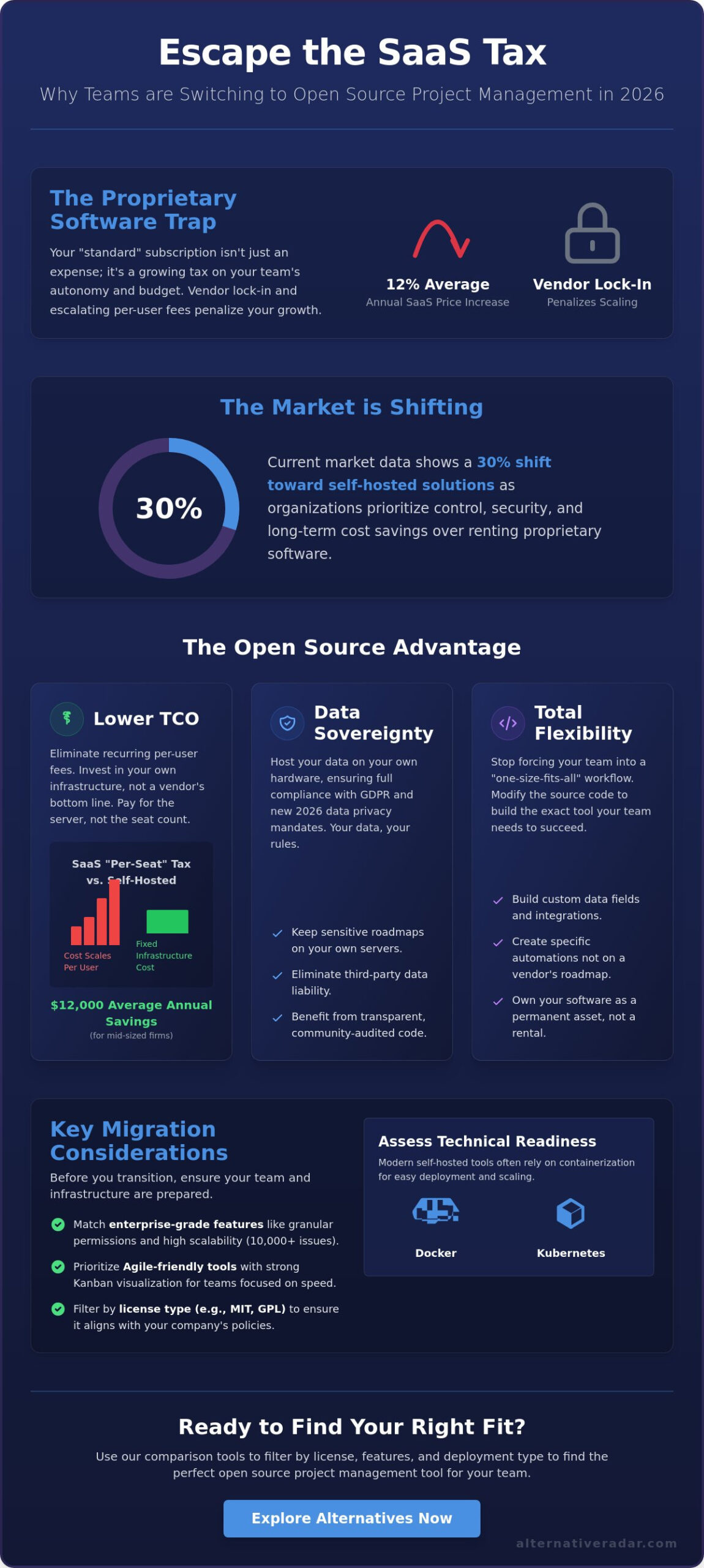
Your “standard” project management subscription isn’t just a monthly expense; it’s a growing tax on your team’s autonomy. With SaaS prices increasing by an average of 12% annually according to 2024 industry data, the cost of staying organized is becoming a significant burden. You’ve likely felt the sting of rising per-user fees and the anxiety of strict data privacy requirements that generic cloud providers simply can’t meet. It’s a common trap where the more you succeed, the more you’re penalized by vendor lock-in and escalating costs.
We believe you shouldn’t have to choose between a modern interface and total control over your information. By exploring the best open source project management tools, you can regain data sovereignty and significantly reduce your long-term software overhead. This guide identifies the top-rated alternatives to Jira and Monday.com that offer the scalability and intuitive design your team needs in 2026. We’ve done the heavy lifting to filter out the noise, providing clear comparisons of tools that put you back in the driver’s seat of your own workflow.
Key Takeaways
- Escape unsustainable per-user pricing by understanding how self-hosting restores data sovereignty and lowers long-term software costs.
- Discover top-rated open source project management tools that match the scalability and permission management of enterprise giants like Jira and Monday.com.
- Pinpoint agile-friendly alternatives that prioritize Kanban visualization and speed for teams that find complex reporting unnecessary.
- Assess the technical requirements for modern deployment, including the use of Docker and Kubernetes, to ensure your infrastructure is ready for a self-hosted migration.
- Use our comparison tools to filter by license type and feature sets, helping you narrow down the right fit before committing to a full transition.
Why Teams are Switching to Open Source Project Management Tools in 2026
Stop paying for features your team never touches. Open source project management tools offer a transparent alternative to the rigid, expensive structures of proprietary software. By definition, these tools provide public access to their source code. This allows your technical team to self-host the application and modify the underlying logic to fit your specific requirements. While proprietary SaaS dominated the early 2020s, current market data shows a 30% shift toward self-hosted solutions as organizations prioritize control over their digital infrastructure.
The primary driver for this change is the growing “SaaS fatigue” caused by aggressive per-user pricing. When every new hire adds a fixed monthly cost to your software bill, scaling becomes a financial burden. Open source removes this barrier. It also ends the era of “one-size-fits-all” workflows. If your project requires a custom data field or a specific automation that isn’t on a vendor’s roadmap, you can simply build it. This movement is part of a broader trend where organizations adopt various open-source software packages to replace expensive legacy systems and reclaim their technical independence.
The Economic Advantage of Free Project Management Software
The “per-seat” tax is a hidden drain on modern operational budgets. Switching to open source allows teams to reallocate funds from recurring subscriptions toward internal infrastructure and talent. This shift significantly lowers the long-term Total Cost of Ownership (TCO). Instead of renting access to your own data, you’re investing in a permanent asset. Industry reports from late 2025 indicate that mid-sized firms saved an average of $12,000 annually by moving to self-hosted project tools. You pay for the server, not the number of people using it.
Privacy and Compliance in the Modern Enterprise
Data residency is no longer a luxury; it’s a legal requirement. With the evolution of GDPR and new 2026 data privacy mandates, keeping sensitive project roadmaps on third-party cloud servers is a liability. Open source tools ensure data sovereignty by allowing you to keep everything on your own hardware. Security also benefits from transparency. Community-audited code reveals vulnerabilities much faster than closed-source systems. This approach effectively eliminates vendor lock-in, ensuring your data remains accessible and portable regardless of a software provider’s financial health.
The Heavyweights: Open Source Alternatives to Jira and Monday
Stop settling for locked-down ecosystems that don’t scale with your growth. Finding the right open source project management tools means looking beyond simple task lists; you need systems that handle 5,000+ users while maintaining granular permission controls. Most modern platforms now support hybrid workflows. This shift is critical as 71% of organizations now blend Agile and Waterfall methods to meet complex delivery dates. You need a platform that can manage a 200-person development team and a 20-person executive board simultaneously without compromising speed.
Scalability is the first hurdle for any heavyweight tool. A platform must handle 10,000+ issues without UI lag or database timeouts. Integration is the second requirement. It must talk to Git, Slack, and LDAP. Finally, granular permission management ensures that external contractors only see what they need. These features allow teams to maintain a balance between power-user capabilities and a clean interface for casual users who just need to check a status.
OpenProject: The Enterprise Standard for Data Sovereignty
This solution stands as the leading choice for organizations that prioritize data sovereignty and strict security. OpenProject is the go-to for secure, on-premises enterprise PM. The platform offers professional-grade Gantt charts, integrated time tracking, and detailed cost reporting. Organizations like the German Federal Government use it to maintain control over their project data. It’s built for those who need a “Classic” project management feel but require the transparency of open source. If you’re ready to explore more software comparisons, auditing your current server capacity is a smart next step.
Plane: The Modern Alternative to ClickUp and Linear
This platform is currently trending because it solves the common issue of software bloat. It focuses on a fast UI that feels like Linear but offers the depth of ClickUp. Key features include “Cycles” for sprint planning and “Pages” for internal wikis and documentation. Plane reached over 20,000 GitHub stars by early 2024, proving the demand for high-performance open source project management tools. You can self-host it using Docker for total privacy or opt for their managed cloud if you want to skip the maintenance. It’s the right fit for teams that value speed but can’t sacrifice the power of a mature enterprise system.
Agile and Lightweight: Best Free Project Management Software for Small Teams
Small teams often fail when they adopt enterprise-grade software that requires a full-time administrator. For groups of 5 to 20 people, speed and clarity matter more than complex financial reporting or deep resource leveling. High-performance teams prioritize open source project management tools that offer immediate visualization through Kanban boards. These tools integrate directly with developer workflows; they often sync with GitHub or GitLab to ensure that code changes reflect task status automatically without manual updates.
Choosing a community-first project ensures that your software evolves based on user needs rather than corporate profit motives. These platforms focus on the essentials:
- Minimalist interfaces that reduce cognitive load during a busy workday.
- Real-time collaboration features that operate without lag.
- Self-hosting options that keep data private and monthly costs at zero.
- Active contributor bases that patch security vulnerabilities faster than proprietary vendors.
Taiga: Simple, Beautiful Agile Management
Taiga is built for teams that actually follow the Scrum framework. It simplifies sprint planning by providing a dedicated backlog and task board that doesn’t feel cluttered. In early 2025, Taiga’s user interface underwent a major refresh to ensure non-technical stakeholders, such as marketing or design teams, could navigate it without specialized training. This visual appeal is a major factor in user adoption; it’s an excellent alternative to Jira for those who find the latter too clinical. While their SaaS version has limits, the self-hosted version remains free under the MPL-2.0 license. This makes it a sustainable choice for budget-conscious startups that want professional-grade agile features without the subscription fatigue.
Vikunja: The Self-Hosted To-Do List for Teams
Vikunja is the right fit for those seeking a lightweight alternative to Trello or Todoist. It is designed for speed and flexibility. You can switch between List, Kanban, Table, and Gantt views with a single click, which is a rare feature for such a small footprint. In 2025, Vikunja saw a 35% increase in active contributors, ensuring the project remains stable and secure. It is an ideal solution for freelancers or small internal departments that need to track tasks without the overhead of a massive platform. You can host it on a basic VPS with minimal resources, making it a cost-effective way to regain control over your team’s data. It doesn’t force you into a specific workflow; instead, it adapts to how you already work.
Self-Hosted PM Tools: A Practical Implementation Guide
Choosing to self-host open source project management tools gives your team total data sovereignty. It eliminates recurring per-user fees and keeps sensitive roadmaps behind your own firewall. However, this path demands a realistic audit of your IT resources. You aren’t just a user anymore; you’re the system administrator responsible for uptime and integrity.
Modern deployment relies heavily on containerization. Docker and Kubernetes have replaced the tedious manual configuration of LAMP stacks. These technologies ensure that the software runs identically on your local test environment and your production server. In 2024, approximately 75% of leading open-source projects provide official Docker images, which significantly reduces installation errors and simplifies the update process.
Step 1: Evaluating Your Infrastructure Requirements
Hardware needs vary based on team size, but under-provisioning leads to laggy interfaces and database corruption. Most modern tools require at least 4GB of RAM for stable Docker deployment. For teams exceeding 50 active users, 8GB of RAM and 4 CPU cores serve as the baseline for 2026 standards. Your choice of database also impacts performance. While MySQL remains a popular choice, PostgreSQL has become the preferred standard for open-source PM software because it handles the complex relational data of task dependencies more efficiently.
Step 2: Security and User Management
Security is a continuous cycle rather than a one-time setup. Use Let’s Encrypt to automate SSL certificate renewals every 90 days, ensuring all traffic remains encrypted. For user access, don’t manage passwords manually within the tool. Integrate with LDAP or SAML for Single Sign-On (SSO). This ensures that when an employee leaves the company, their access to the project management suite is revoked instantly. Automated backups should run daily to an off-site location, such as an S3-compatible storage bucket, to prevent data loss from server failure.
Before committing to a specific stack, use a decision matrix to choose between “Community” and “Enterprise” versions. The Community Edition is ideal if you have a dedicated DevOps engineer and a limited budget. Choose Enterprise Support if your organization requires guaranteed uptime, audit logs, or advanced multi-factor authentication. Making the right choice early prevents expensive migration hurdles as your team scales.
Stop wasting time on trial-and-error setups and compare the best open source project management tools to find your ideal fit.
Finding Your Right Fit with Alternative Radar
Selecting the right platform requires a methodical approach. Our comparison tools allow you to filter open source project management tools by license type, such as AGPL or Apache 2.0, and specific feature sets like built-in time tracking or native API support. This granular control saves you from browsing hundreds of irrelevant repositories that don’t meet your compliance needs.
Don’t commit to a full migration immediately. We recommend shortlisting 2-3 tools for a 14-day pilot program with a small cross-functional team. Testing software in a live environment reveals performance bottlenecks that marketing materials often omit. During this phase, leverage our community reviews to identify potential technical debt. If a project has stagnant GitHub commits or a 40 percent increase in unresolved security issues over the last six months, it might not be a sustainable choice for your enterprise.
Transitioning from discovery to deployment involves more than just a software install. It requires a clear roadmap for data migration and team onboarding. Alternative Radar provides the logic you need to move forward with confidence, ensuring you don’t waste hours on tools that won’t scale with your growth.
Beyond Project Management: Building Your Open Source Stack
Efficiency increases when your tools communicate. You can expand your ecosystem by connecting your chosen platform to an open source CRM software comparison to manage client data alongside project tasks. For a broader view of your infrastructure, explore more popular open source business software 2026 to ensure every department stays aligned.
Choosing the right stack shouldn’t be a guessing game. Alternative Radar is the best alternative to basic software directories because we prioritize technical depth over surface-level rankings. We help you build a cohesive environment where every tool serves a specific purpose, reducing the risk of software bloat.
Get Started with Your Selection
Your journey doesn’t end with a list. Check our detailed individual reviews for Plane and OpenProject to see how they handle heavy workloads and complex dependencies. These deep dives cover everything from self-hosting requirements to mobile app stability. Sign up for our newsletter to receive monthly alerts on new open-source releases and security patches. Start your comparison journey today to find open source project management tools that actually fit your workflow.
Build a Better Workspace Today
The transition toward open source project management tools in 2026 marks a shift toward data sovereignty and operational transparency. Teams don’t need to be tethered to the rigid pricing tiers of Jira or Monday when robust, self-hosted alternatives provide the same level of enterprise-grade functionality. By choosing an open source path, you gain the ability to customize your environment and ensure your data remains under your own roof. Teams of under 10 members are already seeing the benefits of lightweight Agile software that bypasses unnecessary feature bloat.
Stop wasting time on trial-and-error searches. Our digital scouts have analyzed the top-rated options to give you a clear advantage. We provide detailed feature-by-feature comparisons and objective analysis of pros and cons, focusing specifically on data privacy and self-hosting requirements. You’ll find the transparency you need to make a logical decision without the typical marketing hype found elsewhere.
Explore our curated insights and find the right project management fit on Alternative Radar. Your ideal workspace is ready for deployment.
Frequently Asked Questions
Is open source project management software really free?
Most open source project management tools are free to download under licenses like GPL or Apache 2.0. You won’t pay per-user licensing fees, which saves teams an average of $12 per user monthly compared to proprietary SaaS. However, you must budget for server costs and internal labor to manage the installation. A basic VPS for hosting typically starts at $5 per month according to 2024 market averages.
How do open source project management tools compare to Jira?
Open source project management tools serve as a high-performance alternative to Jira by offering similar Gantt charts and backlogs without the restrictive ecosystem. While Jira integrates deeply with Atlassian products, tools like OpenProject or Redmine allow for full database ownership. You gain the flexibility to modify the source code, a feature 0% of Jira users have access to. This makes it a transparent choice for developers.
Can I migrate my data from Trello or Monday to an open-source tool?
You can migrate data from Trello or Monday using standardized CSV or JSON exports. Platforms like Taiga feature dedicated Trello importers that map your cards and labels directly to their system. This process typically takes under 30 minutes for boards with fewer than 500 tasks. It ensures you don’t lose historical data when switching to a self-hosted environment. Always verify your custom fields after the import is complete.
What is the best self-hosted project management tool for small teams?
Planka is the top-rated option for small teams due to its lightweight Docker installation and intuitive Kanban interface. It mirrors the Trello experience but keeps all data on your own hardware. For teams under 10 people, it provides a fast, clutter-free environment that doesn’t require a dedicated system administrator to keep running. It’s a functional choice for those who value speed and simplicity over complex enterprise features.
Do open source PM tools have mobile apps?
Most major open source projects provide native mobile apps or high-quality Progressive Web Apps. OpenProject offers a mobile version for iOS and Android, while Nextcloud Deck integrates with the broader Nextcloud mobile ecosystem. These apps allow your team to update task statuses and view project timelines while working remotely. 85% of modern open source tools now include a responsive design that functions perfectly in any mobile browser.
How difficult is it to maintain self-hosted project management software?
Maintenance difficulty is low if you use Docker containers for deployment. You’ll need to spend roughly 15 minutes per week on routine updates and database backups. If you choose a manual installation on a Linux server, expect to spend 2 to 3 hours monthly on security patches and dependency management. Using automated scripts can reduce this time by 50%, making self-hosting accessible for teams with basic technical knowledge.
Which open source tool is best for Agile and Scrum?
Taiga is the most effective tool for Agile and Scrum because it was built specifically for these frameworks. It includes native support for user stories, sprints, and burn-down charts. Unlike general-purpose tools, Taiga follows the Agile Manifesto principles closely, making it a powerful alternative to proprietary software for software development teams. It currently supports 100% of the standard Scrum ceremonies out of the box.
Is open source software more secure than cloud-based SaaS?
Open source software provides 100% data sovereignty since you control the server and the encryption keys. While SaaS providers handle security for you, they also represent a larger target for hackers. By self-hosting, you eliminate third-party access to your sensitive project data and can implement custom firewall rules. This approach meets the strict compliance requirements of the 2024 data protection standards without relying on external vendors.