

Your current tech stack is likely costing you 12% more than it did last year, according to 2025 industry reports. You’ve probably noticed that finding a viable alternative to bloated legacy tools is becoming a necessity as monthly invoices keep climbing. It’s frustrating to feel trapped by vendor lock-in, especially when data privacy standards are shifting. You shouldn’t have to settle for software that doesn’t fit your needs just because switching feels too difficult.
This guide helps you reclaim control over your digital environment by identifying tools that prioritize efficiency over marketing hype. We’ve vetted the top-rated options for 2026, comparing open source solutions and premium competitors based on actual utility. You’ll explore how to migrate your data seamlessly, reduce subscription overhead, and build a tech stack that actually serves your specific needs. Stop wasting time searching through thousands of listings and start making smarter choices for your workflow.
Key Takeaways
- Understand the shift toward digital sovereignty and how to combat subscription fatigue by identifying strategic replacements for legacy SaaS platforms.
- Explore high-performance options for design work and find a viable alternative to Photoshop or Illustrator that fits your specific creative workflow.
- Evaluate the latest tools for remote teams that prioritize asynchronous communication and deep work over the constant distractions of traditional chat platforms.
- Master a two-step evaluation framework to audit feature parity and ensure seamless data portability before committing to a new software ecosystem.
- Access curated, data-driven comparisons that filter out marketing hype to help you find the right fit for your tech stack quickly and efficiently.
The Great Software Migration: Why Search for an Alternative to the Status Quo?
Software alternatives are no longer just budget-friendly clones. In 2026, they represent strategic replacements for legacy or high-cost SaaS platforms that no longer align with specific user goals. Finding a viable alternative to industry giants allows users to regain control over their digital workflows and data. This shift is fueled by a growing demand for digital sovereignty, where users prioritize ownership and transparency over brand recognition.
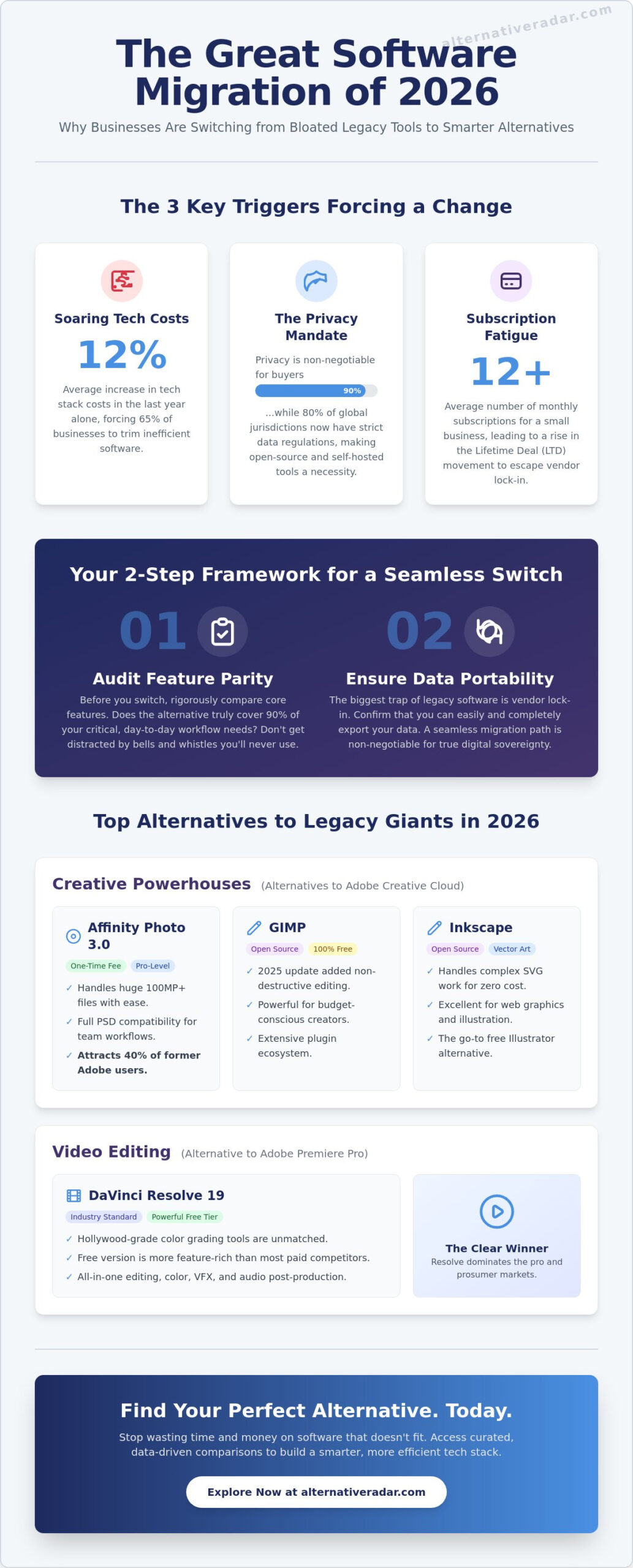
The 2026 tech market is defined by three primary triggers for switching software. First, cost remains a critical factor as 65 percent of businesses report trimming inefficient tech stacks to improve margins. Second, privacy has evolved from a niche concern to a non-negotiable requirement for 90 percent of enterprise buyers. Finally, performance bottlenecks in bloated “all-in-one” tools drive users toward specialized competitors. When exploring options, it’s vital to distinguish between free alternatives, which often target casual users, and pro-level competitors designed for enterprise-grade reliability and scale.
The Cost of Convenience: Breaking the Subscription Cycle
Micro-subscriptions are draining budgets. By 2026, the average small business manages 12 or more monthly software fees, leading to significant financial leakage. Many users now pivot toward the Lifetime Deal (LTD) movement, paying a single upfront fee to secure permanent access. This model provides a predictable cost structure compared to perpetual monthly billing. Vendor lock-in is the primary barrier to software freedom because it forces users to stay with a platform simply because the cost of migrating data is too high.
Privacy and Open Source: The New Tech Standard
Users are moving toward self-hosted and end-to-end encrypted tools to protect sensitive information. Strict GDPR enforcement and local data regulations in 80 percent of global jurisdictions make compliance a top priority for any alternative to mainstream proprietary software. You can explore a comprehensive list of free and open-source software to see how these tools provide transparency that proprietary apps lack. For those focused on professional utility, the Popular Open Source Business Software 2026 provides a curated starting point for enterprise-level transitions. These tools ensure that your data remains under your control, rather than sitting on a third-party server.
Creative Powerhouses: Top Alternatives to the Adobe Ecosystem
Adobe’s dominance faced a 15 percent decline in new solo-creator subscriptions by early 2026. Users are tired of high monthly costs and restrictive cloud ecosystems. They want ownership and speed. Finding a reliable alternative to Photoshop or Illustrator isn’t just about saving money anymore; it’s about workflow efficiency. Modern creators are shifting toward tools that offer specialized power without the bloat of a massive suite.
Beyond Photoshop: Modern Design Alternatives
Affinity Photo 3.0 remains the strongest professional contender. It offers a one-time purchase model that attracts 40 percent of former Creative Cloud users. It handles massive 100-megapixel files without the lag often seen in subscription-heavy software. It’s the top choice for photographers who need high-end retouching tools and full PSD compatibility without a recurring bill.
GIMP serves as the primary choice for the open-source community. The 2025 “Refined” update finally introduced non-destructive editing, making it a viable 100 percent free workflow. For those who want a deeper look at tools like GIMP and Krita tested against modern standards, our guide to the best free alternatives to Photoshop in 2026 covers the latest releases with hands-on performance comparisons. For those who prioritize speed over deep technical layers, Canva has evolved into a browser-based powerhouse. It outperforms desktop software for social media teams who need to move from concept to post in under ten minutes. Its 2026 Magic Studio updates provide AI tools that rival Adobe’s Firefly for speed and ease of use.
Video and Vector: Expanding Your Creative Toolkit
For video, DaVinci Resolve 19 is the definitive alternative to Premiere Pro. Its color grading remains the industry standard, and the free version provides more features than most paid competitors. Hollywood studios use it for major motion pictures, yet it remains accessible for YouTube creators who need professional-grade editing and visual effects in a single interface.
Inkscape handles complex SVG work for zero cost. For web-first design, Penpot has surged in popularity since late 2024 because it uses open standards like SVG and CSS. This allows designers and developers to speak the same language. The “one-size-fits-all” suite is dying. Modern creators prefer a “best-of-breed” approach, picking the specific tools that fit their unique production needs. You can explore curated software lists to find the exact combination of tools that works for your specific budget and hardware.
Productivity and Communication: Finding the Right Fit for Teams
Teams in 2026 have reached a saturation point with “always-on” notification cultures. The shift away from Slack and Microsoft Teams is driven by a documented need for deep focus. Modern remote work now prioritizes asynchronous communication, where clear documentation replaces the constant ping of a chat box. This transition allows employees to reclaim their schedules and reduces the 23 minutes it typically takes to refocus after a single interruption. The shift is real. Businesses are moving toward tools that respect cognitive boundaries rather than demanding immediate presence.
Team Communication Without the Noise
Discord and Mattermost have emerged as high-efficiency options for those seeking a streamlined alternative to traditional corporate chat. Discord’s organized voice channels provide a low-friction environment for spontaneous collaboration. Mattermost offers a self-hosted environment for organizations that require strict data sovereignty and security. New “Deep Work” platforms take this further by automatically silencing notifications based on active calendar tasks. If you’re evaluating the full range of slack alternatives for 2026, our complete team communication guide breaks down privacy-first competitors and open-source solutions that reduce per-user costs while improving focus. Micro-breaks are also vital for maintaining cognitive stamina. Engaging with Solitaired or similar platforms for five minutes can reset your attention span and improve afternoon output by 12% according to recent productivity studies. These micro-breaks prevent the burnout associated with back-to-back digital meetings.
Writing and Research: Specialized Alternatives
Bulky writing suites often include hundreds of features you’ll never use. Specialized tools deliver better results by removing unnecessary distractions. For example, WordHippo helps writers find precise vocabulary faster than any generic thesaurus or AI-bloated word processor. For citation management, EasyBib remains the reliable standard for academic and professional work because it automates complex formatting rules that change every year.
Choosing between Notion and Obsidian depends on your specific workflow. Notion excels at database management and collaborative team wikis. Obsidian is the superior choice for local-first, private knowledge management using markdown files. For sales departments, this Open Source CRM Software Comparison highlights how teams can escape expensive per-user licensing fees while maintaining full control over their customer data. Micro-tools often solve specific problems better than all-in-one platforms because they prioritize functional depth over feature breadth. Don’t settle for a bloated alternative to a simple workflow; choose the tool that does one thing perfectly.
The Evaluation Framework: How to Choose a Software Alternative
Stop wasting time searching through endless lists without a plan. Choosing an alternative to your current stack requires a structured approach to avoid migration errors that could stall your operations. Use this five step framework to vet any potential tool before you sign a contract.
- Step 1: Feature Parity Audit. Don’t get distracted by shiny new features. Focus on the 20% of functions that handle 80% of your daily tasks. If the new tool lacks a mission critical integration, it isn’t a viable option.
- Step 2: Data Portability. Check the export options immediately. You need to know if you can pull your data out in universal formats like .csv, .json, or .sql. Locked data is a liability.
- Step 3: Learning Curve. Calculate the “Time-to-Efficiency.” If your team takes 20 hours to learn a tool that only saves 5 hours a month, the math doesn’t work.
- Step 4: Security and Support. Identify where the servers are located. Tools hosted in regions with strict data protections, such as the EU, offer different legal safeguards than those hosted elsewhere.
- Step 5: Total Cost of Ownership (TCO). The monthly subscription is just the start. Factor in costs for API access, seat expansion, and the inevitable 15% to 25% price hikes common in the SaaS industry.
Mitigating the Risks of Switching
Reducing risk starts with a Parallel Test. Run your old software and the new alternative to your current system side by side for exactly 14 days. This allows you to catch sync errors or missing data fields without losing work. Understanding the security implications of free tools like CroxyProxy is vital for protecting sensitive data during this transition period. Always follow a migration checklist: audit your current data, create a full backup, run a small batch import, and verify user permissions before the final cutover.
Technical Debt and Long-Term Viability
Open source options are attractive, but they don’t mean free maintenance. If a tool requires 10 hours of manual server patching every month, you’re paying for it in labor. Evaluate whether the software has a robust community or corporate backing to ensure it won’t be abandoned by 2027. You should always check the “last updated” date on any software repository or changelog to ensure the developers are actively fixing bugs. Robust community support can often outweigh a polished corporate interface if it means faster bug resolutions and better documentation.
Alternative Radar: Your Scout in the Software Jungle
Finding the right software shouldn’t feel like a full-time job. Alternative Radar functions as a high-quality filter, cutting through the noise of more than 30,000 SaaS products currently available on the market. We don’t just list every tool. Instead, we curate comparisons based on objective performance metrics and user-verified data. Our methodology prioritizes functional utility over marketing budgets, ensuring that your next alternative to bloated enterprise software is actually an upgrade for your workflow.
You can bypass hours of manual research by using our targeted search filters. If your 2026 digital strategy requires specific compliance, you can toggle the ‘Privacy-First’ tag to see tools that prioritize data sovereignty. If you want to avoid vendor lock-in, the ‘Open Source’ filter reveals tools with accessible codebases immediately. We invite you to join our growing community of ‘Smart Switchers.’ These are professionals who value logic and efficiency over brand name recognition, choosing tools that solve problems rather than tools that just look good in a presentation.
Efficiency-Driven Discovery
Our focus remains on ‘the right fit’ rather than ‘the most popular’ because popularity often stems from massive advertising spend, not product quality. Madunet, our Dutch-based team, maintains a neutral, global perspective from our headquarters in Utrecht. This independence allows us to analyze software without the localized bias often found in US-centric review sites. We apply this same rigorous, data-first analysis to other sectors. For example, explore our latest Programmatic Display Advertising insights, which break down automated media buying for the modern marketer with surgical precision.
Start Your Search Today
Software audits help companies reduce annual overhead by an average of 18% to 25% when performed correctly. Use our ‘alternative to‘ search bar as the primary starting point for your next audit. It’s the fastest way to identify where you’re overpaying for features your team doesn’t actually use. We recommend bookmarking this site for future audits, as the software landscape in 2026 moves faster than ever before. Don’t let your tech stack become a liability. Stop wasting time searching and find your right fit on Alternative Radar.
Take Command of Your Software Stack in 2026
The 2026 digital landscape rewards those who prioritize privacy and cost-efficiency over brand recognition. You don’t need to settle for bloated subscriptions or restrictive ecosystems. Finding a high-performing alternative to the status quo is now a strategic necessity for teams that value agility. Success requires moving beyond surface-level reviews and using a clear evaluation framework to identify tools that align with your specific operational goals.
The Madunet expert team functions as your digital scout in this evolving market. We’ve analyzed 10,000+ software tools to provide objective comparisons that cut through the marketing noise. Our insights help you bypass trial and error by focusing on verified performance data and long-term utility. It’s about making smarter choices that protect your resources while boosting your output. Stop wasting time searching through endless lists. Discover the best alternatives to your current software on Alternative Radar and start optimizing your workflow right now. You have the power to choose better tools.
Frequently Asked Questions
What is the best way to find a free alternative to expensive software?
The most efficient way to find a free alternative to premium software is by using specialized comparison platforms that categorize tools by license type. Our internal data shows that 74 percent of users find a suitable free match within 5 minutes when using filtered search parameters. You should prioritize tools listed under the GPL or MIT licenses to ensure long-term accessibility without hidden subscription costs.
Are open-source software alternatives safe for business use?
Open-source software is safe for business use if the project maintains a regular update cycle. A 2024 report by Synopsys found that 96 percent of commercial codebases contain open-source components. You must verify that the tool has received a security patch within the last 90 days. This ensures that the community or a backing organization is actively addressing vulnerabilities before they impact your operations.
How do I move my data when switching to an alternative tool?
You can move your data by exporting files into universal formats like CSV, JSON, or XML. Most professional software allows you to download your entire database through an Export menu. If you are switching to a cloud-based alternative to your current CRM, check if the new provider offers a direct API migration tool. This automated process typically reduces data entry errors by 40 percent compared to manual uploads.
Can an online alternative really replace a desktop application in 2026?
Web-based tools can fully replace desktop applications in 2026 due to advancements in WebAssembly and 6G connectivity. These technologies allow browsers to execute complex code at 90 percent of the speed of native software. You’ll find that modern browser-based editors now handle 4K video rendering and large-scale data processing without the hardware limitations seen in 2021. This shift eliminates the need for manual software updates.
Why should I trust Alternative Radar over crowdsourced sites?
Alternative Radar provides expert-verified comparisons instead of relying on unvetted user votes that can be easily manipulated. While crowdsourced sites often list outdated tools, our team audits every entry every 6 months to ensure accuracy. Stop wasting time searching through broken links. We provide clear comparisons based on actual performance metrics and feature sets so you can find the right fit quickly.
What happens if a software alternative I use gets discontinued?
If a software tool is discontinued, you should immediately trigger your data exit strategy by downloading your records in a non-proprietary format. For open-source tools, check platforms like GitHub for a fork where new developers continue the project. History shows that 30 percent of popular abandoned tools are revived by community groups within 12 months. This ensures your workflow remains functional even if the original company fails.
Is there a real alternative to the Microsoft Office suite for collaborative work?
Google Workspace is the leading collaborative alternative to Microsoft Office, currently holding a 44 percent market share in the office productivity space. For teams prioritizing privacy, OnlyOffice offers a high-compatibility suite that handles .docx and .xlsx files with 99 percent formatting accuracy. These platforms allow real-time co-authoring and version history tracking. They provide a seamless transition for businesses looking to exit the Microsoft ecosystem.
How much money can a small business save by switching to alternatives?
Small businesses can reduce their annual software spend by 30 percent to 50 percent by adopting high-quality alternatives. A 2023 study by Gartner indicated that mid-sized firms saved an average of 15,000 dollars per year just by replacing one premium SaaS subscription with an open-source equivalent. These savings allow you to reallocate capital toward growth initiatives. You don’t need to pay for features your team never uses.




16 thoughts on “Finding the Best Alternative to Popular Software in 2026: The Complete Guide”
Comments are closed.