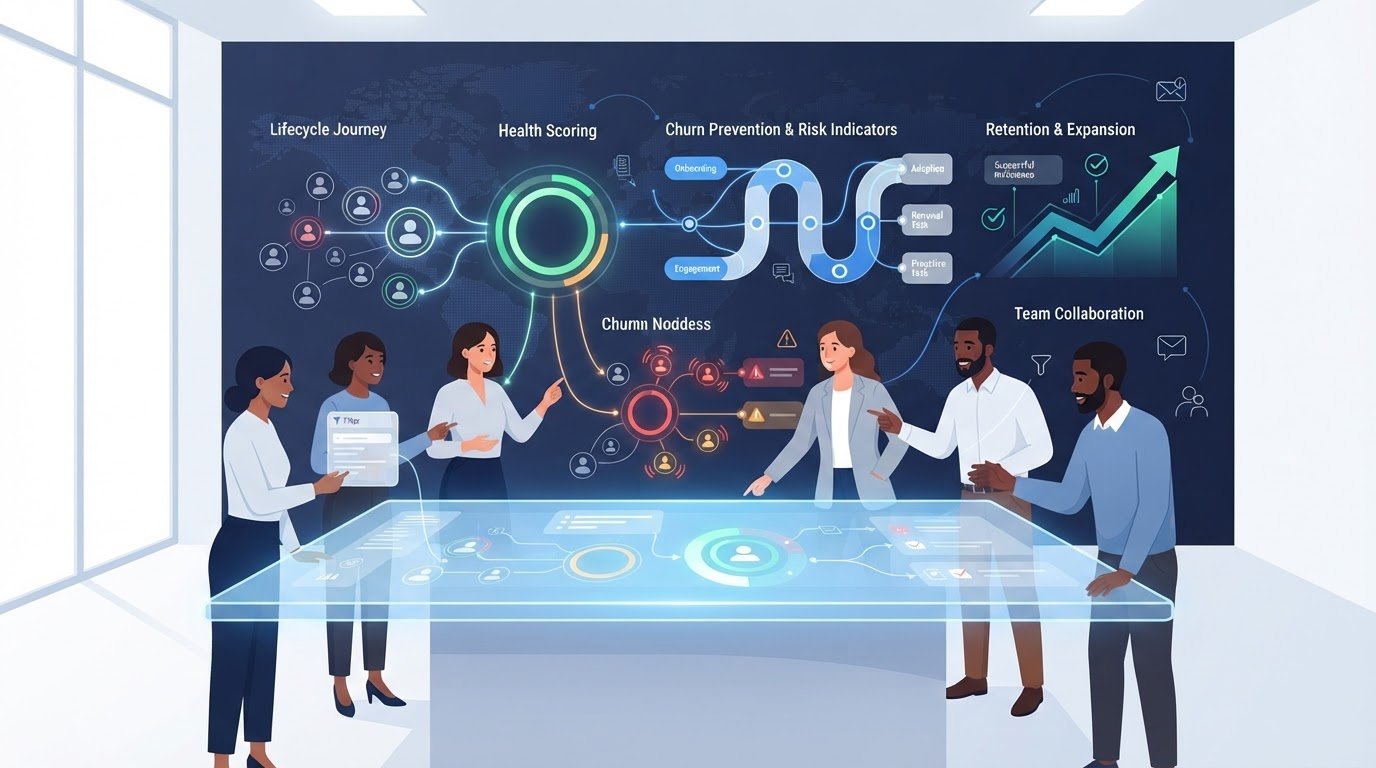
A health score no one acts on won’t prevent churn. Customer success platforms for SaaS teams bring customer data, health scoring, lifecycle goals, and retention workflows together, helping teams spot risks and respond early. They turn account signals into planned actions, from onboarding support to renewal and expansion conversations.
When customer information is scattered across tools, it’s harder to see which accounts need attention or how they’re progressing. A platform gives customer-facing teams a shared view of usage, milestones, and engagement, making it easier to tailor follow-up to each customer’s goals.
This guide explains what a customer success platform does, how health scores and lifecycle plans work, and how these tools can support retention and revenue growth. It also covers expected benefits, key capabilities, and how to assess whether a platform fits your SaaS team’s approach.
Key Takeaways
- Combine product usage, engagement, and milestone data to spot accounts that may need attention before renewal.
- Set customer health criteria around meaningful outcomes, then connect risk signals to clear follow-up actions.
- Use lifecycle goals to coordinate onboarding, adoption, renewals, and expansion around each customer’s needs.
- Compare platforms by how well their data, workflows, and reporting fit your team’s customer success model.
- Track retention and expansion together to see whether customer success efforts support durable revenue growth.
Customer health scoring and churn risk identification
Platforms that combine customer data, health scoring, churn alerts, and renewal workflows can help teams act on changes in product usage, unanswered messages, and missed milestones, and identify accounts that may need attention.
Customer Health Metrics
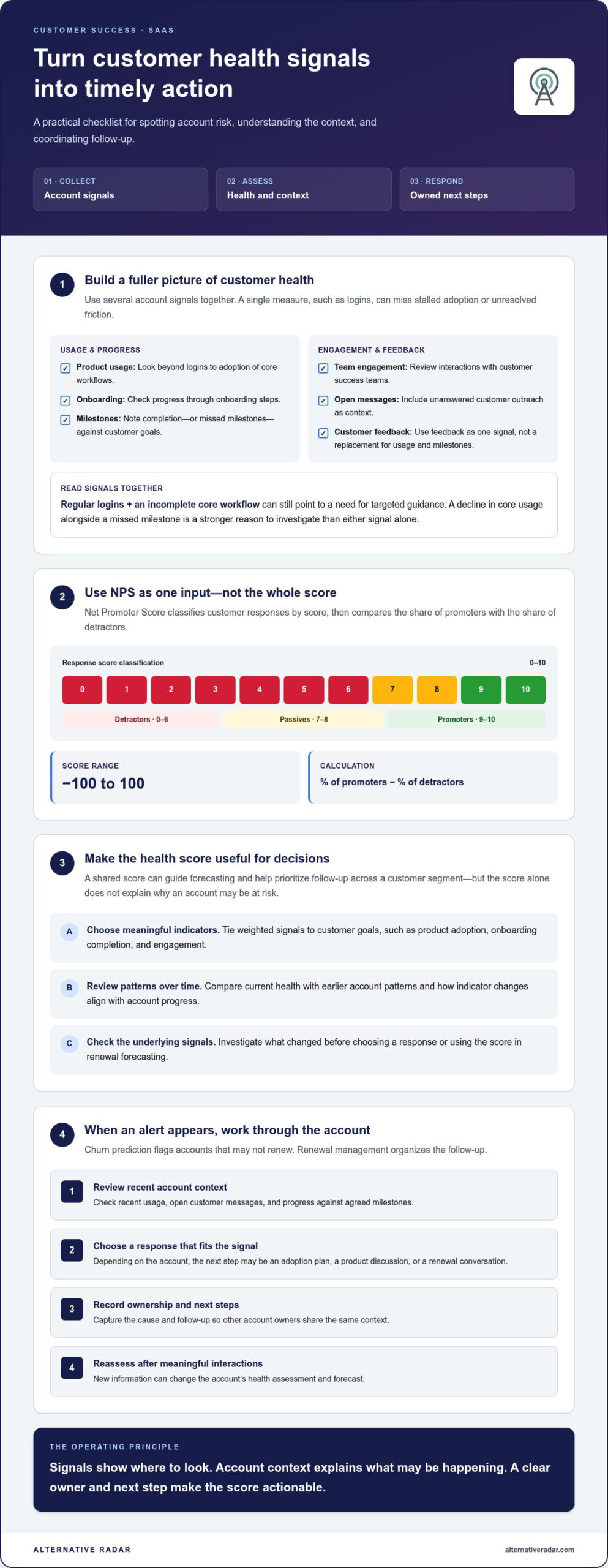
Customer health metrics combine account signals to show whether customers are progressing toward their goals. They matter because a single measure, such as logins, can miss stalled adoption or unresolved friction.
Measure product usage alongside onboarding progress, milestone completion, and engagement with customer success teams. A customer who logs in regularly but hasn’t completed a core workflow, for example, may need targeted guidance. Unanswered messages and missed milestones add context, helping teams distinguish normal variation from patterns that warrant follow-up.
Use customer feedback as another signal. Net Promoter Score classifies scores of 0-6 as detractors, 7-8 as passives, and 9-10 as promoters. It ranges from -100 to 100 and is calculated by subtracting the percentage of detractors from the percentage of promoters. Treat it as one input, not a substitute for usage and milestone data.
Health Scoring and Forecasting
A health score combines weighted account signals to help teams assess likely customer outcomes. A shared score can guide forecasting and help prioritize follow-up across a customer segment.
Build the score from indicators tied to customer goals, such as product adoption, onboarding completion, and engagement. Review how changes in those indicators align with account progress. A decline in core product usage alongside a missed milestone gives teams stronger reason to investigate than either signal alone.
Use analytics to compare current health with earlier account patterns, then connect the findings to renewal planning. A score can support forecasting by highlighting emerging risk or expansion potential. It doesn’t explain the cause on its own, so review the underlying signals before choosing an action.
Churn Prediction and Renewal Management
Churn prediction uses customer signals to flag accounts that may not renew, while renewal management organizes the response. Together, they help teams address declining usage or stalled workflows before a renewal conversation.
When an alert appears, review recent usage, open customer messages, and progress against agreed milestones. Declining use of a core feature alongside unanswered outreach, for example, may call for a direct conversation about the customer’s workflow. Record the cause and next step so other account owners have the same context.
Renewal workflows can connect account health with ownership, customer goals, and follow-up tasks. This helps teams see which accounts need an adoption plan, a product discussion, or a renewal conversation. Reassess the account after each meaningful interaction, since new information can change its health assessment and forecast.
Customer success platform benefits for SaaS businesses
A customer success platform connects account data, customer journeys, and team workflows. For SaaS companies, this can improve coordination: teams use customer behavior as a signal and plan proactive engagement instead of relying on scattered updates.
Leading platforms differ in their health analytics, automation, lifecycle management, and integrations. Compare how each brings together product usage, customer support records, and account tasks, then check whether it connects with the software your team already uses.
For startups and small SaaS businesses, the best fit is often a platform that solves an immediate workflow problem without adding unnecessary complexity. A small team may prioritize onboarding automation and a shared account view, while a larger operation may need deeper segmentation and forecasting.
Evaluate a platform against your customer journey, team size, data sources, and operating process. Map a real workflow, such as onboarding a new account, and assess how easily the system tracks milestones, assigns ownership, and surfaces useful signals.
US SaaS companies should review a platform’s security documentation and data-handling controls. Look for details on encryption, role-based access, audit logs, data retention, and subprocessors; assess SOC 2 reports or ISO 27001 certifications where relevant to your procurement requirements.
Pricing plans commonly vary by user seats, account volume, selected features, integrations, and contract terms. Compare plan structures with the workflows your team will use, including whether analytics, automation, and onboarding tools are included or sold as separate modules.
Onboarding and engagement automation can include lifecycle triggers, milestone-based tasks, in-app messages, and follow-up sequences. For example, a platform can prompt a customer success manager when a new account completes one onboarding milestone but stalls before the next.
Salesforce, HubSpot, and other SaaS tools may connect through native integrations, APIs, or data imports. Check how each connection maps accounts, contacts, product activity, and support records. Then decide which system owns each field to reduce mismatched or duplicated data.
Implementation challenges often include inconsistent account records, unclear ownership, and workflows that don’t match how teams work. Clean up key data fields, define lifecycle stages, and test a customer journey before expanding automation across segments.
SaaS companies of different sizes can benefit from customer success, particularly when they have recurring revenue models and long-term customer relationships. These are the key factors to consider, regardless of company size. Sharing account information across customer-facing teams can also reduce the need for customers to repeat themselves and support more coordinated interactions.
Customer success teams can also use customer segmentation based on factors such as location or purchasing habits to tailor their approach. A well-designed customer success program can generate a 91% return on investment over three years, giving businesses a reason to assess the program’s design alongside its fit with their customer relationships.
Retention, churn prevention, and revenue expansion
Recurring revenue depends on customers continuing to receive value after purchase. In 2025, SaaS customer success was described as a growth engine tied to net revenue retention and expansion. A platform helps teams connect customer outcomes with renewal work, identify adoption barriers, and coordinate account activity across the post-sale lifecycle.
Start by measuring retention over a defined period. Use the customer retention formula: ((E – N) / S) x 100, where E is customers at the end, N is customers gained, and S is customers at the start. This separates retained customers from new acquisitions. Track the result alongside gross and net revenue retention to distinguish customer losses from expansion revenue.
For context, SaaS Capital’s 2025 B2B SaaS retention benchmark included more than 1,000 private B2B SaaS companies with over $1 million in annual recurring revenue. The median gross revenue retention rate in that group was 91%. Compare your own results with a relevant benchmark, but also inspect customer segments, contract profiles, and product usage to understand what drives the difference.
Churn prevention works best when teams act before renewal pressure peaks. If a core workflow stalls, assign an owner to understand the obstacle and agree on a recovery step. A playbook could trigger personal outreach when core-workflow usage falls by half over 30 days. A separate renewal workflow can mark subscription status 60 days before the subscription window, giving teams time to address open concerns.
Expansion should follow demonstrated customer value, not a generic sales prompt. For example, a playbook can trigger an in-app expansion prompt when a team reaches 90% of its seat limit. The account owner can then explore whether added seats match the customer’s plans. Pair that signal with adoption and customer goals to distinguish a genuine need from temporary usage.
Automation makes processes repeatable, but implementation needs clear ownership and relevant triggers. Assign each workflow to a team, define the customer event that starts it, and record the next action. Review whether that action renewed engagement or advanced the account’s goals. Retire playbooks when their triggers no longer reflect customer behavior.
Measure retention and expansion together, then use the results to refine lifecycle plans. If a segment renews but rarely expands, examine adoption and customer outcomes before changing outreach. If cancellations cluster around stalled workflows, improve the implementation experience that precedes them. This links recurring revenue measures to specific customer actions instead of treating retention as a renewal-day task.
SaaS customer success goals and lifecycle
A SaaS customer success lifecycle connects what buyers intended to achieve with the outcomes they realize after purchase. It gives customer-facing teams shared goals, clear ownership, and practical actions across onboarding, adoption, renewal, and expansion. A platform can map those stages into a consistent customer journey while allowing teams to tailor strategies by role, use case, or account segment.
Customer success is proactive and revenue-focused; customer support is generally reactive, while professional services are scoped. That distinction shapes the lifecycle. A support team may resolve a login issue, while a customer success manager connects product use to a customer’s goal and coordinates post-sale care. The aim is not just to close tickets, but to help customers make progress with the product.
The journey can begin when a customer signs a contract. A structured handoff from onboarding specialists to customer success managers preserves context, including the customer’s intended use case and agreed outcomes. Onboarding checkpoints show whether the account is advancing. If a milestone slips, the assigned owner can identify friction and choose an action suited to the customer’s situation.
Make lifecycle goals measurable. For example, a marketing team’s customer success plan could define success as publishing two campaigns and inviting a second user within 14 days. Those outcomes give the customer and account team a shared reference point. The platform can connect the goals with journey stages, task ownership, and progress signals, so follow-up responds to actual customer behavior.
Segmentation makes the lifecycle more relevant to different customers. Collecting role and use case at signup helps teams set criteria for each group. A product administrator may need adoption across a team, while an individual user may focus on completing a specific workflow. The journey can remain consistent, but its milestones and success metrics should reflect these different outcomes.
Customer success strategies also need measures that show whether customers are progressing. Teams can survey customers before and after onboarding to assess whether they feel more comfortable using the product. They can also set operational goals, such as identifying the top 20 ticket drivers each quarter and sharing evidence with product owners. These metrics connect customer experience to specific product or process actions.
Shared account information helps sales, onboarding, support, and customer success coordinate without asking customers to repeat context. A platform can make goals, milestones, and account updates visible across customer-facing teams, supporting consistent action from the first onboarding checkpoint through renewal planning and future growth.
What are the best customer success platforms for SaaS companies in 2026?
The best platform in 2026 is the one that fits your customer journey, data, and team workflow. No single feature set suits every SaaS company. Compare options by how they combine customer records, product activity, health signals, lifecycle automation, and reporting. A team focused on onboarding needs different capabilities from one managing complex renewals across multiple account segments.
For a small team, prioritize a clear account view, straightforward task ownership, and practical onboarding workflows. A startup with one customer success manager, for example, may need a visible list of stalled milestones more than advanced forecasting. Choose a system that supports the team’s current process and can accommodate growth without imposing unused complexity.
For product-led SaaS, compare platforms on their ability to turn product behavior into useful customer actions. Look for signals tied to activation, feature adoption, and stalled workflows. For example, an alert could prompt follow-up when a new account starts onboarding but doesn’t reach an agreed milestone. Assess whether teams can adjust the trigger to fit their customer journey.
For businesses with recurring contracts and dedicated account ownership, prioritize lifecycle planning, renewal visibility, and coordinated engagement. A platform should connect account context with follow-up tasks so teams can see who owns the next action. Compare how each option handles customer segmentation, shared account notes, and retention or expansion reporting.
Use a consistent evaluation process rather than choosing by brand recognition. First, map a real workflow, such as onboarding a new customer. Then assess each platform’s:
- Data connections for product usage, customer support, and account records.
- Health analytics that show the signals behind an account score.
- Automation controls for tasks, messages, and lifecycle milestones.
- Reporting that connects customer activity with retention and expansion goals.
- Access controls and data-handling practices relevant to your organization.
Next, test the workflow with representative account data. For example, check whether a customer success manager can identify a stalled account, review its activity, assign follow-up, and record the outcome without switching between disconnected records. This reveals practical fit more clearly than a feature checklist alone.
Finally, compare implementation effort with your team’s capacity. Extensive data cleanup or complex workflow design can slow adoption when ownership is unclear. Select the option that supports an immediate priority, such as consistent onboarding, while leaving room to develop forecasting and expansion processes as the business grows.
The strongest choice is the platform that matches your company’s customer journey and team needs, whether that means simple onboarding workflows, product-usage alerts, or renewal visibility. Evaluate it using a real customer workflow and account data, including integrations, health analytics, automation, reporting, and implementation effort.
Compare platforms on connections to product usage, customer support, and account records, alongside health analytics, lifecycle automation, and reporting. Test whether a team can review an account’s activity, assign follow-up, and record the result without switching between disconnected records.
Prioritize platforms that explain the signals behind account health scores and provide renewal visibility, lifecycle planning, and coordinated follow-up tasks. The section’s criteria do not establish which platforms offer churn prediction.
Alternative Radar: Programmatic display advertising
Alternative Radar helps readers discover and compare software alternatives through product details, features, pricing, and pros and cons. SaaS teams assessing customer success tools can use these comparisons to build a more informed shortlist. For software businesses seeking visibility, Alternative Radar offers programmatic display advertising, sponsored software placements, and affiliate-linked software recommendations.
Consider these options when you want to reach people researching software or present a product alongside relevant comparisons. Each serves a different purpose: display advertising builds visibility across placements, sponsored placements feature software in relevant discovery content, and affiliate-linked recommendations connect readers with software options.
Explore whether these promotional options fit your software’s audience and discovery goals. Visit alternativeradar.com to learn more.
Turn customer insight into your next growth decision
Use what your customer success process reveals to guide the next business decision. The right customer success platforms for SaaS can help teams understand where customers encounter friction, but that insight can also inform how software products reach the audiences most likely to value them. Keep the connection practical: match the product, audience, and discovery channel.
Alternative Radar supports software discovery through programmatic display advertising, sponsored software placements, and affiliate-linked software recommendations. These options suit software businesses seeking visibility or a relevant presence where readers compare tools. Choose the approach that fits your audience and marketing objective, then assess how it supports your broader growth strategy.
If you’re planning how to reach software researchers, contact Alternative Radar to discuss your options.
Set a clear goal and choose a channel that fits it. This keeps your strategy focused as your product and customer base grow.
Frequently Asked Questions
What is a CS Platform?
A customer success platform is software that helps teams organize and act on customer information after a sale. It can connect account records with product activity, customer communications, and team tasks. For example, a manager can see whether a customer has completed setup, identify an unresolved issue, and coordinate the next follow-up. Unlike a basic contact list, it links customer context to ongoing success work.
How do leading customer success platforms compare on features and integrations?
Leading platforms differ in health analytics, automation, lifecycle management, and integrations. Compare how they combine product usage, support records, and account tasks, and whether they connect to your existing software through native integrations, APIs, or data imports.
Which platforms support customer health scoring, churn prediction, and renewal management?
Platforms that combine customer data, health scoring, churn alerts, and renewal workflows support these functions. The material does not identify specific platform names.
What are the pricing plans and typical costs of customer success platforms?
Pricing commonly varies by user seats, account volume, selected features, integrations, and contract terms. Compare which workflows and tools, including analytics, automation, and onboarding, are included or sold as separate modules.