

By the end of 2026, Gartner projects that 75% of new application development will happen on low-code platforms, yet many of these tools hit a ceiling just as your business starts to gain real momentum. You likely feel the weight of this risk every time you evaluate a new vendor. It’s common to worry that the affordable tool you pick today will become a technical debt nightmare that forces an expensive migration in eighteen months. Learning how to choose a scalable software solution isn’t just about looking at current features; it’s about predicting how that architecture handles the $625 billion enterprise market reality expected by 2030.
You need a tech stack that expands without holding your data hostage or inflating your bill through aggressive vendor lock-in. This guide provides a clear growth framework to help you master the art of selecting tools that remain powerful as you scale. We’ll break down the critical differences between vertical and horizontal growth, explain why 80% of new projects now favor microservices, and provide a functional checklist for your next evaluation. You’ll learn to identify the hybrid pricing models that keep costs predictable while ensuring your software stays fast enough to avoid the 7% conversion drops caused by lagging performance.
Key Takeaways
- Distinguish between vertical and horizontal scaling to ensure your infrastructure supports increased demand without a drop in performance.
- Prioritize modular architectures and API-first designs that allow for seamless integration and prevent technical debt as your feature requirements evolve.
- Master how to choose a scalable software solution by applying a 5-step framework focused on three-year growth projections and rigorous API testing.
- Audit the “Price-to-Growth” ratio of potential vendors to avoid the financial traps of rigid per-user licensing and expensive data migrations.
- Utilize comparative discovery to identify agile alternatives that offer greater flexibility and performance than traditional, legacy-heavy platforms.
Beyond the Hype: What Scalability Really Means in 2026
Scalability is often reduced to a marketing buzzword, but in 2026, it represents a precise technical requirement. To understand What Scalability Really Means, you must view it as the system’s ability to handle growing amounts of work by adding resources rather than failing under pressure. If your software maintains 100ms response times with 100 users but spikes to 5 seconds with 1,000, it isn’t scalable. It’s a bottleneck waiting to happen.
Modern business environments require “Elastic Scalability.” This shift is driven by AI-integrated tools that demand massive, sudden bursts of computational power for processing large datasets or generating real-time insights. You don’t just need software that grows; you need software that expands and contracts instantly based on real-time demand. When learning how to choose a scalable software solution, you must distinguish between technical scalability (handling data and users) and functional scalability (the ability to add new features or modules without breaking the core system).
Vertical vs. Horizontal: Which Growth Path is Yours?
Vertical scaling, often called “scaling up,” involves adding more power to your existing server, such as increasing RAM or CPU capacity. It’s a straightforward approach for smaller teams or local applications, but it has a hard physical ceiling. Eventually, you can’t buy a bigger server, and your growth hits a wall. This model is becoming outdated for enterprise-level needs because it creates a single point of failure.
Horizontal scaling, or “scaling out,” involves adding more instances to your network. This is the foundation of cloud-native, distributed systems. Instead of one giant machine, you use ten smaller ones working in parallel. This path is essential for high-growth companies; in fact, over 80% of new enterprise projects are expected to adopt microservices for their scalability benefits by the end of 2026. This model offers virtually unlimited headroom and better redundancy. If one instance fails, the others pick up the slack without crashing the entire platform.
The Cost of “Static” Software
Choosing a rigid, non-modular legacy system creates a “static” environment that eventually chokes your operations. Much like how logistics hubs explore FLEXIRUN to prevent physical bottlenecks, digital systems need high-speed modularity to avoid stagnation. These systems often lack open APIs, making it nearly impossible to connect new productivity tools or AI agents. When your software cannot adapt to new integrations, you’re forced into manual workarounds that drain your team’s time. This leads to the rapid accumulation of technical debt.
Technical debt is the implied cost of future rework required because you chose an easy, restrictive software path now instead of a flexible one.
When you ignore these architectural foundations, you’re building on a foundation that will crack. Understanding how to choose a scalable software solution requires looking past the current user interface to see how the software handles data at the 80% growth mark. Without a modular structure, every new feature you add increases the complexity and risk of a total system failure.
The Technical Blueprint: 4 Non-Negotiable Scalability Pillars
Selecting software based on current aesthetics is a common mistake that leads to performance degradation. To build a sustainable growth framework, you must evaluate the underlying infrastructure. A robust technical blueprint for scalability focuses on how a system manages resources when demand spikes. If you want to know how to choose a scalable software solution, start by auditing these four pillars: architecture, API design, cloud integration, and database elasticity.
The Role of Microservices in Business Agility
Microservices break a complex application into independent, functional units. This modularity means you can upgrade your marketing automation features without risking the stability of your inventory management. It provides the agility to pivot quickly as market conditions change. Many organizations find that popular open source business software 2026 models leverage this modularity to offer high-tier performance without the restrictive licensing of legacy giants. If your prospective vendor can’t explain their microservices strategy, they’re likely selling you a legacy monolith disguised with a modern UI.
API Connectivity: The Glue of a Scalable Stack
A scalable stack is never a single product; it’s an ecosystem. API-first design ensures that data flows seamlessly between your ERP, CRM, and customer support tools. When evaluating how to choose a scalable software solution, look beyond the list of “native integrations.” For specialized industries, platforms like Valigara demonstrate how industry-specific tools can serve as scalable hubs while maintaining deep connectivity. Check the documentation for rate limits. If a vendor throttles your API calls too early, your automated workflows will fail exactly when your volume increases. Webhooks are equally critical, as they enable real-time data synchronization instead of delayed, scheduled polling.
Testing these technical pillars during the demo phase saves months of migration pain later. If you’re unsure which platforms offer the best architectural flexibility, you can compare modern software peers to see which tools actually support high-velocity growth.
Licensing and Lock-in: Why Your Stack Must Remain Flexible
Financial scalability is just as vital as technical performance. If your software works perfectly but doubles in price every time you add five employees, it isn’t truly scalable. Many businesses fall into the “SaaS Tax” trap because they don’t audit the Licensing and Lock-in terms during the initial procurement phase. When learning how to choose a scalable software solution, you must calculate the long-term Price-to-Growth ratio. This metric reveals how costs accelerate relative to your revenue or team size.
Per-user pricing is the most common growth killer. While it seems affordable for a startup, it becomes predatory once you hit a high-growth phase. For teams planning to scale rapidly, the open source CRM software comparison model often provides a superior alternative. Open source or self-hosted solutions allow you to scale your seat count without an exponential increase in monthly fees, giving you full control over your operational overhead. This flexibility ensures your budget supports your expansion rather than penalizing it.
Avoiding the SaaS Trap: Pricing That Scales With You
Watch out for “cliff pricing.” This occurs when a vendor forces you into a significantly more expensive tier the moment you exceed a small limit, such as moving from 10 to 11 users. Instead, prioritize usage-based models that align with your actual revenue drivers, like the number of transactions or data processed. Even if you’re a small team now, evaluate the enterprise-level tiers today. You don’t want to discover that the “Pro” plan you’re on has a ceiling that forces a mandatory, six-figure upgrade just as you’re trying to expand into new markets.
Exit Strategies and Data Ownership
Scalability includes the freedom to leave. If a vendor raises prices by 40% or fails to maintain their infrastructure, you need an immediate out. True data portability requires access to standard export formats like JSON, CSV, or SQL. Ask vendors point-blank: “Do I own my data, and can I export it with full encryption keys at any time?” A finding the best alternative mindset isn’t about being indecisive; it’s a strategic security feature. It ensures that your business remains agile and isn’t held hostage by a single provider’s roadmap or financial instability. If the data migration process is too complex, you don’t actually own your workflow; the vendor does.
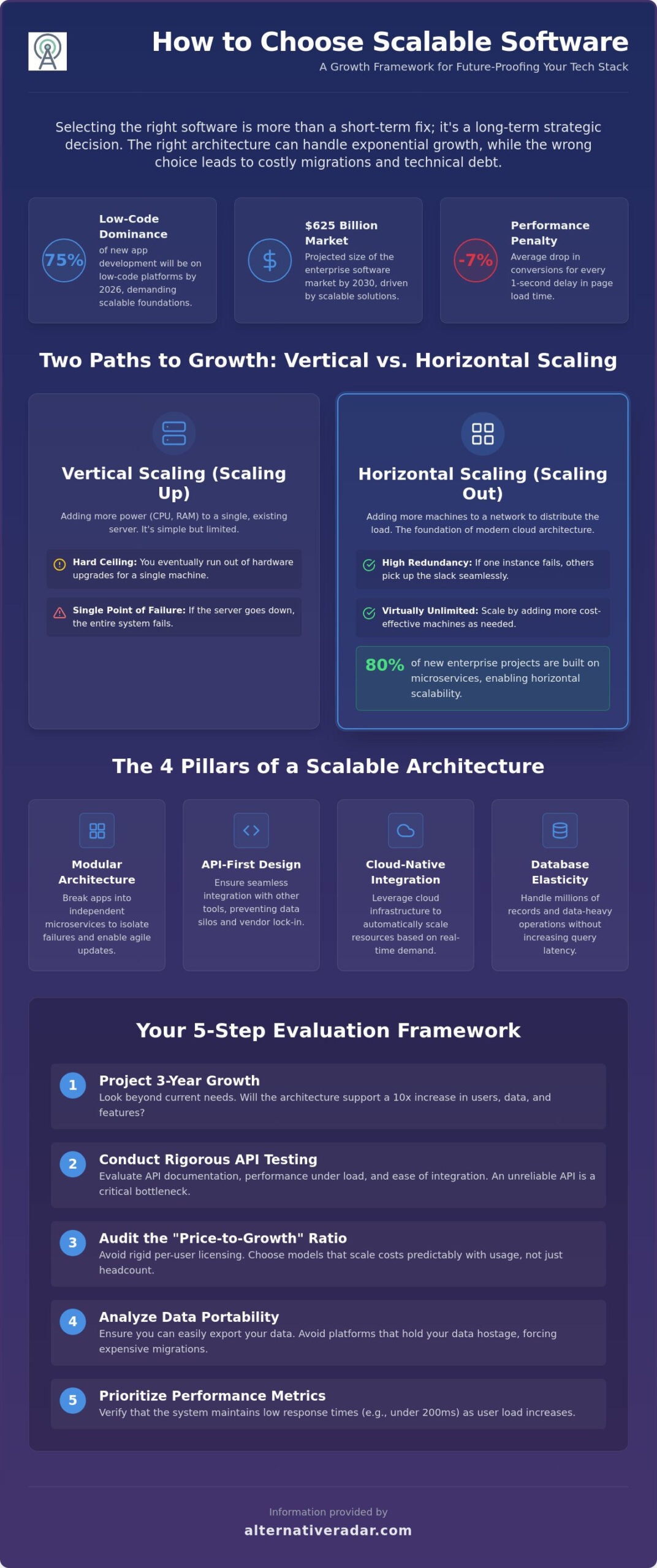
The 5-Step Framework for Choosing a Scalable Solution
Most guides focus on how to build systems from scratch, but as a buyer, you need a repeatable vetting process. Mastering how to choose a scalable software solution requires moving beyond sales demos to stress-testing a vendor’s claims. If you don’t have a structured framework, you’re likely to pick a tool that works for your current team of ten but fails when you hit one hundred. Follow these five steps to ensure your next investment stays relevant for years.
- Step 1: Audit 3-Year Growth Projections: Don’t buy for today. Calculate your expected user count, data storage needs, and required feature sets for the next 36 months.
- Step 2: Test the API Library: Verify that the documentation is clear and the integration library supports your existing stack. A restricted API is a growth bottleneck.
- Step 3: Verify Infrastructure: Confirm the vendor uses top-tier providers like AWS, Azure, or Google Cloud. This ensures they can leverage global data centers as you expand.
- Step 4: Conduct a Load Stress Test: Use your trial period to upload large datasets or run complex reports. If the system lags now, it’ll crash later.
- Step 5: Review the Product Roadmap: Ask for specific details on upcoming scalability features. Look for investments in AI-driven elasticity and microservices.
Conducting a Scalability Audit
A thorough audit starts with data. Project your storage needs by looking at your customer acquisition rate and multiplying it by the average data footprint per account. You must also assess how the software handles seasonal spikes. If your business experiences 400% traffic increases during retail or tax seasons, the software must scale resources automatically. Look for these red flags during your audit:
- Lack of a public status page with historical uptime data.
- Vague answers regarding API rate limits or throttling.
- Manual intervention required by the vendor to increase server capacity.
- Proprietary database structures that make data extraction difficult.
The “Proof of Concept” (POC) Phase
Never sign a multi-year contract based on a slide deck. The POC phase is where you move from theory to reality. Set up a small-scale pilot that mirrors your actual workflows and invite your technical team to vet the underlying stack. They’ll spot architectural flaws that a non-technical buyer might miss. This phase allows you to see how the software performs under pressure before you commit your entire operation to it. To speed up your discovery process, use Alternative Radar to compare software peers and find tools that have already passed these rigorous scalability tests.
Scaling Smarter with Alternative Radar
Researching every vendor in a crowded market is an efficiency killer. Once you’ve applied the 2026 Growth Framework, you need a high-quality filter to identify the specific tools that meet your architectural criteria. Alternative Radar simplifies this process by acting as a neutral curator in the software ecosystem. We don’t just list products; we categorize them by technical labels and licensing types to help you understand how to choose a scalable software solution that fits your specific three-year roadmap.
Our platform focuses on identifying the “Goldilocks” solution for your business size. This means finding software that isn’t so simple it hits a ceiling next year, yet isn’t so bloated with enterprise features that you’re paying for resources you’ll never use. By comparing top-tier industry leaders with agile, open-source peers, we empower you to make a choice based on logic and utility rather than market dominance. The best choice today is always the one that maintains your data portability, allowing you to switch or upgrade tomorrow without a total operational collapse.
Your Scout in the Software Jungle
Finding a tool that balances performance with affordability requires a scout who has already done the heavy lifting. Alternative Radar vets the pros, cons, and hidden pricing tiers of modern software so you can skip the repetitive sales demos. We prioritize objective, efficiency-driven comparisons over marketing hype. For example, if your growth requires high-performance creative tools without the burden of subscription lock-in, our guide on the best free alternatives to photoshop demonstrates how we evaluate professional-grade features against cost-effective models.
We believe transparency is the ultimate productivity tool. When you use our comparative descriptors, you get a clear view of how a platform handles high-velocity data and user scaling. This allows your technical team to focus on implementation rather than endless discovery cycles.
Next Steps: Build Your Scalable Stack Today
Successful scaling isn’t a one-time event; it’s a series of smart, modular decisions. Start by selecting one core tool that adheres to the API-first design principles discussed earlier. Ensure this anchor tool plays well with the rest of your ecosystem to prevent data silos. As your team grows, maintain this agility by regularly auditing your communication and collaboration tools.
Maintaining a lean, responsive tech stack requires constant vigilance against feature creep and predatory pricing. You can keep your internal operations scalable by exploring the latest slack alternatives, which often provide better data ownership and more flexible seat-count pricing for expanding teams. These agile peers offer the same performance as market leaders without the rigid constraints that hinder long-term growth.
Discover your next growth engine and compare the best software peers on Alternative Radar to build a stack that grows as fast as your ambitions.
Future-Proof Your Tech Stack with Precision
Building a growth-ready infrastructure requires looking past the surface features of a vendor’s demo. You’ve learned that true scalability in 2026 relies on modular architecture, API-first connectivity, and transparent licensing that doesn’t penalize your success. By distinguishing between vertical upgrades and horizontal expansion, you can avoid the technical debt that cripples many high-growth teams. Mastering how to choose a scalable software solution is a strategic necessity for maintaining your competitive edge in an increasingly automated market.
Don’t let rigid legacy systems or predatory pricing tiers stall your momentum. We’ve already done the heavy lifting of vetting modern tools against these rigorous standards. You can access detailed pricing and feature comparisons, objective reviews of open-source and premium platforms, and expert-vetted software lists updated for 2026. This ensures you find a tool that’s affordable now but powerful enough for your three-year goals.
Find the best scalable alternatives for your business on Alternative Radar and start building a more resilient stack today. Your future growth depends on the choices you make now; make them with clarity and confidence.
Frequently Asked Questions
What is the most important feature of a scalable software solution?
The most critical feature is a modular architecture that allows individual system components to scale independently. This structure ensures that a surge in one specific area, such as payment processing or data reporting, does not compromise the performance of the entire platform. Elasticity is the technical hallmark of a solution that can handle the sudden, AI-driven workloads that define the 2026 business environment.
How do I know if a software vendor is truly cloud-native?
You can identify a truly cloud-native vendor by verifying if their platform utilizes microservices and container orchestration. Unlike “cloud-hosted” legacy applications that are simply moved to a remote server, cloud-native solutions use auto-scaling groups to spin up new instances automatically during traffic spikes. Ask the vendor if their infrastructure supports serverless functions, as this indicates a modern approach to resource management.
Can open-source software be as scalable as enterprise SaaS?
Open-source software is often more scalable than enterprise SaaS because it removes the artificial seat caps and rigid licensing tiers that limit growth. By hosting open-source tools on your own cloud infrastructure, you maintain full control over hardware resources and data sovereignty. This flexibility is an essential consideration when researching how to choose a scalable software solution that avoids the financial traps of proprietary vendor lock-in.
What is the difference between vertical and horizontal scaling in business apps?
Vertical scaling involves adding more power to a single server, whereas horizontal scaling involves adding more servers to a distributed network. Vertical scaling is a temporary fix with a hard physical limit that eventually leads to performance ceilings. Horizontal scaling is the 2026 standard for enterprise agility, as it allows for virtually infinite expansion and provides superior redundancy if a single instance fails.
How does per-user pricing affect software scalability for large teams?
Per-user pricing creates a financial bottleneck that directly penalizes team expansion. As your headcount grows, the monthly subscription cost can quickly outpace the actual utility provided by the tool. High-growth teams should prioritize usage-based or flat-fee models to ensure that hiring new staff does not result in an unsustainable spike in operational overhead or force a premature migration to a different platform.
When should I consider switching to a more scalable software alternative?
You should consider switching when your current system experiences frequent latency during peak hours or when the cost of adding new users exceeds your revenue projections. If your technical team spends more time building workarounds for integration limits than on core tasks, it is a clear signal to migrate. Evaluating how to choose a scalable software solution early prevents these bottlenecks from becoming permanent inhibitors to your business momentum.
How do APIs contribute to a software’s ability to scale?
APIs act as the essential bridge that allows your software to communicate with other specialized tools in your tech stack. A scalable solution uses an API-first approach to ensure that data flows automatically between departments without manual entry. This interoperability prevents the creation of data silos, which are the primary cause of operational friction and lost productivity during periods of rapid business expansion.
Is there a way to test scalability before committing to a long-term contract?
You can test scalability by conducting a pilot program that uses synthetic load testing to simulate high-volume traffic and data processing. Most modern vendors provide a trial period where you can upload large datasets or run multiple concurrent processes to observe the system’s reaction. If the platform’s latency increases significantly during these stress tests, it is unlikely to support your long-term growth requirements.