

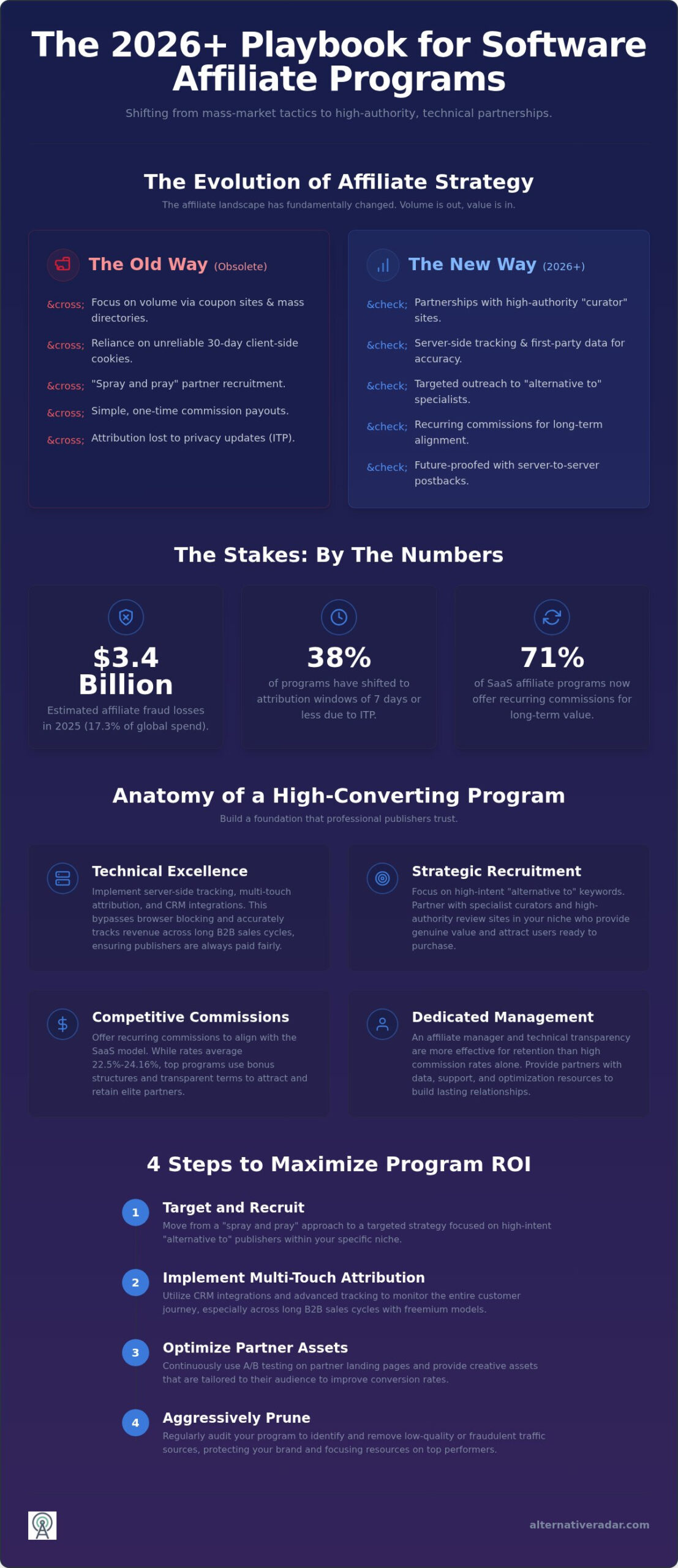
Did you know that affiliate fraud accounted for an estimated $3.4 billion in losses in 2025, representing 17.3% of global spend? If you’re struggling with high affiliate churn or inaccurate tracking, you’re facing the same hurdles as most modern SaaS brands. Implementing the right software affiliate program best practices is no longer just about setting a commission rate; it’s about building a technical foundation that professional publishers can trust. You’ve likely realized that getting noticed by high-traffic review platforms requires more than just a generic outreach email.
We agree that the current landscape is cluttered and often inefficient for both vendors and publishers. This guide provides the exact frameworks and technical standards that top software publishers require to drive high-intent traffic and maximize your affiliate revenue in 2026. You’ll learn how to move beyond basic setups toward a scalable, automated system that secures consistent placement on top “alternative to” lists. We’ll explore server-side tracking, AI-augmented management, and the recurring commission models that define high-performance partnerships today.
Key Takeaways
- Identify why high-authority curator sites and AI-driven search have replaced mass-market coupon affiliates as the primary driver for software discovery.
- Learn why a dedicated affiliate manager and technical transparency are more effective for partner retention than high commission rates alone.
- Implement software affiliate program best practices by utilizing multi-touch attribution and CRM integrations to track revenue across long B2B sales cycles.
- Transition from “spray and pray” recruitment to a targeted strategy focused on high-intent “alternative to” keywords within your specific niche.
- Maximize program ROI by using A/B testing on partner landing pages and aggressively pruning low-quality or fraudulent traffic sources.
The Evolution of Software Affiliate Marketing: Why 2026 is Different
The landscape of affiliate marketing has undergone a fundamental transformation. In earlier years, software vendors focused on volume, often partnering with coupon sites and mass-market directories that prioritized traffic over relevance. By 2026, this strategy has become obsolete. High-performance partnerships now rely on high-authority “curator” sites that offer deep technical analysis. These publishers act as a filter for users who are overwhelmed by choice and seek objective comparisons rather than just a discount code.
AI-driven search engines are further accelerating this trend. Users no longer type broad categories into a search bar; they ask specific questions about software compatibility, performance, and specific use cases. This shift makes “alternative to” search queries the highest intent funnel in the software journey. When a user searches for an alternative to a market leader, they’ve already identified a pain point and are actively looking for a solution to buy. Capturing this traffic requires software affiliate program best practices that prioritize technical accuracy and deep integration with specialist platforms.
The Death of the 30-Day Cookie
Privacy regulations and browser updates have effectively ended the era of the traditional 30-day cookie window. In 2026, research indicates that 38% of affiliate programs have moved to attribution windows of 7 days or less, largely due to Intelligent Tracking Prevention (ITP). To maintain accurate commissions, programs must shift to server-side tracking and first-party data. Relying on client-side cookies leads to lost revenue for publishers and inaccurate data for vendors. Future-proof tracking links now use server-to-server postbacks that bypass browser-based blocking, ensuring that every lead is accounted for regardless of the user’s privacy settings.
From Generalist to Specialist: The Rise of the Curator
Users now distrust generalist directories that list thousands of products without evaluation. They prefer niche comparison sites that provide detailed pros and cons. This is where a digital scout like Alternative Radar adds value. We filter for high-quality software recommendations by testing features and assessing suitability for specific professional needs. Vendors who provide detailed product specs and transparent licensing classifications gain an advantage here. By focusing on specialist curators, you align your brand with objective advice rather than biased sales pitches. This approach significantly improves conversion rates at the bottom of the funnel because the recommendation feels earned rather than bought.
The Anatomy of a High-Converting Software Affiliate Program
A best-in-class software affiliate program is built on more than just a high bounty. It’s built on utility for the publisher and transparency for the user. While general “best of” lists capture top-of-funnel discovery, “alternative to” queries capture high-intent switchers. These users have already identified a problem with their current tool and are actively looking for a replacement. To convert them, your program must provide the technical depth these users demand. Adopting software affiliate program best practices means moving beyond branded portals and focusing on the data needs of professional curators.
Success requires a dedicated Affiliate Manager who understands the SaaS lifecycle. This role is not just about recruitment; it’s about optimization. Professional publishers require transparency in attribution, especially when navigating freemium models. If a user signs up for a free tier and converts to a paid plan six months later, your tracking must account for that delayed revenue. Following standards like IAB Australia’s affiliate software guide ensures that your technical tracking remains ethical and functional across these complex user journeys. If you want to reach these high-intent switchers, you should partner with Alternative Radar to align your brand with objective comparison content.
Competitive Commission Structures for 2026
Commission models are shifting toward long-term alignment. Research shows that 71% of SaaS affiliate programs now offer recurring commissions, reflecting the subscription-based nature of the industry. While the average SaaS commission rate sits between 22.5% and 24.16%, top-tier programs use bonus structures to reward partners who secure placements on high-traffic “alternative” lists. Professional publishers generally prefer recurring revenue over one-time flat fees because it rewards them for the lifetime value of the customer. When handling churn or clawbacks, maintain trust by providing clear data on why a commission was reversed, ensuring your partners don’t feel penalized for factors outside their control.
Creative Assets That Actually Drive Clicks
Static banners have lost their effectiveness in the professional software space. High-performing partners need dynamic comparison widgets and raw data feeds. By providing raw technical specifications, you allow publishers to build custom “alternative to” tables that compare your features directly against market leaders. This level of detail is what drives clicks from savvy buyers. Additionally, offering exclusive discounts for specific reader groups can provide the final push needed for a conversion. These assets empower the publisher to act as an advisor, helping the user make an informed decision rather than just serving an ad.
Technical Excellence: Solving the Attribution and Tracking Puzzle
Technical accuracy is the foundation of partner trust. In the B2B software sector, sales cycles often span several months and involve multiple stakeholders. Relying on a single touchpoint to reward a partner isn’t sufficient anymore. Modern software affiliate program best practices require multi-touch attribution to ensure every contributor in the journey receives fair credit. This approach moves beyond simple link clicks and focuses on the entire lifecycle of a user, from the initial “alternative to” search to the final enterprise contract.
Integrating your affiliate platform with your CRM, such as Salesforce or HubSpot, is a critical step for high-performance programs. This integration allows you to track lead quality beyond the initial sign-up. When your marketing data talks to your sales data, you’ll identify which affiliates drive high-lifetime-value customers and which only generate low-intent trials. This level of transparency helps you reward your best partners more effectively. It’s also vital to ensure your tracking setup accounts for mobile sign-ups with the same precision as desktop conversions, as professional users increasingly research tools across multiple devices.
Direct linking is another technical standard that benefits both parties. By allowing partners to link directly to your domain without messy redirect strings, you improve the user experience and boost SEO signals for your site. It removes the friction often associated with affiliate links and makes the recommendation feel more organic. For publishers, it preserves link equity and reduces the risk of ad blockers stripping out tracking parameters.
Server-Side Tracking and GTM Integration
Reducing “leakage” during the transition from a free trial to a paid subscription is essential for partner retention. Implementing server-side Google Tag Manager (GTM) allows you to track conversions directly from your server rather than relying on the user’s browser. This method is more resilient against privacy-focused browser updates and ad-blocking software. To further empower your partners, provide real-time API access to their conversion data. This allows them to optimize their content and traffic sources based on actual revenue rather than just clicks.
Attribution Models: Last-Click vs. Linear
The traditional last-click model often penalizes top-of-funnel curators who introduce users to your software. If a user discovers your tool on a comparison site but later clicks a retargeting ad to finish the purchase, the original referrer often loses their commission. Implementing linear attribution or first-click protection ensures these high-authority scouts remain incentivized to feature your product. You can also use programmatic display advertising to support your affiliate efforts by staying top-of-mind for users who have already engaged with a partner’s recommendation.
Strategic Recruitment: How to Get Listed on High-Authority Sites
Recruitment in 2026 requires a surgical approach. Generic “spray and pray” outreach is dead for SaaS because top-tier publishers are already saturated with requests. To secure a spot on high-authority sites, you must treat recruitment as a strategic partnership rather than a numbers game. Adopting software affiliate program best practices means researching the specific gaps in a publisher’s current content. Your pitch should never lead with your product’s feature list. Lead with the value you provide to their specific audience. Show them you’ve done the work by identifying which of their existing reviews could benefit from a fresh, high-performing alternative.
Social proof is your most valuable currency during the recruitment phase. Elite publishers want to see that your program is already delivering results for others. Your affiliate landing page should highlight conversion data, average EPC (Earnings Per Click), and testimonials from existing partners. This transparency proves that you aren’t just another software vendor, but a reliable revenue partner. If you’re ready to scale your reach through high-intent comparisons, you can apply for a sponsored placement on Alternative Radar to connect with a pre-qualified audience.
Reverse-Engineering the Search Intent
Success starts with understanding the user’s journey. Most high-intent traffic comes from users finding the best alternative to popular software in your category. Provide publishers with a clear “Why Switch?” narrative. Don’t just say you’re better; explain the specific technical or pricing gap you fill. For example, if you target budget-conscious users, provide data on how your tool compares to open-source or free alternatives. This gives the publisher the exact content they need to build a compelling review without doing all the research themselves.
The Publisher’s Checklist: What We Look For
Professional publishers value their time and efficiency. If your application form has 20 fields, you’ll lose high-quality partners before they even sign up. Streamline the process to focus on essential data. We look for standardized payout schedules, typically a 30-day net rule, which ensures predictable cash flow for the publisher. Most importantly, provide a “Sandbox” account. An editorial team can’t write an objective, authoritative review without hands-on access to the full feature set. Providing this access shows you’re confident in your product and respect the publisher’s need for authenticity.
Optimization and Scaling: Turning Data into Growth
Scaling a program beyond its initial launch requires a shift from recruitment to rigorous optimization. High-performing brands don’t just collect partners; they actively refine the conversion path to maximize Earnings Per Click (EPC). Implementing software affiliate program best practices at this stage involves A/B testing affiliate-specific landing pages. By testing different value propositions against specific competitor comparisons, you can significantly boost the ROI for your top publishers. This iterative process ensures that the traffic sent by your partners doesn’t go to waste on generic homepages.
Pruning is equally important for maintaining program health. With affiliate fraud accounting for over 17% of global spend in recent years, you must identify and remove low-quality or fraudulent partners that dilute your data. As you scale globally, your platform must handle multi-currency payouts and local tax compliance. For instance, in the United States, you’re required to issue a Form 1099-NEC to any affiliate who has been paid $600 or more in a calendar year. Leveraging affiliate referral commissions alongside your programmatic efforts creates a balanced growth engine that rewards both discovery and conversion.
Analyzing the ‘Alternative’ Funnel
Data-driven scaling relies on understanding which “alternative to” lists drive the highest Lifetime Value (LTV). Not all comparison traffic is equal. Users switching from a high-priced enterprise tool often have different retention rates than those moving from a free version. Use Alternative Radar’s insights to refine your software’s value prop by identifying exactly where competitors are failing their users. This allows you to optimize your product positioning in real-time, ensuring your partners have the most persuasive narrative for their reviews. When you know why users are leaving a competitor, you can arm your affiliates with the exact data points needed to close the sale.
Advanced Partner Incentives
Move beyond standard commission tiers by offering co-marketing opportunities like webinars or guest posts to your elite affiliates. This deepens the partnership and provides the social proof required to convert skeptical B2B buyers. Providing custom landing pages for high-tier partners reduces friction and improves the overall user experience. Additionally, support your partners with internal link strategies. By helping them rank for your target keywords through high-quality backlinks or data shares, you ensure their success remains sustainable. This collaborative approach transforms a simple referral link into a long-term, high-performance asset.
Building a Resilient Affiliate Engine for 2026 and Beyond
The shift toward curator-led discovery and technical transparency isn’t just a trend; it’s the new standard for SaaS growth. Successfully implementing software affiliate program best practices requires moving beyond basic commission structures to embrace server-side tracking, multi-touch attribution, and strategic publisher relationships. By focusing on high-intent “alternative to” funnels, you position your brand exactly where professional buyers are making their final decisions. This approach ensures your marketing spend translates into high-lifetime-value customers rather than just vanity metrics.
Efficiency in performance marketing comes from data-driven insights and reliable curation. Madunet brings over a decade of performance marketing expertise to help you navigate these technical requirements and regulatory standards. With a global reach across thousands of software categories, we provide the visibility needed to compete in a crowded market. We’ve already done the work of searching and testing so you can focus on building a better product.
It’s time to stop chasing generic traffic and start building high-performance partnerships that scale. Partner with Alternative Radar to scale your software’s reach today and leverage our deep expertise to drive consistent ROI. Your growth in 2026 depends on the quality of your technical foundation and the strength of your curator relationships. Start making smarter partnership choices now.
Frequently Asked Questions
What is a good commission rate for a B2B software affiliate program?
Average SaaS commission rates in 2026 range from 22.5% to 24.16%. High-performance programs often favor recurring models rather than one-time payouts to align with the subscription nature of the software. Professional publishers usually prioritize programs that offer long-term revenue stability. You should also consider bonus tiers for partners who secure top-tier placements on comparison lists. This ensures your software affiliate program best practices stay competitive in a crowded market.
How do I track affiliate sales if I have a long free trial period?
Use server-side tracking integrated with your CRM to bridge the gap between a trial sign-up and a final purchase. This ensures that the original affiliate ID remains associated with the user throughout the entire sales cycle. Relying on browser cookies is insufficient due to shorter tracking windows. By syncing your affiliate platform with tools like Salesforce or HubSpot, you can accurately attribute revenue regardless of trial length.
What is the difference between a referral program and an affiliate program?
Referral programs typically target existing customers who recommend your software to their personal network. They often receive rewards like credits or discounts. In contrast, affiliate programs are built for professional publishers and content creators who drive high-intent traffic through reviews and comparisons. Affiliates operate on a performance-based commission model and require more technical tracking and marketing assets to be successful. They focus on reach rather than personal relationships.
Should I use an affiliate network or host my own program?
Hosting your own program provides greater control over data and partner relationships, while networks offer immediate access to a pre-existing pool of affiliates. For B2B SaaS, a self-hosted program often yields better results because it allows for deeper CRM integration. However, if you lack the internal resources for management, a reputable network can handle the technical infrastructure and payout compliance for you. The choice depends on your technical capacity and scaling goals.
How do I prevent affiliate fraud in a software program?
Implement AI-augmented management tools and server-side GTM tracking to identify suspicious patterns in real-time. Since affiliate fraud represented over 17% of global spend in 2025, proactive monitoring is essential. You should regularly audit traffic sources and prune partners with high churn rates or inconsistent lead quality. Setting clear compliance rules and using manual approval for high-tier partners further reduces the risk of fraudulent activity. Transparency in data is your best defense.
Do I need to provide my affiliates with a free version of my software?
Yes, providing a “Sandbox” or full-featured account is one of the essential software affiliate program best practices. Professional publishers cannot write objective, authoritative reviews without hands-on access to your tool’s capabilities. This access allows them to create custom “alternative to” comparisons and technical guides that drive high-intent traffic. It demonstrates transparency and helps the publisher provide genuine value to their readers. Without it, your reviews will lack the depth required to convert.
How can I get my software listed on Alternative Radar?
You can get your software listed on Alternative Radar by pursuing sponsored software placements or affiliate-linked software recommendations. We prioritize tools that offer clear value propositions for users searching for specific software alternatives. As a platform owned by Madunet, we focus on high-intent traffic and objective comparisons. Providing us with detailed technical specifications and a dedicated partner contact helps streamline the listing process. We value accuracy and utility for our users.
What is the best way to handle multi-touch attribution in 2026?
The best approach in 2026 is moving away from last-click attribution toward a linear or first-click model. This ensures that top-of-funnel curators who introduce users to your software are fairly compensated. Using server-side Google Tag Manager is the current industry standard for maintaining tracking accuracy across multiple devices and sessions. This technical setup reduces data leakage and ensures your most influential partners remain incentivized to promote your brand throughout the entire buyer journey.