
With the global CRM market projected to exceed $112 billion in 2026, why do so many high-growth teams still find themselves trapped in systems that lag under heavy datasets? You likely chose your current platform expecting it to expand alongside your revenue, yet you’re now facing exponentially increasing seat costs and rigid data structures that can’t accommodate new business units. Finding the best crm brands for scalability is about more than just adding users. It’s about maintaining performance and cost-predictability as your operational complexity increases.
Stop wasting time searching through endless feature lists. We’ve done the hard work of testing and comparison so you don’t have to. You’ll discover platforms that offer modular pricing and robust API limits designed for 2026 integrations. This article provides a clear roadmap for growth, comparing top-rated options like Salesforce, which currently holds 23% of the market share, against flexible alternatives like HubSpot and Zoho. We focus on finding the right fit for your trajectory, ensuring your next software choice isn’t just another temporary fix before a costly migration.
Key Takeaways
- Shift your focus from seat counts to data-driven scaling to ensure your system maintains performance as your customer records grow.
- Evaluate API throughput and modular functionality to support high-frequency AI pings without paying for unused software engines.
- Discover how the best crm brands for scalability, like Salesforce and HubSpot, balance complex enterprise needs with frictionless mid-market growth.
- Identify and avoid the “scalability tax” by auditing hidden storage fees and ROI-killing seat traps before they impact your bottom line.
- Build a 36-month scalability roadmap by auditing your data volume projections and exploring our comprehensive 2026 software list.
What Defines a Scalable CRM in 2026?
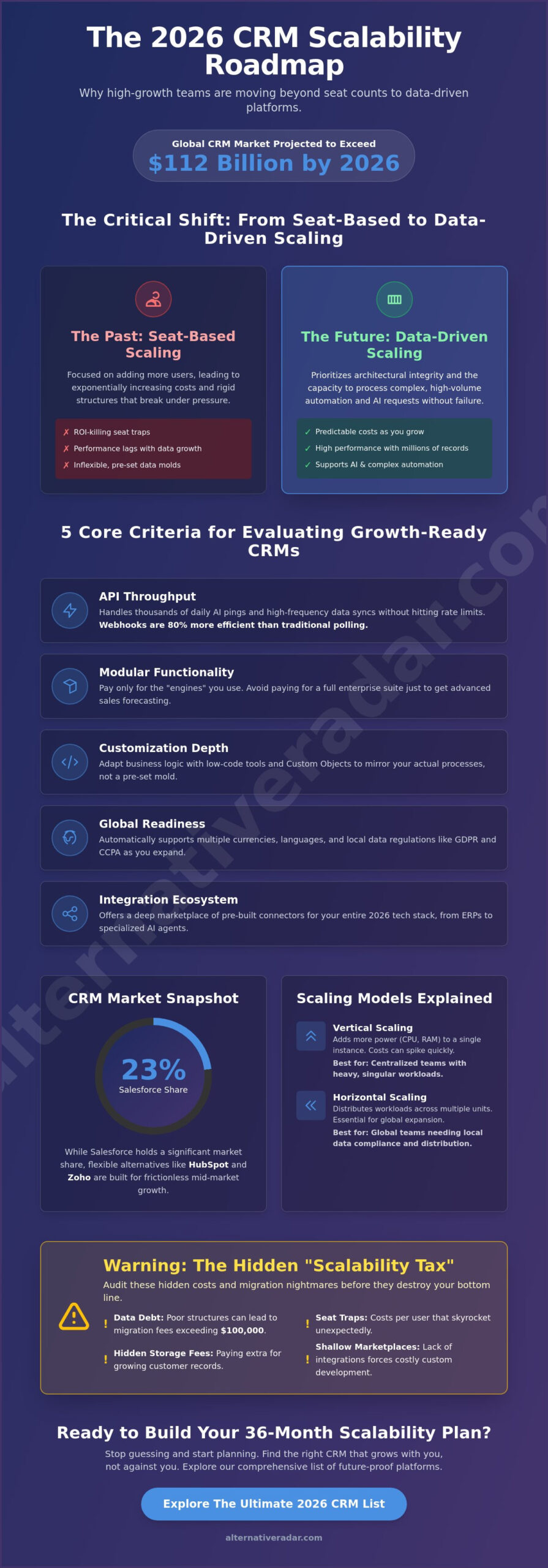
True scalability is the engine’s ability to maintain high speed while the weight of the cargo increases. In 2026, adding seats is the easy part. The real challenge is maintaining system performance when your data volume hits millions of records. The best crm brands for scalability prioritize architectural integrity over simple user counts. This marks a significant shift from “Seat-Based Scaling” to “Data-Driven Scaling,” where the platform’s value depends on its capacity to process complex automation and AI requests without crashing.
Modern Customer relationship management (CRM) systems must now handle global data residency requirements and multi-tenant architectures. Legacy systems often fail during rapid expansion because their underlying code wasn’t designed for the 2026 reality of high-velocity data. For instance, a system built a decade ago might struggle with the 500% increase in API pings required by modern AI tools. If your system lags every time you run a report or sync an external database, you’ve hit a technical ceiling. Choosing the best crm brands for scalability means finding a partner that invests in infrastructure, not just marketing.
Vertical vs. Horizontal CRM Scaling
Vertical scaling involves adding more processing power to a single instance. It works for a while, but it’s often a “pay-to-play” model where costs spike as you demand more speed. Horizontal scaling is different; it distributes workloads across multiple units or regions. This is essential for teams launching new product lines or expanding into international markets. Before committing, determine if your growth is centralized or distributed. A single, heavy instance might suit a massive headquarters, but distributed workloads are better for global teams needing local data compliance.
The Problem of Data Debt
Early-stage startups often choose “out-of-the-box” simplicity, but this can become a long-term liability. Poor data structures create “data debt,” leading to migration nightmares that can cost over $100,000 in implementation fees later. To future-proof your database, look for systems that support Custom Objects. These allow you to build a structure that mirrors your actual business processes rather than forcing your data into a pre-set mold. For a detailed comparison of options, check out our ultimate CRM list for 2026 to see which platforms offer the most flexible data models. This prevents the “rigidity trap” where your software dictates how you sell, rather than the other way around.
Core Criteria for Evaluating Growth-Ready CRM Brands
Selecting the right software requires looking past the user interface. The best crm brands for scalability provide an infrastructure that handles high-velocity data without performance degradation. In 2026, your evaluation should center on five technical pillars that dictate whether a system will support your 36-month growth plan or become a bottleneck. If you’re feeling overwhelmed by technical specs, you can explore alternative software reviews to see how these brands compare in real-world scenarios.
- API Throughput: High-growth teams in 2026 rely on AI-driven automation. Your CRM must handle thousands of API pings daily without hitting rate limits that stall your workflows.
- Modular Functionality: Scalable systems allow you to pay only for the “engines” you use. You shouldn’t have to pay for a full enterprise marketing suite just to access advanced sales forecasting.
- Customization Depth: The ability to rewrite business logic using low-code tools is essential. You need to adapt the system as your sales cycles evolve without hiring a full-time developer team.
- Global Readiness: As you expand, your CRM must support multiple currencies, languages, and local data regulations like GDPR or CCPA automatically.
- Integration Ecosystem: A shallow marketplace is a growth killer. The best crm brands for scalability offer pre-built connectors for the entire 2026 tech stack, from ERPs to specialized AI agents.
API Limits and Integration Elasticity
Daily API call limits are the invisible ceiling of CRM growth. If your automated workflows involve real-time data syncing between your CRM and a data warehouse, you’ll consume thousands of calls per hour. Scalable brands prioritize “Webhooks” over traditional polling. Webhooks send data only when an event occurs, which is 80% more efficient for real-time syncs. Before signing a contract, verify the “burst” limits of the API. This ensures your system doesn’t freeze during high-traffic events like product launches or seasonal sales peaks.
Workflow Automation and Logic Complexity
Simple “if-this-then-that” triggers aren’t enough for complex organizations. Growth-ready systems offer multi-branch conditional logic that can route leads based on dozens of variables. A critical feature to look for is a “sandboxing” environment. This allows your ops team to test new growth strategies or automation sequences in a safe mirror of your database. Without a sandbox, you risk breaking live data every time you try to scale your processes. Additionally, look for built-in natural language processing (NLP) to automate data entry, which can reduce manual admin time by up to 30% for expanding sales teams.
Top CRM Brands for Scalability: 2026 Performance Roundup
Finding the best crm brands for scalability means looking at how these platforms handle the transition from 50 to 500 users. Salesforce remains the dominant force. It holds 23% of the CRM market share in 2026. Its Unlimited Edition, priced at $350 per user per month, provides the architectural depth required for global organizations. However, the market has expanded. HubSpot has successfully pivoted from a marketing tool to a leader in frictionless scaling. Its Sales Hub Enterprise now costs $150 per seat per month and effectively handles deployments exceeding 1,000 seats. For many, customizable crm software is the only way to avoid hitting a technical ceiling when business models don’t fit a standard template.
Zoho CRM offers an unbeatable value-to-scale ratio for multi-national SMEs. Its Enterprise plan at $40 per user per month, billed annually, provides features that competitors often gate behind much higher tiers. Meanwhile, Creatio stands out as the best-in-class option for no-code, process-driven scalability. It allows non-technical users to build complex workflows that would usually require a developer team. Identifying the best crm brands for scalability involves balancing these feature sets against your specific growth trajectory.
The Enterprise Heavyweights
Salesforce Customer 360 is built for massive complexity across siloed departments. It’s the standard for companies that need total control over every data point. Oracle NetSuite CRM is the logical choice for businesses scaling through ERP integration, as it creates a unified view of finance and sales. Microsoft Dynamics 365 offers a unique advantage for those already invested in the Azure ecosystem, providing native scalability for teams using the full Office stack.
The Agile Scalers
HubSpot Enterprise removes the friction of complex onboarding, though its $3,500 one-time fee is a factor to consider. Freshsales is gaining traction by allowing teams to scale without the typical enterprise price tag. Pipedrive remains the specialist for high-velocity deal flow, where scaling is measured by the sheer volume of transactions rather than the complexity of the data structure.
The Open-Source Alternative
SuiteCRM and Odoo offer a path to scale without seat-based licensing constraints. This model allows you to add hundreds of users without a corresponding jump in monthly fees. You’ll find a deeper breakdown in our open source crm software comparison. The trade-off is the shift from license fees to hosting and maintenance costs, which requires a dedicated internal team to manage.
Avoiding the “Scalability Tax”: Hidden Costs of CRM Growth
Growth often comes with a hidden invoice. While you might start with a $25 per month Salesforce Starter Suite, the best crm brands for scalability often trigger significant price jumps at specific milestones. This is the “Scalability Tax.” For example, moving to the Enterprise Edition requires a jump to $175 per user per month. These costs are predictable, but others are not. Storage fees are a common culprit. Many platforms charge premiums once your database exceeds a few gigabytes, effectively taxing you for maintaining a long customer history. You should compare transparent CRM alternatives before committing to a platform that penalizes your success.
- The Seat Trap: As your team grows, the price per user often stays static or increases, causing your ROI to drop relative to your software spend.
- Storage Fees: Keeping 10 years of customer history can lead to monthly surcharges that rival your base subscription costs.
- Integration Maintenance: Connecting 50 or more apps creates a technical tax. You’ll spend significant time fixing broken API links as various software updates occur.
- Training and Onboarding: Complex systems like HubSpot Enterprise require a $3,500 one-time onboarding fee, plus the internal cost of training 100 or more employees.
Seat-Based vs. Usage-Based Pricing Models
Predicting costs at 10, 50, and 500 users is essential for long-term budgeting. A platform that costs $1,500 monthly for 10 users might balloon to $75,000 monthly when you hit 500 users. To avoid this, negotiate “Growth Tiers” during your initial contract phase. Some best crm brands for scalability are shifting toward “Platform-as-a-Service” billing in 2026. This model charges based on data processing volume rather than just headcount, which often aligns better with the actual value you derive from the system.
Third-Party Consultant Dependency
When a CRM becomes highly scalable, it often becomes too complex for a generalist to manage. Salesforce implementation costs can range from $5,000 to over $100,000 depending on the depth of customization. If you require a full-time admin or external consultant just to keep the system running, your total cost of ownership has shifted significantly. Balance “Customizable” with “Maintainable.” Choosing standard configurations over proprietary code ensures you aren’t locked into expensive developer contracts for every minor update.
Developing Your CRM Scalability Roadmap
Building a roadmap for growth requires looking past the immediate quarter. You must audit your current data volume and project user growth for the next 36 months to ensure your chosen platform won’t hit a technical ceiling. Selecting from the best crm brands for scalability involves more than just comparing features; it requires a deep dive into how each system handles increased architectural pressure. To begin your search with a vetted database, consult our comprehensive crm list of top-rated options for 2026.
A critical decision in your roadmap is the choice between hosted crm and on-premise solutions. While cloud-based systems like Salesforce or HubSpot dominate the market, some global enterprises still opt for on-premise or private cloud hosting to maintain total control over data residency. Once you’ve selected an architecture, finalize your migration strategy with a strict focus on data integrity. Cleaning your data before the move prevents the “garbage in, garbage out” cycle that often plagues high-growth teams during transitions.
The Pilot Project Approach
Never migrate your entire company at once. This is a high-risk strategy that often leads to operational downtime. Instead, run a pilot program with a subset of “power users” to test logic limits and automation triggers. Set clear KPIs for this trial phase, such as record load times and API sync success rates. Gathering direct feedback from these users is the most effective way to prevent “Shadow CRM” usage, where employees return to spreadsheets because the new software feels too complex or slow. This phased approach allows you to identify the best crm brands for scalability based on real performance rather than marketing promises.
The Role of Alternative Radar in Your Discovery
Stop wasting time searching through fragmented reviews and biased sales pitches. Alternative Radar serves as your digital scout, providing clear comparisons and detailed insights into the software market. Use our comparison tools to filter platforms by scalability metrics, such as API limits and modular pricing structures. We categorize products using transparent labels like premium competitors and open source alternatives, ensuring you find the right fit for your specific trajectory. Our goal is to empower you with the logic and data needed to make a smart, long-term investment that supports your business as it scales toward global enterprise status.
Future-Proof Your Sales Infrastructure Today
Selecting a platform in 2026 requires looking past the 23% market share held by industry leaders like Salesforce. You must prioritize data-driven scaling and modular billing to avoid the hidden fees that trigger at specific growth milestones. A successful transition depends on testing logic limits with a pilot group before you commit to a full-scale migration. This approach ensures your software supports your headcount rather than restricting it.
Identifying the best crm brands for scalability is a strategic move that prevents costly software replacements every few years. We’ve simplified this process by providing objective insights for 2026 software buyers and expert-vetted alternatives to legacy leaders. Stop wasting time on trial and error. You can find the perfect CRM for your growth stage on Alternative Radar, where we offer detailed comparisons of 50+ CRM brands.
Take control of your technical future now. With the right roadmap and a clear understanding of your data requirements, your team can scale with confidence and precision.
Frequently Asked Questions
What is the most scalable CRM for a small business?
Zoho CRM is a top choice for small businesses due to its $14 per user monthly entry point for the Standard plan. It allows teams to start with basic lead management and transition to the Ultimate plan at $52 per user as operational needs evolve. This flexibility makes it one of the best crm brands for scalability for startups that need to manage costs while maintaining a clear growth path.
How do I know when my current CRM is no longer scaling?
You’ll know your system is failing when report generation takes longer than 60 seconds or API limits frequently stall your automated workflows. Another sign is the “rigidity trap,” where adding a new business unit requires a total database restructure rather than a simple configuration change. If your team spends more time on manual data entry than selling, your current infrastructure has peaked.
Is Salesforce really the only option for large enterprises in 2026?
No, Salesforce is not the only enterprise option despite its significant market presence. Microsoft Dynamics 365 and Oracle NetSuite CRM provide similar depth for global organizations, especially those requiring tight ERP integration. Creatio is also gaining ground as a no-code alternative that allows enterprise teams to scale their processes without heavy reliance on specialized developers.
What are the hidden costs of scaling a CRM?
Hidden costs include storage surcharges and one-time onboarding fees, such as the $1,500 required for HubSpot Sales Hub Professional. You must also budget for API overage charges if your tech stack relies heavily on real-time data syncing. These expenses can increase your total cost of ownership by 30% beyond the advertised monthly seat price as your data volume grows.
Can open-source CRMs handle enterprise-level data volumes?
Yes, open-source platforms like Odoo and SuiteCRM can handle millions of records if your hosting environment is properly configured. The primary benefit is the removal of seat-based licensing, which can save a 500-person company thousands of dollars annually. You’ll need a dedicated internal team to manage security updates and server maintenance, but the architectural freedom is unmatched for unique business models.
How does AI impact CRM scalability?
AI increases scalability by automating roughly 40% of routine data entry tasks, but it also places a massive load on your system’s API. Tools like Salesforce Einstein or Zoho’s Zia require robust processing power to deliver predictive analytics in real time. The best crm brands for scalability in 2026 are those that have upgraded their back-end architecture to support these high-frequency AI pings without performance lag.
Should I choose a seat-based or usage-based pricing model for growth?
Usage-based models are often better for high-automation teams with low headcounts, as you only pay for the data you process. Seat-based models provide more cost-predictability for large sales teams with stable headcounts. If your business relies on AI agents to handle lead qualification, a usage-based model might offer a 20% higher ROI by decoupling costs from your physical team size.
How long does a typical CRM migration take for a scaling company?
A typical migration for a high-growth company with over 50,000 records usually takes between 3 and 6 months. This timeline includes data cleansing, mapping custom objects, and user training. Larger enterprise transitions involving global data residency requirements can extend to 9 months or longer to ensure total data integrity during the move.