
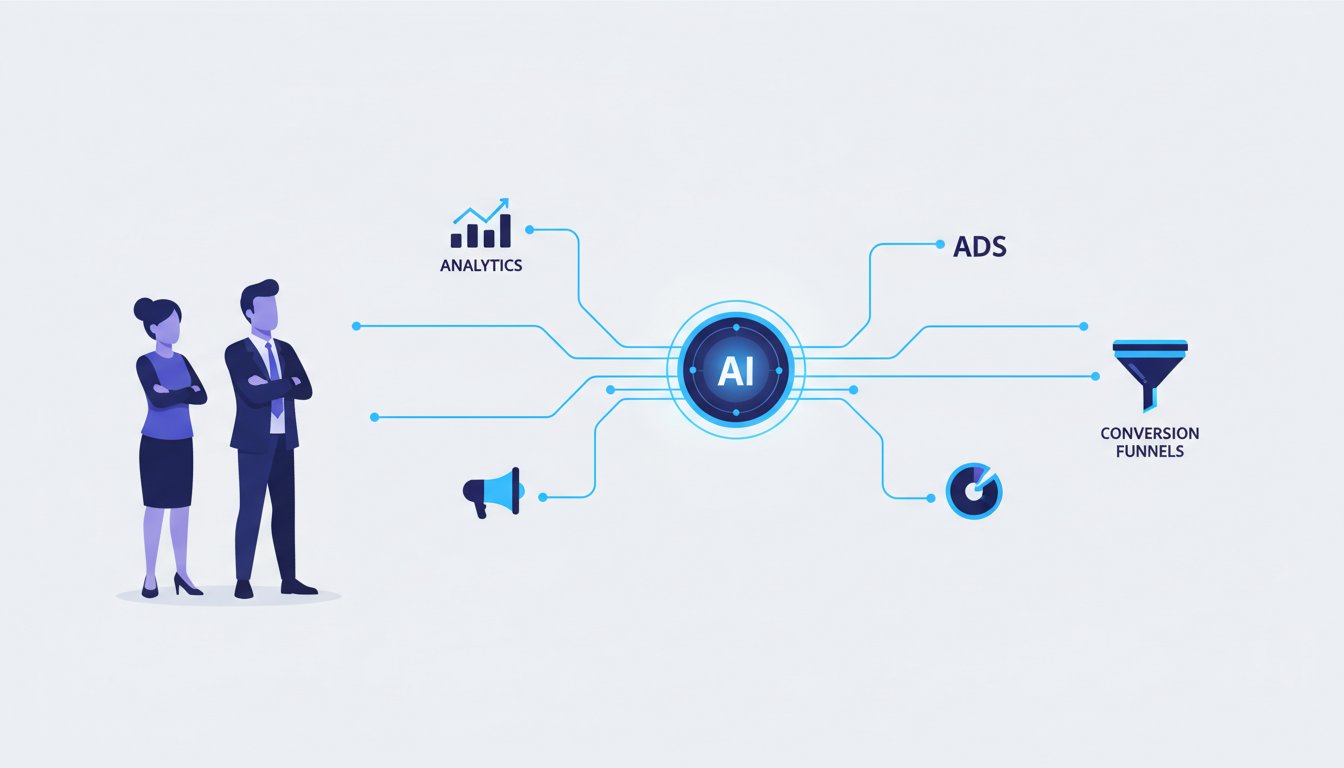
Ninety percent of marketers report measurable productivity gains from using AI, yet many teams still struggle with prompt fatigue and the high costs of managing a fragmented tech stack. It is a common disconnect where the promise of efficiency actually leads to more manual work. Finding the best AI tools for marketing automation is no longer about finding a better writer; it’s about identifying executors that connect your entire stack and move data without constant supervision.
You likely want a system where manual labor drops by 50% or more and your marketing scales without a massive increase in headcount. We understand that your time is best spent on strategy, not troubleshooting software integrations. This guide provides an objective comparison of the top-rated AI tools that actually automate workflows, from lead generation to programmatic ad management. We will examine verified pricing for platforms like HubSpot and Zapier, navigate the 2026 regulatory landscape, and help you build a tech stack that delivers a clear, measurable ROI.
Key Takeaways
- Transition from manual prompting to agentic AI to remove the primary bottleneck in your current marketing workflows.
- Compare the best AI tools for marketing automation across high-impact categories like programmatic ad management and lead generation.
- Analyze the 2026 shift toward usage-based and agent-based pricing models to ensure your tech stack remains scalable and cost-effective.
- Use a structured audit to map your manual tasks and clean your data before connecting new AI agents to your existing software.
- Discover why specialized alternatives often outperform market leaders when building a “set and forget” automation strategy.
Beyond Prompting: The Rise of Agentic AI Marketing Automation
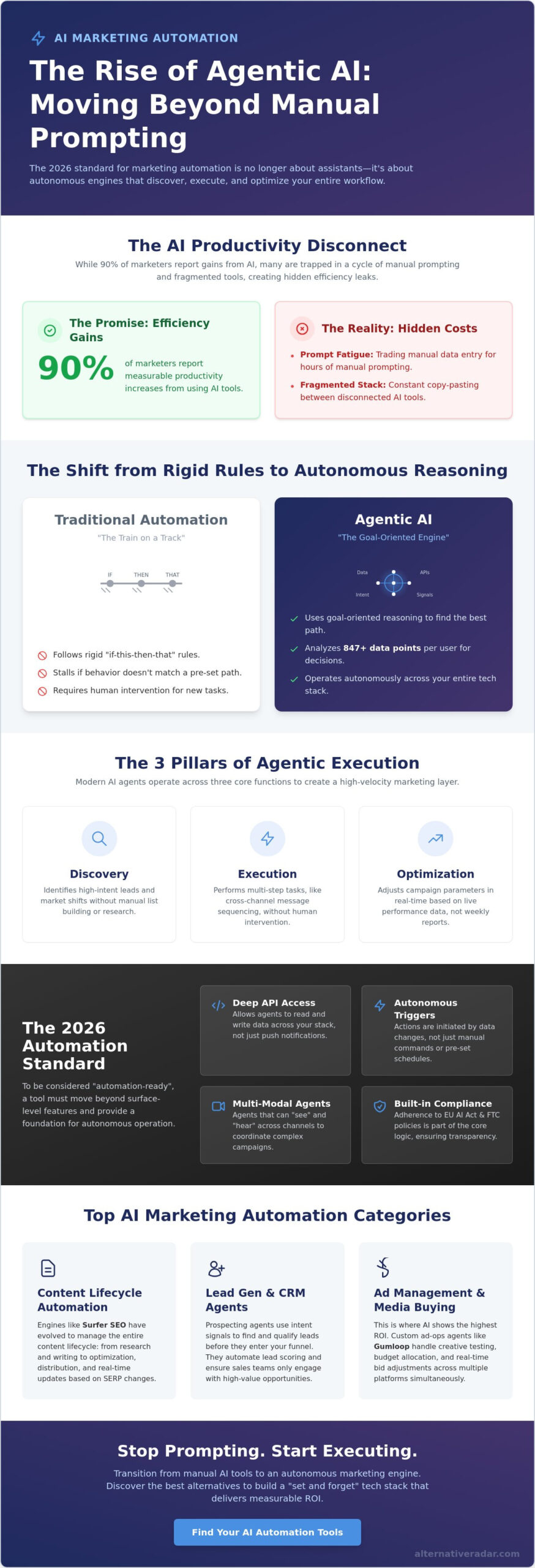
Traditional Marketing automation functions like a train on a track; it only goes where you’ve pre-laid the rails. If a customer behavior doesn’t match a pre-set “if-this-then-that” rule, the system stalls. Agentic AI represents a fundamental shift from these rigid rules to goal-oriented reasoning. Instead of following a sequence, these agents use 847 data points per user to determine the most effective next step autonomously. The best AI tools for marketing automation in 2026 are no longer just software features; they’ve become high-velocity execution layers that operate across three core pillars.
- Discovery: Identifying high-intent leads and market shifts without manual list building.
- Execution: Performing multi-step tasks, such as cross-channel message sequencing, without human intervention.
- Optimization: Adjusting campaign parameters in real-time based on live performance data rather than weekly reports.
We’re seeing a transition from siloed SaaS platforms to AI-first operating systems. In this new model, the AI isn’t an add-on; it’s the core engine that manages your data flow and tool integrations. This reduces the need for middle-layer connectors and creates a more cohesive marketing environment.
The Problem with “Manual” AI Tools
Many teams are currently stuck in a cycle of prompt fatigue. If your staff spends four hours a day “talking” to a chatbot to generate content or analyze data, you’ve simply traded manual data entry for manual prompting. This is the hidden cost of 2026. Fragmented workflows, where you must copy-paste data between separate AI tools, create massive efficiency leaks. True automation doesn’t require a human to act as the bridge between systems. It requires agents that can trigger actions based on data changes, not just text commands.
Defining the 2026 Automation Standard
To be considered “automation-ready” today, a tool must offer deep API access and autonomous triggers. Surface-level integrations aren’t enough. The best AI tools for marketing automation now use multi-modal agents that can “see” and “hear” across channels, coordinating a programmatic display ad with a personalized email follow-up simultaneously. With the EU AI Act and FTC policies now in full effect, data privacy has moved from a legal hurdle to a core functional feature. Modern tools build compliance into their logic, ensuring that automated decisions remain transparent and within regulatory boundaries without slowing down your operations.
Top AI Marketing Automation Software by Category
Selecting the best AI tools for marketing automation requires a shift from looking for assistants to finding engines. By 2026, the market has moved toward specialized agents that operate within specific silos but communicate across your entire stack. The goal isn’t just to generate content or leads; it’s to manage the entire lifecycle with minimal human oversight. This evolution of AI in marketing has turned once-complex manual tasks into autonomous background processes.
AI for Content Lifecycle Automation
Modern content automation has moved past simple text generation. While tools like Jasper AI still offer robust plans starting at $39 per month for creators, the real efficiency gains come from content engines that manage your entire calendar. Surfer SEO has evolved from a simple optimization tool into a full-site agent that researches, writes, and updates content based on real-time SERP fluctuations. Unlike basic writing assistants, these engines handle social distribution and internal linking without requiring a human to hit publish every time.
Lead Generation and CRM Automation Agents
Manual LinkedIn outreach and cold emailing have become bottlenecks. AI-driven prospecting tools now use intent signals to find and qualify leads before they even enter your funnel. These agents perform lead scoring by analyzing behavioral data and historical conversion patterns, ensuring your sales team only touches high-value opportunities. To manage this influx of data, many organizations are turning to specialized database solutions. You can find a detailed breakdown in our open source CRM software comparison to see which platform best supports your automation goals.
Automated Ad Management and Media Buying
Programmatic advertising is where AI automation shows the highest ROI. Tools like Gumloop allow you to build custom ad-ops agents that handle creative testing and budget allocation across multiple platforms simultaneously. These systems don’t just set bids; they analyze 847 data points per user to serve the right creative at the right moment. For a deeper look at how to scale these efforts, see our programmatic display advertising guide. If you’re overwhelmed by the options, you can filter software by automation depth to find the right fit for your specific budget and scale.
The best AI tools for marketing automation in 2026 prioritize “set and forget” functionality over flashier features. Whether you’re integrating HubSpot’s Professional plan at $890 per month or building custom workflows with Zapier’s Team plan at $69 per month, the focus must remain on seamless data flow. Choosing tools with strong API maturity ensures that your lead generation, content, and ad management systems work as a single, unified organism.
Comparing AI Automation Tools: Scalability, Cost, and Integration
Choosing the best AI tools for marketing automation involves a strategic trade-off between all-in-one platforms and a best-of-breed stack. All-in-one solutions like HubSpot Marketing Hub offer a unified data environment but come with high entry barriers, such as a Professional Plan starting at $890 per month plus a one-time $3,000 onboarding fee. In contrast, a best-of-breed approach allows you to connect specialized agents using Zapier, where a Team plan starts at $69 per month. While the latter offers more flexibility, it can lead to technical debt if your integrations aren’t documented or if you’re managing too many disparate subscriptions.
Pricing models have evolved significantly by 2026. We’re seeing a shift from seat-based licensing to usage-based or agent-based models. Usage-based pricing, like Zapier’s task-limit tiers, charges you for the actual work performed. Agent-based models often charge for the “intelligence” level of the automation. To calculate a true ROI, you must look beyond the monthly fee and measure “Time Saved.” If an automation reduces manual labor by 50% across a four-person team, the tool’s cost is easily justified by the reduction in headcount requirements and the ability to scale without adding staff.
SaaS vs. Open Source Automation
Proprietary SaaS tools like Claude or Salesforce Marketing Cloud are ideal for teams that require high security and out-of-the-box compliance. These platforms handle the infrastructure, but they often lock your data within their ecosystem. Open-source frameworks offer a compelling alternative for custom marketing agents, allowing you to build tailored workflows without recurring licensing fees. However, these require more technical oversight. Balancing these choices is a key part of ethical AI implementation, as you must ensure that your automated systems remain transparent and compliant with the EU AI Act’s August 2026 transparency obligations.
Integration Depth: The API Factor
A pretty interface is a secondary concern in 2026. The most valuable tools prioritize deep API access, allowing for seamless data flow between your CRM, ad platforms, and content engines. Tools that offer “alternative to” legacy software logic are often easier to integrate because they’re built on modern, flexible architectures. You should avoid “locked” ecosystems that limit data export or charge extra for API access. These bottlenecks prevent your AI agents from communicating, which kills the efficiency you’re trying to build. Prioritize tools that support multi-step, cross-platform triggers to ensure your marketing stack functions as a single, autonomous unit.
How to Audit and Implement AI Automation in Your Marketing Stack
Buying the best AI tools for marketing automation won’t solve your efficiency problems if your underlying processes are broken. Successful implementation requires a structural audit before you ever commit to a subscription. Many organizations rush into Enterprise plans like Salesforce, which can cost $3,600 per month, only to find their data is too fragmented for the AI to function. You must start by mapping your manual tasks and identifying clear trigger-action loops where a human is currently acting as a data bridge.
Once you’ve identified these loops, audit your data cleanliness. Over 74% of marketers use AI to drive decision-making; however, an AI system processing 847 data points per user will only produce garbage results if the source data is outdated. Clean your CRM and standardize your lead tags before connecting any autonomous agents. After your data is ready, pilot a single agentic workflow to prove ROI. Start small, verify the time saved, and then scale by connecting previously siloed functions like content production and lead generation. Finally, establish a weekly review of your agent performance logs to catch errors before they impact your customers.
The Pre-Automation Audit Checklist
Focus on low-hanging fruit for your first wins. Look for high-volume, low-complexity tasks like lead scoring or social media scheduling. Check for data silos that will break AI logic; if your email tool can’t talk to your CRM, your automation will fail. Write a single sentence defining your North Star automation goal, such as “reduce lead response time by 80%.” This clarity prevents feature creep and keeps your team focused on outcomes. To find software that fits your specific infrastructure, you can compare automation-ready tools based on their API depth.
Building Your First AI Workflow
A simple content-to-social loop is an excellent starting point. Configure an agent to monitor your blog for new posts, generate platform-specific summaries, and schedule them for optimal engagement times. You must set strict guardrails to ensure AI agents don’t go rogue. This includes setting maximum budget caps on ad spend and requiring human approval for high-stakes customer interactions. Use debugging tools to monitor agent logs daily. This allows you to identify where a logic chain broke or where an API connection timed out, ensuring your automation remains a reliable asset rather than a liability.
Finding the Best AI Tool Alternatives for Your Specific Workflow
The market leader is rarely the most efficient choice for a specific, automated workflow. Large platforms often suffer from feature bloat, forcing you to navigate complex menus for simple tasks. In contrast, challenger brands are often built from the ground up with an AI-native focus. These tools prioritize deep API access, which is essential for creating a seamless data flow across your stack. Choosing the best AI tools for marketing automation means looking past the marketing budget of a software giant and evaluating the actual technical utility of the agent.
Adopting a vendor-neutral stance is the most effective way to stay agile in 2026. If you lock your entire operation into a single ecosystem, you’re at the mercy of their development roadmap and pricing hikes. By selecting modular, specialized tools, you can swap out individual components as better technology emerges. This approach ensures your marketing engine remains high-performance without requiring a total system overhaul every time a new AI model is released. Focus on tools that solve your specific bottlenecks rather than those that promise to do everything for everyone.
Why We Scout for Alternatives
Niche AI tools often provide better flexibility for developers and power users. While a major platform might lock certain automation triggers behind an Enterprise paywall, a specialized alternative might offer them in a starter tier. This is a crucial distinction when you’re trying to scale without increasing your overhead. Legacy systems often add AI as a secondary layer, which can lead to clunky execution and higher latency. We prioritize scouting for tools that treat automation as a core function. For more on this strategy, read our guide on finding the best alternative to popular software.
Your Next Steps with Alternative Radar
Start small by automating a single deep workflow rather than trying to overhaul your entire stack at once. Use our comparison engine to filter by your specific integration needs, data privacy requirements, and budget constraints. This allows you to see how a challenger brand’s API maturity stacks up against an industry giant. You can also sign up for our Radar Alerts to stay informed about new disruptors in the automation space before they become mainstream. When you’re ready to build your 2026 stack, explore our full directory of AI marketing tools to find the exact fit for your operations.
Building a Scalable Marketing Infrastructure
The shift toward agentic AI has fundamentally changed how we define efficiency. Success in 2026 depends on moving beyond manual prompting and toward autonomous execution layers that connect your entire stack. By prioritizing data cleanliness and deep API access, you can reduce manual labor by 50% or more without increasing your headcount. Identifying the best AI tools for marketing automation is no longer a search for a single all-in-one solution; it’s about curating a modular ecosystem that adapts to your specific workflows.
Stop following market leaders and start making data-driven choices for your unique needs. We’ve done the hard work of scouting and testing so you don’t have to. You can find the perfect AI automation alternative for your team through our objective, commission-neutral reviews of 500+ tools updated for 2026 trends. Take control of your tech stack today and build a system that prioritizes utility and precision over marketing hype.
Frequently Asked Questions
What are the best AI tools for marketing automation for small businesses?
HubSpot Starter and Zapier Professional are the best AI tools for marketing automation for small businesses due to their low entry costs. HubSpot Starter begins at $15 per month, providing basic CRM and email automation without branding. Zapier’s Professional plan at $19.99 per month allows for 750 tasks, making it ideal for connecting niche tools without a massive budget. These platforms allow smaller teams to scale operations without hiring additional technical staff.
Can AI completely replace a marketing manager in 2026?
AI cannot completely replace a marketing manager in 2026 because it lacks the capacity for high-level creative strategy and ethical oversight. While 90% of marketers report productivity gains, these come from automating repetitive execution tasks. A manager is still required to define the “North Star” goals and ensure compliance with new 2026 regulations like the EU AI Act. AI remains a powerful executor that requires human direction to stay effective.
How do I choose between Zapier and standalone AI agents?
Choose Zapier if you need to connect disparate legacy applications through simple triggers; choose standalone AI agents for complex, goal-oriented tasks. Zapier’s Team plan at $69 per month is excellent for linear workflows. However, agentic tools like Gumloop or Lindy are better for multi-step processes that require the system to make decisions based on live data. Agents operate autonomously, while Zapier usually follows pre-defined “if-this-then-that” rules.
Are there free AI tools for marketing automation that actually work?
Free AI tools for marketing automation like HubSpot’s free CRM and Zapier’s free tier provide functional entry points for testing. HubSpot’s $0 plan includes basic email marketing and lead capture forms, while Zapier allows for 100 free tasks per month. These are useful for proving a concept before committing to paid plans. However, professional-grade automation usually requires moving to a paid tier to remove branding or access deeper API integrations.
What is the difference between Generative AI and Marketing Automation?
Generative AI focuses on creating new content like text or images, while marketing automation focuses on the flow of data and execution of tasks. Tools like Jasper AI, which starts at $39 per month, are generative. Automation tools move that content into your social scheduler or CRM. In 2026, the most efficient stacks combine both, using generative engines to produce assets and automated agents to distribute them based on user behavior.
Is it safe to connect my CRM data to AI automation tools?
Connecting your CRM data is safe if you prioritize tools that comply with the 2026 regulatory environment. The EU AI Act and FTC policy statements now require transparency in how automated decisions are made. Look for SOC2 Type II certification and clear data processing agreements. Most enterprise-grade tools, such as Salesforce or HubSpot, provide robust encryption and compliance features to protect your 847 data points per user from unauthorized access.
How much does it cost to implement a full AI marketing stack?
A full AI marketing stack can cost anywhere from $150 to over $4,000 per month depending on your scale. A “Best-of-Breed” stack using Zapier ($69) and Jasper ($59) is affordable for mid-sized teams. Conversely, an “All-in-One” Enterprise system like HubSpot starts at $3,600 per month and requires a $6,000 onboarding fee. You must balance these subscription costs against the projected 50% reduction in manual labor to determine your ROI.
Which AI tools are best for automated social media management?
Jasper Pro and Surfer SEO are currently top-rated for automated social media management and content distribution. Jasper’s $69 per month plan allows for multi-channel campaign generation, while Surfer’s agents handle real-time optimization and scheduling. These tools reduce the need for manual posting by using autonomous triggers to share content when engagement signals are highest. They ensure your social presence remains active without requiring daily human intervention.