

The platform with the longest feature list may be the wrong choice for your program. The best affiliate management software is the one that fits how you recruit partners, track referrals, set commissions, and manage payouts without adding unnecessary complexity.
Comparing platforms can be frustrating when similar feature lists hide important differences. Attribution rules, commission settings, payout workflows, integrations, and migration effort all affect how well a tool works for your team. A capability that matters to a large partner network may be optional for a small SaaS referral program.
This guide compares affiliate management software by tracking, payouts, integrations, and business fit. You’ll learn which capabilities to prioritize, which costs and plan limits to verify, and what to check before moving existing program data. Use the practical checks and comparison table to build a shortlist around your requirements rather than defaulting to the most familiar name.
Key Takeaways
- Distinguish affiliate management software from networks and agencies so you can identify the type of solution your program needs.
- Compare tracking rules, attribution windows, commission controls, and refund handling before judging platforms by feature count.
- Match integrations and workflows to your business model, including whether you manage recurring SaaS referrals or ecommerce orders.
- Use a weighted shortlist to separate must-haves from optional features and assess technical fit before committing.
- The best affiliate management software supports dependable tracking and manageable operations at your program’s scale.
What Is Affiliate Management Software, and Who Needs It?
Affiliate management software helps a business run its own partner referral program. Depending on the platform, it can support partner onboarding, referral tracking, commission management, and program administration. The affiliate marketing model connects businesses with partners who refer customers, while management software helps organize and measure those relationships.
This software is most useful when a team needs a consistent way to manage referrals beyond spreadsheets and manual checks. A long feature list alone doesn’t prove that a platform is a good fit. The best affiliate management software for a SaaS company may differ from what an ecommerce business needs because their referral events, commission rules, and day-to-day workflows can vary.
What does affiliate management software actually manage?
Depending on the product, the software may help a team recruit or onboard partners, issue unique referral links or codes, record attributed clicks and conversions, and review performance reports. It may also let administrators define commission rules, approve referrals, or prepare partner payouts. Check which tasks the platform tracks, which it supports, and which still require manual work. Don’t assume every tool automates the whole process.
Affiliate software, networks, and agencies: what is the difference?
Affiliate software gives a company tools to operate its own program. An affiliate network, by contrast, connects advertisers with publishers and may provide a marketplace or other network services. An agency supplies people and expertise to help manage or grow a program, but it doesn’t necessarily own or provide the underlying software. Hamster Garage, for example, presents itself as an agency offering affiliate and partnership marketing services, not as affiliate management software.
Broader partnership management platforms may cover additional relationship types, such as influencers or other business partners. Consider that broader scope only if your team needs it. Otherwise, it can add workflows and controls you won’t use.
Who benefits most? SaaS teams often need to track sign-ups, paid conversions, or recurring revenue referrals. Ecommerce businesses may prioritize order attribution, coupon codes, and handling returns or cancellations. Organizations that manage partner referrals can benefit from clearer records, consistent commission decisions, and shared reporting.
Start with your program model and operational needs, not the size of a vendor’s feature list. Identify what counts as a successful referral, how commissions are determined, and who handles approvals and payouts. These answers help you compare platforms on fit instead of focusing on features that don’t match how your team works.
Which Affiliate Software Features Matter Most for Accurate Tracking?
A tracking dashboard is only useful if you understand how its numbers are produced. Attribution quality depends on the platform’s tracking rules, the events it can record, and how reliably connected systems pass conversion, refund, and cancellation data back to it. Compare those mechanics before relying on headline feature claims.
Start with the rules that determine who receives credit: the attribution method, conversion window, and whether tracking can connect activity across devices. Ask how the platform records link clicks, coupon use, and conversions. Find out what happens if a customer switches devices or uses more than one referral link. These details can affect commission outcomes, so check them against your customer journey.
How should you evaluate affiliate attribution?
Test realistic cases in a trial or product demonstration. For a subscription business, follow a referral from sign-up through a later payment, cancellation, or refund. For ecommerce, test a coupon purchase, a duplicate referral, and a returned order. Check whether the system updates attribution and commission records as expected or requires an administrator to intervene.
Ask vendors to explain what they can’t track natively. Record workarounds, manual steps, and gaps that could affect partner payments or reporting. A platform may support your main referral path but not every edge case. Decide whether those limits are acceptable before you commit.
Which integrations and controls should you verify?
Map integrations to your existing checkout or ecommerce platform, billing system, CRM, and analytics tools. Confirm that each connection is currently available for your plan and use case, and ask whether it syncs data automatically or requires configuration. Don’t assume an integration listed in a vendor’s materials passes every event your program needs.
Tracking is only one part of program operations. Check whether commission rules can accommodate your approval process, whether reports show the data your team needs, and whether partners can access relevant performance details through a portal. Review payout administration separately: some platforms may help calculate or prepare payouts without sending payments automatically.
- Permissions: Can access be limited by role or team responsibility?
- Data portability: Can you export partner, referral, and commission records in a usable format?
- Technical fit: Is API access available if your workflow needs it, and what security documentation can the vendor provide?
Verify current capabilities directly with each provider, then record what you tested and what remains uncertain. This makes comparisons more useful than treating a vendor’s feature list as a market-wide standard. For a wider view of software options, compare software features and trade-offs before building your shortlist.
How to Compare Affiliate Management Platforms by Business Model
Compare platforms against the work your program needs to do. A SaaS team tracking subscriptions has different requirements from an ecommerce business attributing orders and coupon codes. Larger programs may need more control over partner access and reporting. Use the table to frame your evaluation, then confirm each vendor’s current capabilities directly.
| Business model | Tracking fit | Integrations to verify | Workflow complexity and support needs |
|---|---|---|---|
| SaaS or subscription business | Subscription attribution, recurring commissions, cancellations, and refunds | Billing system, checkout, CRM, analytics | Check whether referral and affiliate programs can be managed separately when their rules differ |
| Ecommerce business | Order-level referrals, coupon attribution, returns, and cancellations | Store platform, checkout, analytics, CRM | Confirm how orders are approved and how commission adjustments are handled |
| Larger or multi-channel program | Consistent attribution across partner types and channels | Existing billing, ecommerce, CRM, and reporting systems | Assess partner segmentation, role-based access, reporting, approval controls, and operational capacity |
What should SaaS teams compare?
Trace the full subscription journey: referral, sign-up, payment, renewal, cancellation, and refund. Confirm when a commission is earned, whether recurring payments are included, and how billing updates reach the affiliate platform. Rewardful’s supplied vendor information cites a Stripe integration, but availability and fit can change. Verify the current connection and test the events your commission rules depend on.
Also check whether customer referral and affiliate workflows can be kept distinct. They may use different eligibility rules, rewards, or approval steps. Combining them without suitable controls can complicate administration.
What should ecommerce and larger programs compare?
For ecommerce, test a completed order, coupon-based referral, return, and cancellation. Ask whether the platform records order-level details and updates commission records after adjustments. Confirm the exact store-platform connection rather than relying on a general integration claim.
For larger programs, compare how teams group partners, assign account permissions, review performance, and approve referrals or payments. More controls can help coordinate a complex operation, but they may add setup and administration. The best affiliate management software is not a universal winner. It’s the platform whose verified capabilities match your model, systems, and team capacity. Mark unconfirmed features as not verified in your comparison instead of assuming they’re included.
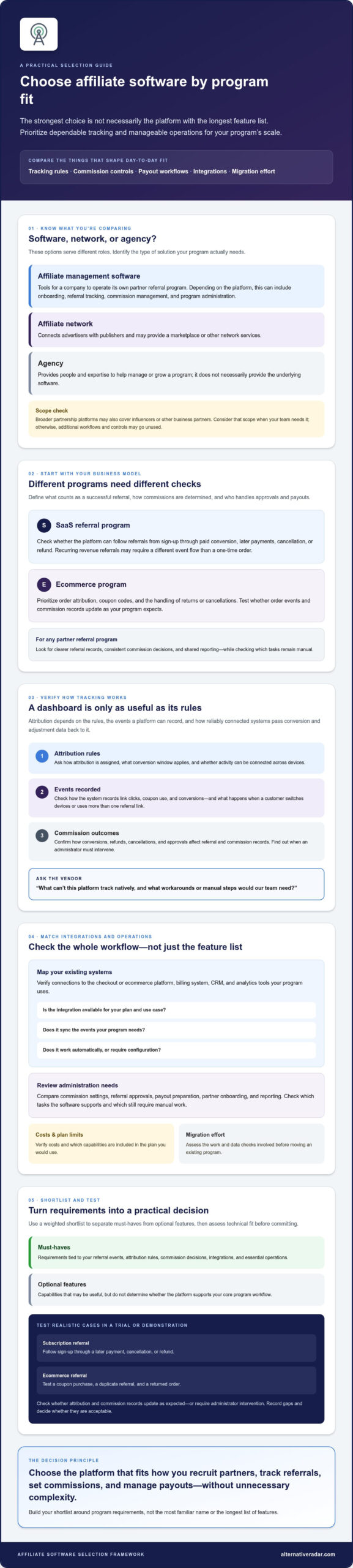
How to Shortlist and Test Affiliate Management Software
A structured evaluation turns overlapping feature lists into evidence you can compare. Start with your program’s essential requirements, then test the same workflows across shortlisted vendors. This shows whether a platform fits your operations, not just its product page.
- Define requirements. Record your business model, referral events, commission rules, integrations, team roles, and expected program scale.
- Screen vendors. Remove options that miss a must-have, such as a required billing connection or approval control.
- Test workflows. Use sample referrals and realistic commission scenarios in a demo or trial. Check each result against your defined rules.
- Compare trade-offs. Score remaining platforms for must-haves, nice-to-haves, technical fit, and ability to support your program as it grows.
- Confirm terms. Verify plan limits, included features, data handling, support arrangements, and any costs tied to setup or additional usage.
Set the importance of each criterion before scoring vendors. For example, give tracking accuracy and a required integration more weight than a feature your team may not use. The best affiliate management software for your shortlist should meet critical needs without creating avoidable workflow or migration work. For broader evaluation ideas, see this software alternatives comparison guide.
What should you test in a vendor demo?
Ask the vendor to walk through partner onboarding, referral-link creation, conversion attribution, and commission approval using a sample scenario from your program. Then introduce a refund or cancelled subscription and check whether the commission record and reports reflect the adjustment. Note every step that requires manual work or technical configuration. Ask whether any requested help has additional terms or costs.
How can you assess migration and adoption effort?
Before moving platforms, inventory partner records, active tracking links, commission rules, and historical reports. Ask vendors how data imports work, what transition support and training are available, and how account permissions can be set. Plan a controlled launch, compare test referrals with source records, and resolve tracking discrepancies before expanding to the full program.
Keep a simple scorecard based on evidence, not impressions: what you tested, what happened, and what remains unconfirmed. For a wider software comparison, explore software options and compare their trade-offs before making your final choice.
Choose Affiliate Management Software That Fits Your Program
Make the decision in order: confirm that a platform can track the referrals that matter, connect with your existing systems, support your commission and approval workflows, and handle your program’s scale. Then compare secondary features. A focused referral program may work well with a simpler tool. A larger or multi-channel operation may need more partner controls, permissions, and reporting. More features aren’t automatically a better fit if they add work your team won’t use.
Use this final checklist before committing
Review your requirements and resolve any gaps that could affect attribution, commissions, or day-to-day administration:
- Tracking and commissions: Confirm the platform supports your essential referral events, attribution rules, and commission workflows.
- Technical fit: Check that required integrations are available for your systems, and clarify data access, exports, and reporting capabilities.
- Team effort: Estimate the internal work needed for configuration, migration, ongoing approvals, and partner administration.
- Vendor terms: Verify current pricing, contract terms, support options, security information, plan limits, and feature availability directly with the provider.
- Open questions: Record unresolved issues and request written confirmation for any vendor claim that could change your decision.
Keep the evidence from your evaluation together: tested workflows, confirmed capabilities, known limitations, and outstanding questions. This makes it easier to explain why a platform fits your program and to revisit the choice if your requirements change.
Find and compare your next software options
Alternative Radar is a software discovery and comparison resource, not a software provider. It helps readers compare features, pricing information, and pros and cons across free, open-source, and premium options. Use comparisons to refine your shortlist, then verify current details with each vendor before deciding. The best affiliate management software is the one that fits your program’s real requirements, not simply the one with the broadest feature list.
Explore software comparisons on Alternative Radar to continue evaluating your options. Some recommendations may use affiliate links, which should be clearly disclosed alongside those links.
Build a Shortlist You Can Stand Behind
The strongest choice isn’t necessarily the platform with the most features. It’s the one your team can rely on to record the referrals that matter, fit your existing systems, and manage commissions without adding unnecessary work. Before deciding, verify current capabilities and terms with vendors. Use your demo results to separate proven fit from promising claims.
Compare the best affiliate management software for your program’s actual needs, not just its category or popularity. Alternative Radar helps readers compare software features, pricing information, and pros and cons across free, open-source, and premium options. Recommendations may include affiliate links, which should be clearly disclosed.
Compare software options for your program on Alternative Radar, then confirm the details that matter directly with each provider. An evidence-based evaluation gives your team a clear basis for its decision.
Frequently Asked Questions
What is affiliate management software?
Affiliate management software helps a business run its own referral program by organizing partner onboarding, tracking links or codes, recording attributed conversions, and managing commissions and reporting. Depending on the platform, it may also support approval workflows, partner portals, or payout administration. Capabilities vary, so check which tasks are automated and which still need manual work. The right tool should match how your program defines, reviews, and rewards referrals.
What is the best affiliate management software for a small business?
The best affiliate management software for a small business reliably tracks its referral activity without adding workflows the team doesn’t need. Start with your business model, then check essential integrations, commission rules, reporting, and the work required for setup and ongoing administration. A focused SaaS referral program may need subscription tracking, while a small online store may prioritize order and coupon attribution. Verify plan limits and current terms directly with vendors.
How do I choose affiliate management software?
Choose affiliate management software by defining your must-haves, screening out platforms that don’t meet them, and testing realistic workflows before deciding. Check attribution windows, conversion and refund handling, commission rules, required integrations, reporting, permissions, and data export options. In a demo, test a referral from link creation through commission approval, then see how a refund or cancellation changes the record. Confirm current features, plan limits, pricing, and contract terms with each vendor.
Can affiliate software track recurring commissions?
Some affiliate platforms can support recurring commissions, but the details depend on the software, billing connection, and commission rules. Ask whether referrals can be associated with renewals, how long commissions apply, and how cancellations, failed payments, or refunds affect them. Test a sample subscription from sign-up through a later billing event, and compare the platform’s records with your billing system. Confirm any limits or manual steps before relying on recurring commission tracking.
Do I need an affiliate network or affiliate management software?
Use affiliate management software to operate your company’s own program, track referrals, and manage partner workflows. An affiliate network can connect advertisers with publishers and may provide access to a partner marketplace. They address different needs, and some businesses may use both. Consider whether you already have partners to manage or need help finding publishers. Compare each option’s responsibilities, costs, controls, and terms before choosing a setup.
How much does affiliate management software cost?
Affiliate management software pricing ranges from entry-level subscriptions of roughly $30 to $50 per month to small-business options commonly around $100 to $300 per month; enterprise platforms can cost substantially more. Actual pricing depends on the vendor, plan, usage, and contract. Check for transaction fees, tracking overages, paid features, and required contract terms, not just the monthly subscription. Verify current pricing directly with providers before comparing total costs.
Can I migrate an affiliate program to a new platform?
Yes, an affiliate program can be migrated, but the effort depends on what data and workflows the new platform supports. Inventory partner records, active tracking links, commission rules, and historical reports before switching. Ask vendors about data import, transition support, and any limits on historical records. Test the new setup with a controlled launch, compare referral and commission results against source data, and resolve tracking issues before moving the full program.