

Why wait 10 seconds for your API client to launch when a 40MB tool can do it in under a second? Most developers are frustrated with proprietary tools that feel like bloated operating systems. You shouldn’t have to deal with mandatory cloud logins for local testing or pay high enterprise fees for simple team collaboration. It’s time to stop wasting time on slow software that prioritizes its own cloud over your local workflow.
This guide explores why hoppscotch has become the leading open-source alternative for API development in 2026. We compare the latest v2026.3.0 release against industry giants like Postman to determine if it’s the right fit for your specific team needs. You’ll learn how to leverage its offline-first philosophy, self-hosting capabilities, and the $0 forever free plan to reclaim your productivity. Discover how to transition to a lightweight ecosystem that provides total data control without the vendor lock-in of traditional premium competitors.
Key Takeaways
- Understand how to streamline your workflow using a minimalist interface that provides comprehensive support for REST, GraphQL, and WebSockets.
- Analyze the architectural differences between MIT-licensed tools and proprietary software to ensure long-term vendor independence.
- Evaluate the security advantages of self-hosting hoppscotch via Docker to maintain total control over sensitive API data.
- Access detailed performance benchmarks that highlight the resource efficiency of lightweight clients compared to market leaders.
- Determine if an open-source ecosystem is the right fit for your team based on specific scaling and security requirements.
Why Developers are Switching to Hoppscotch in 2026
Hoppscotch is a lightweight, open-source API development suite designed for speed and transparency. In March 2026, the release of version 2026.3.0 solidified its position as the primary choice for engineers who prioritize performance over feature bloat. Unlike traditional tools that have evolved into heavy, multi-purpose platforms, this ecosystem focuses on a “Zen mode” development experience. This philosophy centers on a clean, distraction-free interface that allows developers to focus on their code rather than the tool they’re using to test it. Minimalism is winning in 2026 because it reduces cognitive load and accelerates the debugging cycle.
The core philosophy of the platform is rooted in community-driven development. Every feature is built with transparency, allowing users to audit the code or contribute improvements directly. This open-source nature ensures that the tool evolves based on actual developer needs rather than corporate sales targets. Key advantages that drive the current migration include:
- No mandatory login: You can start testing APIs immediately without creating an account or syncing data to a third-party cloud.
- Instant startup: The application launches in under a second, compared to the 10-second wait times common in proprietary alternatives.
- Minimal footprint: The desktop app occupies only 40MB of space, while competing tools often consume upwards of 400MB of RAM during basic operations.
The Rise of Open-Source API Tools
Open-source infrastructure is now the standard for modern engineering teams. Developers require community-audited security to ensure that sensitive API keys and environment variables remain protected. By choosing open-source tools, organizations avoid the risks associated with proprietary black boxes. This shift is part of a larger movement where hoppscotch fits perfectly into the popular open source business software 2026 landscape. Teams are choosing tools that offer long-term viability and community support over restricted, subscription-heavy models.
Addressing the “Postman Fatigue”
Many development teams are experiencing “Postman fatigue” due to the increasing complexity and forced cloud synchronization of legacy tools. Frustrations often stem from mandatory cloud logins that prevent offline testing and slow down local workflows. There’s a growing demand for local-first environments that give developers total control over their data. The platform addresses these pains by maintaining a “light” feel while achieving feature parity with its larger competitors. It proves that a tool doesn’t need to be resource-intensive to be powerful, providing a professional-grade experience that respects the user’s system resources and privacy.
Key Features of the Hoppscotch API Ecosystem
Hoppscotch provides a robust suite of tools that extends far beyond a simple request builder. In version 2026.3.0, the platform offers full support for REST, GraphQL, and WebSockets, ensuring that modern engineering teams don’t need multiple clients for different protocols. This unified approach eliminates the friction of switching tools, which often leads to lost context and reduced efficiency. By consolidating testing into a single ecosystem, teams can maintain a more organized and predictable development cycle.
Advanced scripting capabilities allow users to write pre-request scripts and post-request test suites using standard JavaScript. These scripts enable dynamic request generation and automated validation of API responses. It’s a critical feature for maintaining reliability across complex microservices. The Thoughtworks Technology Radar highlights this lightweight yet capable design as a primary reason for its adoption in privacy-conscious environments. It’s clear that the tool manages to provide professional-grade power without the overhead of enterprise bloat.
Managing multiple stages of development is equally seamless. Users can define environment variables to switch between dev, staging, and production with a single click. This prevents accidental data leaks or service disruptions by ensuring the right credentials and endpoints are always used in the correct context. If you’re looking for the best software alternatives for your stack, evaluating how a tool handles these environment transitions is essential for team safety.
Multi-Protocol Mastery
Handling complex GraphQL schemas is intuitive within the interface. The schema explorer and query builder simplify the process of constructing nested queries. For teams working with real-time data, the platform supports WebSockets, MQTT, and Server-Sent Events (SSE). It also handles modern authentication protocols like OAuth 2.0 and OIDC. This makes it easy to test secure enterprise APIs without manual header manipulation or complex workarounds.
Developer Productivity Tools
The workspace is designed for speed. Power users can rely on keyboard-centric navigation to trigger requests or toggle panels without touching a mouse. Customizable themes and layouts allow developers to personalize their environment to match their existing IDE setup. Additionally, a built-in documentation generator creates clean, readable API docs for internal use. This feature saves teams hours of manual writing by turning your collections into shareable guides instantly. For developers looking to further accelerate their coding workflow, exploring the best roo code alternatives for AI coding can complement a streamlined API testing setup with autonomous, repository-level code generation.
Hoppscotch vs. Postman vs. Insomnia: A 2026 Comparison
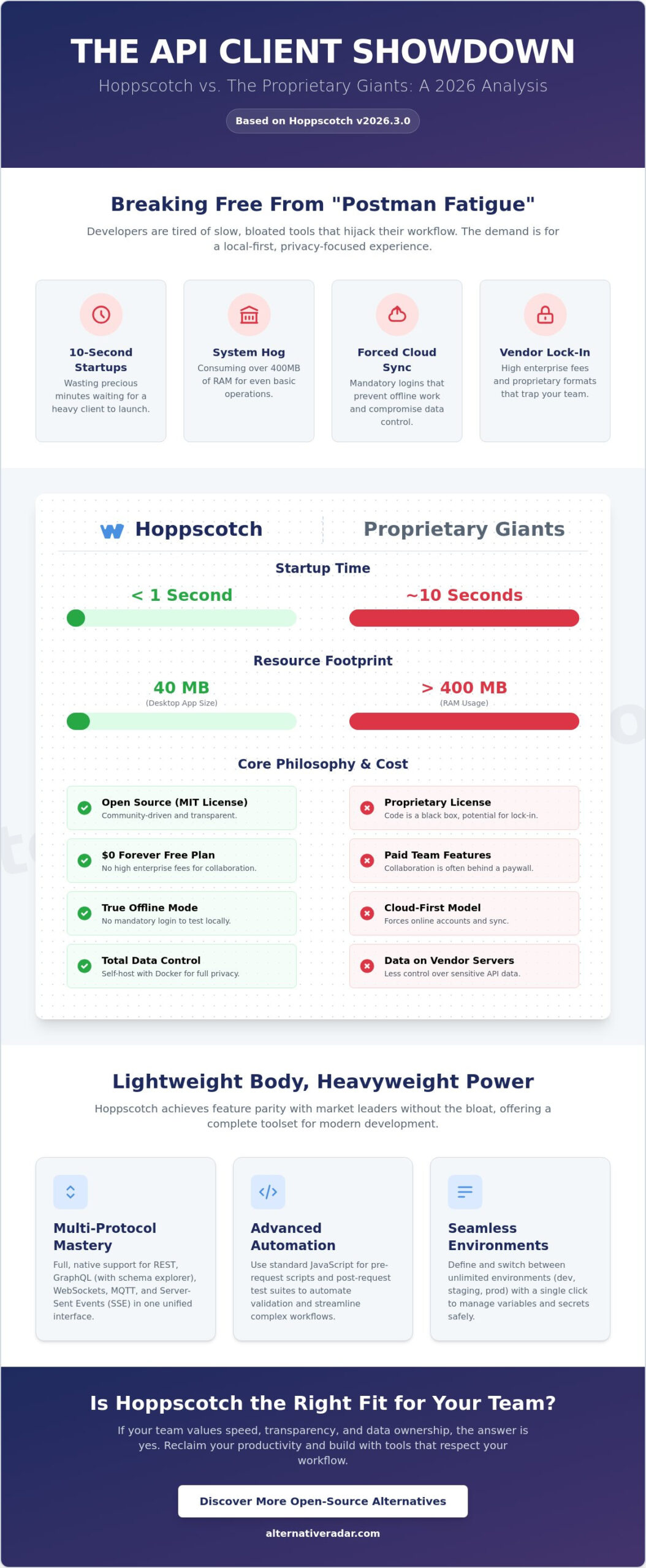
Choosing the right API client depends on your team’s stance on data sovereignty and system performance. While Postman and Insomnia operate on proprietary models, hoppscotch utilizes the MIT license. This distinction is vital for organizations that require complete transparency in their toolchain. A detailed Hoppscotch vs. Postman analysis reveals that while Postman pushes a cloud-first agenda, the open-source alternative prioritizes a local-first approach. This means your data stays on your machine unless you explicitly choose to sync it, providing a higher level of security for sensitive endpoints.
Efficiency is where the gap becomes most visible in daily workflows. Benchmarks from May 2026 show that the desktop client starts in under a second. In contrast, Postman’s cold-boot time often reaches 10 seconds. Memory usage follows a similar pattern; the lightweight client consumes roughly 40MB of RAM, which is 10 times less than the 400MB typically required by Postman. These performance gains ensure that your development environment remains responsive even when running multiple resource-intensive applications simultaneously.
Cost structures have also diverged significantly. The free plan remains $0 forever, offering unlimited workspaces and collections with community support. For teams needing centralized administration, the Organization plan costs $6 per user per month when billed annually. Proprietary giants often gate essential collaboration features behind much higher enterprise tiers. This makes scaling an expensive prospect for growing startups that don’t need the heavy governance features found in premium competitors.
When to Choose Hoppscotch
This tool is the best fit for teams requiring high privacy and on-premise deployments. It’s ideal for developers who prefer a browser-based experience or a Progressive Web App (PWA) that works offline without an account. It’s the right choice for organizations already committed to an open-source stack, such as those using an open source crm software comparison to find their business tools. If your priority is a fast, transparent, and account-free testing environment, this is your primary option.
Where Postman and Insomnia Still Lead
Postman maintains an edge for massive enterprises that require deep governance, advanced API monitoring, and complex lifecycle management features. Its ecosystem is vast, though it comes at the cost of speed. Insomnia remains a strong contender for developers who prioritize a design-first approach and a native plugin ecosystem. The tipping point for switching usually occurs when your team values local-first speed and data privacy over the extensive, cloud-dependent feature sets of the market leaders.
Deployment and Migration: Making the Switch
Transitioning to hoppscotch is designed to be a frictionless process, whether you’re an individual developer or part of an enterprise team. The ecosystem offers multiple entry points to suit different infrastructure needs. Hoppscotch Cloud provides the fastest setup for teams that want real-time collaboration without managing their own servers. For those who prefer a native experience, the 40MB desktop app delivers the same intuitive UI with the performance of a local application. If you’re looking to optimize your stack, you can explore more software comparisons on our platform to find the right fit for your workflow.
Enterprise users often require more than just a fast client. The March 2026 Enterprise release (v2026.3.1) addresses these needs with robust security features. This includes Single Sign-On (SSO) integration for centralized access management and detailed audit logs for compliance tracking. These tools ensure that as your team grows, your API testing infrastructure remains secure and transparent. By moving away from proprietary cloud dependencies, organizations can reclaim control over their internal development data.
Step-by-Step: Migrating from Postman
Switching from Postman doesn’t mean losing years of work. The migration process is straightforward and preserves your existing logic. Follow these steps to move your data:
- Export your data: In Postman, export your collections and environments as JSON files. Version 2.1 is recommended for the best compatibility.
- Import to the new client: Use the import feature in the collections panel to upload your JSON files. The platform recognizes the structure and populates your workspace instantly.
- Map variables: Check your environment variables to ensure global and collection-level values have transitioned correctly.
- Validate scripts: Since both tools use JavaScript for testing, most scripts will work immediately. Run a quick test suite to verify that specific library dependencies are resolved.
Self-Hosting for Privacy-First Teams
Privacy-conscious organizations can maintain total control over their API data by self-hosting. Using the official Docker image allows for rapid on-premise deployment on your own hardware or private cloud. This setup supports persistent storage and custom domains, ensuring your internal tools align with your company’s security policies. Many teams integrate their self-hosted instances with internal logseq knowledge bases. This connection allows you to link live API requests directly to your internal documentation, creating a unified source of truth for your engineering team without relying on external cloud providers. Teams with the same privacy-first mindset often extend this philosophy to their media libraries as well, using a self-hosted solution like navidrome for personal music streaming to keep their audio collections fully under their own control.
Conclusion: Is Hoppscotch the Right Fit for Your Workflow?
Hoppscotch has redefined what a modern API client looks like by prioritizing speed over bloat. In 2026, its value proposition is clearer than ever. You get a professional-grade tool that starts instantly and respects your privacy. It’s no longer just a lightweight alternative; it’s a robust ecosystem that supports the most complex GraphQL and WebSocket workflows. By choosing this path, you’re investing in a tool that grows with your needs without locking your data behind a proprietary wall.
Our final recommendation depends on your specific constraints. For individual developers and small-to-medium teams, the free tier is unbeatable. It offers unlimited collaborators and workspaces at no cost. Larger organizations with strict compliance needs should look toward the self-hosted Docker deployment. While Postman still holds a niche for massive enterprise governance, this open-source alternative is the right fit for teams that value developer experience and local-first autonomy. It’s about choosing a tool that works for you, rather than forcing you to work within its limitations.
Before making a full organizational pivot, we suggest running a pilot project. Use the web app or PWA to test your most complex collections. It’s the best way to see how the sub-second startup time impacts your daily rhythm. If you’re still exploring your options for other parts of your stack, Alternative Radar is here to help you find the best alternative to any industry-standard tool. We provide the data so you can stop wasting time searching and start building with the right software.
The Future of Hoppscotch
The roadmap for the remainder of 2026 looks promising. Anticipated features include AI-driven request generation, which will automatically suggest headers and body structures based on your endpoint patterns. Enhanced mocking capabilities are also expected to simplify front-end development by simulating complex back-end responses without requiring a live server. The community is growing at a rapid pace, ensuring that bugs are fixed weekly and new features are vetted by actual users. The final verdict is simple: if you want a fast, transparent, and community-driven API client, this is the definitive choice for your 2026 workflow.
Reclaim Your Development Speed
Adopting hoppscotch is more than just a tool change; it’s a commitment to a faster, more transparent development environment. You’ve seen how its under-one-second startup time and 40MB memory footprint outperform legacy clients. With 79k+ GitHub stars and the trust of millions of developers, this MIT Licensed open-source ecosystem provides the long-term reliability your team needs. It’s time to move past the bloat and embrace a local-first philosophy that keeps your data secure and your workflow efficient.
The transition from proprietary platforms is simple, and the benefits of open-source freedom are immediate. If you’re ready to explore how this tool fits into your broader software stack, we’ve done the heavy lifting for you. You can find the best Hoppscotch alternatives on Alternative Radar to compare the top-rated options in the market today. Stop wasting time on slow software and start building with tools that prioritize your productivity. Your ideal API development workflow is just one click away, so take the first step toward a more responsive environment.
Frequently Asked Questions
Is Hoppscotch completely free to use?
Yes, the free plan is $0 forever and includes unlimited workspaces, collections, and requests for individual developers. For teams requiring centralized administration and dedicated support, an Organization plan is available for $6 per user per month. This transparent model ensures that core testing features remain accessible to everyone without hidden paywalls.
Can I use Hoppscotch offline without an account?
Yes, you can use the platform entirely offline as a Progressive Web App (PWA) or a desktop client. Unlike many proprietary tools, hoppscotch doesn’t require a mandatory cloud login for local testing. This local-first approach ensures your data stays on your machine, providing a faster and more private development experience.
How do I import my Postman collections into Hoppscotch?
You can import collections by exporting them from Postman as a JSON file in version 2.1 format. Once you have the file, click the Import button in the collections panel and select the JSON option. The platform mapping handles your variables and request structures automatically, allowing you to resume your testing workflow in seconds.
Does Hoppscotch support GraphQL and WebSockets?
Yes, the ecosystem provides comprehensive support for GraphQL, WebSockets, MQTT, and Server-Sent Events (SSE). The GraphQL interface includes a schema explorer and query builder to handle complex nested data. Real-time testing for WebSockets is integrated directly into the unified interface, which eliminates the need for separate testing tools.
What is the difference between Hoppscotch Cloud and Self-Hosted?
Hoppscotch Cloud is a managed service that offers the fastest path to team collaboration and cloud synchronization. In contrast, the Self-Hosted version uses a Docker image to run the entire suite on your private infrastructure. Self-hosting provides complete control over your API data and is the preferred choice for teams with strict regulatory requirements.
Is Hoppscotch secure for enterprise-level API testing?
Yes, it’s built for enterprise security with features like Single Sign-On (SSO) and detailed audit logs in the v2026.3.1 release. The open-source MIT license allows your security team to audit the codebase directly. This transparency, combined with local-first data storage, makes hoppscotch a highly secure choice for sensitive engineering environments.
Does Hoppscotch have a desktop application for Windows and Mac?
Yes, native desktop applications are available for both Windows and Mac operating systems. The application is remarkably lightweight at approximately 40MB, which is 10 times smaller than some major competitors. It maintains the same clean UI as the web version while offering the performance benefits and system integration of a native tool.
How does Hoppscotch handle environment variables and secrets?
The tool manages secrets through environment variables that you can toggle between development, staging, and production contexts. Sensitive values are stored locally in your browser or desktop client rather than being synced to the cloud by default. This ensures that your API keys and credentials remain protected from unauthorized access during the testing process.