
The most recognizable name in email marketing might be the biggest obstacle to your growth in 2026. While Mailchimp remains a market leader, its increasingly restrictive subscriber caps and hidden costs for basic automation often force small businesses into expensive tiers too early. If you’re tired of managing a list that you can’t actually afford to message, it’s time to evaluate the latest free mailchimp alternatives that prioritize utility over brand recognition.
We understand the frustration of hitting a ceiling just as your marketing starts to gain momentum. You need a platform that empowers your outreach rather than one that treats basic features like premium add-ons. This guide identifies seven tools that offer higher sending limits and easy-to-use automation without the typical pricing traps. We’ve done the testing to find the most cost-effective options, from platforms offering massive contact limits to those providing full feature access for $0. You’ll find a clear, objective comparison designed to help you make a smarter, data-backed choice for your bottom line.
Key Takeaways
- Escape the “freemium trap” by identifying platforms that provide essential growth tools without gating them behind expensive monthly subscriptions.
- Compare the highest-rated free mailchimp alternatives for 2026 to find the optimal balance between subscriber limits and automation features.
- Master the evaluation matrix to distinguish between restrictive contact caps and daily sending limits that could stall your marketing momentum.
- Select a platform based on your specific operational needs, ensuring features like API access or simple templates align with your technical expertise.
- Implement a risk-free migration strategy to clean your list and map custom tags accurately when switching to a more cost-effective provider.
Beyond the Chimp: Why Small Businesses are Migrating in 2026
Small business owners are re-evaluating their marketing stacks. The era of accepting restrictive “freemium” models is ending. Many are searching for free mailchimp alternatives to regain control over their budgets and data. This migration is driven by a need for efficiency rather than just a desire for lower costs.
Proprietary platforms often gatekeep essential growth tools. You might start for free, but you’ll quickly find that basic automation or advanced segmentation requires a paid upgrade. This “freemium trap” stunts growth by making essential marketing tactics inaccessible to those who need them most. Additionally, SaaS fatigue is setting in. Recurring per-subscriber costs eat into small business margins, making it harder to justify a growing list that doesn’t immediately convert.
Data sovereignty is another critical factor. In a platform-volatile world, owning your audience list is paramount. Relying on a single all-in-one provider can be risky. These platforms often become a “master of none,” offering mediocre features across the board. A foundational step in understanding email marketing is recognizing that your list is your most valuable asset. You shouldn’t be penalized for growing it.
The Hidden Costs of Mailchimp’s Legacy Pricing
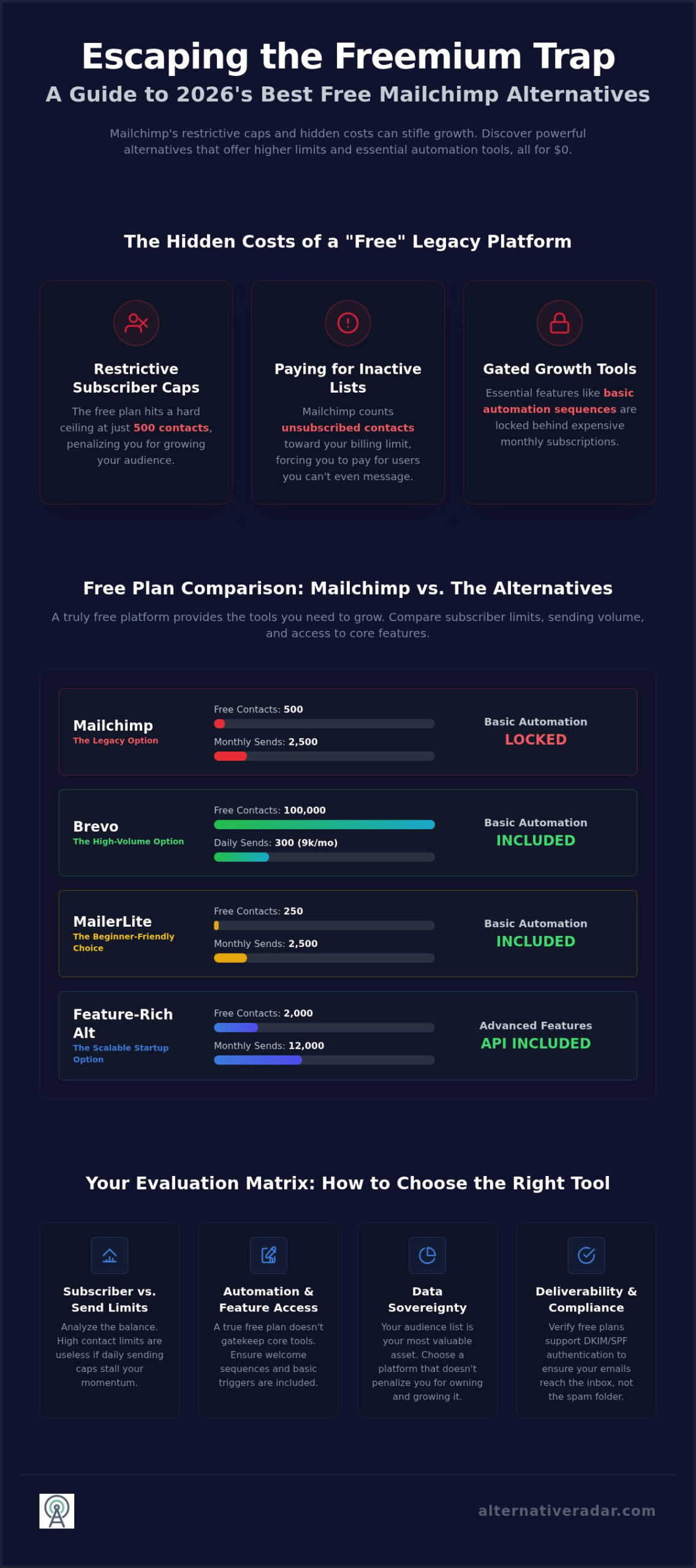
Legacy pricing models often include hidden drains on your budget. For instance, Mailchimp counts unsubscribed contacts toward your billing limit. This means you’re paying to store data for people you can’t even message. Feature gating also prevents small teams from using basic automation without upgrading. Scaling becomes a financial burden when costs jump exponentially as soon as you cross the 500-contact threshold. These structural hurdles make it difficult for lean teams to maintain a positive ROI.
Why 2026 is the Year of the Switch
The shift toward modular, API-first marketing stacks has reached a tipping point. Businesses now prefer specialized tools that integrate seamlessly rather than one-size-fits-all solutions. AI has simplified these alternative tools, making them as user-friendly as legacy giants. The ‘Alternative Software’ movement represents a strategic pivot toward high-utility tools that prioritize user ROI over platform lock-in. Switching to free mailchimp alternatives is no longer a compromise; it’s a competitive advantage for businesses that value agility and transparency.
The Evaluation Matrix: What Makes a Truly ‘Free’ Alternative?
Selecting the right free mailchimp alternatives involves more than just checking for a zero dollar price tag. You must analyze the technical constraints that define your daily operations. Most providers implement a two-pronged cap: subscriber limits and send limits. For instance, Brevo allows up to 100,000 contacts but restricts sends to 300 per day. In contrast, MailerLite’s June 2026 update limits free accounts to 250 subscribers and 2,500 monthly emails. Understanding these nuances prevents you from outgrowing a platform within weeks of migration.
Automation accessibility is another critical filter. You shouldn’t have to pay to build a basic welcome sequence. If a tool gates essential triggers, it isn’t truly free; it’s a limited trial designed to force an upgrade. Similarly, template flexibility matters. While drag-and-drop editors are standard for speed, ensure the platform doesn’t lock mobile-responsive design behind a paywall. When researching free mailchimp alternatives, prioritize providers that offer full feature access over high volume. Comparing options for the best email marketing software requires focusing on how these features align with your specific growth stage.
The ‘Ease of Use’ vs. ‘Power’ Trade-off
Identify whether a tool prioritizes a 10 minute setup or complex logic. Solopreneurs often need a modern, clean UI that allows them to launch a campaign in minutes without a steep learning curve. However, scaling startups might require advanced segmentation and webhooks. A clunky interface wastes time and discourages team adoption. Since over half of all recipients view messages on phones, mobile-responsive design is no longer an optional feature; it’s a baseline requirement for any professional sender.
Deliverability and Compliance Standards
Your reputation depends on the provider’s underlying infrastructure. A tool must support DKIM and SPF authentication on its free plan to ensure your emails reach the inbox rather than the spam folder. In 2026, maintaining GDPR and CCPA compliance is a standard legal necessity for global reach. Evaluate the health of the provider’s shared IP pool. If the free tier is crowded with low quality senders, your deliverability rates will suffer. You can compare technical specifications on our discovery platform to see which providers maintain the highest standards.
The 7 Best Free Mailchimp Alternatives for 2026
Identifying the right platform requires a clear understanding of your volume requirements and technical needs. These free mailchimp alternatives lead the market in 2026 by offering specific utility that legacy platforms often gatekeep. Whether you prioritize list size, automation depth, or ecommerce integration, there’s a tool designed for your specific workflow.
- MailerLite: This remains the gold standard for creators who value a clean interface. Following its June 2026 update, the free plan supports 250 subscribers and 2,500 monthly emails, including a robust landing page builder.
- Brevo (formerly Sendinblue): Ideal for those with large lists, Brevo allows up to 100,000 contacts on its free tier. It limits sends to 300 per day, making it perfect for steady, transactional communication.
- Omnisend: A powerhouse for ecommerce, providing full access to automation and segmentation for up to 250 contacts. It’s the best choice for small shops needing advanced triggers.
- EmailOctopus: Known for simplicity, it offers high-volume sending by leveraging Amazon SES infrastructure. It’s built for users who want to avoid complex UI clutter.
- Moosend: This platform stands out for providing advanced automation workflows on its free tier, allowing small teams to build complex customer journeys without a subscription.
- Zoho Campaigns: The logical choice for businesses already using the Zoho ecosystem, offering seamless data syncing and professional templates.
- Mailjet: Designed with developers in mind, Mailjet provides a flexible API and advanced relay features for those building custom marketing stacks.
- Alternative Radar: As an objective discovery platform, we act as your digital scout. We curate these tools to ensure you find the most efficient software without falling into proprietary pricing traps.
Top 3 Picks for Different Business Models
MailerLite is the primary choice for creators and newsletter authors. Its drag-and-drop editor and built-in landing page tools allow you to grow an audience and publish content from a single dashboard. For B2B organizations, Brevo offers superior value through its integrated CRM and SMS features, allowing you to manage leads and outreach in one place. Retailers should prioritize Omnisend due to its deep integrations with Shopify and WooCommerce, which enable automated abandoned cart emails and personalized product recommendations on the free plan.
Niche Options for Technical Teams
Technical teams often require more control over their data and infrastructure. If you’re building a modular stack, you might benefit from an open source crm software comparison to find tools that integrate directly with your database. Self-hosted options like Mautic provide maximum privacy and no subscriber caps, though they require more maintenance. Source-available tools are also gaining traction in 2026, offering a middle ground between proprietary SaaS and fully open-source projects. These specialized options ensure your marketing stack remains agile and scales alongside your technical requirements.
Strategic Selection: Matching Tools to Your Growth Stage
Choosing from the pool of free mailchimp alternatives requires more than just comparing subscriber counts. You must align the platform’s technical capabilities with your current operational complexity. A tool that works for a single newsletter might lack the infrastructure needed for a high-volume retail operation. Efficiency comes from selecting a platform you won’t outgrow in six months.
- The Solopreneur Stack: If you’re a team of one, prioritize time-to-market. Tools like MailerLite offer simple templates and intuitive drag-and-drop editors that allow you to launch campaigns in minutes. You don’t need complex logic; you need reliability and speed.
- The Scaling Startup: For businesses with growing technical needs, API access and webhooks are non-negotiable. Platforms like Mailjet or Brevo allow you to integrate email marketing into your proprietary app or CRM. This connectivity ensures your data remains synchronized as you scale.
- The Ecommerce Giant: Focus on behavioral triggers. If you run a Shopify or WooCommerce store, you need a tool like Omnisend that handles cart abandonment and post-purchase sequences out of the box. These automated touchpoints drive ROI without manual intervention.
- Non-Profits and Education: Many providers offer permanent “free-plus” discounts or expanded free tiers for verified organizations. Look for platforms that value social impact, as these often provide premium features for $0 to eligible entities.
When to Stick with a Managed Free Tier
Staying on a free plan is viable as long as your monthly send volume remains within the provider’s limits. However, you must calculate the “cost of maintenance” versus the subscription fee. If you spend five hours a week manually cleaning lists to stay under a 250-subscriber cap, paying for an upgrade is actually the cheaper option. Many savvy marketers leverage multiple free mailchimp alternatives for different segments, using one for a small high-intent list and another for broad transactional updates.
The Role of AI in 2026 Email Marketing
In 2026, even free tiers incorporate advanced AI. These tools now offer automated subject line optimization and predictive send-time settings to maximize open rates. AI-driven list cleaning is also essential; it identifies “dead” or bot-generated addresses before they damage your deliverability reputation. As you refine your stack, you can find a suitable alternative to any legacy tool that still relies on manual processes. You can compare growth-ready software on our platform to ensure your choice supports these modern features.
The Migration Roadmap: How to Switch Without Losing Your List
Transitioning to one of the free mailchimp alternatives requires a structured technical approach to maintain deliverability. You can’t simply import a CSV and hit send. A successful migration follows a five-step protocol designed to protect your sender reputation and ensure data integrity throughout the move.
First, conduct a rigorous data audit. Remove inactive or “dead” subscribers who haven’t engaged with your content in the last six months. This step is vital for staying within the tighter subscriber caps of 2026 free plans. Second, map your custom fields and tags during the export/import process. Consistency here ensures your existing automation triggers and segmentation logic function correctly in the new environment.
Third, configure your DNS settings. You must update your SPF, DKIM, and DMARC records to authorize the new provider. Without these technical handshakes, your emails will likely trigger spam filters. Fourth, port your templates. Most modern tools allow for HTML import or provide similar drag-and-drop blocks, so you don’t need to rebuild your brand identity from zero. Finally, implement a warm-up schedule. Gradually increase your sending volume over two weeks rather than blasting your entire list immediately. When evaluating free mailchimp alternatives, the actual migration is where most businesses fail or succeed based on these technical details.
Avoiding the Spam Folder During Transition
Day one of a new tool is high risk. ISPs like Gmail and Outlook view sudden shifts in sending infrastructure with suspicion. Instead of a full-list blast, use “segment warming.” Start by sending to your most engaged subscribers, specifically those who have opened an email in the last 30 days. High engagement on these initial batches builds trust with ISPs. Monitor your bounce rates and unsubscribe counts closely. Any spike above 1% requires an immediate pause and review of your list quality.
Measuring Success Post-Migration
Evaluate your new platform’s performance throughout the first 30 days. Track your open rates and click-through rates against your previous benchmarks to ensure parity. More importantly, calculate your “Cost Per Lead” savings. By eliminating recurring subscriber fees, you should see a direct improvement in your marketing ROI. For those looking to further optimize their technical stack beyond email, exploring popular open source business software 2026 provides a roadmap for total platform independence. This structured migration ensures you gain the benefits of a free tier without sacrificing the audience you’ve worked hard to build.
Future-Proofing Your Email Marketing Strategy
Transitioning to a more efficient marketing stack is a strategic necessity in 2026. By moving beyond legacy platforms, you reclaim control over your data and your budget. You’ve seen how the right free mailchimp alternatives can offer higher subscriber limits and more robust automation without the “freemium trap” that often stunts growth. Success depends on matching your tool to your specific operational needs, whether you’re a solopreneur or a scaling ecommerce brand.
Remember that a successful switch requires more than just importing contacts. You must prioritize technical configuration and list hygiene to protect your sender reputation. This objective approach ensures that your email marketing remains a high-ROI channel rather than a recurring expense. Alternative Radar serves as your digital scout in this evolving landscape. We provide objective software scouting for 2026, empowering you to build cost-effective tech stacks through detailed comparisons of features and deliverability.
Discover more software alternatives on Alternative Radar to find the perfect fit for your next growth phase. Take the first step toward a more agile marketing future today.
Frequently Asked Questions
Is there a truly free Mailchimp alternative with no subscriber limits?
Brevo (formerly Sendinblue) is the primary option for businesses needing high contact volume. It allows up to 100,000 contacts on the free plan, which is significantly higher than most competitors. However, it limits daily sends to 300 messages. If you require absolutely no limits, self-hosted open-source tools like Mautic are available, though they require technical expertise to maintain. For most small businesses, Brevo offers the most efficient balance for $0.
Can I use my own domain name with a free email marketing plan?
Yes, most reputable free mailchimp alternatives allow you to send from your own domain. You’ll need to verify ownership by adding SPF and DKIM records to your DNS settings. This step is essential for maintaining high deliverability and professional branding. Avoid using generic addresses like @gmail.com for bulk sends. Modern spam filters increasingly block mail from non-verified domains to protect users, making custom domain authentication a non-negotiable requirement in 2026.
Do free alternatives to Mailchimp include automation features?
Many modern alternatives provide robust automation on their free tiers. For example, Omnisend and Moosend allow you to build welcome sequences and behavioral triggers without an upfront cost. While some platforms gate advanced logic, basic “if-this-then-that” workflows are now a standard industry offering. Always check if a provider limits the number of active automations. MailerLite currently restricts free accounts to three active workflows, which is usually sufficient for a starting strategy.
How do I migrate my contacts from Mailchimp to a new tool?
Most platforms offer a direct import tool or a standard CSV upload feature. You should first export your audience from Mailchimp, ensuring you include all tags and custom segments. Once you’ve imported the file into your new tool, map these fields to the corresponding attributes. It’s best to clean your list before the move to ensure you don’t waste your subscriber cap on inactive or “dead” addresses that won’t engage.
Which free email tool has the best deliverability rates in 2026?
Deliverability depends largely on your sender reputation and the provider’s IP health. MailerLite and Brevo consistently maintain high standards by enforcing strict anti-spam policies across their entire user base. Because these providers require authentication via SPF and DKIM even on free plans, they protect the integrity of their shared IP pools. Your inbox placement will also improve if you follow a gradual warm-up schedule during your first 14 days on the platform.
Are free email marketing tools GDPR compliant?
Leading providers like Brevo and MailerLite are fully GDPR compliant and provide the necessary tools for data protection. They offer built-in features for managing consent, processing data deletion requests, and hosting data on secure servers. If you serve customers in the EU, ensure your chosen platform provides a clear Data Processing Agreement. Most reputable free mailchimp alternatives have updated their terms to meet 2026 global privacy standards, ensuring your marketing remains legally sound.
What are the biggest limitations of free-forever plans?
The most common constraints include subscriber caps, monthly send limits, and mandatory provider branding in the email footer. You’ll likely see a “Sent with [Brand]” badge on every message. Additionally, advanced features like A/B testing, multi-user access, or priority customer support are often reserved for paid tiers. Some platforms also limit the number of landing pages or sign-up forms you can host simultaneously, which can restrict your lead generation efforts.
Can I use a free Mailchimp alternative for my Shopify store?
Omnisend is specifically designed for ecommerce and offers a deep integration with Shopify. It allows you to sync customer data and trigger automated abandoned cart emails on the free plan. Other tools like MailerLite also offer Shopify plugins, but Omnisend provides more specialized retail templates and behavioral tracking. These integrations help small retailers drive revenue through automated sequences without the high overhead costs of a premium email marketing subscription.