
If your team is spending more on per-user licensing fees than on actual project development, who really owns your workflow? In 2026, the promise of simple cloud software has morphed into a cycle of exponentially increasing costs and bloated interfaces that hinder velocity rather than helping it. You likely feel the weight of these proprietary platforms; specifically the lack of control over where your sensitive project data is stored and the frustration of being locked into a vendor’s rigid roadmap.
Choosing the right open source project management software is no longer a budget compromise but a strategic move for data sovereignty. You deserve a modern, fast UI that your team actually enjoys using, combined with the security of on-premise hosting. This guide cuts through the marketing noise to highlight mature alternatives to Jira, Monday, and ClickUp that prioritize your ownership and eliminate vendor lock-in.
We have vetted the most reliable platforms for 2026, including the latest releases of OpenProject, Plane, and Taiga. You will discover how to migrate seamlessly from proprietary tools to solutions that offer full data ownership and customizable workflows. This comparison provides the technical clarity needed to select a platform that fits your team’s specific requirements and privacy standards.
Key Takeaways
- Understand why 2026 marks the “SaaS Exit” for privacy-conscious teams looking to regain data sovereignty and eliminate unpredictable per-user pricing.
- Distinguish between pure FOSS and Open Core models to choose an open source project management software that matches your long-term hosting and budget requirements.
- Identify mature, high-velocity alternatives to Jira and Monday, such as Plane and OpenProject, that provide modern interfaces without the proprietary bloat.
- Evaluate critical technical criteria, including API maturity and one-click migration importers, to ensure your new stack integrates seamlessly with existing workflows.
- Leverage Alternative Radar’s vetted comparison data to bypass weeks of manual testing and move directly from discovery to implementation.
The Shift to Open Source Project Management in 2026
In 2026, the definition of open source project management software has evolved from a developer-only niche into a cornerstone of enterprise strategy. It’s no longer just about saving money; it’s about the fundamental right to control your own operational infrastructure. Modern teams view their project data as a core asset. Entrusting that asset to a closed, proprietary ecosystem is increasingly seen as a strategic risk. Organizations are now prioritizing tools that offer transparency, allowing them to audit source code and verify security protocols without waiting for a vendor’s quarterly report.
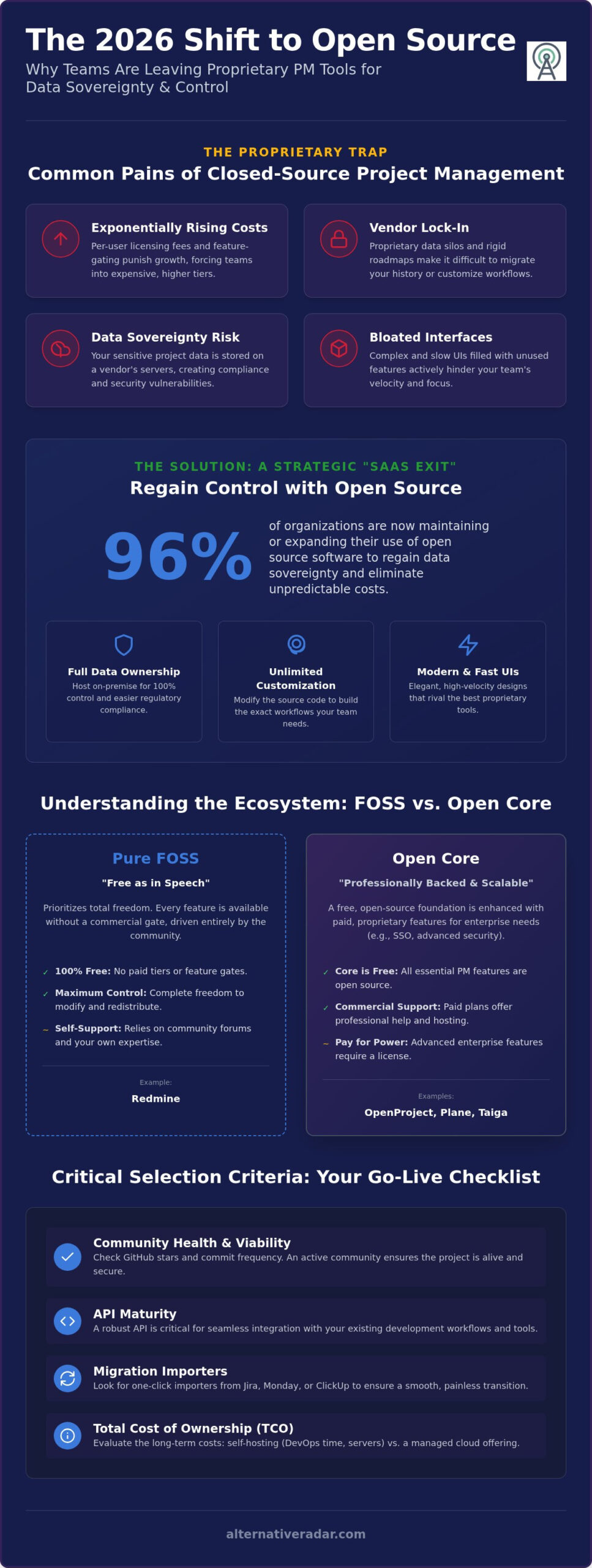
Many organizations are initiating a “SaaS Exit” due to the compounding costs of per-user licensing. Industry data indicates that 96% of organizations are now maintaining or expanding their use of open-source software to combat these rising overheads and regain data sovereignty. This shift is driven by the need for unlimited customization. When you own the code, you aren’t limited by a vendor’s roadmap. You can build the exact workflows your team needs to maintain velocity.
When evaluating these tools, we distinguish between “free as in beer” and “free as in speech.” The former refers to the price tag, while the latter refers to the liberty to modify and redistribute the software. While many platforms like OpenProject offer free community editions, the real value lies in the “speech” aspect. This ensures that your project management stack remains a permanent part of your company’s intellectual property, protected from sudden price hikes or service shutdowns.
The Problem with Proprietary Vendor Lock-in
Proprietary giants like Jira and Monday often utilize “feature-gating” to force growing teams into higher pricing tiers. This creates a financial ceiling that punishes success. Beyond the cost, proprietary data silos make it difficult to export your full history if you decide to switch providers. By 2026, stricter global data regulations have made on-premise hosting a requirement for many sectors. Open source project management software provides a direct path to compliance by keeping data on your own servers.
Open Source Maturity: From “Ugly” to “Elegant”
The old stereotype that open-source tools lack polish is dead. Modern platforms like Plane and Taiga have redefined the user experience with sleek, intuitive designs. These tools now rival the speed and aesthetic of Linear and ClickUp. Because they are community-driven, feature deployment happens at a velocity that proprietary roadmaps can’t match. Developers fix bugs and release patches in real-time. This ensures the software evolves alongside the teams using it, rather than lagging behind market needs.
Understanding the Open Source PM Ecosystem: FOSS vs. Open Core
Selecting the right open source project management software requires a clear understanding of how these tools are built and funded. Most modern platforms follow an “Open Core” model. In this setup, the foundational features are free and open to the public, while advanced enterprise capabilities, such as Single Sign-On (SSO) or high-level resource auditing, are locked behind a paid tier. This differs from “Pure FOSS” (Free and Open Source Software) projects like Redmine, where every feature is available without a commercial gate. Choosing between them depends on whether you need a polished, commercially backed product or a community-driven tool that prioritizes total freedom over out-of-the-box convenience.
Efficiency-driven teams must also evaluate the Total Cost of Ownership (TCO) when deciding between self-hosting and managed cloud options. While self-hosting eliminates per-user fees, it introduces costs in the form of server maintenance and DevOps hours. Managed cloud versions offer a middle ground, providing the benefits of open-source transparency without the operational burden of managing infrastructure. To gauge the long-term viability of a tool, look beyond the marketing site and check its GitHub “Stars” and commit frequency. An active community is your best guarantee that bugs will be fixed and security patches will be released promptly. You can use Alternative Radar’s comparison tools to filter platforms by their community health and licensing models.
Licensing 101 for Project Managers
Licensing dictates how you can use, modify, and distribute your software. Permissive licenses like Apache 2.0 allow you to build custom internal integrations with very few restrictions. In contrast, copyleft licenses like the GPL ensure that any improvements made to the software remain open to the community. The AGPL-3.0 license requires that if you modify the software and run it over a network, you must make those modifications available to users, ensuring the software remains transparent even in cloud environments. Understanding these nuances prevents legal friction when your engineering team starts customizing the platform to fit your specific workflow.
The Self-Hosting Reality Check
Self-hosting offers the ultimate security advantage by keeping your project roadmaps and sensitive data behind your own firewall. However, it requires a baseline of technical maturity. Most modern tools are deployed via Docker or Kubernetes, which simplifies the process but still requires regular updates and backups. If your team lacks dedicated DevOps capacity, the maintenance of an on-premise stack can quickly become a bottleneck. The goal is to find a balance where the security gains of on-premise hosting don’t come at the expense of your team’s innovation velocity.
Top Open Source Alternatives to Jira, Monday, and ClickUp
Migrating to open source project management software is simpler when you understand which tool mirrors your current proprietary stack. Most teams don’t want to reinvent their entire workflow; they want to keep their existing processes while gaining data sovereignty. Alternative Radar has vetted the current market to identify which platforms offer the most reliable migration paths and feature parity for 2026. Whether you need the high-speed issue tracking of Linear or the enterprise governance of Jira, there is a mature open-source equivalent ready for deployment.
Plane: For Teams Who Crave Speed
Plane has emerged as the premier alternative for developers who find Jira too sluggish. With the July 2026 release of v3.0.0, the platform has refined its “Linear-inspired” keyboard-first interface, making it one of the fastest tools in the ecosystem. It excels at managing issues, cycles, and product roadmaps through a clean, distraction-free UI. Dev-heavy teams benefit from native integrations with GitHub and GitLab, allowing for automated state changes and seamless code-to-task synchronization. If your priority is developer velocity and a modern aesthetic, Plane is the logical choice.
OpenProject: For Enterprise-Grade Governance
OpenProject remains the powerhouse for organizations requiring classic, agile, or hybrid project management. The January 2026 launch of v17.0.0 introduced enhanced Gantt charts and sophisticated cost reporting tools that rival MS Project. Teams managing complex sales cycles alongside development might apply open source crm software comparison logic to integrate their project workflows with customer data. Security is a core feature here, with built-in 2FA, LDAP integration, and hosting options that are fully compliant with 2026 GDPR standards. It is the most robust replacement for Jira’s enterprise tier.
Focalboard and Taiga: Specialized Use Cases
Taiga continues to lead for teams strictly following Scrum or Kanban methodologies. Its v6.10.2 update, released in July 2026, maintains a focus on “Pure Agile” principles without the bloat found in multi-purpose tools. For simpler needs, Focalboard serves as a direct Trello alternative, providing a streamlined Kanban experience that is easy for marketing and design teams to adopt. While Taiga wins for technical Scrum masters, Focalboard is often the better fit for cross-functional departments that need visual task management without the steep learning curve of a full-scale PM suite.
For those requiring deep customization, Redmine’s v7.0.1 release in August 2026 proves that legacy stability still has a place in modern stacks. Meanwhile, Leantime offers a unique strategy-focused approach, making it the best option for non-technical teams that need to align daily tasks with high-level business goals.
Critical Selection Criteria: How to Choose Your Stack
Choosing the right stack isn’t just about checking boxes on a feature list. It’s about ensuring technical longevity and operational efficiency for your organization. When you evaluate open source project management software, prioritize API maturity. A robust, well-documented API allows you to automate project reporting and synchronize data with your existing CI/CD pipelines or internal dashboards. Without this level of connectivity, you risk creating another data silo that requires constant manual upkeep. Next, verify the availability of native migration tools. The most mature platforms provide one-click importers for Jira, Trello, and Asana. If a tool makes it difficult to bring your data in, it will likely make it just as hard to get your data out later.
Extensibility is another critical pillar for 2026 teams. You need a platform where writing custom plugins or themes is straightforward, allowing you to tailor the environment to your specific brand and internal workflows. Don’t overlook mobile accessibility. While many open-source projects started as web-only, modern teams require responsive mobile apps or high-quality PWA support to update tasks and check roadmaps on the go. You can use Alternative Radar’s comparison filters to see which stacks offer the best integration support and mobile performance.
The “User Adoption” Litmus Test
UI “snappiness” is the primary predictor of whether a team will actually adopt a new tool. If the interface feels heavy or unresponsive, team members will quickly revert to spreadsheets or private, unmanaged boards. Evaluate the learning curve specifically for your non-technical stakeholders, such as marketing or sales leads. They need to navigate the tool and extract value without a technical manual. To minimize deployment risk, run a 30-day pilot program with a small, cross-functional subset of your team. This reveals real-world friction points that a static feature list won’t show.
Security and Compliance Checklist
In 2026, security is a non-negotiable requirement for enterprise procurement. Your chosen stack must support industry-standard data encryption both at rest and in transit. Granular Role-Based Access Control (RBAC) is essential for larger organizations to ensure users only access the data relevant to their specific roles. Finally, verify the depth of the audit logs. You must be able to track exactly who changed a task status, modified a roadmap, or deleted a file for compliance and troubleshooting purposes. This level of transparency is where open-source solutions truly shine, as you can audit the source code to verify exactly how your sensitive data is being handled.
Implementing Your Open Source Strategy with Alternative Radar
Alternative Radar acts as your digital scout, shortening the path from SaaS frustration to a fully deployed open source project management software stack. We have already mapped features across 50+ platforms to save you hundreds of hours of manual testing. This allows you to focus on implementation rather than wading through marketing fluff. A successful “SaaS Exit” requires a cohesive strategy that looks beyond just task management. You should also evaluate the popular open source business software 2025 guide to ensure your entire enterprise stack is unified and sovereign.
Our final verdict for 2026 is based on team persona and technical requirements. If your team prioritizes developer velocity and a “Linear-style” keyboard-first interface, Plane is the clear winner. For organizations needing heavy-duty governance, sophisticated Gantt charts, and GDPR compliance, OpenProject remains the industry standard. For those who need a strategy-first approach without technical complexity, Leantime provides the most accessible entry point. Pick the tool that aligns with your team’s existing maturity level rather than just the one with the most features.
Bridging the Gap Between Discovery and Deployment
Alternative Radar earns trust through objective, data-driven software rankings that prioritize user utility over external partnerships. Our detailed pros and cons provide the technical evidence you need to justify the switch to leadership. Moving to an open-source PM tool often reveals gaps in other areas of your stack. You can find the right slack alternatives to pair with your new tool, ensuring your communication and project data remain under your direct control.
Next Steps: Your 48-Hour Open Source Roadmap
Don’t let analysis paralysis stall your progress. You can validate a new platform in less than two days by following this streamlined roadmap. High-velocity teams don’t wait for perfection; they test for suitability in real-world environments.
- Step 1: Spin up a Docker container for your top two candidates. This allows you to test the hosting requirements and interface speed without a permanent commitment.
- Step 2: Import a sample project using native migration tools. This is the only way to see if the software handles your specific task dependencies and data structures correctly.
- Step 3: Survey a small, cross-functional group of your team on the interface feel. Their feedback on “snappiness” and ease of use will predict long-term adoption better than any feature list.
Once you’ve completed these steps, you’ll have the data required to commit to a full-scale migration. Regaining your data sovereignty starts with this single, informed choice.
Future-Proof Your Team’s Productivity
The transition toward data sovereignty in 2026 isn’t just a trend; it’s a necessary defense against rising SaaS costs and proprietary lock-in. By selecting a mature open source project management software stack, you’re investing in a platform that grows with your team rather than taxing your success. Whether you prioritize the speed of Plane or the governance of OpenProject, you now have the tools to maintain full control over your project roadmaps and sensitive data.
Stop following market leaders and start making smarter software choices based on objective data. Alternative Radar provides 2026 updated discovery data and detailed pros and cons for 100+ software categories. Our objective, commission-independent rankings act as your digital scout, helping you filter through the noise to find the perfect fit for your specific technical requirements. Reclaiming your workflow velocity starts with choosing tools that respect your ownership.
Discover the best open-source alternatives for your team on Alternative Radar and secure your operational independence today.
Frequently Asked Questions
Is open source project management software actually free?
The source code for the community editions is typically free to download and host. However, you must account for the cost of server infrastructure and the technical hours required for maintenance. Many modern tools follow an Open Core model where foundational features are free, but enterprise-grade capabilities like Single Sign-On require a paid license. While you eliminate high per-user SaaS fees, your total cost includes hosting and internal DevOps support.
Can I migrate my data from Jira to an open-source tool like Plane or OpenProject?
Yes, most mature platforms provide dedicated migration paths for Jira users. Plane and OpenProject offer importers that handle issues, comments, and attachments via JSON or CSV uploads. These tools are designed to map your existing data structures into the new environment with minimal friction. It is best to perform a test migration with a single project to verify that your custom fields and dependencies transfer accurately before a full-scale move.
Which open-source project management tool is best for Agile and Scrum?
Taiga and Plane are the top choices for teams following strict Agile methodologies. Taiga is purpose-built for Scrum and Kanban, offering native support for backlogs, sprint planning, and burn-down charts. Plane provides a high-velocity, Linear-inspired interface that excels at managing rapid development cycles. Both platforms prioritize developer speed and transparency, making them more efficient for iterative workflows than traditional, multi-purpose enterprise tools that often feel bloated and slow.
Do open-source PM tools offer professional support for enterprises?
Most commercially backed projects offer paid support tiers that include Service Level Agreements and technical assistance. Companies behind platforms like OpenProject and Leantime provide dedicated account managers and expert help with on-premise installations. While the community editions rely on public forums and documentation, these premium tiers ensure that your organization has a direct line to the developers for critical troubleshooting. This makes open source project management software a viable choice for large-scale enterprise deployments.
Is it secure to self-host my project management software?
Self-hosting is generally more secure because it keeps your sensitive project roadmaps behind your own corporate firewall. It eliminates the risk of a third-party cloud breach exposing your intellectual property. However, the security of the installation depends on your team’s ability to manage server hardening and regular software updates. You must implement industry-standard encryption, frequent database backups, and granular access controls to ensure your project environment remains protected from external threats.
What are the hardware requirements for hosting a modern PM tool?
Hardware requirements are typically modest for most teams. For an organization with 25 to 50 active users, a server with 2 vCPUs, 4GB of RAM, and 20GB of SSD storage is usually sufficient. Most modern tools use Docker containers, which helps keep the resource footprint small and simplifies the deployment process. As your database expands with thousands of tasks and file attachments, you will need to scale your CPU and memory resources to maintain interface snappiness.
How does Open Core differ from traditional proprietary software?
Open Core provides a transparent foundation where the source code is public and auditable by anyone. Proprietary software is a closed system where you have zero visibility into how your data is handled or how the features are built. With Open Core, you have the freedom to modify the software or switch to a different hosting provider at any time. Proprietary vendors use closed ecosystems to create lock-in, making it difficult and expensive to leave their platforms.
Can non-developers use open-source project management tools effectively?
Modern open source project management software features intuitive interfaces that are accessible to all departments. Tools like Focalboard and Leantime are built specifically for non-technical users in marketing, operations, and design. They utilize familiar Kanban boards and drag-and-drop task management that require no coding knowledge. While the initial server setup usually requires a developer’s assistance, the daily user experience is designed to be as simple and responsive as any mainstream proprietary application.