

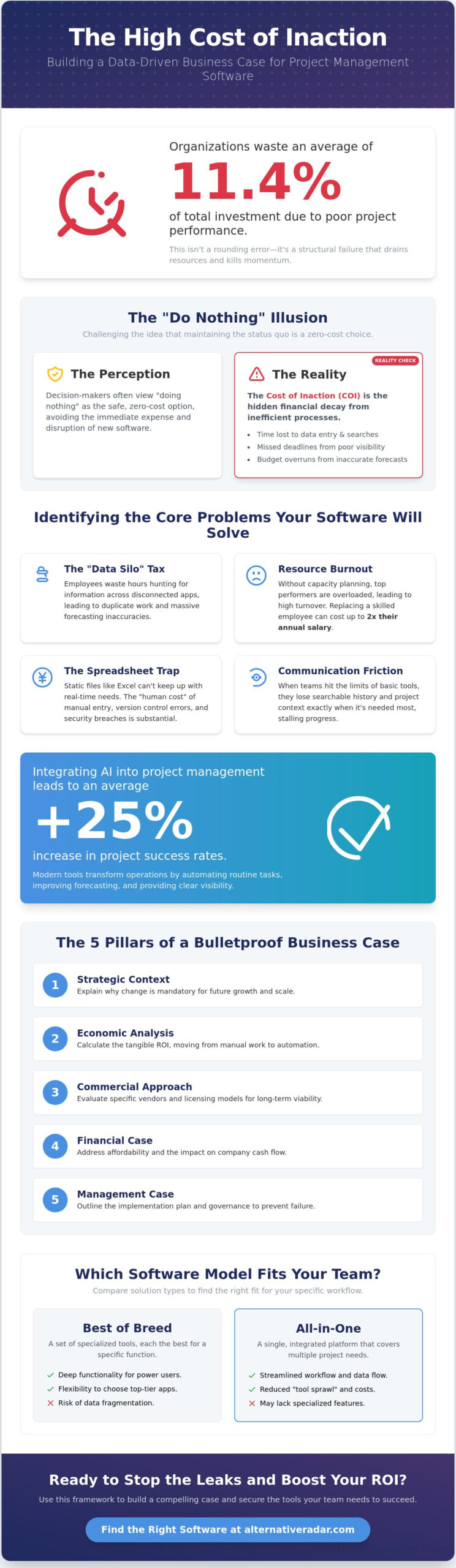
Organizations currently waste an average of 11.4% of their total investment due to poor project performance. In a high-stakes economy, that isn’t just a rounding error. It’s a structural failure that drains resources and kills momentum. If you’re struggling to justify a budget for new tools, you need a data-driven business case for project management software that shifts the focus from simple features to the measurable Cost of Inaction.
It’s frustrating to manage remote teams through “spreadsheet hell” only to have leadership reject your requests due to concerns over tool sprawl. You know that visibility and efficiency are suffering, but you need the numbers to prove it. Integrating AI into project management has already led to an average 25% increase in project success rates, yet many teams still rely on manual workflows that don’t scale. You’re ready for a change, and your stakeholders need to see the logic behind the investment.
In this guide, you’ll learn how to quantify efficiency and build a bulletproof case for modern tools. We provide the professional document structure and hard ROI data points you need to secure executive buy-in. We’ll also explore how to navigate the 2026 landscape of software pricing and functionality to find the right fit for your organization’s specific goals.
Key Takeaways
- Define the formal justification required to navigate the 2026 digital-first procurement cycle.
- Identify the hidden costs of data silos and inaccurate forecasting to build a compelling business case for project management software.
- Quantify the ROI of tool consolidation and the potential to reclaim time by automating routine administrative tasks.
- Use a structured framework to draft an executive summary that prioritizes financial benefits over simple feature lists.
- Compare “Best of Breed” versus “All-in-One” solutions to determine which model suits your team’s specific workflow.
What is a Business Case for Project Management Software?
A business case for project management software is a formal document that explains why an organization should invest in a specific system. It moves beyond a simple feature list. It focuses on how a Project Management System (PMS) solves operational bottlenecks and delivers a measurable return on investment. In the 2026 digital-first procurement cycle, stakeholders don’t just look for “better tools.” They look for systems that mitigate risk and accelerate delivery.
Unlike general IT infrastructure requests, which might focus on server capacity or security patches, a Project Management Software business case is deeply tied to human output. It addresses how people collaborate, how data flows between departments, and how leadership gains visibility into progress. The core objective is alignment. If the software doesn’t directly support your strategic goals, the investment is difficult to justify. You aren’t just buying a tool; you’re upgrading your operational architecture.
The 5 Essential Elements of a Software Business Case
Building a winning case requires five structural pillars. First, the strategic context explains why change is mandatory for growth. You must prove that your current tools can’t support future scale. Second, the economic analysis calculates the ROI of moving from manual spreadsheets to automated tracking. Third, the commercial approach evaluates specific vendors and their licensing models to ensure long-term viability. Fourth, the financial case addresses affordability and cash flow impact. Finally, the management case outlines how the transition will be governed to prevent implementation failure. These elements ensure your proposal is grounded in logic rather than just a desire for new tech.
Why “Do Nothing” is Your Biggest Competitor
Professional procurement standards require you to analyze the “do-nothing” option. This isn’t just a baseline; it’s a risk assessment. Maintaining the status quo often hides leaks in your current workflow, such as time lost to duplicate data entry or missed deadlines due to poor visibility. Decision-makers often view “do nothing” as the safe, zero-cost choice. You must challenge this habit by highlighting the financial decay of sticking with inefficient processes. The Cost of Inaction (COI) is the financial loss sustained by maintaining the status quo. By quantifying this loss, you transform the software from an optional luxury into a necessary intervention for productivity.
Identifying the Core Problems Your Software Will Solve
Building a business case for project management software requires a clear audit of your current operational leaks. Most teams suffer from a “Data Silo” tax. This occurs when employees spend hours each week hunting for information across disconnected apps. This fragmentation doesn’t just slow down work; it creates massive inaccuracies in forecasting. When you lack a centralized Overview of Project Management Software and its capabilities, project overruns become an expensive inevitability rather than a rare exception.
Fragmented data leads to several specific financial drains:
- Search Time: Employees lose productivity searching for the latest file version.
- Duplicate Work: Teams accidentally recreate tasks because they lack visibility into other departments.
- Forecasting Errors: Management makes budget decisions based on outdated or incomplete data.
Resource burnout is another hidden cost that your proposal must address. Without proper capacity planning, your best performers often carry a disproportionate load. This leads to high turnover rates. Replacing a skilled employee can cost up to twice their annual salary, making retention a primary financial driver. Additionally, communication friction often stalls progress. Many teams hit the limitations of free Slack plans, losing searchable history and project context exactly when they need it most.
The Spreadsheet Trap: Why Excel is No Longer Free
Excel might seem like a cost-effective solution, but the “human cost” of manual data entry and version control errors is substantial. In a 2026 hybrid workforce, static files can’t keep up with real-time changes. There’s also a significant risk of data security breaches in unmanaged file-sharing environments. Legacy tools simply weren’t designed for the velocity of modern digital collaboration. If you’re stuck in spreadsheet hell, it’s time to evaluate more efficient alternatives that offer automated workflows.
Visibility Gaps and Stakeholder Trust
Delayed reporting directly impacts executive decision-making speed. When leadership waits days for a status update, the window for corrective action often closes. A strong business case for project management software highlights these visibility gaps as a financial risk. You should focus on creating “one version of the truth” to eliminate redundant status meetings and reduce administrative overhead. Real-time dashboards directly correlate to reduced project risk by providing instant visibility into budget health and timeline deviations. This transparency builds stakeholder trust and ensures that resources stay aligned with high-priority strategic objectives.
Quantifying Tangible and Intangible Benefits
To secure executive approval, your proposal must translate software features into financial gains. Direct cost savings are the easiest to track. By consolidating multiple niche tools into one comprehensive platform, you eliminate redundant licensing fees. Beyond software costs, the most significant tangible benefit in 2026 is time reclaimed. Using AI automation to handle 20-30% of administrative project tasks allows your team to focus on high-value delivery. This shift doesn’t just save hours; it increases the profitability of every project by improving your overall margin through better resource allocation.
While numbers drive decisions, intangible gains shouldn’t be ignored. These include:
- Improved Team Morale: Reducing “spreadsheet hell” lowers burnout and increases employee retention.
- Brand Reputation: Delivering projects on time and within budget consistently strengthens your market position.
- Client Transparency: Providing stakeholders with self-service portals builds trust and reduces the volume of status-update emails.
When these factors combine, they create a more resilient operational framework. You aren’t just buying a tool to track tasks. You’re building a business case for project management software that positions your organization as an efficiency-first competitor.
Calculating the ROI of Modern Project Tools
A credible business case requires a realistic ROI formula. Use the standard calculation: (Gain from Investment – Cost of Investment) / Cost of Investment. Be honest about the “Learning Curve.” Factor in implementation costs and the temporary dip in productivity during the transition. To keep scaling costs manageable, many organizations link their core systems to popular open source business software 2026. This strategy allows you to customize your stack while avoiding the “per-user” price hikes common in proprietary enterprise models.
AI and Automation as Value Multipliers
In 2026, AI is the primary engine for project success. Predictive analytics now reduce the cost of “unknown” project risks by identifying potential delays before they impact the critical path. Automated scheduling also removes the burden of manual Gantt chart updates, saving project managers several hours each week. For the best results, your software should pull data from across the company. Integrating insights from an open source CRM software comparison into your project lifecycle ensures that delivery teams are always aligned with sales promises. This level of integration turns your business case for project management software into a roadmap for total organizational synchronization.
Step-by-Step: How to Write Your Business Case
Developing a business case for project management software requires a structured approach that speaks the language of the executive suite. You aren’t just asking for a new interface. You’re proposing a financial strategy that turns operational chaos into a predictable asset. Follow these five steps to build a document that withstands rigorous scrutiny.
Step 1: Executive Summary. This is your 30-second pitch. It must highlight the primary financial benefit immediately. Don’t lead with features like “dark mode” or “Gantt charts.” Lead with the bottom line. For example, show how the tool will directly reduce the 11.4% waste typically lost to poor project performance.
Step 2: Problem Statement. Define your pain points with hard data. Mention the “Data Silo” tax or the hours lost to manual data entry. If your team currently loses five hours per person per week to administrative overhead, calculate the annual cost of that lost productivity across the entire department.
Step 3: Option Appraisal. Compare the market leader against specialized alternatives. Don’t assume the most expensive tool is the best fit. Evaluate vendors based on “Feature Fit” rather than “Feature Count” to ensure you aren’t paying for bloat your team won’t use.
Step 4: Financial Analysis. Present the 3-year Total Cost of Ownership (TCO). This includes licensing, implementation, training, and potential integration costs. Clear financial modeling shows that you’ve considered the long-term impact on the company’s cash flow.
Step 5: Risk Assessment. Acknowledge the risk of “Implementation Failure.” Explain how you’ll mitigate this through phased rollouts or dedicated internal champions. Showing that you have a plan for user adoption makes the investment feel safer to stakeholders.
Executive Summary: The 30-Second Pitch
CFOs prioritize the bottom line. Start with the financial outcome, then explain the mechanism. Clearly state the required investment and the expected payback period. A sample executive summary sentence might read: “The proposed $15,000 investment in a modern PMS will reclaim 400 hours of monthly administrative time, resulting in a 22% increase in billable capacity by year-end.” This approach balances the initial cost with a clear strategic gain.
Option Appraisal: Why Alternatives Often Win
Market leaders often carry feature bloat that confuses users and inflates costs. You should focus on finding the best alternative to popular software that aligns with your specific workflow. User adoption rates are the most critical factor in vendor selection. If the tool is too complex, the team will revert to spreadsheets, and your ROI will vanish. To ensure you’re making the most efficient choice, compare project management software alternatives based on real-world utility rather than marketing hype. A well-vetted business case for project management software prioritizes usability over brand names every time.
Selecting the Right Software Alternative for Your Case
Building a successful business case for project management software culminates in the selection of a tool that matches your specific delivery methodology. You must decide if your team operates best under Agile, Waterfall, or a Hybrid framework. Choosing a tool that forces a change in methodology often leads to friction and failed adoption. Instead, align the software’s native features with your existing workflows to ensure the promised efficiency gains actually materialize.
Successful teams often find that “Best of Breed” solutions outperform “All-in-One” platforms for specialized work. While a general platform might offer basic task tracking, it often lacks the deep functionality required by engineering or creative departments. Use comparison platforms to validate your vendor shortlist. These resources provide neutral filters that help you look past marketing claims. By comparing technical labels and licensing classifications, you can present a shortlist to stakeholders that is backed by logic rather than brand recognition.
Don’t jump straight to a full rollout. Use a pilot program to prove your business case in a controlled environment. A 30-day trial with a single department allows you to gather real-world data on time savings and user satisfaction. This evidence makes the final budget request significantly harder to reject. It transforms your proposal from a theoretical benefit into a proven solution.
Shortlisting Your Candidates
Your selection criteria should focus on ease of use, integration depth, and scalability. If a tool doesn’t connect with your existing tech stack, it creates a new data silo. Check peer reviews and comparison data to see how the software performs in organizations of your size. For specialized departments, look for tools that offer deep integration with their primary work apps. For instance, creative teams might prioritize a PMS that pairs well with the best free alternatives to photoshop to streamline asset management. This level of specificity proves you’ve considered the actual needs of the end users.
Finalizing the Approval
Prepare for the inevitable “it’s too expensive” objection. Your rebuttal should focus on the Cost of Inaction (COI) discussed earlier. Compare the monthly seat cost, such as the $10.99 for Asana Starter or the budget-friendly $5 for Trello Standard, against the cost of lost billable hours. Set clear KPIs for the first six months, such as a 15% reduction in meeting time or a 20% increase in on-time delivery. Once you have executive buy-in, move immediately to the RFP stage to lock in 2026 pricing and start the implementation process. A strong business case for project management software is only the beginning; the real value starts with execution.
Executing Your Strategic Shift Toward Efficiency
Securing budget approval requires shifting the conversation from tool features to operational ROI. You’ve identified that the cost of maintaining manual workflows often exceeds the price of modern automation. By quantifying the average waste in project performance and leveraging AI to reclaim administrative hours, you provide leadership with a clear financial mandate. It’s no longer about whether to upgrade, but how quickly you can stop the drain on your resources.
Creating a business case for project management software isn’t just about procurement; it’s about building a scalable foundation for your team’s future. Success depends on choosing a tool that fits your specific workflow rather than just following the market leaders. You need independent software comparisons and data-driven insights for 2026 to validate your shortlist and ensure long-term adoption. Find the best project management software alternatives on Alternative Radar and prioritize efficiency over brand hype. You now have the framework to justify your budget and lead your organization toward smarter, more profitable project delivery.
Frequently Asked Questions
What is the most important part of a business case for project management software?
The most critical element is the executive summary that links software capabilities to specific financial outcomes. You must clearly define the problem, such as lost billable hours or fragmented data silos, and present the business case for project management software as the primary solution. Stakeholders care most about how the investment reduces risk and improves the company’s bottom line through measurable efficiency gains.
How do I calculate the ROI of a new project management tool?
Calculate ROI by subtracting the total cost of ownership from the total gain, then dividing that figure by the cost. Gains include consolidated software fees and the value of employee hours reclaimed through AI automation. Costs must include licenses, implementation, and training time. This formula provides a percentage that helps leadership compare the software investment against other capital expenditure requests.
Should I include open-source alternatives in my business case?
Yes, including open-source options demonstrates a thorough market analysis and a commitment to cost efficiency. These alternatives often provide greater customization and lower long-term licensing fees compared to proprietary enterprise tools. Showing a range of options proves that your recommendation is based on technical merit and fiscal responsibility rather than just following popular market trends.
How long should a business case for software procurement be?
A standard business case for project management software should be between two and five pages. It needs to be detailed enough to cover financial modeling and risk assessment, but concise enough for an executive to read in five minutes. Use clear headings and bullet points to ensure that key data points like the payback period are easy to find during a quick review.
Who should own the business case for a new PM tool?
The business case is typically owned by the Project Management Office (PMO) lead or the department head who will manage the budget. While IT provides technical validation, the business owner must define the operational benefits and drive the adoption strategy. This ensures that the tool selection is guided by actual user needs rather than just technical specifications or security requirements.
Can I use a business case template for different departments?
You can use a standard structure, but you must customize the specific pain points and KPIs for each department. A marketing team might prioritize creative collaboration, while an engineering team needs deep integration with development tools. Tailoring the problem statement ensures that each stakeholder sees the direct relevance of the new software to their specific daily challenges and goals.
How do I handle objections about software implementation time?
Address implementation concerns by proposing a phased rollout that minimizes disruption to active projects. Highlight that the long-term time savings, such as the 20 to 30 percent reduction in administrative tasks, far outweigh the initial setup period. Providing a clear timeline for training and data migration helps stakeholders feel confident that the transition is managed and predictable.
What are the risks of a poorly written business case?
A weak business case leads to budget rejection or the selection of a tool that doesn’t solve core operational problems. If the justification is vague, the organization might invest in a platform with high feature bloat that users eventually abandon. This results in wasted capital and a continued reliance on inefficient manual processes, which ultimately increases the financial loss sustained by maintaining the status quo.