

Businesses using marketing automation generate twice as many leads as those who don’t, yet many teams still lose revenue to disconnected data silos. Managing a standalone CRM alongside a separate email tool often leads to software friction where your sales and marketing efforts never quite align. Finding a robust crm with email marketing automation is no longer a luxury; it’s a requirement for reducing overhead and ensuring every lead nurturing sequence feels personal. You’re likely tired of paying for multiple subscriptions that don’t sync or struggling with complex builders that have steep learning curves.
We’ve done the heavy lifting by testing and categorizing the best platforms for 2026. This guide delivers a clear, objective comparison of tools ranging from industry leaders like HubSpot to high-utility alternatives that prioritize efficiency. You’ll discover how to unify your customer data into a single source of truth while navigating the latest Active Intelligence 3.0 features and strict 2026 privacy regulations. We’ll break down pricing, automation capabilities, and specific use cases so you can stop following market hype and start using a tool that fits your actual workflow.
Key Takeaways
- Understand how CRM has evolved into an “Active Intelligence” engine to avoid the common trap of paying for redundant features that do not serve your bottom line.
- Identify your specific business archetype to ensure you select a crm with email marketing automation that matches your operational scale.
- Compare top-tier platforms based on whether your primary goal is sales-first management or marketing-led automation giants.
- Master critical evaluation criteria for 2026, including native tech stack integration and the ability to manage complex workflows via mobile apps.
- Learn how to leverage neutral advisors to discover hidden gem software and open-source alternatives that major market leaders often overshadow.
Why a Structured CRM List is Essential in 2026
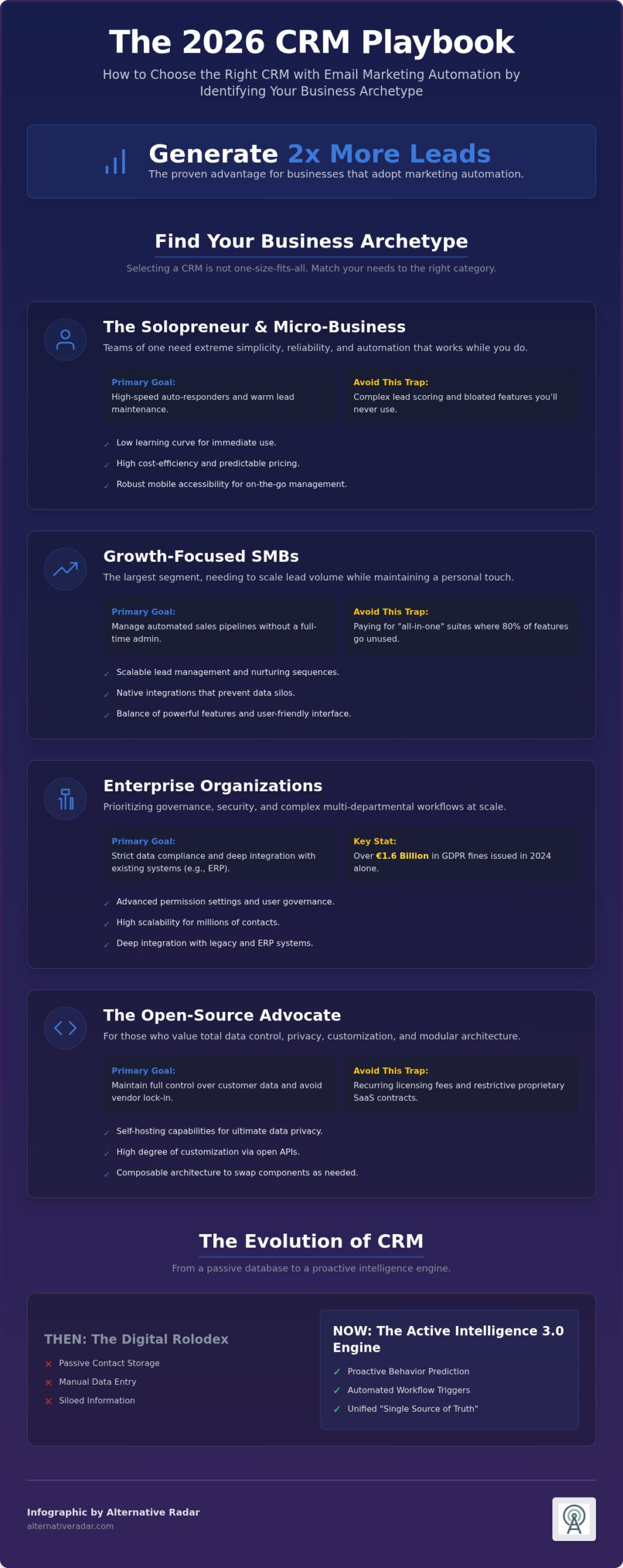
CRM software has shifted from being a simple digital Rolodex to a proactive “Active Intelligence” engine. In 2026, a platform doesn’t just store contact info; it predicts user behavior and triggers responses. Many businesses fall into the “all-in-one” trap, paying for bloated suites where 80% of the features remain untouched. This leads to high subscription costs without the promised ROI. Choosing a specific crm with email marketing automation that prioritizes native functionality over clunky API plugins ensures your data flows without friction. This list acts as your digital scout, filtering the 10,000+ SaaS ecosystem to find tools that prioritize utility over marketing hype.
The Paradox of Choice in Modern SaaS
Having 500+ options for a single software category makes decision-making harder for teams. It’s common to buy “shelfware”, which is software bought but never fully adopted because it doesn’t fit the daily workflow. Moving from broad discovery to specific comparison is the only way to avoid this waste. High-intent decision-making requires a filter that separates market leaders from high-utility alternatives. We focus on the searcher journey, moving you from a state of confusion to a clear, data-backed choice.
Defining the 2026 CRM Landscape
The current market is dominated by AI-native platforms. Tools like ActiveCampaign now utilize Active Intelligence 3.0 to automate complex Marketing automation workflows that previously required manual oversight. We also see a shift toward composable and open-source architectures, allowing you to swap parts of your tech stack as you scale. Remember that the “best” tool is subjective. It must match your business DNA rather than just having the most features. This list focuses on finding a crm with email marketing automation that balances power with actual usability. Using a neutral advisor like Alternative Radar helps you spot these hidden gems before you commit to a restrictive long-term contract.
Efficiency in 2026 is about reducing software friction. If your sales team is jumping between three different tabs to send a single follow-up, your tech stack is failing you. A structured list helps you identify which platforms offer the “single source of truth” required for modern growth. We prioritize tools that offer native automation, ensuring that your lead nurturing feels personal even when it’s running on autopilot.
Essential CRM Categories: Finding Your Business Archetype
Before you can select a specific tool, you must understand what a CRM is in the context of your specific operations. In 2026, software is no longer one-size-fits-all. We categorize users into four distinct archetypes to prevent over-spending on features that don’t align with your daily goals. Identifying your archetype early in the search process is the most effective way to eliminate “SaaS friction.”
Solopreneurs and micro-businesses require extreme simplicity. If you’re a team of one, your priority is high-speed auto-responders that keep leads warm while you work. You don’t need complex lead scoring; you need reliability and a low learning curve. These users often prioritize cost-efficiency and mobile accessibility over deep data mining.
Growth-focused SMBs represent the largest market segment. These teams need a crm with email marketing automation that handles lead management and automated sales pipelines without requiring a full-time administrator. Since businesses using marketing automation generate twice as many leads as those who don’t, this archetype focuses on scaling lead volume while maintaining a personal touch.
Enterprise organizations prioritize governance, scale, and multi-departmental workflows. With GDPR violations resulting in over €1.6 billion in fines in 2024, these users require strict data compliance and advanced permission settings. They often need deep integrations with existing ERP systems and legacy software.
Finally, the open-source advocate values privacy, customization, and self-hosting. These users prefer to maintain total control over their customer data, often to avoid the recurring licensing fees of proprietary SaaS. This archetype is common in highly regulated industries or tech-heavy firms that require unique, modular architectures.
Operational vs. Analytical vs. Collaborative CRM
Operational CRMs focus on the “now.” They streamline daily email and marketing tasks to keep your sales engine running. Analytical CRMs are for the “why.” They provide deep dives into campaign data and revenue forecasting, helping you spot trends before they become problems. Collaborative CRMs focus on the “who,” breaking silos between sales, support, and marketing teams to ensure a unified customer experience across every touchpoint.
Why Categorization Matters for ROI
Categorization is your best defense against the “Enterprise Tax.” This occurs when a business pays for a high-tier plan just to unlock a single automation feature. Selecting the right crm with email marketing automation ensures your team doesn’t outgrow its tech stack in six months. If your current tool feels too bloated or expensive, finding the best alternative to popular software can save thousands in annual subscription costs. You can use Alternative Radar to filter these archetypes and find a platform that fits your business DNA perfectly.
The Master CRM List: Top Contenders by Use Case
Selecting a crm with email marketing automation requires looking beyond the surface level of feature lists. In 2026, the market has split into platforms that prioritize sales pipelines and those that lead with marketing intelligence. For teams that live in their deal boards, Pipedrive and Salesforce offer robust sales-first automation. These tools excel at moving leads through a funnel, but their email capabilities often serve the specific deal rather than the broader campaign. If your primary goal is high-volume outreach, you’ll need to look at specialists that prioritize the inbox. Alternative Radar serves as your neutral filter here, helping you identify which tools provide the best ROI for your specific use case.
The Marketing Automation Specialists
ActiveCampaign and Brevo are the benchmarks for marketing-led environments. ActiveCampaign’s Active Intelligence 3.0 allows for “Autonomous Marketing,” where the system drafts and sends sequences based on real-time user intent. This is ideal for high-velocity brands that need to scale personalization without adding headcount. Brevo remains a critical hybrid choice for businesses that need transactional email reliability alongside traditional CRM features. It’s particularly effective for e-commerce and SaaS companies where account updates and marketing blasts must coexist in one platform.
The Open Source and Privacy-First List
Data sovereignty is no longer a niche concern. With regulations like GDPR and CCPA carrying heavy penalties, many firms move toward self-hosted solutions to maintain total control over customer data. Odoo, SuiteCRM, and Vtiger lead this category by offering modular architectures that you can customize to your specific business DNA. These “hidden gems” provide a level of flexibility that proprietary giants don’t match. For a deep dive into technical specifications and licensing, view our open source CRM software comparison. These tools are the best fit for businesses that require high customization without recurring per-user licensing fees.
Enterprise Powerhouses and AI Workflows
Salesforce and HubSpot remain the dominant forces for complex organizational automation. By 2026, these platforms have integrated AI agents that don’t just suggest templates but autonomously manage entire campaign lifecycles. This level of power is essential for enterprises managing multi-departmental workflows. However, small businesses should be wary of the “Enterprise Tax.” The U.S. Chamber of Commerce guide to CRM email marketing suggests that lightweight tiers from Zoho CRM or Freshsales often provide better ROI for smaller teams. Invest in a “no-limits” platform only when your data complexity demands it; otherwise, a niche or lightweight alternative usually offers a faster path to productivity.
Critical Selection Criteria: Evaluating Your Shortlist
A feature-rich list is only the beginning of your selection process. Choosing a crm with email marketing automation requires you to look past the marketing dashboard and into the daily operational reality of your team. User adoption is the single most important factor in automation success. Software that feels like a chore won’t be used. If your team finds the automation builder too complex, they’ll bypass it entirely, leaving you with expensive, empty databases. Prioritize tools that offer native mobile apps, allowing your sales reps to manage workflows and trigger email sequences while they’re in the field.
The 2026 Integration Checklist
Your tech stack’s efficiency depends on how well your CRM communicates with tools like Slack, Gmail, and your project management software. Native integrations are always faster and more stable than third-party workarounds. When evaluating a crm with email marketing automation, verify the API availability and no-code connector support for platforms like Zapier or Make. Data portability is another critical requirement. Ensure you can export not just your contacts, but your actual automation logic and email templates. Being locked into a proprietary system’s logic can make switching platforms in the future prohibitively expensive.
Hidden Costs to Watch For
The advertised per-user price is often just a fraction of the total cost of ownership (TCO). For example, a mid-market firm with 50 users might face a first-year total cost of approximately $157,000 once you factor in implementation, data migration, and staff training. You must also distinguish between per-user and per-contact pricing models. A “cheap” per-user license can quickly become a liability if the platform charges heavily for every 1,000 contacts added to your marketing list. Watch for these additional expenses:
- Onboarding Fees: Many enterprise tiers from vendors like Salesforce or HubSpot require mandatory consultant-led setup.
- API Limits: Some platforms charge extra if your automated workflows exceed a certain number of daily calls.
- Support Tiers: Check if “Premium Support” is a required add-on for accessing live technical help.
- Sandbox Environments: Testing complex automations often requires a separate dev environment, which isn’t always included in the base price.
Don’t let hidden fees erode your marketing budget. You can use Alternative Radar to compare the real TCO of these platforms and find high-utility alternatives that offer transparent, flat-rate pricing models.
Navigating the CRM Landscape with Alternative Radar
Alternative Radar acts as your neutral advisor in a market often crowded with biased sales pitches. We provide the clarity needed to cut through marketing hype and focus on actual utility. Whether you’re looking for a household name or popular open source business software, our platform serves as a high-quality filter. We’ve done the hard work of searching and testing so you don’t have to. Our goal is to empower you to make smarter choices that value your time and resources. By acting as a digital scout, we ensure you discover tools that fit your specific business DNA.
Our Commitment to Objective Comparison
We prioritize user utility over vendor partnerships. This independence allows us to highlight hidden gems that major directory sites often ignore. Many businesses find that a specialized crm with email marketing automation provides better ROI than a bloated, all-in-one suite. We categorize items using clear technical labels, ensuring that both casual users and professional buyers can find their match. We encourage you to explore alternative software before committing to a restrictive long-term contract with a market leader. Our lists include free and open-source options because we value transparency and logic over external commissions.
Final Recommendation: The Trial Framework
Moving from a list to a live environment is the final stage of your journey. Most platforms offer a 14-day trial; use this time to test actual workflows with real data. Don’t just look at the interface. Set up a “Three-User Test” where team members from sales, marketing, and support evaluate the software for adoption and speed. If a crm with email marketing automation feels clunky or slows down your response time during this phase, it’s not the right fit. Speed is a feature. If the automation builder has a steep learning curve that stalls your campaigns, move on to the next contender on your shortlist.
Start your comparison journey today by using our filtered lists to shortlist three contenders. Your objective is to find a platform that reduces software friction and creates a single source of truth for your customer data. By following a structured evaluation process, you’ll avoid the common industry pain points of data silos and wasted subscription costs. Success in 2026 requires a tech stack that works for you, not the other way around. Take the next step by testing a platform that aligns with your specific business archetype and growth goals.
Optimizing Your Sales and Marketing Engine
Choosing a crm with email marketing automation is a strategic decision that dictates your team’s operational velocity. You’ve identified your business archetype and learned how to navigate the total cost of ownership beyond the sticker price. Success in 2026 relies on eliminating software friction and ensuring your data remains portable across your tech stack. Don’t let bloated subscriptions or complex builders stall your growth. By prioritizing native automation and high-utility features, you can build a system that works for your team instead of against them.
It’s time to move from discovery to implementation. We provide objective comparisons of 500+ tools with a dedicated focus on open-source and free alternatives that major directories often overlook. Our efficiency-driven reviews are designed for busy professionals who value clarity over marketing hype. Explore the best CRM alternatives on Alternative Radar to find the hidden gems that fit your unique business DNA. You possess the tools to make a smarter choice. Take control of your customer data today and watch your productivity scale.
Frequently Asked Questions
What is the best CRM with email marketing for a small business in 2026?
Zoho CRM and HubSpot Starter are top choices for small teams in 2026. Zoho provides a strong balance of price and features, while HubSpot offers a polished user interface that speeds up adoption. Many small businesses also use Pipedrive for its focus on visual sales pipelines. Your final choice should depend on whether you prioritize simple lead tracking or complex marketing sequences for your growth.
Are there any truly free CRM software options with robust email automation?
Truly free options with robust logic are rare, but HubSpot and Zoho offer limited free tiers. HubSpot’s free tools include basic email marketing, though advanced automation logic is usually locked behind a paywall. For a crm with email marketing automation that is completely free and uncapped, you’ll likely need to explore self-hosted open-source solutions like SuiteCRM. These require more technical setup but eliminate recurring monthly licensing fees.
How do I migrate my email list to a new CRM without losing automation history?
You can migrate contact data easily, but automation history and logic rarely transfer between platforms. Most CRM systems use proprietary code for their workflow builders. You’ll need to map out your existing sequences manually and rebuild them in the new tool. Prioritize exporting your engagement data, such as last open dates and click-through rates, to maintain your lead scoring accuracy. This ensures your nurturing sequences remain effective after the move.
What is the difference between an open-source CRM and a hosted SaaS CRM?
Hosted SaaS CRMs like Salesforce are managed by the vendor, offering high reliability but recurring monthly fees. Open-source CRMs like Odoo or Vtiger give you the source code, allowing for total customization and data sovereignty. While open-source options eliminate licensing costs, they require your own server infrastructure and technical expertise to maintain. SaaS is generally better for teams that want a plug-and-play experience without managing the backend.
Does my business really need an AI-powered CRM for email marketing?
AI isn’t mandatory, but it significantly reduces the time spent on manual tasks like drafting emails or scoring leads. In 2026, AI agents can autonomously manage follow-up sequences based on real-time user intent. If your team handles a high volume of leads, AI-powered tools like ActiveCampaign’s Active Intelligence 3.0 provide a competitive edge. Smaller operations with lower lead volume can still succeed using traditional rule-based triggers and manual oversight.
How long does it typically take to implement a new CRM with automation?
Implementation typically takes between two weeks and three months depending on data complexity. A simple setup for a small business might be ready in days. However, enterprise-level migrations involving custom API integrations and extensive staff training often span several months. Planning your data mapping and cleansing before you start the migration is the most effective way to shorten this timeline. This preparation reduces downtime and prevents data silos.
Can I integrate my existing Gmail or Outlook calendar with these CRM tools?
Yes, almost every modern CRM offers native sync for Gmail and Outlook calendars. This integration ensures that your meetings, follow-ups, and email threads appear directly within the customer record. High-utility platforms use two-way sync, so changes made in your calendar app reflect in the CRM immediately. This functionality eliminates the need for manual data entry and prevents double-booking during your sales outreach. It creates a single source of truth.
What are the risks of using a “free” CRM for email marketing?
The primary risks include data limitations, lack of technical support, and feature gating. Many free tiers limit the number of contacts you can store or the volume of emails you can send monthly. You might also find that critical security features or advanced crm with email marketing automation capabilities require a paid upgrade. Always check the vendor’s data privacy policy to ensure your customer information isn’t being monetized or shared with third parties.