

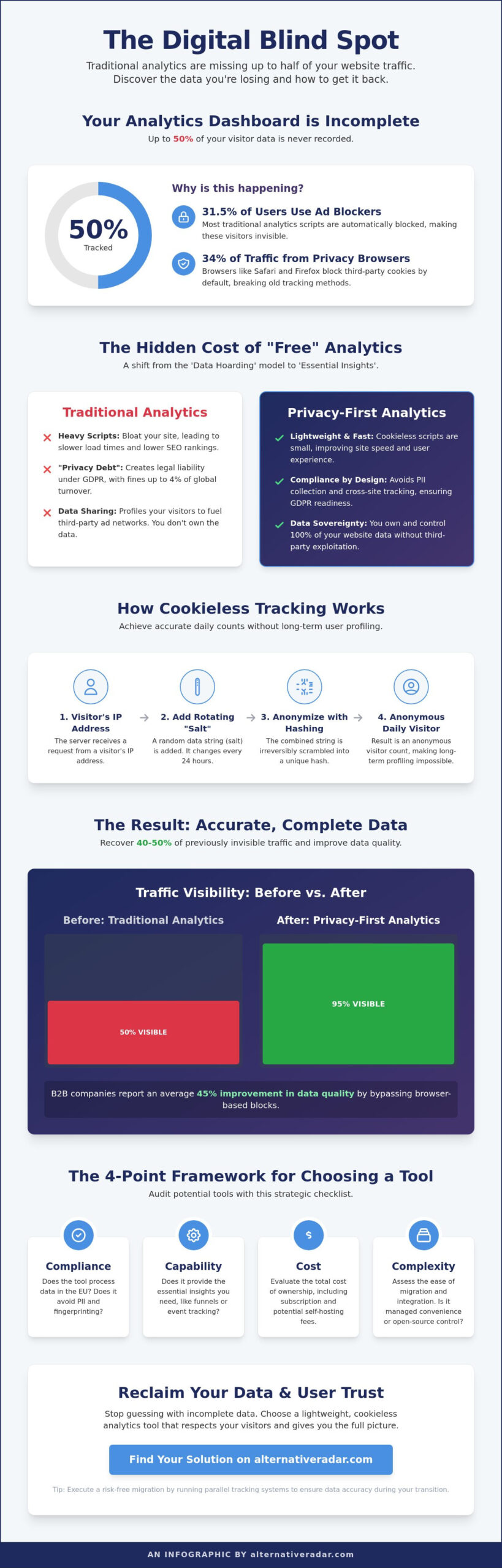
Did you know that traditional analytics platforms are currently missing up to 50% of your actual website traffic? Between the 31.5% of internet users who now utilize ad blockers and the “Reject All” buttons standard on EU consent banners, your dashboard is likely providing an incomplete picture. Switching to privacy-focused analytics tools is no longer just a compliance choice; it’s a performance strategy to recover the data you’re already losing to Big Tech surveillance and browser restrictions.
You likely feel the legal anxiety surrounding the SECURE Data Act of 2026 or the latest GDPR enforcement trends. It’s exhausting to manage complex interfaces like GA4 while worrying if your data transfers are truly compliant. You want a clear view of your audience without the weight of invasive scripts that slow down your site and alienate your visitors through intrusive tracking prompts.
This guide will show you how to reclaim your data and user trust by adopting a privacy-first stack. We compare the leading 2026 solutions, including the latest versions of Fathom and Plausible, to help you achieve faster load times and accurate visitor counts. By the end of this article, you’ll know exactly which lightweight, cookieless tools fit your specific operational needs and budget.
Key Takeaways
- Identify the “Privacy Debt” caused by legacy tracking and learn how you’ll recover up to 50% of your missing visitor data.
- Master the technical shift toward server-side events and IP hashing to maintain anonymity without sacrificing insight.
- Evaluate top privacy-focused analytics tools using a comparative lens that balances managed convenience with open-source control.
- Use a dedicated four-point framework to audit potential tools for compliance, capability, cost, and operational complexity.
- Execute a risk-free migration from GA4 by running parallel tracking systems to ensure data accuracy during your transition.
Beyond the Cookie Banner: Why Privacy-Focused Analytics are Essential in 2026
The landscape of digital measurement changed permanently in early 2026. Privacy-focused analytics tools are defined by what they don’t do: they don’t collect Personal Identifiable Information (PII), they don’t use persistent identifiers, and they don’t follow users across the web. This marks a fundamental shift from the “Data Hoarding” model, where every possible click is harvested for future use, to an “Essential Insights” model. In this new framework, you only collect the data necessary to improve your user experience and site performance.
Traditional Big Tech tracking scripts create what we call “Privacy Debt.” This is the accumulated legal and ethical liability your brand carries by allowing third-party surveillance on your platform. As of May 2026, European authorities are processing an average of 443 data breach notifications every day. If your current stack relies on transferring user data to non-compliant servers, you’re building a liability that could result in fines up to 4% of your global turnover. The shift toward strict EU-only data processing is no longer a suggestion; it’s a requirement for operational safety.
Modern Web analytics must now balance the need for high-level trends with the user’s right to anonymity. By choosing tools that prioritize data sovereignty, you’re not just avoiding legal trouble. You’re opting for a cleaner, more efficient way to understand your audience.
The High Cost of “Free” Analytics
Most “free” platforms operate as data-sharing agreements. When you install their script, you’re essentially allowing them to profile your audience to refine their own ad networks. This model carries a hidden performance tax. Heavy, multi-purpose tracking scripts often bloat your site’s code, leading to slower load times and lower SEO rankings. If you’re currently auditing your tech stack, finding the best alternative to popular software in 2026 is a critical step toward a leaner, faster website that respects user resources.
Recovering Lost Data from Ad-Blockers
The data gap is significant. Research shows that Safari and Firefox, which block third-party cookies by default, now account for 34% of North American web traffic. When you add the 31.5% of global users who utilize ad blockers, your traditional analytics dashboard might only be showing half the truth. Privacy-focused analytics tools solve this by using first-party, cookieless scripts. These scripts are rarely flagged by blockers because they don’t engage in invasive profiling. By switching, you can often recover 40% to 50% of the traffic data that was previously invisible. This isn’t just about compliance; it’s about making business decisions based on accurate, complete numbers.
The Technical Shift: How Cookieless Tracking Works Without Invasive Profiling
The transition away from third-party cookies isn’t just a trend; it’s a structural change in how the internet functions. Traditional tracking relied on placing a persistent file on a user’s device to follow them across different websites. Modern privacy-focused analytics tools replace this invasive method with server-side event processing. Instead of the browser storing a history, your server records a single event at the moment of interaction. This shift has led to a 72% adoption rate of server-side tracking among B2B companies, who report an average 45% improvement in data quality by bypassing browser-based blocks.
To identify unique visitors without storing Personal Identifiable Information (PII), these tools use IP hashing combined with a rotating “salt.” A salt is a random string of data added to the visitor’s IP address before it’s processed into a hexadecimal string. Because this salt changes every 24 hours, a visitor will have a completely different identifier if they return the next day. This technical barrier makes long-term profiling impossible while still providing accurate daily visitor counts. For those new to these concepts, a basic introduction to analytics helps clarify how data flows from a user’s click to your final report without compromising their identity.
Legal compliance is the secondary benefit of this technical architecture. Because these tools don’t store data on the user’s device or collect PII, many configurations don’t require a GDPR consent banner. For example, Matomo 5.9.0 recently introduced one-click compliance with CNIL standards, allowing site owners to collect essential data immediately. If you’re looking to upgrade your stack, you can compare top software options to see which engine fits your current infrastructure and traffic volume.
IP Anonymization vs. Fingerprinting
There’s a critical difference between identifying a person and identifying a session. Fingerprinting attempts to create a permanent ID by looking at browser settings and hardware specs. In contrast, privacy-focused analytics tools use temporary hashes that expire. This is particularly relevant for businesses engaged in programmatic display advertising, where clean first-party data has become the primary currency for effective targeting. By using daily salt rotation, you ensure that your data is useful for optimization without building a prohibited database of user behavior.
Lightweight Scripts and Core Web Vitals
Performance is a primary driver for the switch. Legacy analytics scripts are often bloated, reaching sizes over 30KB and requiring significant JavaScript execution time. Privacy-first tools like Plausible or Fathom offer scripts as small as 1KB. This reduction directly improves your Core Web Vitals, specifically Interaction to Next Paint (INP) and Largest Contentful Paint (LCP). In 2026, every millisecond of script execution translates directly to conversion rate fluctuations. Reducing the weight of your tracking stack ensures a smoother mobile experience and better organic search visibility.
Top-Rated Privacy-Focused Analytics Tools: A Comparative Review
Choosing between privacy-focused analytics tools requires a choice between two primary deployment models: managed SaaS or self-hosted open source. Managed services offer immediate deployment and zero maintenance; self-hosted versions provide total data sovereignty and zero subscription costs for those with the technical infrastructure to support them. Your decision should hinge on whether you prioritize ease of use or absolute control over your data pipeline.
Plausible Analytics remains the standard for simplicity. Its $9/month starter plan covers 10,000 pageviews, making it an efficient choice for smaller projects. On May 27, 2026, Plausible added a “User Journeys” feature to its dashboard, finally bridging the gap between basic pageview counting and behavioral analysis. This update allows site owners to see the paths visitors take without the need for invasive tracking scripts or persistent cookies.
Fathom Analytics, the original pioneer of the simple movement, released Fathom V4 in February 2026. For $15/month, it supports up to 100,000 pageviews across 10 different sites. Its new engine includes custom data exports and a deep Google Search Console integration that provides SEO insights without the heavy script execution of legacy tools. Fathom’s focus on speed and reliability makes it a high-quality filter for businesses that need data without the UI clutter.
For enterprise-level ownership, Matomo is the dominant choice. Version 5.10.0, released on May 3, 2026, continues to offer a feature set that rivals GA4 while keeping data entirely under your control. Developers seeking even leaner privacy-focused analytics tools often turn to Pirsch.io for its backend integration or Ackee for its Node.js-based architecture. These tools cater to specific technical requirements where standard SaaS solutions might feel too restrictive.
Managed SaaS Leaders: Plausible and Fathom
Fathom’s “forever data retention” policy and Plausible’s community-driven roadmap represent two different philosophies in the SaaS space. Setup for WordPress or Shopify users is nearly identical: you replace a 30KB legacy script with a 1KB alternative. While Plausible is more cost-effective for low-traffic sites, Fathom’s pricing tiers offer better value as you scale toward 500,000 monthly pageviews. Both platforms ensure your site remains lightweight and fast, directly benefiting your mobile user experience.
Self-Hosted Giants for Data Sovereignty
Matomo serves as the premier open source business software for organizations that cannot risk data transfers to third-party clouds. Healthcare and government sectors utilize the on-premise version to ensure 100% compliance with regional data residency laws. While the software is free, you must account for the technical overhead of server maintenance and security patches. Matomo 5.9.0’s one-click CNIL compliance makes this process significantly easier for EU-based teams looking to minimize legal anxiety.
Strategic Evaluation: Matching Analytics Tools to Your Business Model
Selecting the right platform requires a balance between operational efficiency and data depth. While the shift toward privacy-focused analytics tools simplifies compliance, it also demands a strategic look at your internal resources. To make an informed choice, evaluate every potential platform through a four-point framework: Compliance (data residency and PII handling), Capability (event tracking and integrations), Cost (scaling with traffic), and Complexity (technical overhead).
Your traffic volume is the primary driver of cost. Managed SaaS tools like Plausible or Fathom are highly efficient for sites under 500,000 monthly pageviews. However, for enterprise-level traffic reaching millions of hits, subscription costs can scale quickly. This is the point where the “Privacy-Utility Tradeoff” becomes a financial decision. You must determine if the “set it and forget it” nature of SaaS outweighs the potential savings of a self-hosted instance. If you’re currently auditing your options, you can compare top-rated software solutions to find the most cost-effective tier for your specific traffic profile.
Capability is the second major factor. If your marketing strategy relies on advanced features like heatmaps or session recordings, your choice narrows. While basic tools provide high-level trends, powerhouses like Matomo 5.10.0 offer deep behavioral insights that rival traditional legacy platforms. You must decide if these advanced features are essential or if they add unnecessary weight to your site’s performance and legal liability.
SaaS vs. Self-Hosted: The Hidden Maintenance Costs
Managed SaaS is the remedy for teams without dedicated IT resources. You pay for the convenience of automatic security patches, server maintenance, and guaranteed uptime. In contrast, self-hosting Matomo or Plausible removes monthly subscription fees but introduces “hidden” time costs. Your team becomes responsible for database optimization, storage scaling, and ensuring the server remains compliant with evolving regulations like the SECURE Data Act of 2026. Choose the self-hosted model only if you have the internal bandwidth to manage monthly updates and security audits.
E-commerce and Goal Tracking Capabilities
Modern privacy-focused analytics tools have evolved significantly in their ability to track revenue without using persistent cookies. Fathom V4 and Plausible’s recent updates include robust support for custom event tracking, allowing you to monitor checkout completions and form submissions via first-party scripts. These tools integrate directly with Shopify and WooCommerce, providing accurate conversion attribution without harvesting PII. For custom Single Page Applications (SPAs), ensure the tool supports history-based routing to capture state changes accurately without reloading the tracking script.
Implementing Your New Stack: From GA4 Migration to Data Sovereignty
Transitioning from Google Analytics 4 (GA4) to privacy-focused analytics tools is a strategic move that requires more than just swapping tracking IDs. One major hurdle often ignored by vendors is the limitation of historical data exports from Google. You can’t simply “import” your GA4 history into a new privacy-first platform due to fundamental differences in data structure. Therefore, your implementation strategy must focus on building a clean, first-party data foundation starting from today. Owning your data stack ensures that your metrics remain accessible and compliant, regardless of future shifts in Big Tech’s terms of service or API restrictions.
A structured transition prevents data gaps and allows you to verify accuracy before making a permanent change. Running tools in parallel is the only way to quantify the “Privacy Debt” you’ve been carrying. By the time you reach the final step of decommissioning legacy scripts, you’ll have a clear understanding of your true traffic volume, unskewed by the limitations of cookie-based tracking.
The 4-Step Migration Framework
Follow this systematic approach to ensure your new analytics stack is configured correctly from day one:
- Step 1: Inventory existing goals. Document your current GA4 conversion events and custom dimensions. Only migrate the “essential insights” that drive actual business decisions to keep your new dashboard lean and fast.
- Step 2: Install parallel tracking. Deploy your new privacy-friendly script alongside your existing GA4 tags. This allows both systems to collect data simultaneously without interfering with one another.
- Step 3: Compare data for 14 days. Expect a discrepancy in your reports. Because privacy-focused analytics tools bypass most ad blockers and consent rejections, businesses often see 40% to 50% more traffic than GA4 reports. This “dark traffic” represents the real audience GA4 was unable to capture.
- Step 4: Decommission legacy scripts. Once you’ve verified data parity and adjusted your internal benchmarks for the volume increase, remove the GA4 tags and the intrusive cookie banner.
After the technical swap, update your Privacy Policy. Transparency is a significant competitive advantage in 2026. Explicitly state that you’ve moved to a cookieless system that respects user anonymity. This builds immediate trust with the 50% to 66% of users who typically click “Reject All” on traditional banners.
Future-Proofing Your Marketing Strategy
Your new analytics stack shouldn’t exist in a vacuum. The high-quality, first-party data you collect can be integrated into other parts of your workflow, such as open source CRM software. Research indicates that companies with strong first-party data strategies achieve 3.2x better customer retention and 1.7x higher marketing ROI. By moving away from third-party dependencies, you’re building a resilient marketing engine that isn’t vulnerable to browser updates or regulatory crackdowns. Switch to a privacy-first tool today to protect your brand and reclaim the data you’ve been losing to outdated tracking methods.
Reclaim Your Data Sovereignty in 2026
The transition to a cookieless future is no longer a prediction; it’s an operational requirement for any business valuing data accuracy and user trust. By implementing privacy-focused analytics tools, you eliminate the legal risks of “Privacy Debt” while recovering the 40% to 50% of traffic data typically lost to ad blockers and consent rejections. Whether you choose the simplicity of a managed SaaS platform or the total sovereignty of a self-hosted instance, the result is a faster, leaner, and more transparent website.
Choosing the right engine for your specific traffic volume and technical capability is the final step in future-proofing your marketing stack. You can find the perfect privacy-first analytics alternative on Alternative Radar. Our platform provides detailed comparisons of 50+ analytics tools and objective, commission-neutral reviews updated for 2026 compliance standards. It’s time to move beyond invasive tracking and start making decisions based on complete, ethical data. Take control of your digital infrastructure today to build a more resilient brand.
Frequently Asked Questions
Is Google Analytics illegal in the EU in 2026?
The legality of Google Analytics remains a complex issue depending on your specific configuration and data proxying methods. While GA4 introduced more regional controls, many European data protection authorities still find standard implementations non-compliant due to how data is transferred to U.S. servers. To eliminate this legal anxiety, many organizations are switching to EU-hosted privacy-focused analytics tools that ensure all data processing remains within the European Economic Area.
Do privacy-focused analytics tools require a cookie consent banner?
Most of these tools don’t require a cookie consent banner because they don’t use persistent identifiers or store data on the user’s device. By moving away from invasive tracking, you can typically remove the “Reject All” prompts that currently cause you to lose up to 50% of your visitor data. However, you should verify your specific setup against local laws like the California Delete Act or the SECURE Data Act of 2026 to ensure full compliance.
Can I import my historical Google Analytics data into Plausible or Fathom?
Full historical imports are generally not possible because the data structures between legacy platforms and privacy-first tools are fundamentally different. Privacy-focused tools don’t collect the same depth of PII, meaning there is no direct way to map old user IDs to new anonymized hashes. Most site owners choose to run their new stack in parallel with GA4 for 14 days to establish a comparative baseline before starting fresh with their new data foundation.
How do cookieless analytics tools distinguish between unique visitors?
These tools distinguish unique visitors by using IP hashing combined with a “salt” that rotates every 24 hours. This technical process creates a temporary identifier that allows the system to count a unique session without knowing the user’s actual identity. Because the salt changes daily, it’s impossible to track that same user across multiple days, which prevents long-term profiling while still providing accurate daily visitor counts.
Will using a privacy-focused analytics tool improve my SEO rankings?
Switching can indirectly improve your SEO by significantly enhancing your site’s performance and Core Web Vitals. Legacy scripts are often 30KB or larger, while privacy-focused analytics tools typically offer scripts as small as 1KB. This reduction in JavaScript execution time leads to faster Largest Contentful Paint (LCP) and Interaction to Next Paint (INP) scores, both of which are critical ranking factors for search visibility in 2026.
Are there free privacy-focused analytics tools for small blogs?
Yes, Matomo offers a free “On-Premise” version that you can host on your own server infrastructure. This is an excellent choice for small blogs with the technical capability to manage their own updates and security. For managed SaaS options, Plausible and Fathom typically start around $9 to $15 per month, though they often provide 30-day free trials to help you test the interface before committing to a subscription.
Can I track e-commerce conversions and revenue with these tools?
You can track e-commerce revenue and custom conversion goals with most modern privacy-first platforms. Tools like Fathom V4 and Matomo 5.10.0 offer dedicated integrations for Shopify and WooCommerce. These systems allow you to monitor checkout completions and order values using first-party scripts, ensuring you get accurate attribution data without the need for invasive third-party cookies or persistent user tracking.
Do privacy-first analytics work with ad-blockers?
Privacy-first tools are significantly more resilient to ad blockers because they use first-party domains and don’t engage in cross-site tracking. Since they don’t appear on major blocklists, they can capture the 31.5% of internet users who typically block traditional analytics scripts. This allows you to see a much more accurate picture of your actual traffic volume compared to the incomplete reports provided by legacy Big Tech platforms.