

The easiest platform to set up is often the one that will force you to migrate in six months. You likely want to launch quickly without getting buried in code or hit by unexpected transaction fees. It’s a common frustration; you find a tool that feels intuitive, only to realize later that it lacks the SEO depth or inventory scaling you need as sales grow. Choosing the best e-commerce platform for beginners isn’t just about finding a drag-and-drop interface. It’s about selecting a foundation that supports a live store in under 48 hours while offering a clear path to capture a share of the $7.4 trillion global market.
This guide cuts through the marketing noise to help you find a balance between simplicity and long-term utility. We have analyzed the leading contenders for 2026, including Shopify, Wix, and Squarespace, to ensure your monthly costs remain predictable. You’ll discover which platforms offer 0% transaction fees and which ones provide the best marketing integration for new entrepreneurs. This comparison provides the technical clarity needed to bypass overwhelm and start selling with confidence.
Key Takeaways
- Evaluate the shift from manual configuration to AI-assisted store building to launch your business with minimal technical friction.
- Compare the maintenance requirements of hosted SaaS platforms against self-hosted open-source options to determine which model fits your technical capacity.
- Identify the best e-commerce platform for beginners by auditing scalability features that prevent a forced migration as your sales volume increases.
- Prioritize mobile-first design and intuitive inventory tools to ensure your store meets the demands of 2026’s digital shoppers.
- Access a direct comparison of top-tier platforms like Shopify and Wix to select a solution tailored to your specific creative or growth objectives.
Why Choosing an E-commerce Platform for Beginners is Different in 2026
Launching a store used to require technical literacy or a significant budget for developers. In 2026, the landscape has shifted toward total accessibility. While What is e-commerce? remains the fundamental exchange of goods and services online, the methods for entering this space have evolved into streamlined, automated workflows. Today, the best e-commerce platform for beginners is no longer just the one with the most features. It’s the one that minimizes the distance between an idea and a transaction. The barrier to entry has never been lower, but the cost of a wrong choice has never been higher. Selecting a platform that doesn’t scale can result in expensive migrations and lost data as your business grows.
The Definition of Beginner-Friendly
In the current market, “beginner-friendly” describes a platform that removes the need for manual configuration. Modern users expect no-code environments where drag-and-drop interfaces handle the heavy lifting of design. This includes integrated payment processing and automated shipping logistics that work immediately upon sign-up. Beginner-friendly e-commerce is a balance of intuitive UI and automated backend management. You shouldn’t have to worry about PCI DSS compliance or server security patches. A truly accessible platform provides out-of-the-box functionality, reducing the need for a dozen third-party apps that inflate your monthly bill and complicate your dashboard. Efficiency is the goal; technical debt is the enemy.
The 2026 Market Landscape
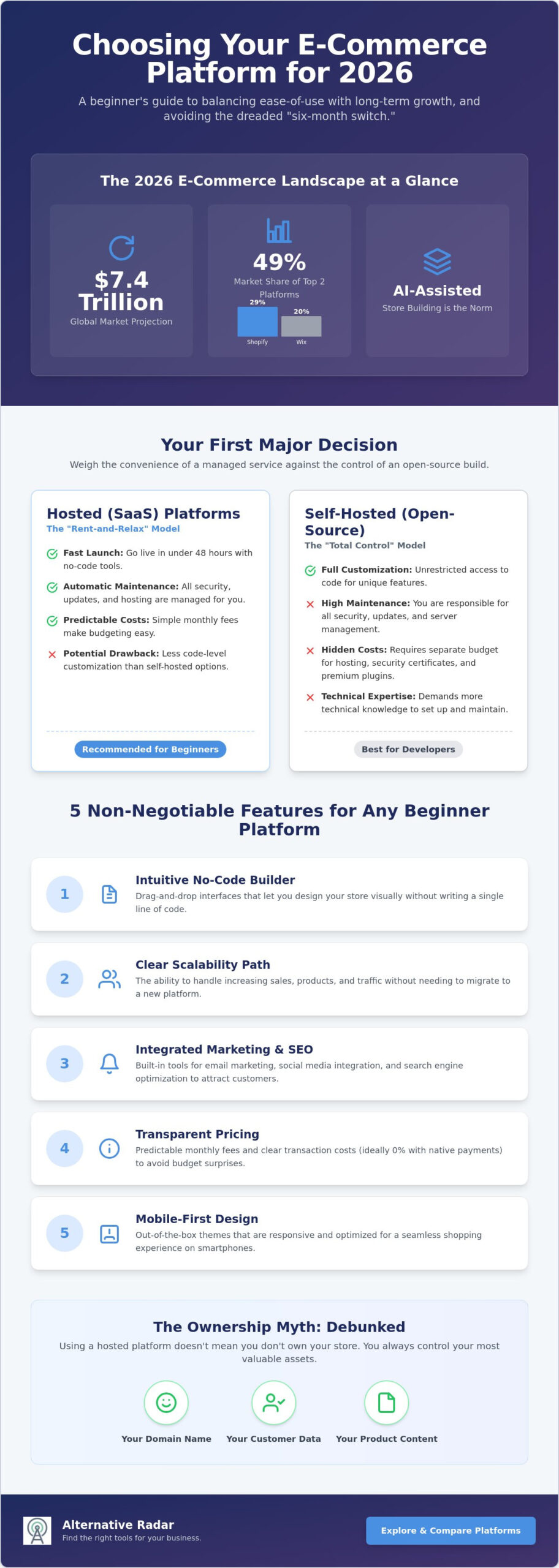
The most significant shift in 2026 is the rise of AI-assisted store building. Traditional giants like Shopify, which currently powers 29% of stores, have integrated AI site generators that build entire product catalogs from a single text prompt. These tools don’t just create layouts; they suggest pricing strategies and generate SEO-optimized product descriptions. However, popularity doesn’t always equal suitability. For many new entrepreneurs, finding the best alternative to market leaders is a smarter move for niche businesses. While Shopify and Wix (powering 20% of stores) dominate the conversation, smaller competitors often offer more predictable pricing or specialized tools for specific industries. The best e-commerce platform for beginners is the one that aligns with your specific product type and growth trajectory. Evaluating these options requires looking past the brand name to see how the software handles the daily realities of inventory and customer data.
Hosted vs. Self-Hosted: Which Path Suits a New Entrepreneur?
Deciding between a hosted and self-hosted system is the first major hurdle for any new merchant. This choice dictates your daily workload and your long-term budget. To find the best e-commerce platform for beginners, you must weigh the convenience of a managed service against the granular control of an open-source build. While both routes offer valid ways to start selling online, they demand very different levels of technical commitment.
Maintenance is the invisible cost of self-hosting. If you choose an open-source platform, you are responsible for security patches, plugin updates, and server management. A single missed update can lead to a security breach. In contrast, hosted platforms manage these background tasks automatically. Over a 12-month period, the total cost of ownership (TCO) for a self-hosted site often exceeds that of a SaaS platform once you factor in premium hosting, security certificates, and the time spent troubleshooting. Efficiency-driven entrepreneurs usually find that the predictable monthly fee of a hosted service is a small price to pay for peace of mind.
The ownership myth often scares beginners away from SaaS. Some believe that using a hosted platform means you don’t truly own your store. This is a misunderstanding. While you are renting the software, you own your domain name, your customer data, and your product content. You can export this data at any time. The platform is simply the engine; you remain the driver. If you’re ready to see how these tools stack up, you can compare specific software features to find your perfect match.
SaaS Platforms: The “Rent-and-Relax” Model
SaaS platforms prioritize speed to market. You can launch a fully functional store in hours rather than weeks. These systems include SSL certificates and PCI compliance by default, which are non-negotiable for accepting payments safely. You pay for the infrastructure, so you don’t have to build it. This model provides predictable monthly billing, which helps beginners manage their cash flow without worrying about variable hosting costs or sudden developer fees. It’s the best e-commerce platform for beginners who want to focus on marketing rather than code.
Self-Hosted Solutions: For the Tech-Curious Beginner
Self-hosted platforms like WooCommerce offer unmatched flexibility. They are ideal if you have specific design requirements that standard templates can’t meet. However, they come with a steep learning curve. You must manage a complex ecosystem of plugins and themes. This structure is similar to how businesses manage an open source CRM software comparison; the power lies in customization, but the responsibility for stability rests entirely on your shoulders. For most new entrepreneurs, the time-cost of this management outweighs the benefits of the lower initial software price.
5 Non-Negotiable Features for Any Beginner Platform
A visually appealing storefront is a secondary concern if the backend systems fail to support daily operations. The best e-commerce platform for beginners must provide a utility-first environment where technical management is invisible. Many new entrepreneurs focus on “cool” visual themes, but backend stability determines your ability to scale. You need a system that prioritizes automation, security, and accessibility without requiring a computer science degree. These five features are the baseline requirements for any software choice in 2026.
Inventory management should be intuitive. Tracking stock levels, managing variants, and syncing across channels shouldn’t require a manual. If you have to update numbers across multiple screens, the system is flawed. Equally important is a mobile-first design philosophy. In 2026, 80% of your traffic will likely arrive via a smartphone. A platform that treats mobile as an afterthought will kill your conversion rates. Finally, ensure you have 24/7 access to human support. AI chatbots can handle basic queries, but when a payment gateway fails at midnight, you need a person to intervene.
The Importance of Native SEO Tools
Search visibility is your primary growth engine. Research from BrightEdge indicates that 93% of online experiences begin with a search engine. If your platform doesn’t handle technical SEO natively, you’ll remain invisible to potential customers. Look for systems that automatically generate sitemaps and include schema markup by default. Speed optimization is also a critical ranking factor. The platform must offer high-performance hosting and image compression to ensure your pages load in under two seconds on mobile devices. Built-in tools are superior to third-party plugins because they don’t bloat your code or slow down your site.
Payment and Security Essentials
Security is a major pain point for new sellers. Hosted platforms handle PCI DSS compliance automatically, which is a significant advantage for beginners. You shouldn’t have to touch security patches or encryption protocols manually. When evaluating costs, look past the monthly subscription fee. A “free” tier often hides high transaction fees that become more expensive than a paid plan once you reach a certain sales volume. For example, a plan with a 3% transaction fee might look cheaper than a $39 monthly subscription, but the math changes quickly as you scale. Ensure the platform supports modern payment methods like Apple Pay, Google Pay, and native cryptocurrency payments to reduce friction at checkout. Multi-currency support is also essential if you plan to reach a global audience without managing separate storefronts.
The Scalability Audit: Avoiding the “Six-Month Switch”
Choosing a platform based solely on its launch speed is a common strategic error. While you want a live store quickly, the best e-commerce platform for beginners must survive the transition from your first sale to your thousandth. Technical debt accumulates when you select a tool that lacks API access or limits your ability to export data. If you hit a growth ceiling in six months, the cost of migrating your entire catalog and customer history will far exceed any initial savings. You need a solution that scales horizontally across new marketplaces and vertically through deeper technical integrations.
Beginners should evaluate a platform’s internationalization capabilities early. With the introduction of Digital Product Passports in the EU starting in 2026, your software must handle complex supply chain transparency and multi-region tax compliance. If your platform doesn’t support multi-language storefronts natively, you’ll be locked out of global markets as soon as you try to expand. True scalability means your backend stays stable even as you add hundreds of SKUs and thousands of monthly visitors. Before you commit, compare platform scalability and API access to ensure your choice has the longevity your business requires.
When “Easy” Becomes “Limited”
The problem with many entry-level tools is their closed ecosystem. Proprietary code might make the initial setup feel seamless, but it often prevents you from adding custom features later. Data portability is the most important feature you haven’t thought of yet. If you can’t easily move your customer reviews, order history, and SEO metadata to a new provider, you’re effectively trapped. Signs you are outgrowing your current setup include sluggish dashboard performance, limited checkout customization, and a lack of advanced reporting tools. Don’t wait for your site to crash during a high-traffic event to realize you’ve reached a growth ceiling.
Planning for Multi-Channel Success
In 2026, selling exclusively through your own website is a missed opportunity. The best e-commerce platform for beginners provides a single source of truth for inventory across TikTok, Amazon, and Instagram. When a product sells on social media, your website’s stock levels should update instantly to prevent overselling. Unified customer data allows you to track a buyer’s journey across different touchpoints, which is essential for personalized marketing. By selecting a platform with robust multi-channel synchronization today, you prevent the administrative nightmare of manual updates tomorrow. Efficiency in the early stages creates the momentum needed for long-term survival.
Top 5 Beginner-Friendly E-commerce Platforms for 2026
Selecting the best e-commerce platform for beginners requires matching your current technical skill level with your future revenue goals. While the previous sections established the importance of scalability and native SEO, the following five platforms represent the most efficient entry points into the market. Each has been evaluated based on its 2026 feature set, including AI integration and cost transparency.
Shopify remains the primary choice for merchants planning significant expansion. Its Basic plan starts at $39 per month, providing a robust foundation for those who want a professional ecosystem. For creators who prioritize aesthetics, Wix Studio offers a Core plan at $29 per month with zero transaction fees. Meanwhile, absolute novices are increasingly turning to AI-first builders like Hostinger, which uses prompt-based generation to bypass the design phase entirely. BigCommerce serves those with complex inventory needs, while WooCommerce remains the standard for users who demand total data ownership. Choosing between them is a matter of identifying which “growth ceiling” you are willing to manage; if you want to see how a specialized retailer manages a complex catalog of custom products, click here to explore an example in the home decor industry.
Platform-Specific Verdicts
- Shopify: Best for serious growth. Pro: Unmatched app ecosystem and reliability. Con: Additional fees (up to 2.0%) if you don’t use Shopify Payments.
- Wix Studio: Best for creative brands. Pro: Total drag-and-drop design freedom. Con: Difficult to migrate data to other platforms later.
- WooCommerce: Best for technical control. Pro: No monthly software subscription. Con: High maintenance burden for security and updates.
- Hostinger Website Builder: Best for absolute novices. Pro: AI builds the store in minutes. Con: Limited scalability for high-volume catalogs.
- BigCommerce: Best for multi-channel. Pro: Most features are native rather than app-based. Con: Revenue limits force you into higher-priced tiers.
Shopify remains the leader for apps, while Wix wins on pure visual ease. Your decision should rest on whether you prefer to pay for convenience or invest time in customization. If you plan to sell across TikTok and Amazon immediately, BigCommerce or Shopify provide the most stable synchronization. If you’re launching a small boutique with a focus on brand identity, Wix or Hostinger will get you live faster.
The Alternative Radar Recommendation
Before committing to a subscription, use our comparison tools to audit the specific API limits and payment gateway restrictions of your top choices. A free trial is only valuable if you test the backend efficiency, not just the front-end templates. Verify that your chosen platform supports the 2026 requirements for Digital Product Passports if you plan to sell in international markets. You can find the best e-commerce software alternatives on Alternative Radar to ensure you aren’t overlooking a niche tool that better suits your specific industry. Use our final checklist to confirm that your selected platform offers 24/7 human support and automated PCI compliance before you enter your credit card details.
Building Your Store for 2026 and Beyond
Choosing the best e-commerce platform for beginners requires looking past the initial setup and planning for a multi-channel future. You’ve seen that while AI-driven builders like Hostinger can get you live in minutes, platforms like Shopify provide the infrastructure needed to handle global sales and complex inventory. Success in 2026 depends on selecting a tool that automates the technical backend so you can focus on brand growth. Avoid the trap of closed ecosystems that limit your data portability; your data is your most valuable asset as you scale.
We provide objective, data-driven comparisons that filter out marketing fluff to give you purely functional insights. Our research is updated for 2026 software standards to ensure your choice remains relevant as market regulations and consumer behaviors evolve. You don’t have to navigate these technical decisions alone. Compare the top e-commerce platforms on Alternative Radar to find a solution tailored to your specific operational needs. Take the first step today and build a business that is ready to scale from your very first transaction.
Frequently Asked Questions
Is Shopify really the best for beginners in 2026?
Shopify is often considered the best e-commerce platform for beginners because it balances a shallow learning curve with extreme scalability. It currently powers 29% of online stores, offering a reliable infrastructure that handles security and hosting automatically. While the $39 monthly entry price is standard, the platform’s real value lies in its massive app ecosystem. You can add complex features without writing code, though you must use Shopify Payments to avoid additional transaction fees.
Can I start an e-commerce store for free?
You can use free trials to build your store, but running a live business requires a paid subscription. Most platforms offer a 3 to 14 day trial period to test their interface. While open-source software like WooCommerce has no licensing fee, you still face costs for web hosting, security certificates, and domain registration. In 2026, a truly free professional store doesn’t exist because payment processors always charge transaction fees to handle your customer’s data.
Do I need coding skills to use an e-commerce platform?
Coding skills are not required to launch a store in the current market. Modern platforms use AI-assisted site generators and drag-and-drop editors to build the technical architecture for you. You can manage your inventory, design your layout, and set up shipping logic through a visual dashboard. Coding only becomes relevant if you decide to build highly specialized features that aren’t available in the standard app store or template library.
What is the cheapest e-commerce platform for a small business?
Wix Core is currently one of the most affordable options at $29 per month when billed annually. Hostinger also offers competitive entry-level pricing for users who prioritize AI-driven setup. When evaluating the best e-commerce platform for beginners on a budget, you must calculate the total cost of ownership. A platform with a lower monthly fee can become more expensive if it charges high transaction fees or requires paid apps for basic SEO functions.
Can I switch platforms later if I make the wrong choice?
You can migrate to a different platform, but the process is technically demanding and can disrupt your search engine rankings. Moving your product catalog and customer data often requires third-party migration tools or manual data entry. To minimize this risk, choose a platform that offers robust data portability. Ensure you can export your orders and content into a CSV format easily, which prevents you from being permanently locked into a single provider’s ecosystem.
How much do e-commerce platforms actually cost per month?
Entry-level plans for reputable platforms typically range from $29 to $39 per month. For instance, Shopify Basic is $39 while Squarespace Business is $33. Beyond the subscription, you’ll pay payment processing fees which average 2.9% plus 30 cents per transaction. Many beginners overlook the cost of premium themes or essential apps for email marketing and advanced analytics. Budgeting an additional $20 to $50 per month for these tools is a realistic expectation for new stores.
To cover these initial expenses, some business owners look into financing; for those in the German market, a Ratenkredit Vergleich is an effective way to evaluate loan options for their startup capital.
Which platform is best for dropshipping as a beginner?
Shopify is the most efficient choice for dropshipping due to its deep integration with global supplier networks. It offers native apps that automate the entire fulfillment process, from importing products to syncing tracking numbers. This automation is critical for beginners who want to avoid the administrative burden of manual order entry. While Wix and BigCommerce have improved their dropshipping tools, Shopify’s infrastructure remains the most stable for managing high-volume, third-party inventory without physical stock.
Do I need a separate hosting plan for my online store?
You don’t need separate hosting if you select a hosted SaaS platform like Shopify, Wix, or Squarespace. These services include high-speed, secure hosting in their monthly price, which means they handle server maintenance and security patches for you. You only need a separate hosting plan if you choose a self-hosted solution like WooCommerce. For most new entrepreneurs, the hosted model is the best e-commerce platform for beginners because it eliminates technical server management entirely.