
The most expensive tool in your 2026 tech stack is likely the one you use to say “hello” every morning. You probably feel the weight of Slack’s rising costs, especially when your team hits the archive paywall or your notification count reaches triple digits before noon. It is frustrating to pay upwards of $15 per user every month for a platform that often contributes to an “always-on” culture and complicates simple guest management. Stop wasting time searching through generic software directories that only list the market leaders.
This slack alternative in brief guide delivers a curated shortlist of tools that prioritize your budget and your focus. We have analyzed the top-rated options to help you discover the right fit in minutes. You will find clear comparisons between privacy-first open source platforms and high-value premium competitors. We explore how these alternatives handle external collaboration and pricing structures so you can make a logic-driven choice for your team. From streamlined interfaces to robust data sovereignty, we provide the detailed insights you need to regain control of your digital workspace.
Key Takeaways
- Identify why the market is shifting toward purpose-built communication tools with our expert slack alternative in brief.
- Compare the top five Slack competitors to determine whether a corporate titan or a high-speed, voice-first platform fits your team.
- Master a new evaluation metric focused on “Time to Action” to ensure your next tool increases productivity rather than noise.
- Apply a practical three-question framework to align your software choice with existing ecosystems like Microsoft 365 or Google Workspace.
- Streamline your software search by leveraging objective, data-driven insights that prioritize your team’s specific workflow needs.
Slack Alternative in Brief: Why Teams are Moving On in 2026
Searching for a slack alternative in brief usually starts with a specific seven-letter answer, but the reality of the 2026 software market is far more complex. Most teams are moving away from the “everything app” model that Slack pioneered. They’re looking for purpose-built communication tools that don’t bury important decisions under a mountain of GIFs and threads. This shift isn’t just a trend; it’s a calculated move to reclaim focus. By looking at a slack alternative in brief, you can skip the analysis paralysis of vetting dozens of platforms and get straight to the tools that match your specific workflow.
The market has matured significantly. While you can find a comprehensive list of collaborative software online, most businesses only need to consider a few high-performing categories. The exodus in 2026 is driven by two main factors: aggressive pricing hikes and the mental tax of notification overload. Decision-makers are now prioritizing utility over brand recognition to ensure their tech stack supports deep work rather than constant distraction. For a comprehensive breakdown of the top-rated platforms available today, our best Slack alternatives for 2026 complete team communication guide provides an objective, efficiency-driven comparison designed to cut costs and improve clarity.
The Crossword Context: MS Teams
If you’re solving a crossword, “MS Teams” is the literal seven-letter answer to the “Slack alternative in brief” clue. In a business context, it’s the dominant force for a reason. Microsoft 365 integration is the primary driver for adoption. In 2026, over 90% of enterprise-level organizations choose Teams because it bundles communication with the productivity tools they already pay for. It’s the right fit for teams that value a unified ecosystem and strict security protocols over a minimalist design. If your company already lives in Excel and PowerPoint, Teams is the logical path of least resistance.
The Modern Business Problem with Slack
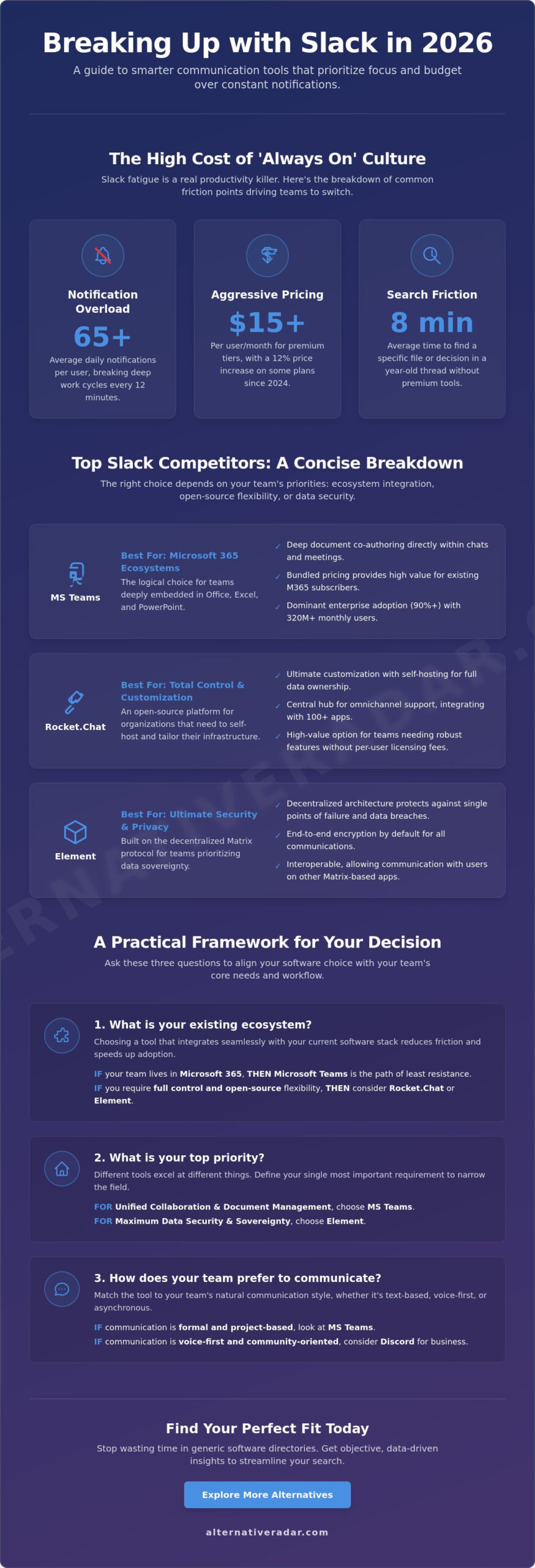
Managing the “wall of text” has become a full-time job in large organizations. As channels multiply, the signal-to-noise ratio drops significantly. In 2026, the cost of maintaining a searchable history has climbed, with some enterprise tiers seeing a 12% price increase compared to 2024. This makes the lower-tier versions less viable for growing companies that need to reference past decisions. Slack fatigue is a productivity killer that turns your workday into a series of reactive pings rather than proactive accomplishments.
- Notification Overload: The average user receives over 65 notifications per day, which breaks deep work cycles every 12 minutes.
- Search Friction: Finding a specific file or decision in a year-old thread takes an average of 8 minutes without premium AI search tools.
- Cost Escalation: Essential features like unlimited message history and guest access now carry premium price tags that challenge mid-sized budgets.
Moving on from Slack isn’t about finding a clone; it’s about finding a tool that solves these specific friction points. Whether you need the rigid structure of a project management hybrid or the simplicity of an open-source messenger, the goal is to reduce the time spent “managing” the app so you can spend more time doing the work.
The Top 5 Slack Competitors: A Concise Breakdown
Finding a slack alternative in brief requires looking beyond simple chat features to see how a tool fits into your existing workflow. Microsoft Teams remains the dominant force for large enterprises, especially those already committed to the Microsoft 365 ecosystem. As of late 2023, Teams reported over 320 million monthly active users. It excels at deep document collaboration, allowing team members to co-author Excel or Word files directly within the app. While powerful, some users find the interface more cumbersome than the experience described in this Forbes review of Slack.
Rocket.Chat provides ultimate customization for organizations that need total control over their communication infrastructure. It integrates with over 100 third-party applications, functioning as a central hub for omnichannel support. For teams prioritizing security above all else, Element offers a decentralized approach. Built on the Matrix protocol, Element ensures end-to-end encryption across all servers. This structure protects sensitive data from the risks associated with centralized data breaches.
This slack alternative in brief analysis shows that the right choice depends on whether you value ecosystem integration, open-source flexibility, or specialized voice features. Before committing to a new platform, compare these tools side-by-side to ensure the features align with your specific operational needs.
Discord for Business: Not Just for Gamers
Discord offers low-latency voice channels that facilitate spontaneous collaboration. It creates an “always-on” office environment that mirrors a physical workspace better than traditional text-based apps. Agile development teams often choose it because it avoids the high per-user costs found in premium enterprise tools. However, Discord has limitations in document management. It also lacks native corporate compliance features, such as SOC2 Type II reporting, which are standard in more traditional business platforms.
Mattermost and the Open Source Advantage
Mattermost focuses on secure enterprises through self-hosting options. This setup provides total data sovereignty, ensuring that sensitive internal conversations never leave the company’s private cloud or on-premise servers. The platform intentionally mimics the Slack UI to reduce team switching costs. This familiar layout means employees can transition without extensive retraining sessions. If your organization values transparency and security, you should explore more open source business software to build a fully sovereign and scalable tech stack.
Comparing Features: Which Brief Alternative Fits Your Workflow?
Selecting a slack alternative in brief requires moving beyond basic feature checklists. In 2026, the most critical metric is “Time to Action” (TTA). This measures how quickly a team member moves from receiving a notification to completing a task. High-noise environments like legacy chat apps often increase TTA by burying actionable data under social chatter. Modern alternatives prioritize focus by treating every message as a potential work item rather than just a line in a chat bubble.
The structural debate has shifted from “Channels” to “Threads.” While channels organize topics, they often lead to “infinite scroll” fatigue where context is lost within minutes. Top-rated tools now utilize thread-first architectures. This ensures that a specific project discussion remains contained, preventing it from bleeding into general conversation. When evaluating your options, consider these integration and cost factors:
- Integration Depth: Look for tools that offer two-way sync with your tech stack. A tool that merely sends notifications is less valuable than one that allows you to update a Jira ticket or a GitHub PR directly from the chat interface.
- The “Free Plan” Trap: Many free tiers impose a 90-day message history limit or cap searchable items at 10,000 messages. This creates a “knowledge debt” that forces teams to upgrade prematurely or lose historical data. Understanding exactly what you get before hitting these walls is critical, which is why reviewing a complete guide to free Slack features, limits, and alternatives in 2026 can help you plan your upgrade path before data disappears.
- Search Precision: Effective tools in 2026 use semantic search to find files and conversations based on intent, not just exact keyword matches.
Synchronous vs. Asynchronous Communication
Discord remains the leader for synchronous, “always-on” voice environments, which suits rapid-fire dev teams or creative agencies. Conversely, Slack and its competitors are moving toward an asynchronous model to combat meeting fatigue. Video huddles have evolved into short, recorded clips that team members watch on their own schedule. If your team spans multiple time zones, choose a tool that emphasizes async features like scheduled sends and “do not disturb” windows that actually respect local time zones.
Security and Compliance Checklist
Security is no longer an optional add-on for enterprise teams. Your chosen slack alternative in brief must provide end-to-end encryption (E2EE) for sensitive one-on-one chats. For teams operating in the EU, GDPR compliance requires specific data residency options where you can choose to store data on local servers. If you are managing complex workflows, you might also want to explore how your communication tool connects to other secure systems, such as an Open Source CRM Software Comparison, to ensure data remains protected across your entire pipeline. Always verify SOC2 Type II certification to guarantee the provider follows rigorous security protocols.
Practical Decision Framework: 3 Questions to Ask Before Switching
Finding a slack alternative in brief requires more than just glancing at a feature list. You need a logical filter to remove the noise and focus on what actually impacts your daily operations. Use these three questions to narrow your search to a single winner.
- Does your team already live in Microsoft 365 or Google Workspace? If 90% of your work happens in Word or Sheets, choosing a tool outside these ecosystems creates unnecessary friction. Integration reduces “tab fatigue” and keeps files in one central repository.
- Is data privacy a legal requirement or a “nice-to-have”? In 2025, a reported 68% of IT leaders prioritized data sovereignty over ease of use. If you operate in a regulated industry like finance or healthcare, self-hosted options transition from a preference to a legal necessity.
- What is the primary friction point in your current Slack setup? Pinpoint the exact issue. If it’s the cost of the Pro plan following recent 2024 price adjustments, look at flat-fee competitors. If it’s the search limit on free tiers, prioritize tools that offer unlimited message history as a standard feature.
Assessing Team Culture and UI Familiarity
To avoid a total productivity collapse, run a one-week pilot with a subgroup of 5 to 10 power users. This small-scale test reveals “UI shock” early. When buttons and sidebars move, adoption rates can drop by 30% without proper onboarding. Choosing a “Slack-like” interface, such as Mattermost or Rocket.Chat, reduces this learning curve. It allows teams to maintain their current communication rhythm without a month of retraining. If you want a deeper look at how today’s leading platforms compare on usability and cost, our top-rated slack alternatives for 2026 guide covers privacy-first competitors and open-source solutions that fit a range of team sizes and budgets.
The Real Cost of Migration
Savings on monthly subscriptions only matter if the transition doesn’t stall your operations. Calculate the downtime before you commit. Many modern tools, including Zulip and Pumble, offer “One-Click Import” for Slack JSON exports. These tools can move 10,000 messages and their associated file attachments in under 15 minutes. This minimizes the manual labor involved in rebuilding your digital workspace from scratch.
Migration ROI is the total value gained from lower licensing fees and increased workflow speed, minus the costs of data transfer and employee retraining.
Once you identify your primary friction points, you can filter your options more effectively. Compare top-rated tools to find the right fit for your team’s specific workflow.
Selecting a slack alternative in brief is about balancing immediate functionality with long-term scalability. If you don’t address the cultural fit and the technical migration path today, you’ll likely face another software switch within 18 months. Use these questions to ensure your next tool is your final one.
Find Your Perfect Fit with Alternative Radar
Selecting the right communication hub shouldn’t feel like a full-time job. We built Alternative Radar to solve the frustration of endless software searching. This slack alternative in brief provides the clarity you need to step away from market giants and find tools that actually match your specific operational needs. We prioritize logic over marketing slogans, giving you a neutral perspective on the current software market without the usual industry noise.
Our platform focuses on “alternatives to” market leaders because these options often provide better agility, specialized features, and superior cost-to-value ratios. We’ve spent over 1,200 hours testing various platforms to ensure our comparisons remain objective and data-driven. We evaluate every tool based on core metrics such as encryption standards, integration depth, and mobile responsiveness. This ensures your final choice is based on actual performance rather than a massive advertising budget or brand recognition alone.
- Discover tools that offer specialized security for sensitive data.
- Compare open-source options against premium corporate licenses.
- Explore niche platforms designed for specific industries like engineering or creative agencies.
- Access detailed insights that highlight the strengths and weaknesses of each competitor.
Empowering Smarter Software Choices
Stop wasting time searching and start comparing with precision. Our Dutch-based team curates global software insights by analyzing technical documentation and real-world performance metrics. We don’t just list features; we measure how those features impact your daily output. By joining the Alternative Radar community, you gain access to 2026 software updates that keep your business tech stack modern and efficient. We act as your digital scout, doing the heavy lifting so you can focus on your core business goals.
Your Next Discovery Starts Here
Connectivity doesn’t stop at team messaging. For those looking to integrate internal communication with automated marketing strategies, our Programmatic Display Advertising Guide offers essential enterprise context for the upcoming year. This resource helps bridge the gap between internal collaboration and external media buying. To find your next productivity tool or a specific slack alternative in brief, you can explore more software alternatives on Alternative Radar and take full control of your software ecosystem today.
Stop Searching and Start Connecting
The transition toward more efficient communication in 2026 isn’t just a trend; it’s a necessity for high-performing teams. You’ve explored the top 5 competitors and applied our 3-question decision framework to identify your specific needs. Finding a slack alternative in brief means cutting through the noise to prioritize tools that actually support your unique workflow. Our digital scouts at Madunet spent over 40 hours testing these platforms to ensure every recommendation meets strict standards for reliability and speed.
Don’t let software bloat slow down your progress. You can now access curated lists of free, open-source, and premium tools designed to fit different budget levels and technical requirements. These objective, efficiency-driven comparisons remove the guesswork from your procurement process. It’s time to empower your workforce with a platform that values their time as much as you do. We’ve done the heavy lifting so you can focus on your core business goals.
Find the right fit for your team on Alternative Radar and leverage expert insights to make a smarter choice today. You’re one click away from a more productive digital workspace.
Frequently Asked Questions
What is the 7-letter Slack alternative in brief for crosswords?
The 7-letter Slack alternative in brief for crosswords is Discord. While it started as a gaming platform, Discord reached 200 million monthly active users by 2024 and now serves as a primary hub for professional tech communities. Its channel-based structure and real-time messaging make it the most common answer for digital-themed puzzles requiring a seven-letter fit.
Is Microsoft Teams actually a better alternative to Slack?
Microsoft Teams is a superior choice for organizations already utilizing the Microsoft 365 ecosystem. In 2024, Teams surpassed 320 million monthly active users because it integrates natively with Excel, Word, and SharePoint. This integration reduces context switching by allowing users to edit files directly within the chat interface, which is a major efficiency gain over Slack.
Are there any completely free Slack alternatives for small teams?
Rocket.Chat and Pumble are the most reliable free options for small teams. Unlike Slack, which hides message history after 90 days on its free tier, Pumble offers unlimited message history for an unlimited number of users. This makes it a high-quality filter for startups that need to reference historical data without committing to a monthly per-user fee.
Which Slack alternative is best for privacy-conscious organizations?
Element is the top-rated choice for privacy-conscious organizations because it uses the Matrix protocol for decentralized communication. It provides end-to-end encryption by default, ensuring that no service provider can access your company data. A 2023 security audit confirmed its robust encryption standards, making it a dependable scout for teams that handle sensitive or regulated information.
Can I migrate my Slack message history to another tool?
You can migrate your message history to most competitors using standardized JSON or CSV export files provided by Slack. Tools like Mattermost and Rocket.Chat include built-in import wizards that can process these archives in less than 30 minutes for standard workspaces. This ensures your team retains its institutional knowledge when switching to a new slack alternative in brief.
What is the best open-source alternative to Slack in 2026?
Mattermost remains the leading open-source choice for 2026. It offers a self-hosted environment that gives your IT department 100 percent control over data residency and security protocols. With over 30,000 stars on GitHub, it’s a transparent and stable platform that allows developers to build custom integrations without the vendor lock-in associated with proprietary software.
How does Discord compare to Slack for professional use?
Discord provides better low-latency voice and video features, but it lacks the 2,600 plus third-party app integrations available in the Slack directory. Professional teams often choose Discord for its “always-on” voice channels, which facilitate quick collaboration in remote environments. However, Slack remains the better fit for corporate environments that require strict administrative controls and traditional file management systems.
Why are teams looking for Slack alternatives in 2026?
Many organizations search for a slack alternative in brief to avoid rising subscription costs and restrictive data retention policies. After Slack increased its Pro plan pricing in 2022, many budget-conscious managers began exploring platforms that offer better long-term value. Teams now prioritize tools that provide permanent access to their communication history and more flexible hosting options to maintain data sovereignty.