

Still using an AOL email address in 2026? You’re not alone, but you might be paying a higher price than you realize, in spam, sluggish interfaces, and nagging uncertainty about who actually owns your inbox now. If you’ve landed here searching for the best email service alternatives, you’ve already made the smartest first move.
Here’s the thing most people already sense but rarely act on: legacy email platforms weren’t built for how we communicate, work, or protect our data today. AOL Mail has changed hands more than once, and that instability has left millions of users wondering whether their provider is keeping pace with modern security standards or quietly falling behind.
This guide cuts through the noise. You’ll walk away knowing exactly which modern email providers offer end-to-end encryption, clean interfaces, and reliable cross-platform sync, plus which web portals have genuinely replaced what AOL’s homepage used to offer. Whether you want a privacy-first inbox, a clutter-free news portal, or simply a fresh start, the right alternative is closer than you think. Let’s get into it.
Key Takeaways
- The best email service alternatives to AOL in 2026 include Gmail, Outlook, and privacy-first providers, each suited to different user needs and security requirements.
- Legacy email platforms like AOL carry real risks in 2026, from aging security infrastructure to uncertain ownership, making migration a practical necessity rather than just a preference.
- Switching from AOL is simpler than most users expect, with straightforward steps for backing up contacts, exporting old emails, and setting up auto-forwarding to a new provider.
- The classic AOL homepage experience hasn’t disappeared, it has evolved into modern portals like MSN.com and Yahoo News, which offer comparable content aggregation with better performance.
- Even crossword clues now point to Gmail, Yahoo, and MSN as the cultural successors to AOL, a telling sign of just how completely the landscape has shifted.
AOL Alternative: The Definitive Crossword Answers
If you’ve landed here from a puzzle grid rather than a tech search, you’re in the right place. Crossword clues referencing “AOL alternative” or “early internet rival” have a handful of reliable solutions, and knowing which answer fits depends entirely on your letter count. Here’s the definitive breakdown.
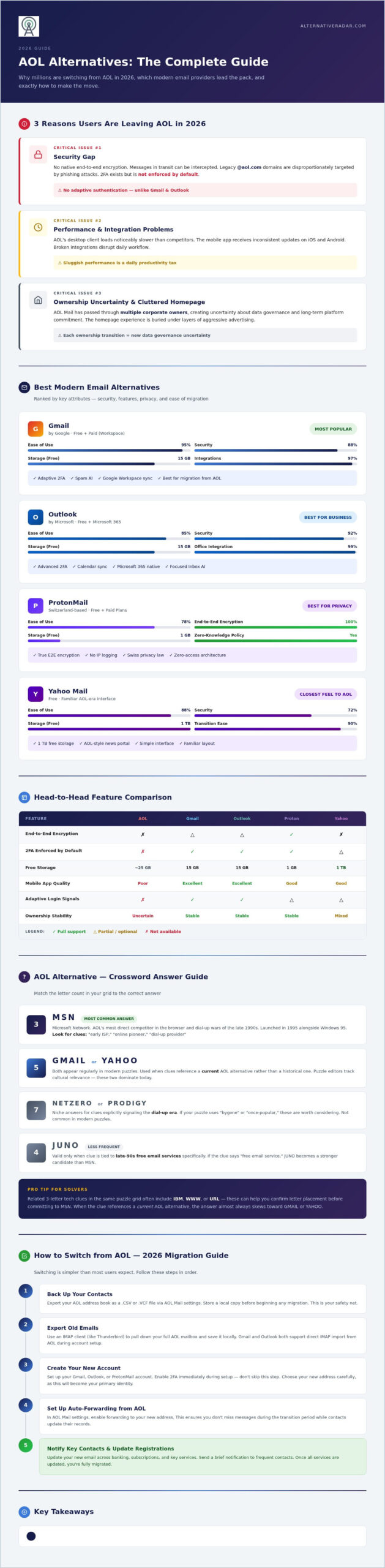
- 3 letters: MSN (the most common correct answer)
- 5 letters: GMAIL or YAHOO (both appear regularly in modern puzzles)
- 7 letters: NETZERO or PRODIGY (used in clues specifying dial-up era services)
- 4 letters: JUNO (less frequent, but valid for clues tied to late-90s free email services)
MSN is the puzzle editor’s go-to for a reason. It was AOL’s most direct competitor during the browser and dial-up wars of the late 1990s, making it culturally embedded enough to earn crossword legitimacy. GMAIL and YAHOO earn their spots as the modern successors, which is why they now appear in clues framed around the best email service alternatives rather than strictly historical rivals.
Why MSN is the Top Puzzle Solution
Microsoft launched MSN (Microsoft Network) in 1995, timed deliberately to coincide with Windows 95. The strategy mirrored AOL’s bundled CD approach: get the software onto the desktop, convert curiosity into subscribers. Both platforms competed aggressively for dial-up market share, which is exactly the kind of cultural footprint that crossword constructors reward with recurring clue status. MSN later pivoted away from ISP services and repositioned as a web portal, a move that kept it relevant long after the dial-up era ended.
Alternative Search Terms for Puzzle Solvers
Crossword clues for this answer category aren’t always phrased the same way. Watch for variations like “early ISP,” “online pioneer,” “dial-up provider,” or “internet service of the 90s.” Related 3-letter tech clues in the same puzzle grid often include IBM, WWW, or URL, which can help you confirm letter placement before committing to MSN. If the clue specifies “free email service” specifically, JUNO becomes a stronger candidate than MSN.
One practical tip: when the clue references a current AOL alternative rather than a historical one, the answer almost always skews toward GMAIL or YAHOO. Puzzle editors track cultural relevance, and those two platforms now dominate the conversation around the best email service alternatives in a way that MSN no longer does.
Services like NetZero and Prodigy are niche answers reserved for clues that explicitly signal the dial-up era. If your puzzle uses the word “bygone” or “once-popular,” those longer answers are worth considering before defaulting to MSN.
Why Users are Replacing Legacy AOL Services in 2026
Nostalgia doesn’t protect your inbox. AOL Mail still has millions of active users, but the platform’s underlying architecture hasn’t kept pace with how people actually work, communicate, and secure their data in 2026. The problems aren’t cosmetic. They’re structural, and they compound over time.
Three friction points push most users toward the best email service alternatives faster than anything else: deteriorating security, broken integrations, and a homepage experience that’s been buried under layers of aggressive advertising. Each one is worth understanding before you make the switch.
The Security Gap in Legacy Email
Older email infrastructure wasn’t designed with today’s threat landscape in mind. AOL Mail doesn’t offer native end-to-end encryption, meaning messages in transit can be intercepted without additional third-party tools. Legacy domains like @aol.com are also disproportionately targeted by phishing campaigns precisely because attackers know older accounts are less likely to have modern authentication layers enabled. Two-factor authentication (2FA) exists on AOL, but it’s not enforced by default, and the platform lacks the adaptive authentication signals that providers like Gmail and Outlook use to flag suspicious login behavior in real time.
The ownership chain adds another layer of risk. AOL Mail has passed through multiple corporate hands, and each transition introduces uncertainty about data governance, security investment priorities, and long-term platform commitment.
Performance and Integration Issues
Speed is a daily tax. AOL’s desktop client loads noticeably slower than browser-based competitors, and its mobile app receives inconsistent updates on both iOS and Android. That sluggishness isn’t just annoying; it breaks workflow. When an email client can’t sync reliably with a calendar, a task manager, or a cloud storage drive, productivity takes a measurable hit.
Storage is another gap. AOL Mail offers limited free storage compared to Gmail’s 15GB pooled across Google services or Outlook’s integration with OneDrive. For users managing attachments, receipts, or project files through email, that ceiling becomes a real constraint quickly.
The all-in-one web portal model that AOL once pioneered has also aged poorly. What was once a convenient hub now feels cluttered, ad-heavy, and disconnected from the productivity tools most users rely on daily. AI-assisted features like smart compose, automated categorization, and natural language search are now standard on competing platforms. AOL offers none of them.
If you’re mapping out your options and want a structured comparison rather than guesswork, exploring curated email alternatives cuts the research time significantly and surfaces the providers that actually match your security and workflow requirements.
Best Modern Email Alternatives: Moving Beyond @aol.com
Choosing a replacement isn’t just about picking a new address. It’s about matching a platform to how you actually work, communicate, and manage risk. The best email service alternatives in 2026 fall into three distinct categories: productivity-first giants, privacy-hardened providers, and clean ad-free options for personal use. Each solves a different problem.
Gmail vs. Outlook: Which Giant Wins?
Gmail leads on search and integration. Its indexing of your inbox is genuinely powerful, surfacing old attachments, conversations, and contacts faster than any competing platform. Spam filtering is aggressive and accurate, with AI-driven categorization that separates promotional clutter from priority mail without manual setup. For former AOL users, the transition is low-friction: Gmail’s interface is intuitive, and Google’s migration tool imports contacts and emails directly.
Outlook wins on professional infrastructure. If your workflow runs through Microsoft 365, Teams, or SharePoint, Outlook isn’t just an email client; it’s a coordination hub. Calendar integration is tighter, shared mailboxes are easier to manage, and enterprise-grade compliance tools come built in. For anyone moving from AOL in a business context, Outlook closes the productivity gap faster.
- Gmail: Best for Google Workspace users, smart search, and personal productivity
- Outlook: Best for Microsoft 365 environments, team coordination, and professional workflows
- Zoho Mail: Best for users who want a clean, ad-free inbox without committing to a Google or Microsoft ecosystem
Zoho Mail deserves a specific mention here. It’s genuinely ad-free on its free tier, which is rare. The interface is uncluttered, the mobile app is reliable, and it doesn’t scan your emails to serve targeted advertising. For personal users who want a fresh start without trading one data-hungry platform for another, Zoho is a practical and underrated pick.
Privacy-Focused Providers for the Security Conscious
ProtonMail operates on zero-access encryption, meaning even Proton’s own servers can’t read your messages. Based in Switzerland, it’s subject to Swiss privacy law rather than US or EU data retention frameworks, which matters if data sovereignty is a concern. Setup takes minutes, and the free tier covers most personal use cases.
Tutanota, hosted in Germany, takes a similar approach but extends encryption to subject lines and contact lists, areas where ProtonMail’s free tier leaves gaps. Both platforms represent the clearest break from legacy portal surveillance models.
Privacy isn’t a niche concern anymore. It’s the primary reason security-aware users are abandoning legacy portals. If your current provider can read your inbox, so can anyone who compromises their servers. That’s the core argument for encrypted mail, and it’s one the best email service alternatives in this category make without requiring any technical expertise from the user.
Content and News Portal Alternatives to the AOL Homepage
The AOL homepage was more than an email gateway. For millions of users through the late 1990s and 2000s, it was the starting point for the entire internet: news headlines, weather, sports scores, and entertainment all bundled into a single tab. That model still has genuine appeal. The question is which platforms have actually inherited it, and which ones have improved on it.
The Evolution of the Web Portal
AOL’s original model was a walled garden, a curated slice of the internet designed to keep you inside one ecosystem. That approach collapsed as broadband replaced dial-up and browsers became the default navigation layer. What replaced it wasn’t one portal but several competing aggregators, each pulling content differently. MSN.com is the closest structural successor: it maintains a traditional grid layout with news, weather, sports, and entertainment, all accessible without an account. Yahoo News follows a similar format, preserving the familiar column-based design that legacy users find immediately comfortable. Neither requires a login to browse, which removes the friction that drives people away from modern platforms.
Google News takes a sharply different approach. Instead of a fixed editorial layout, it uses algorithmic personalization to surface stories based on your reading history, location, and stated interests. The result is a feed that gets more relevant over time rather than delivering the same homepage to every visitor. For users who found AOL’s curated picks too generic, Google News solves that problem directly.
Feedly sits in its own category. It’s an RSS aggregator that lets you build a custom news portal from scratch, pulling feeds from any publication, blog, or podcast you choose. There are no algorithmic surprises and no editorial gatekeeping. You decide exactly what appears. The free tier covers most personal use cases, and the interface is clean enough that it doesn’t require any technical knowledge to set up.
Ad-Free Alternatives for a Cleaner Experience
The trade-off with free portals is advertising density. MSN.com and Yahoo News are both ad-supported, and the experience reflects that. For users who want the aggregation without the clutter, three practical options exist:
- Feedly (free tier): RSS-based, no behavioral advertising, fully customizable source list
- Paid news subscriptions: Direct subscriptions to outlets like The Guardian or The Atlantic eliminate middleman portals entirely
- Browser extensions: Tools like uBlock Origin significantly reduce ad load on legacy portals without requiring a platform switch
The best email service alternatives and the best portal alternatives share a common thread: the upgrade is almost always less disruptive than users expect. Replacing a cluttered homepage takes minutes. The harder part is knowing which option actually matches your reading habits rather than defaulting to the most familiar name. If you’re mapping that decision alongside an email migration, comparing your options on Alternative Radar surfaces the right fit faster than working through each platform individually.
How to Switch from AOL: A 2026 Migration Guide
Most users overestimate how complicated this is. Switching from AOL to one of the best email service alternatives typically takes under an hour when you follow the right sequence. The order matters more than the effort. Do these steps out of sequence and you risk locking yourself out of accounts or losing contact history you can’t recover.
Start with a full export before touching anything else. AOL Mail lets you export contacts as a CSV file directly from the Contacts section. For email archives, use a desktop client like Thunderbird configured with IMAP to download your full message history locally before the migration begins. That local backup is your safety net if anything goes wrong mid-transfer.
Technical Steps for Email Forwarding
Configure auto-forwarding in AOL Mail under Settings, then Mail Settings, then forward all incoming messages to your new address. This keeps communication flowing during the transition window. For a cleaner import, Google’s native “Import Mail and Contacts” tool (found under Gmail Settings, then Accounts and Import) pulls messages directly via POP3 without requiring manual file transfers. Enter your AOL credentials, and Gmail handles the rest in the background. Keep your AOL account active for at least 90 days after switching. That window catches late-arriving messages and gives contacts time to update their records.
Security Checklist During the Move
Don’t skip this step. Before you notify anyone of your new address, run through this sequence:
- Change passwords on financial and sensitive accounts first, prioritizing banking, healthcare portals, and any subscription tied to your AOL address
- Enable multi-factor authentication on your new provider immediately, before importing any data or contacts
- Audit your recovery email settings across every account that lists your AOL address as a backup, update each one before closing the old account
- Check third-party logins using “Sign in with AOL” options on retail, media, or productivity platforms and migrate those credentials to your new address
Closing your AOL account while it’s still listed as a recovery address on active accounts is the single most common migration mistake. It locks users out permanently with no recovery path.
Finding More Alternatives with Alternative Radar
Email is rarely the only legacy tool holding a workflow back. Alternative Radar functions as a digital scout for exactly this kind of audit, helping you identify what’s outdated before it becomes a problem. The guide on finding the best alternative to popular software walks through a structured framework for evaluating any legacy platform, not just email. For teams also reassessing their CRM stack, the open source CRM software comparison applies the same objective lens to contact management tools.
The practical value here is speed. Rather than researching each replacement individually, Alternative Radar surfaces the best email service alternatives and adjacent tools in a single comparison layer, so you’re making decisions based on current data rather than outdated reviews. Legacy software sunsets rarely announce themselves clearly. Staying ahead of them is easier when you’ve already mapped your full software stack against modern alternatives.
Your Inbox Upgrade Starts Now
The case for switching is straightforward. Legacy platforms like AOL weren’t built for 2026’s security landscape, and the gap between what they offer and what modern providers deliver widens every year. The best email service alternatives, whether that’s Gmail’s smart search, ProtonMail’s zero-access encryption, or Zoho’s genuinely ad-free experience, are each built around how people actually work today, not how they browsed the internet in 1998.
Three things to carry forward: match your provider to your workflow rather than defaulting to the most familiar name, complete your migration in sequence to avoid losing account access, and don’t treat email as the only legacy tool worth auditing.
That last point matters more than most users realize. Email is rarely the only outdated platform slowing a workflow down. Explore expert comparisons across 500+ software categories on Alternative Radar, where a privacy-first recommendation engine updated for 2026 standards does the research legwork for you.
The right tools are already out there. Now you know exactly where to find them.
Frequently Asked Questions
What is a 3-letter crossword answer for AOL alternative?
MSN is the standard 3-letter crossword answer for an AOL alternative. It fits clues referencing early internet rivals, dial-up competitors, or Microsoft’s online service launched in 1995. If the clue specifies a current or modern alternative rather than a historical one, check your crossing letters carefully since some constructors now use abbreviations tied to newer platforms.
Is MSN the same as AOL?
No, MSN and AOL are separate companies with different ownership histories. AOL was developed by America Online and later passed through Verizon and Apollo Global Management. MSN (Microsoft Network) was built and remains owned by Microsoft. They competed directly during the dial-up era, which is why crossword clues treat them as interchangeable rivals, but their technology stacks, business models, and current offerings are entirely distinct.
Can I still keep my @aol.com email address if I switch ISPs?
Yes. AOL Mail has operated independently of ISP service for years, so your @aol.com address isn’t tied to a specific internet provider. You can keep it regardless of which broadband or mobile carrier you use. The more practical question is whether keeping it serves you well in 2026, given the security and integration gaps covered earlier in this guide.
Which email provider is the most similar to the AOL interface?
Yahoo Mail is the closest visual match. It uses a similar left-panel folder structure, a familiar reading pane layout, and a bundled news feed alongside the inbox, which mirrors what AOL users expect. Zoho Mail is a strong second option if you want a clean, folder-based interface without the news clutter. Both represent practical first steps when exploring the best email service alternatives without a steep learning curve.
Is Gmail a better alternative to AOL for seniors?
Gmail works well for most users, but it’s not automatically the best fit for seniors transitioning from AOL. The interface is cleaner than AOL’s, search is faster, and spam filtering is more reliable. The adjustment period comes from Gmail’s label-based organization, which replaces the traditional folder system AOL users know. For seniors who prefer a conventional folder structure, Yahoo Mail or Zoho Mail may reduce friction during the switch.
How do I move my AOL folders to Outlook?
The most reliable method uses a desktop email client as an intermediary. Configure Thunderbird with your AOL account via IMAP, which downloads all folders locally. Then add your Outlook account to the same Thunderbird instance and drag folders across. Alternatively, Outlook’s built-in import wizard accepts PST files, and several third-party migration tools handle AOL-to-Outlook transfers directly. Whichever method you choose, export a local backup of your AOL folders first before initiating any transfer.
Are there any free alternatives to AOL’s dial-up service?
Dial-up as a primary internet connection has largely been replaced by broadband, but options still exist in rural areas where high-speed infrastructure hasn’t reached. NetZero historically offered free dial-up tiers, though availability and terms change frequently, so verify current offerings directly before assuming the free tier still exists. For most users in 2026, the practical alternative isn’t another dial-up provider but a mobile hotspot or fixed wireless service, both of which deliver significantly better speeds at comparable or lower cost.
Why is AOL still charging me for service in 2026?
AOL Mail itself is free, but many long-term users were enrolled in paid AOL dial-up or premium plans years ago and never cancelled. Those subscriptions don’t automatically stop when you stop using the service. Check your bank or credit card statements for charges from AOL or its current parent company, then contact AOL support directly to cancel any active paid plan. Your @aol.com email address remains accessible on the free tier after cancellation, so you don’t lose your inbox by ending the billing relationship.