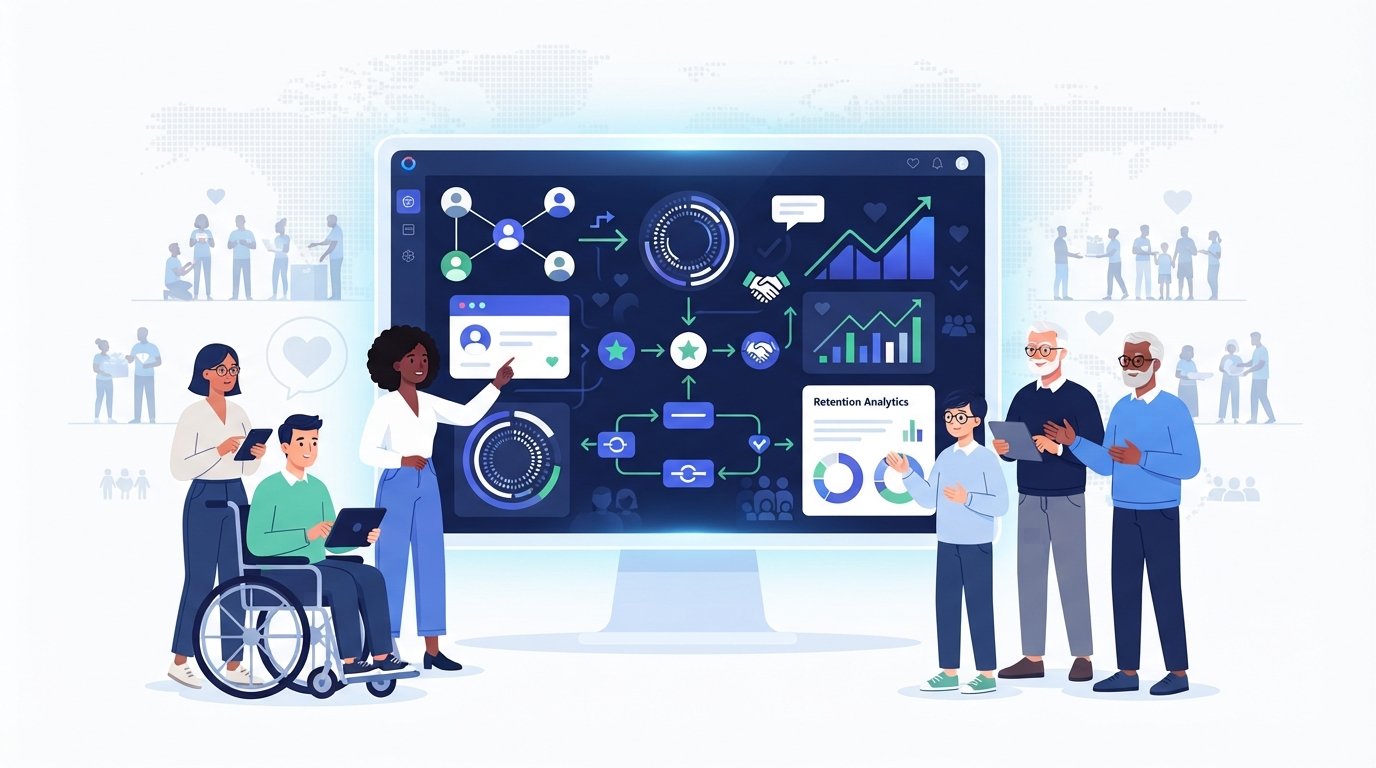
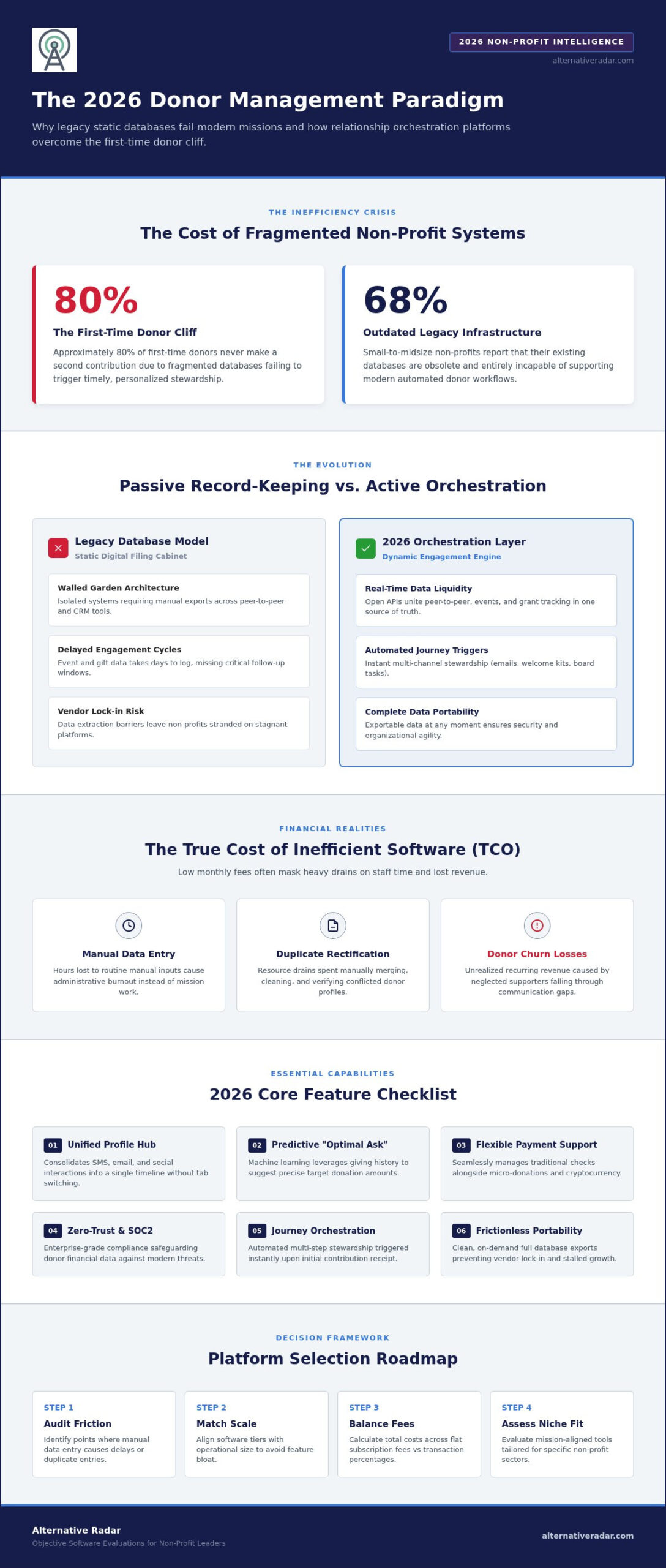
Approximately 80% of first-time donors never make a second contribution to the organizations they initially support. This “first-time donor cliff” is often a direct result of fragmented systems that fail to trigger timely, personalized stewardship. If your team struggles with siloed data across multiple platforms, you’re losing more than just administrative hours; you’re losing the lifetime value of your supporters. Choosing the right non-profit donor management software is no longer about finding a digital filing cabinet. It’s about deploying an orchestration layer that automates retention and simplifies reporting for your next board meeting.
Research shows that 68% of small-to-midsize nonprofits find their legacy databases outdated and incapable of supporting modern automation. We understand that high subscription costs and steep learning curves for volunteers are major barriers to growth. You deserve a tech stack that works for your mission, not against your budget. This guide provides an objective 2026 comparison of features, pricing models, and mission-aligned alternatives. We act as your digital scout, filtering through the marketing noise to find tools that offer a single source of truth. You’ll learn how to increase recurring donation rates through automation and select a platform that fits your specific operational scale.
Key Takeaways
- Identify the transition from passive record-keeping to active orchestration by treating your database as a dynamic engagement tool rather than a static storage unit.
- Evaluate high-impact 2026 features like predictive analytics for donor churn and native support for micro-donations to maintain a competitive fundraising edge.
- Navigate the market by matching your organizational scale to the right non-profit donor management software tier, carefully balancing subscription costs against transaction fees.
- Apply a structured evaluation framework to audit your current data friction points and prioritize essential functionality over unnecessary platform bloat.
- Discover why specialized, mission-aligned alternatives often outperform general-market leaders for niche sectors such as animal welfare or medical research.
The 2026 Shift: Why Legacy Donor Databases Are Failing Modern Non-Profits
Legacy databases are static. They store names and numbers but do little to inspire action. In 2026, the definition of non-profit donor management software has pivoted from a passive record-keeping system to an active engagement engine. The “all-in-one” walled garden is dead. Modern organizations now favor modular tech stacks where specialized tools for peer-to-peer fundraising, event management, and grant tracking communicate through robust APIs.
The current industry standard is donor-centricity driven by real-time data liquidity. This means your data must flow freely between platforms without manual intervention. When your fundraising tools and CRM exist in separate silos, you lose the ability to act on donor behavior in the moment. If a donor attends a gala but your database doesn’t reflect that for a week, you’ve missed the optimal window for a personalized follow-up. Efficiency requires a single source of truth that updates instantly.
From Record-Keeping to Relationship Orchestration
Modern tools prioritize donor journey mapping. Instead of a simple contact list, you have a visual representation of every touchpoint. Automated triggers now handle the repetitive tasks that previously led to staff burnout. For instance, a first-time donation can automatically trigger a sequence of personalized emails, a physical welcome kit request, and a task for a board member to make a thank-you call. This level of orchestration ensures no donor falls through the cracks.
Data portability is the most critical security feature you should demand. In 2026, true security means you aren’t held hostage by a vendor whose platform no longer serves your mission. You must be able to export your entire database in a clean, usable format at any time. A platform that makes it difficult to leave is a platform that has stopped innovating.
The Cost of Inefficiency: What Legacy Systems Really Charge You
Legacy systems often hide their true cost behind low monthly fees. The real expense lies in the Total Cost of Ownership (TCO). This includes hours spent on manual data entry, the cost of rectifying duplicate records, and the missed revenue from donors who churned because they felt ignored. These inefficiencies eat into program budgets and reduce your overall impact.
Modern alternatives focus on reducing TCO through deep automation and “plug-and-play” integrations. For organizations operating on tight budgets, looking at an open source CRM software comparison can reveal high-utility tools that provide enterprise-level features without the enterprise-level price tag. Efficiency is the only way to ensure more of your budget reaches the programs that matter. Your non-profit donor management software should be a driver of revenue, not a drain on resources.
Essential Features for 2026: The Non-Profit Tech Checklist
Modern efficiency requires more than just a place to store names. To stay competitive, your non-profit donor management software must act as a proactive tool that anticipates donor needs. In 2026, the baseline for software utility has shifted toward predictive intelligence and unified communication. You shouldn’t have to jump between five different tabs to see how a donor interacts with your mission. A high-quality platform provides a single dashboard that integrates SMS, email, and social media interactions into one unified donor profile.
Security is no longer a “nice-to-have” add-on. With cyber threats targeting charitable data, your system needs SOC2 compliance and a zero-trust architecture as standard protocols. Furthermore, your payment processing must be flexible. Modern donors expect to give via cryptocurrency or through micro-donation triggers at checkout. If your software can’t handle a $5 Bitcoin donation as easily as a $500 check, you’re excluding a growing demographic of tech-savvy supporters.
AI and Predictive Giving for Every Budget
Advanced machine learning is no longer reserved for enterprise foundations. Today’s tools use historical data to suggest the “optimal ask” amount for each donor, reducing the risk of asking for too little or alienating a supporter with an excessive request. Predictive giving is defined as the use of historical data to forecast future donor behavior with at least 85% accuracy, allowing teams to focus their energy on the highest-probability opportunities. Automated segmentation now moves beyond simple demographics; it groups donors based on behavioral triggers like email open rates or event attendance patterns. Scouting these tools through Alternative Radar allows you to compare these features without the pressure of a sales pitch.
Integrations: The Glue of Your Digital Ecosystem
A donor database that doesn’t talk to your accounting software is a liability. Your digital ecosystem depends on data liquidity. Whether you’re syncing with QuickBooks for financial reporting or Mailchimp for marketing, the integration must be seamless. Small teams should prioritize “low-code” or “no-code” capabilities to avoid hiring expensive developers for basic setup tasks. Building a custom stack that fits your specific mission is easier when you’re finding the best alternative to popular software in 2026 rather than settling for a rigid, one-size-fits-all solution. This modular approach ensures your non-profit donor management software grows with you, rather than becoming a bottleneck as your donor base expands.
Tiered Comparison: Matching Software to Your Organizational Scale
Selecting the right non-profit donor management software depends on your current data volume and your three-year growth targets. A tool that serves a local community garden will likely fail an international relief organization. By categorizing the market into three distinct tiers, you can avoid the “Blackbaud Tax” of overpriced enterprise contracts or the frustration of outgrowing a basic tool within six months. Objective scouting via Alternative Radar helps you identify which tier aligns with your mission before you commit to a demo.
Tier 1: Transactional and ‘Free’ Platforms
These platforms are ideal for small non-profits, individual campaigns, and startups. They prioritize fast setup and high-converting donation forms over deep database management. Givebutter is a prime example, offering a tip-supported model with 0% platform fees. However, if you disable tipping, a flat 3% fee applies. While these tools offer zero upfront costs, they often lack sophisticated donor history tracking and custom reporting. They’re excellent for immediate revenue generation but may create data silos as your needs become more complex.
Tier 2: Growth-Focused SaaS Solutions
Mid-sized organizations with dedicated development teams should look here. This tier is the sweet spot for ROI, balancing subscription costs with increased donor retention. Solutions in this category often use different pricing models. Little Green Light offers record-based pricing starting at $45 per month for 2,500 constituents. Conversely, Neon CRM prices by organizational revenue, starting at $99 per month for unlimited records. Key differentiators include:
- Robust automation triggers for donor stewardship.
- Advanced segmentation based on giving velocity.
- Native integrations with accounting and marketing apps.
Tier 3: Enterprise and CSR Ecosystems
Large foundations and international NGOs require the heavy lifting provided by enterprise ecosystems. These platforms handle massive data processing and global compliance requirements. Blackbaud Raiser’s Edge NXT is a dominant player here, with mid-market contracts often ranging from $10,000 to $60,000 per year. Another major shift in 2026 is the transition to Salesforce’s native Nonprofit Cloud, now part of the Agentforce suite. These systems are powerful but require significant investment in implementation and administration. Many organizations find that their non-profit donor management software needs are better met by Tier 2 tools, which offer 80% of the functionality at a fraction of the total cost of ownership.
The scalability path isn’t always linear. You don’t have to move to a complex CRM just because your donor count increased. Focus on data liquidity; if your current tool can’t export clean data or sync with your modern tech stack, it’s time to evaluate an alternative. Use a neutral advisor to compare these tiers objectively, ensuring your choice supports your mission rather than just adding another line item to the budget.
The Step-by-Step Evaluation Framework: How to Choose Your Alternative
Selecting the right non-profit donor management software requires a shift from reactive purchasing to proactive scouting. Most organizations fail this transition because they prioritize flashy features over operational fit. To avoid this, follow a structured five-step process that places your mission’s efficiency at the center of the decision.
- Step 1: Audit Current Friction. Identify exactly where your data gets stuck. Is it the manual entry of event registrations? Is it the inability to pull a report for board meetings without a spreadsheet expert?
- Step 2: Define Must-Haves. Separate essential functionality from “nice-to-have” bloat. If you don’t run auctions, you shouldn’t pay for auction modules.
- Step 3: Calculate TCO. The sticker price is rarely the final cost. Factor in transaction fees (ranging from 2.2% to 3.95% plus $0.30 per gift) and the cost of staff hours spent on maintenance.
- Step 4: The Portability Test. Ask prospective vendors for a sample export file. If the data comes out in a proprietary format that requires a developer to read, walk away.
- Step 5: Neutral Comparison. Use a curator to filter out marketing bias and focus on objective performance metrics.
You can compare non-profit software alternatives now to see how different platforms handle these specific requirements.
Auditing Your Mission’s Tech Needs
Start by asking your team: “Which task do you dread most each week?” The answer usually points to the primary friction point your new non-profit donor management software must solve. Many teams suffer from feature bloat, paying for enterprise-grade tools they only use at 10% capacity. For organizations seeking maximum control and lower long-term costs, exploring popular open source business software 2026 provides a strategic path to a flexible, custom-built tech stack.
The Trial and Demo Strategy
Never buy software based on a recorded video. Request a sandbox environment and run a pilot program using a subset of your real donor data. Watch for red flags during demos: if a salesperson can’t explain how their API handles bi-directional syncing with your accounting tool, the platform likely lacks true data liquidity. Always involve your non-technical staff and volunteers in UX testing. If the person responsible for entering donations finds the interface confusing, your data integrity will eventually suffer. A successful trial proves that the software works for your people, not just your IT department.
Beyond the Big Names: Specialized Alternatives for Niche Missions
Standardized solutions often fail when applied to specialized missions. A general CRM might track a donation perfectly but struggle to manage the microchip IDs and intake records of an animal shelter or the complex grant cycles of a medical research foundation. In 2026, non-profit donor management software has evolved into highly verticalized categories. Choosing a platform built specifically for your sector reduces the need for expensive custom development and ensures your data fields align with your daily operations from day one.
Market leaders often suffer from “innovation stagnation,” where their size prevents them from adopting new tech as quickly as smaller competitors. You don’t have to settle for a legacy system just because it has the largest market share. Breaking free from these non-innovative giants allows you to leverage agile tools that prioritize user experience and data liquidity. Alternative Radar acts as your digital scout, filtering through the noise to find these “hidden gem” providers that offer better mission alignment at a lower total cost of ownership.
Specialized Tools for Specialized Impact
Niche tools offer functionality that general platforms simply can’t match without heavy modification. For example, platforms dedicated to environmental advocacy often include built-in legislative tracking and petition tools. Medical research CRMs might feature advanced HIPAA-compliant data silos for patient-donor privacy. Working with these smaller, more responsive vendors often means your feature requests are heard and implemented faster. In the 2026 SaaS landscape, “alternative” doesn’t mean “inferior.” It means “specialized.” These platforms often provide deeper integration with the specific point solutions your team already uses, ensuring a more cohesive digital ecosystem.
Empowering Your Mission Through Smart Selection
A successful software transition requires more than just a data migration. It demands a commitment to continuous scouting. The tech environment changes rapidly; a tool that was the market leader last year might be the legacy bottleneck of the next. Use this final checklist to ensure your selection supports long-term growth:
- Mission-Specific Logic: Does the software handle your unique data points natively?
- Vendor Responsiveness: Can you speak to a human who understands your specific sector?
- API Openness: Will this tool talk to the next piece of tech you buy in two years?
- User Adoption: Is the interface intuitive enough for your least tech-savvy volunteer?
Stop following the crowd and start leading with efficiency. You can navigate your options with confidence at Alternative Radar, where we prioritize your mission’s utility over market hype. Finding the right non-profit donor management software is the first step toward a more sustainable and automated future for your organization.
Modernizing Your Donor Stewardship Strategy
The landscape of 2026 demands that your mission moves beyond the limitations of legacy databases. Effective donor engagement now relies on data liquidity and automated orchestration rather than static record-keeping. By applying a tiered evaluation framework, you can identify the exact point where your current tool becomes a bottleneck and select a platform that scales with your ambition. Whether you need a transactional-first tool or a specialized niche solution, the goal is to reduce total cost of ownership while maximizing donor retention. Efficiency is the only path to sustainable growth in a crowded philanthropic market.
Success requires a commitment to continuous scouting. You don’t have to settle for market leaders that no longer innovate. Instead, empower your team with objective software comparisons and efficiency-driven decision frameworks. Our tech-savvy scouting for modern missions ensures you find tools that offer a single source of truth for your data. Take the first step toward a more integrated tech stack today. Discover the best alternatives to legacy donor management software on Alternative Radar. Your mission deserves non-profit donor management software that works as hard as your staff does.
Frequently Asked Questions
What is the difference between a donor database and donor management software?
A donor database functions primarily as a digital filing cabinet for contact information and gift history. In contrast, modern donor management software acts as an active engagement tool that automates stewardship and donor journey mapping. While a database simply stores records, management software uses that data to trigger personalized emails, flag churn risks, and manage multi-channel campaigns from a single dashboard to improve retention rates.
Is free non-profit donor management software actually secure for sensitive data?
Security depends on the specific platform’s architecture rather than its price tag. Many free or tip-supported tools now implement SOC2 compliance and zero-trust protocols as standard industry features. You should verify that any free non-profit donor management software uses 256-bit encryption for data at rest and in transit. Always audit the vendor’s privacy policy to ensure they don’t monetize your donor data through third-party sales.
How much should a mid-sized non-profit expect to pay for donor management in 2026?
Costs vary based on whether the vendor prices by constituent records or annual revenue. For record-based models, mid-sized organizations with 10,000 constituents might pay approximately $75 per month. Revenue-based models for organizations with $1 million in annual fundraising often start around $209 per month. You must also factor in transaction fees, which typically range between 2.2% and 3.95% depending on the specific payment processor used for gifts.
Can I integrate my donor management software with my existing accounting tools?
Most modern platforms offer native integrations with popular accounting software like QuickBooks or Xero. This bi-directional sync ensures that every donation recorded in your CRM automatically updates your general ledger without manual entry. You should prioritize tools with “low-code” integration capabilities to avoid technical friction. If a native integration isn’t available, check for robust API access that allows for custom connections through third-party automation tools.
What happens to my donor data if I decide to switch software providers later?
Your data belongs to your organization, but your ability to move it depends on the platform’s export capabilities. You should prioritize vendors that offer full, clean CSV or Excel exports without proprietary formatting. Before signing a contract, run a data portability test to ensure you can extract constituent history and notes easily. Avoid “walled garden” systems that make data extraction difficult or charge excessive fees for bulk exports.
Does donor management software help with grant tracking and management?
Many growth-tier and enterprise solutions include dedicated modules for grant tracking. These features allow you to monitor application deadlines, manage reporting requirements, and link specific grants to funded projects. While basic transactional tools might lack these capabilities, specialized non-profit donor management software often provides a unified view of both individual giving and institutional support. This helps your team maintain a consistent pipeline of diverse revenue streams.
Is AI really necessary for small non-profits to manage their donors effectively?
AI isn’t a requirement, but it acts as a powerful force multiplier for small teams with limited staff. Machine learning tools can suggest “optimal ask” amounts and automate donor segmentation with an accuracy level that manual analysis can’t match. Small organizations can use these predictive triggers to focus their stewardship efforts on the supporters most likely to upgrade their giving, ultimately driving higher ROI without increasing administrative headcount.
What are the best open-source alternatives for donor management?
CiviCRM remains the most prominent open-source option, offering deep customization for organizations with technical resources. It integrates natively with content management systems like WordPress and Drupal to handle memberships and events. Other tech-savvy teams explore ERPNext for its broader organizational management features. These alternatives provide high utility and data ownership, though they often require more initial setup time and technical oversight than standard SaaS products.