

Scaling a SaaS product in 2026 isn’t a battle of features; it’s a war against rising customer acquisition costs that threaten to swallow your margins. Most founders realize that traditional paid search and social ads are becoming too expensive to sustain long-term growth. You’ve likely seen your cost-per-click climb while conversion rates stall in crowded categories. It’s frustrating to build a superior tool only to have it buried under the massive marketing budgets of incumbents. This is where affiliate-linked software recommendations change the math for growing brands.
You probably agree that the old playbook of “spend more to earn more” is broken. You need a way to stand out that doesn’t rely on brute force spending. This article shows you how performance-based software recommendations bridge the gap between user discovery and SaaS scaling while maintaining editorial integrity. We’ll explore how to lower your CAC through performance-based channels, gain visibility on trusted discovery platforms, and calculate the clear ROI of affiliate partnerships. It’s time to move from being a hidden gem to a market leader by leveraging high-velocity discovery filters that match user intent with your specific solution.
Key Takeaways
- Understand how affiliate-linked software recommendations serve as high-velocity discovery filters that connect user intent with validated solutions.
- Learn how to lower customer acquisition costs by shifting from broad-reach advertising to performance-based models that target high-intent search queries.
- Discover the structural safeguards that maintain editorial integrity and objective testing to protect the long-term value of your brand partnerships.
- Identify the essential criteria for evaluating discovery platforms, focusing on traffic quality and the depth of category-specific expertise.
- Explore how leveraging programmatic efficiency alongside human curation can accelerate your path to becoming a market leader in crowded software categories.
What Are Affiliate-Linked Software Recommendations?
Affiliate-linked software recommendations are curated suggestions that connect users with specific tools through performance-based tracking links. Unlike a standard directory, these recommendations function as a filter. They prioritize suitability over simple alphabetical listing. The platform acts as a neutral advisor, doing the legwork of testing and comparing so the user doesn’t have to. Affiliate marketing has evolved from simple link sharing into a sophisticated discovery ecosystem where the platform’s reputation depends on the quality of its suggestions.
By 2026, users have grown weary of generic search engine results cluttered with AI-generated noise. They prefer curated lists because they provide immediate clarity. These recommendations differ from traditional “pay-to-play” display ads because they’re integrated into the decision-making process rather than interrupting it. You aren’t seeing a random banner; you’re seeing a solution to a specific problem you’re already researching. This model aligns the interests of the user, the platform, and the software vendor.
The Anatomy of a High-Intent Recommendation
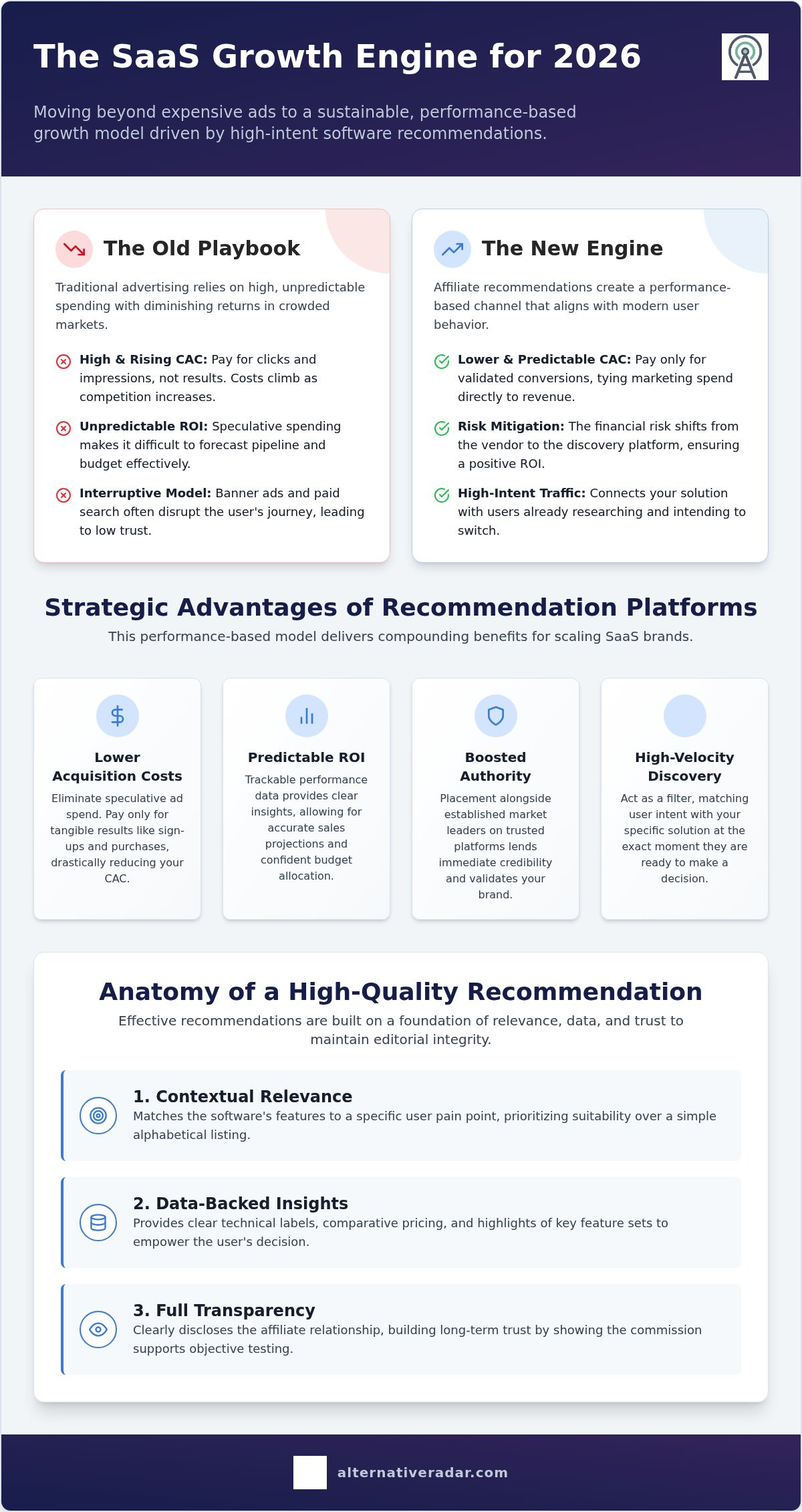
A high-quality recommendation starts with contextual relevance. It doesn’t just list features; it matches the alternative to a specific user pain point. If a user needs a CRM for a small team, the recommendation focuses on ease of use and price rather than enterprise-level complexity. These insights are backed by data, including:
- Clear technical labels: Identifying the exact software category and licensing model.
- Comparative pricing: Showing how the tool stacks up against market leaders.
- Feature sets: Highlighting the specific utilities that solve the user’s problem.
Transparency is the final pillar. Clearly disclosing the affiliate relationship builds trust, as users understand the commission supports the platform’s objective testing without increasing their own costs.
Affiliate Links vs. Direct Placements
Direct placements often function like digital billboards, where a vendor pays for visibility regardless of the outcome. In contrast, affiliate-linked software recommendations rely on a performance-based model. The vendor only pays when a user takes a specific action, such as a sign-up or purchase. This creates a natural incentive for the discovery platform to provide “value-first” content. Tracking links allow vendors to measure the exact ROI of each partnership, ensuring that marketing spend is tied directly to growth. This shift toward utility-focused content ensures that the user’s needs remain the priority, moving away from aggressive sales tactics toward helpful guidance.
The Growth Engine: How Recommendations Fuel SaaS Scaling
SaaS growth in 2026 requires a distribution strategy that doesn’t bleed capital. Affiliate-linked software recommendations serve as a high-efficiency growth engine by shifting the financial risk from the vendor to the discovery platform. Instead of paying for impressions that might not convert, you pay for results. This model directly lowers your Customer Acquisition Cost (CAC), allowing you to reinvest saved capital into product development. It creates a sustainable cycle where growth is funded by actual revenue rather than speculative venture debt.
Visibility on these platforms also provides a significant authority boost. When your software appears alongside established market leaders in a curated list, you inherit a portion of their perceived reliability. It’s a shortcut to trust. This performance-based model offers several strategic advantages for scaling brands:
- Risk Mitigation: You only pay for validated conversions, not speculative clicks.
- Predictable ROI: Performance data allows for more accurate sales pipeline projections.
- Brand Association: Placement alongside market leaders validates your tool’s position in the category.
Over time, being featured on multiple top-tier discovery platforms creates a compounding effect. As your brand appears more frequently across various lists, your organic search presence and brand recognition grow simultaneously.
Capturing High-Intent “Switching” Traffic
The most valuable leads are often those actively looking to leave a competitor. Users engaged in finding the best alternative to popular software in 2026 have already identified a problem and are ready to pay for a solution. They aren’t just browsing; they’re in “switching” mode. This intent is far more potent than broad interest because the friction to purchase is lower. Recommendations provide a frictionless path to your landing page at the exact moment the user is most motivated to act.
Scalability Through Performance Marketing
Traditional marketing often hits a ceiling when fixed ad budgets are exhausted. Affiliate-linked software recommendations remove this barrier by moving toward variable growth. This allows you to scale lead volume predictably without the volatility of auction-based ad platforms. Integrating these partnerships into your broader marketing stack is essential for long-term stability. You can use insights from top-performing affiliate categories to inform your programmatic display advertising campaigns, ensuring your automated media buying targets the right personas.
If you want to see how these recommendations fit into your current growth plan, you can explore how Alternative Radar categorizes software to match specific user intent. This data-driven approach ensures that every marketing dollar contributes to measurable SaaS scaling through validated channels.
Solving the Trust Paradox in Affiliate Marketing
The primary objection to affiliate-linked software recommendations is the fear of bias. If a platform earns a commission when you click a link, can you really trust their ranking? In 2026, the answer depends on the platform’s underlying business model. Low-quality directories prioritize the highest bidder, resulting in “Top 10” lists that are essentially paid ads in disguise. You’ll recognize these by their lack of critical analysis and their refusal to mention any drawbacks. They treat every tool as a perfect solution, which is never the case in the real world.
A professional curator operates with a “digital scout” mentality. We do the hard work of testing so you don’t have to. Providing a bad recommendation is a business-killing move; once you lose a user’s trust, they won’t return. Editorial integrity isn’t just a moral choice. It’s a survival strategy for platforms that value long-term utility over quick wins. Objective testing and honest comparisons protect the platform’s value by ensuring users actually find the efficiency they’re searching for.
Editorial Standards in Software Comparison
Credibility is built through balance. High-quality recommendations must include both pros and cons for every product listed. If a tool has a steep learning curve or lacks a mobile app, the curator should say so. This helps you disqualify unsuitable options quickly, saving you time. Another hallmark of integrity is the inclusion of free or non-commercial tools. For example, comprehensive open source CRM software comparison pages serve users by providing high-value alternatives that may not offer commissions at all. This commitment to variety proves the platform prioritizes your needs over its own immediate revenue.
Transparency as a Competitive Advantage
Transparency is the most effective filter for information. Best practices for affiliate-linked software recommendations in 2026 involve clear, prominent disclosures that explain how the site stays free for users. By being upfront about partnerships, a platform builds a “Second Brain” for the user, filtering out irrelevant noise and focusing only on tools that meet strict quality benchmarks. Alternative Radar prioritizes personalized suitability over commission rates because a happy user who finds the right tool is more valuable than a one-time click. We focus on licensing classifications and technical labels to ensure you get the precision you need to make a smart choice.
Evaluating High-Quality Recommendation Platforms
Not every platform delivering affiliate-linked software recommendations provides the same value. To find the right partner, you must look past simple traffic numbers and examine the intent behind those visitors. High-quality platforms focus on the user’s navigational journey rather than just raw volume. You should prioritize sites that rank for specific, high-intent “alternative” keywords. If a platform dominates search results for users looking to switch, it functions as a high-velocity discovery filter that captures buyers at the peak of their motivation.
User experience is another critical indicator of quality. A site designed for ad impressions will feel cluttered and distracting. In contrast, a site designed for discovery prioritizes clarity, using technical labels and licensing classifications to help users filter results quickly. Transparency is the final test. You want a partner that clearly distinguishes between organic editorial picks and sponsored software placements. This distinction protects your brand’s reputation by ensuring your tool is seen as a legitimate solution rather than a paid intrusion.
- Traffic Quality: Does the site attract users with specific switching intent?
- Category Depth: Does the platform offer granular comparisons or just surface-level summaries?
- Data Accuracy: Is the pricing, feature list, and licensing information up to date?
- Labeling: Are commercial relationships disclosed clearly to maintain user trust?
Metrics That Matter for SaaS Vendors
For a SaaS vendor, the most important metric is the conversion rate of “alternative” traffic compared to generic search traffic. Users arriving from a recommendation platform are already problem-aware and solution-seeking, which typically leads to a higher conversion rate. You should also monitor the click-through rate (CTR) from comparison tables to your specific landing pages. High-quality referrals often result in a higher Average Order Value (AOV) because the discovery platform has already done the work of filtering for professional suitability, ensuring the user understands your tool’s value before they sign up.
The Role of Niche Expertise
Niche expertise is what separates a generic tech blog from a reliable digital scout. Being featured on a specialized guide like the best Slack alternatives for 2026 is worth significantly more than a mention in a broad productivity listicle. Experts in a specific category can verify technical accuracy and provide the nuanced comparisons that professional buyers require. This level of detail prevents users from wasting time on incompatible tools and ensures that your software is recommended to the right audience. If you want to see how precision curation can impact your growth, you can explore how targeted software placements connect your brand with high-intent users on Alternative Radar.
Alternative Radar: Precision Software Discovery & Recommendations
Alternative Radar operates as a high-velocity discovery filter for the global software market. As a Dutch-owned platform under Madunet, we bring over a decade of expertise in lead generation, dating back to 2012. We don’t just aggregate links; we categorize tools using clear technical labels and licensing classifications. This ensures every user finds a solution tailored to their specific resource constraints and technical requirements. Our role is that of a neutral advisor, prioritizing clarity and comparison over marketing hype.
Our methodology combines programmatic efficiency with rigorous human curation. This ensures our affiliate-linked software recommendations aren’t just based on popularity, but on validated performance and suitability. We cover a vast global landscape across both productivity and entertainment categories, providing detailed insights that include features, pricing, and objective pros/cons. This data-backed approach removes the guesswork from SaaS procurement, allowing both casual users and professional buyers to move with momentum through the decision-making process.
Empowering Smarter Software Choices
We empower smarter choices by acting as your digital scout. From finding the best free alternatives to Photoshop to evaluating complex enterprise CRM solutions, we’ve already done the hard work of searching and testing. This saves you valuable time and resources. As we look toward the future, we’re integrating AI-driven suitability matching. This will allow our platform to offer even more personalized results, acting as a necessary intervention for your productivity and ensuring your software stack is always optimized for your current goals.
Partnering for Growth
SaaS brands can leverage our platform to reach users who are in active search mode. By utilizing sponsored software placements and affiliate-linked software recommendations, vendors can tap into a predictable lead volume that bypasses the volatility of traditional ad auctions. We focus on utility and precision in every recommendation, positioning your product as the logical remedy to a common industry pain point. This performance-based model ensures your growth is tied directly to user value and validated discovery. Discover how Alternative Radar can scale your software discovery today.
Mastering Precision Growth in 2026
Succeeding in the 2026 SaaS market requires a distribution strategy that prioritizes high-intent discovery over speculative spending. You’ve seen how affiliate-linked software recommendations serve as a high-velocity filter, matching users who are ready to switch with the exact tools they need. By shifting toward performance-based models, you can lower your acquisition costs while building brand authority alongside established market leaders. Trust remains the ultimate currency; maintaining editorial integrity ensures your growth is both sustainable and credible.
Alternative Radar provides the expert curation you need to stand out. Backed by Madunet’s lead generation expertise since 2012, we deliver helpful, objective, and efficiency-driven analysis for global SaaS brands. Our data-driven comparisons do the hard work of testing so you can focus on building better software. It’s time to move past inefficient ad auctions and embrace a model that rewards utility. Explore the best software alternatives on Alternative Radar and take the next step toward smarter scaling. Your path to efficient growth starts with precision discovery.
Frequently Asked Questions
What exactly are affiliate-linked software recommendations?
These are expert-vetted software suggestions that include unique tracking links. When you click these links and sign up, the discovery platform receives a commission from the vendor. This model funds the intensive testing and comparison work required to maintain high editorial standards. Unlike static directories, these recommendations focus on matching specific user intent with validated tools, providing a high-quality filter for professional buyers looking for efficiency.
How do these recommendations differ from paid ads?
Paid ads usually appear as banners or sponsored search results that interrupt your browsing experience regardless of context. In contrast, affiliate-linked software recommendations are integrated into detailed comparison guides that you have actively searched for. They offer utility by comparing features, pricing, and technical labels. While an ad simply demands attention, a recommendation provides the comparative data needed to make a smarter, faster purchasing decision.
Can I trust software reviews that contain affiliate links?
Trust depends on the curator’s commitment to objective testing. Reliable platforms act as digital scouts, highlighting both pros and cons to protect their reputation. If a site only offers praise, it is a red flag. High-quality curators include free and open-source alternatives alongside commercial ones. This balance proves that the primary goal is user suitability rather than just capturing a commission from a single vendor.
Do affiliate links make the software more expensive for me?
Using an affiliate link does not increase the price you pay for the software. The commission comes from the vendor’s existing marketing budget, not from your subscription fee. In some cases, clicking these links might even provide access to exclusive discounts or extended free trials. You receive the same product and support while supporting the platform that provided the research and comparison data for free.
Why do software companies use affiliate programs for growth?
SaaS vendors use these programs to achieve predictable growth with lower customer acquisition costs. Instead of spending on speculative ad impressions, they only pay when a recommendation results in a validated conversion. This performance-based model allows smaller brands to compete with incumbents by appearing on trusted discovery platforms. It aligns the vendor’s success with the curator’s ability to provide accurate, high-intent referrals to the right audience.
How does Alternative Radar ensure its recommendations remain objective?
We maintain objectivity by using a structured framework that evaluates tools based on technical labels, licensing classifications, and pricing data. Our Dutch-owned team at Madunet has refined this process since 2012, focusing on detailed insights rather than marketing hype. We prioritize personalized suitability, ensuring that our recommendations address specific user pain points. This logic-driven approach ensures our platform remains a reliable tool for exploration rather than a biased sales channel.
What is the difference between an affiliate link and a sponsored placement?
An affiliate link is performance-based, where the platform earns a commission only after a user converts. A sponsored placement is usually a fixed-fee arrangement where a vendor pays for a specific position or visibility on the site for a set period. Both models are clearly labeled on high-quality platforms to maintain transparency. While both drive growth, affiliate-linked software recommendations focus on conversion ROI, whereas sponsored placements prioritize immediate brand visibility.
How can I find the best alternatives to popular software using this site?
You can use our navigational categories to move from broad discovery to specific comparisons. We categorize software across productivity and entertainment sectors, providing a fast-paced rhythm for users in search mode. Simply look for the “Alternative To” guides or category-specific lists. Our detailed insights and comparison tables allow you to filter results based on your specific needs, helping you find a better fit than the current market leaders.