
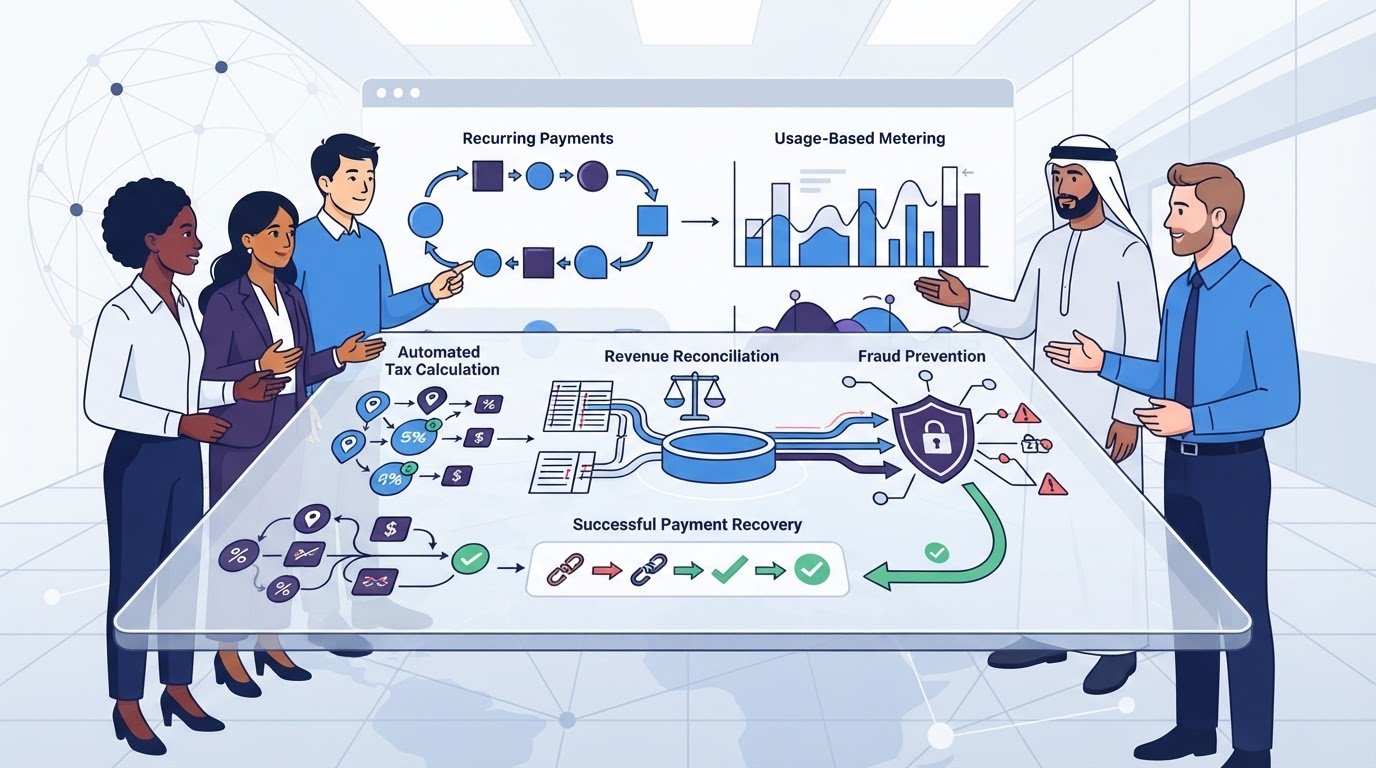
Involuntary churn accounts for 20% to 40% of SaaS customer attrition, quietly eroding revenue simply because rigid checkout tools fail to recover expired cards and transient payment errors. You already know the operational drag that follows: accounting teams waste hours manually reconciling transactions across separate gateways and ERP ledgers, while engineers burn vital sprint cycles writing custom billing code for hybrid or usage-based models. Adopting dedicated subscription billing management software is the most effective way to decouple monetization logic from your codebase, eliminating dev bottlenecks while protecting your cash flow.
In this guide, you’ll discover how to evaluate, compare, and implement billing engines capable of scaling complex pricing models, automated tax calculations, and ASC 606 compliance workflows. We evaluate the leading platforms side by side, analyzing recurring fee structures, dunning workflows, and ledger integrations so you can deploy the right solution for your architecture.
Key Takeaways
- Selecting the right subscription billing management software requires decoupling your product catalog from raw payment processors to enable rapid pricing updates without engineering debt.
- Managing hybrid and usage-based pricing models demands dedicated event-metering infrastructure rather than basic recurring calendar schedulers.
- Automating real-time address validation, regional digital tax calculations, and ASC 606 revenue recognition rules prevents costly audit exposure and compliance bottlenecks.
- Evaluating the true total cost of ownership means looking past headline monthly fees to calculate gateway cuts, transaction overages, and add-on module expenses.
- Executing a zero-downtime billing migration depends on structured gateway token portability, data mapping, and dual-write testing before full platform cutover.
Evaluating Subscription Billing Management Software: Core Architectural Requirements
Subscription billing software operates as the financial brain of modern recurring revenue operations, sitting between front-end customer touchpoints and back-end accounting ledgers to coordinate plan lifecycles, automated invoicing, and collections. As companies scale the subscription business model, relying on basic merchant gateways creates technical bottlenecks. Modern platforms decouple the product catalog from raw payment processing pipelines. This separation lets product managers adjust rate plans, experiment with bundles, and launch localized currency tiers without requiring engineering teams to rewrite checkout code.
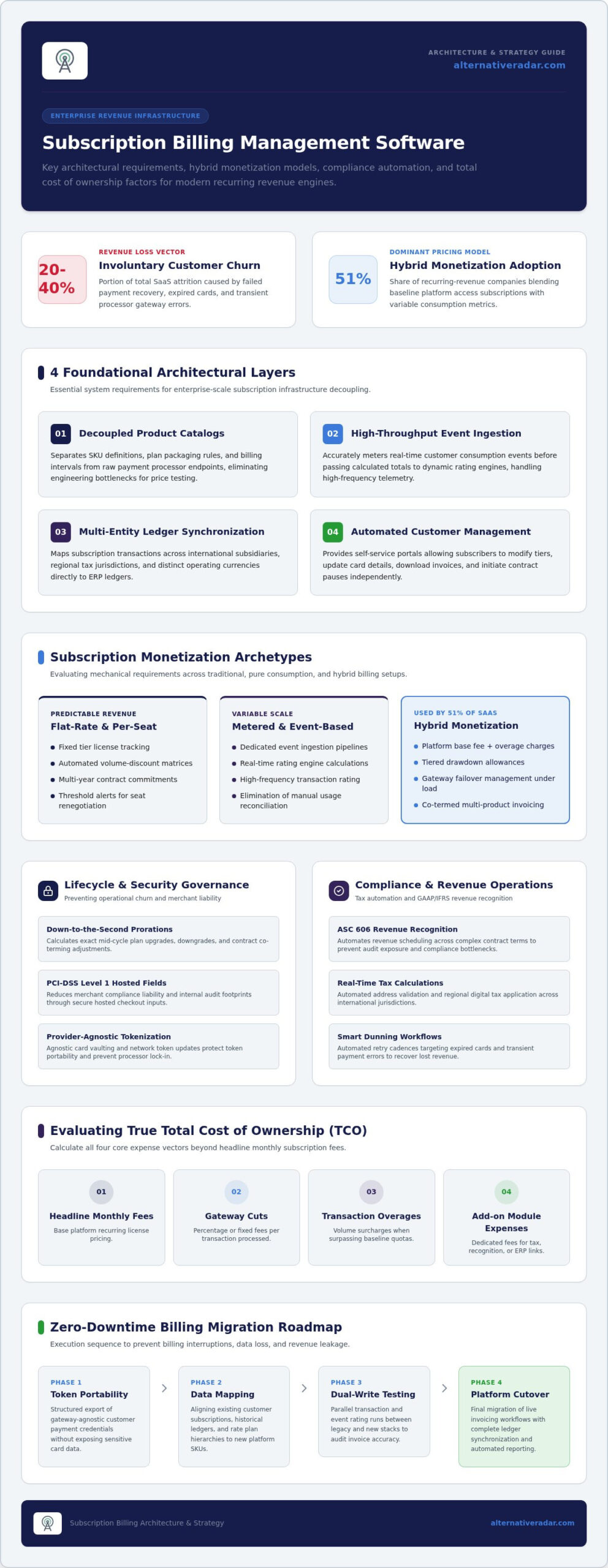
To support enterprise scale, high-performing billing infrastructure requires four foundational architectural layers:
- Decoupled product catalogs: Separate SKU definitions, plan rules, and billing intervals from payment processor endpoints.
- High-throughput event ingestion: Meter real-time consumption data accurately before passing totals to rating engines.
- Multi-entity ledger synchronization: Map transactions across subsidiaries, regional tax jurisdictions, and distinct operating currencies.
- Automated customer management: Empower subscribers to modify tiers, update cards, and view invoice history independently.
Selecting adaptable subscription billing management software depends on matching platform architecture to your technical ecosystem rather than following brand market share. The system you deploy must solve operational complexity before it stalls revenue velocity.
Automated Lifecycle Management: Upgrades, Prorations, and Cancellations
Mid-cycle subscription adjustments break rigid billing setups. When evaluating tools, examine how their underlying rating engines calculate complex, down-to-the-second prorations for tier adjustments. Your billing stack should support contract co-terming so expanding accounts maintain unified billing dates across multiple seat additions. Look for native subscription pause options alongside self-service account portals. Giving subscribers immediate control over upgrades and pauses curbs support tickets while directly preventing preventable cancellations.
Security Governance: PCI-DSS Compliance, Vaulting, and Tokenization
Protecting payment credentials demands rigorous architecture that reduces merchant liability without sacrificing checkout flexibility. Prioritize solutions certified for Level 1 PCI-DSS compliance that leverage hosted fields to minimize internal audit footprints. In addition, demand provider-agnostic tokenization and native network token updates. Agnostic card vaulting prevents aggressive vendor lock-in, ensuring you retain full ownership of customer payment tokens if you ever switch underlying gateway processors.
Monetization Models: Comparing Fixed, Usage-Based, and Hybrid Billing
Modern software monetization has moved far beyond simple monthly subscriptions. Today, 51% of recurring-revenue companies utilize a hybrid model that blends platform access fees with variable consumption charges. Legacy recurring billing tools frequently fail when forced to handle this balance. They choke on high-volume event pipelines, leaving finance teams stuck reconciling unrated usage events by hand. Selecting the right subscription billing management software requires auditing how platforms handle real-time event rating, tiered drawdowns, and gateway failovers under load. For a broader framework on vetting modern architectures, review our guide to finding the best alternative to popular software in 2026.
Flat-Rate, Per-Seat, and Tiered Subscription Mechanics
Seat-based licenses and fixed tiers provide baseline predictability, but they quickly introduce friction during organizational expansion. Your billing software must automate volume-discount matrices, manage multi-year contract commitments, and track concurrent versus assigned seats. When accounts cross user thresholds, automated threshold alerts ensure sales teams can initiate contract renegotiations without billing interruptions or manual account audits.
Metered Consumption, Event Ingestion, and Rating Engines
Metered models hinge entirely on ingestion throughput and rating latency. Modern systems must continuously ingest millions of raw API events, database queries, or compute cycles, converting them into billed currency units without drop-offs. Look for engines that manage prepaid credit balances, drawdown mechanics, and overage tiers out of the box. Real-time consumption dashboards are equally essential, warning subscribers before unexpected overages trigger invoice disputes.
Payment Gateway Orchestration and Multi-Currency Routing
Global operations collapse without resilient payment orchestration. Top-tier subscription billing management software decouples transaction processing across regional gateways, automatically routing transactions to local acquirers to boost authorization rates. Deploying smart routing gives your stack three vital capabilities:
- Localized rails: Native processing for SEPA direct debit, ACH transfers, iDEAL, and regional digital wallets.
- Automated failover: Real-time rerouting of failed transactions to secondary gateways during processor downtime.
- Currency settlement: Processing and settling payments in native buyer currencies without punishing conversion markups.
If you want to benchmark alternative providers against market leaders, explore our objective evaluations on Alternative Radar to choose an architecture tailored to your transaction scale.
Revenue Operations Friction: Solving Tax, Involuntary Churn, and ASC 606
Revenue operations break down when front-end billing activity fails to sync with back-end financial governance. For the median B2B SaaS business, monthly churn hovers around 3.5%, with involuntary churn from failed transactions driving roughly 0.8% to 0.9% of that total. Beyond uncollected cash, international and domestic tax expansion creates heavy compliance overhead. States like California and Colorado are expanding their sales tax base to include SaaS starting January 1, 2027, while economic nexus thresholds continue to shift across jurisdictions. Advanced subscription billing management software neutralizes this operational drag by automating global sales tax lookups, algorithmic card retries, and strict revenue recognition schedules.
Automated Revenue Recognition and General Ledger Sync
Under ASC 606 and IFRS 15, revenue can only be recognized as performance obligations are delivered, not when cash hits your bank account. Enterprise billing engines must calculate dynamic amortization schedules across multi-year contracts, usage add-ons, and mid-cycle tier amendments. Modern subscription billing management software automatically generates double-entry journal entries, mapping deferred revenue balances directly to your ERP general ledger to ensure audit-proof compliance.
Smart Dunning Cycles and Involuntary Churn Prevention
Static retry rules like pinging a failed credit card every 24 hours trigger bank fraud filters and accelerate customer churn. In contrast, modern dunning engines employ machine-learning retry algorithms that systematically recover between 50% and 70% of failed subscription charges by scheduling transaction attempts around specific cardholder habits and optimal bank processing windows.
Protecting recurring revenue requires deploying a layered recovery workflow before subscriptions expire:
- Pre-dunning alerts: Send proactive notifications and in-app banners when saved cards approach expiration dates.
- Dynamic retry schedules: Execute retries using machine-learning models tuned to issuer error codes and localized clearing times.
- Configurable grace periods: Maintain subscriber software access during active collection windows while flagging delinquent accounts.
- Subscription pauses: Give customers encountering short-term cash flow issues the option to pause accounts rather than churning completely.
Deploying automated recovery rules and strict revenue schedules protects your cash flow without forcing engineering and finance teams into constant manual firefighting.
Leading Subscription Billing Platforms: Comparative Evaluation Matrix
Selecting the right subscription billing management software requires matching architectural maturity to business model requirements. Off-the-shelf tools accelerate launch times, while modular platforms accommodate bespoke billing workflows. The difference comes down to developer overhead, contract complexity, and variable volume fees.
Enterprise Powerhouses: Zuora, BillingPlatform, and SAP
Large-scale operations with global entities and complex Configure, Price, Quote (CPQ) needs rely on enterprise engines. Zuora dominates high-volume environments; it added conversational AI rate plan management in July 2026 to streamline complex pricing catalog updates. BillingPlatform excels at hybrid usage modeling and automated accounts receivable. These platforms demand substantial implementation cycles and custom consulting, but they eliminate scale ceilings for multinational enterprises.
Mid-Market and SaaS Favorites: Stripe Billing, Chargebee, and Recurly
High-growth SaaS teams prioritize turnkey gateway integrations and operational agility. Each mid-market platform targets distinct scaling priorities:
- Stripe Billing: Best for developer-led teams wanting seamless integration. It charges 0.7% of billing volume or starts at $620 monthly for up to $100,000 in volume, backed by high-throughput usage capabilities following its acquisition of Metronome in January 2026.
- Chargebee: Ideal for multi-gateway orchestration. It offers a Starter tier free up to $250,000 in cumulative billing, shifting to the Performance plan at $599 monthly for up to $100,000 in volume plus a 0.75% overage fee.
- Recurly: Built for high-velocity subscriber retention and algorithmic dunning. Its Starter plan costs $249 monthly plus 0.9% of volume, with the first $40,000 in monthly billings exempt from percentage fees.
Alternative and Open-Source Billing Engines: Kill Bill and Lago
Engineering teams prioritizing data residency and zero platform percentage fees often turn to self-hosted alternatives. Platforms like Kill Bill and Lago provide modular, event-based usage engines that integrate directly into proprietary stacks. You avoid revenue-share pricing, though internal teams take on the hosting maintenance and infrastructure overhead. If self-hosting fits your strategy, examine our open source crm software comparison to align your data stack.
To audit fee structures and compare vendor capabilities side by side, explore verified software alternatives on Alternative Radar before committing to a multi-year contract.
Step-by-Step Implementation: Auditing, Migrating, and Launching Your Billing Stack
Migrating live customer contracts to a new billing platform is a delicate operational exercise. A single dropped token or inaccurate proration formula creates billing disputes, damages brand credibility, and triggers involuntary churn. Success requires methodical execution across data mapping, sandbox load testing, dual-run reconciliations, and cross-functional validation between engineering, finance, legal, and support teams. Establishing rigorous testing protocols guarantees that your new subscription billing management software activates smoothly without interrupting recurring cash flow.
Payment Token Portability and Customer Vault Migration
Never ask active subscribers to re-enter payment details during a backend infrastructure upgrade. Initiate a secure, PCI-compliant token transfer directly between your legacy payment vault and the new processor. Both compliance teams exchange encrypted customer tokens, billing addresses, and card expiration dates using PGP key pairs. Map these imported tokens to your CRM and internal identity databases before cutting over production billing, verifying that every customer record points to a valid, active payment method.
Dual-Run Testing and Financial Reconciliation Audits
Before decommissioning your legacy engine, execute parallel billing cycles for at least one full renewal period. Run both platforms concurrently in sandbox and staging environments, matching real-world transaction data against the new system’s rating engine. During this dual-run audit, follow a strict reconciliation checklist:
- Invoice line matching: Compare net totals across base rates, multi-tier usage overages, and promotional credits.
- Tax validation: Cross-check calculated sales tax and VAT against secondary tax automation engines down to the exact cent.
- Edge-case auditing: Test complex scenarios such as mid-cycle plan cancellations, credit balance drawdowns, and partial refunds.
- Webhook integrity: Verify that provisioning webhooks fire instantly upon successful renewal to prevent service access dropouts.
Selecting Your Optimal Billing Fit on Alternative Radar
Deploying new subscription billing management software requires honest assessment of your monetization roadmap. You must decide whether developer velocity, complex enterprise CPQ, or agnostic multi-gateway routing matters most. Evaluate full financial terms, comparing percentage-of-revenue platform cuts against flat monthly software tiers. To discover unbiased comparisons and evaluate software alternatives outside standard marketing hype, explore the curated vendor profiles on Alternative Radar to build an efficient, scalable billing stack.
Scale Your Revenue Operations With the Right Billing Engine
Rigid billing setups constrain commercial agility and introduce ongoing operational drag. Decoupling your monetization layer from raw payment pipelines protects vital engineering cycles, while automated tax calculations, compliant revenue schedules, and smart dunning workflows systematically eliminate revenue leakage. Selecting the ideal subscription billing management software isn’t about following market momentum. It’s about matching your pricing complexity, transaction volume, and general ledger architecture to an engine built for long-term operational velocity.
Before committing to an expensive vendor contract, evaluate your architectural options with clarity. Compare top subscription billing software alternatives on Alternative Radar to explore unbiased, side-by-side feature and pricing comparisons across enterprise platforms, agile SaaS engines, and open-source frameworks. With the right billing foundation in place, you can confidently turn monetization experiments into predictable, recurring profit.
Frequently Asked Questions
What is subscription billing management software and how does it differ from a payment gateway?
Subscription billing management software acts as the business logic engine that orchestrates recurring invoices, prorations, plan upgrades, and customer lifecycles. In contrast, a payment gateway simply processes the actual financial transaction between banks. The billing software sits above the gateway, tracking what a subscriber owes and telling the underlying payment gateway when and how much to charge.
How does subscription billing software manage usage-based or metered pricing models?
Modern billing platforms ingest high-frequency event streams through dedicated APIs, recording metrics like gigabytes stored, API calls made, or active seats. The engine aggregates these raw usage events over a defined billing cycle, applies volume discounts or tiered rating logic, and adds the resulting variable overage fees to the subscriber’s base periodic invoice automatically.
What is involuntary churn and how do automated billing platforms help reduce it?
Involuntary churn occurs when active customer subscriptions drop due to passive payment failures like expired cards, network timeouts, or insufficient funds. Subscription billing management software combats this loss using automated card account updaters, proactive pre-expiration emails, and algorithmic dunning schedules that reattempt failed charges at optimal bank processing times.
Can I migrate customer payment data between subscription billing platforms without downtime?
Yes, you can migrate payment profiles without service interruptions or asking subscribers to re-enter sensitive details. The process involves a secure, PCI-compliant token transfer directly between your old and new payment vaults. After the encrypted tokens transfer, you map those identifiers to your internal database and run parallel dual-billing tests before the final cutover.
Why is ASC 606 and IFRS 15 compliance important in subscription billing software?
Statutory accounting standards require recurring revenue businesses to recognize earnings only after fulfilling specific performance obligations over time. Advanced billing software automatically builds deferred revenue schedules and generates auditable journal entries. This prevents finance teams from tracking multi-year contract amortizations manually in error-prone spreadsheets, ensuring accurate financial statements during external audits.
How does subscription billing software calculate global sales taxes, VAT, and GST?
Billing platforms integrate real-time tax calculation services that validate customer addresses and determine economic nexus status across regional jurisdictions. The software identifies whether digital software goods are taxable in the buyer’s territory, applies the exact statutory rate at checkout, and compiles detailed tax liability reports to simplify regional remittance filings.
What are the main advantages of multi-gateway routing in recurring billing software?
Multi-gateway routing lets businesses connect several payment processors to a single billing engine. The system automatically routes payments to local acquirers to lower processing fees and improve authorization rates. Additionally, if a primary processor suffers a service outage, the billing engine instantly triggers smart failover routing to secondary gateways to prevent lost revenue.