

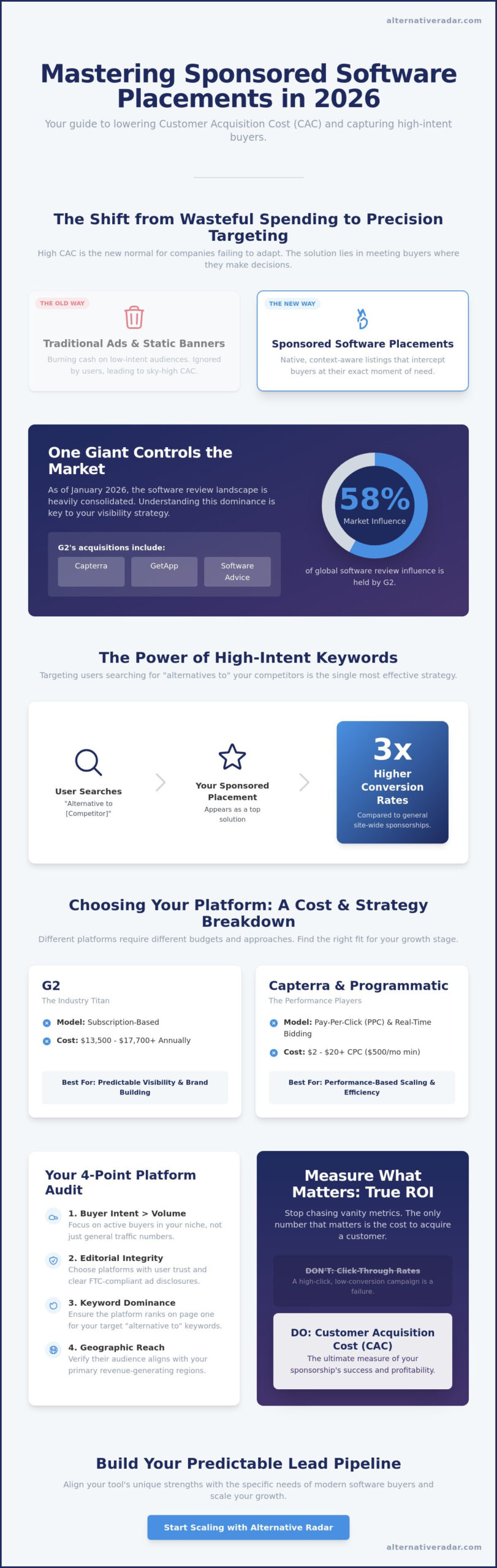
Since January 2026, G2 has controlled 58% of global software review influence through its acquisition of Capterra, GetApp, and Software Advice. If you feel like your traditional search ads are just burning cash, you aren’t alone. High CAC is the new standard for SaaS companies that fail to use sponsored software placements to intercept buyers at the peak of their decision-making process. You want to stop wasting time searching for leads and start appearing exactly where your future customers are already comparing options.
This guide explains how to secure high-intent traffic and maximize your ROI through strategic placements on these dominant platforms. We’ll show you how to find the right fit for your growth stage, whether you’re starting with a $2,999 G2 Starter plan or managing Capterra’s $2 minimum CPC model. We’ll preview the exact strategies needed to lower your CAC and dominate “alternative to” search results to build a predictable lead generation pipeline.
Key Takeaways
- Understand the shift from static banners to native, context-aware listings that prioritize your software in specific categories.
- Identify “vulnerable competitors” to target with sponsored software placements, capturing high-intent users at the exact moment they consider a switch.
- Evaluate platform quality by looking past general traffic volume to focus on editorial integrity and active buyer intent.
- Calculate the true ROI of your campaigns by shifting focus from vanity metrics like click-through rates to specific customer acquisition costs.
- Build a predictable lead generation pipeline by aligning your tool’s unique strengths with the specific needs of modern software buyers.
What are Sponsored Software Placements in 2026?
By May 2026, the strategy for SaaS growth has shifted away from generic reach toward precision targeting. Sponsored software placements are paid positions within software directories and comparison engines that prioritize your brand in specific categories. This is a targeted form of online advertising that places your product directly in front of users who’ve already identified a need. These placements serve as the bridge between a user’s current tool frustration and your specific solution.
The industry has moved beyond static sidebar banners that users typically ignore. Modern placements are native, context-aware listings that appear as a seamless part of the software discovery process. This evolution is driven by the massive consolidation seen in January 2026, when G2 acquired Capterra, GetApp, and Software Advice. With G2 now influencing 58% of global software reviews, these sponsorships aren’t just ads; they’re essential visibility markers in a centralized market. They outperform traditional display ads because they rely on intent data rather than broad demographic guesses.
The Mechanism of High-Intent Visibility
Visibility on comparison platforms works differently than standard search engine marketing. When your software appears in “Alternative to” search results, you’re catching a buyer at their most decisive moment. Internal data suggests these specific slots drive 3x higher conversion rates compared to general site-wide sponsorships. While a global sponsorship might build brand awareness among 100 million annual G2 visitors, niche category targeting ensures you only pay for traffic from users looking for your specific functionality. It’s the difference between shouting in a crowded room and answering a direct question.
Native vs. Programmatic Placements
Native integration ensures your software looks like a natural recommendation within a list of top-rated options. This builds immediate trust with the buyer. However, 2026 is also the year of automated, auction-based software sponsorships. The rise of programmatic display advertising within the software discovery space allows vendors to bid on placements in real-time. This model mirrors Capterra’s $2 minimum CPC framework but applies it to dynamic layouts across multiple platforms. It’s an efficiency-driven approach that lets you scale your sponsored software placements based on performance data rather than fixed annual contracts.
Evaluating Platforms: Where Should You Buy Placements?
Selecting the right platform for sponsored software placements requires a cold, analytical look at traffic quality. You aren’t just buying eyeballs; you’re buying access to a user’s decision-making process. High-volume sites like G2 boast over 100 million annual visitors, but you must distinguish between “window shoppers” and “active buyers.” If a platform doesn’t align with your specific category, like CRM or ERP, you’ll likely see high click-through rates with zero conversion at the bottom of the funnel.
Editorial integrity is another non-negotiable factor. Platforms that maintain honest, unfiltered reviews drive better long-term results because they possess the user’s trust. When you evaluate a site, check how they handle disclosures. Reliable platforms strictly follow the FTC’s native advertising guidelines to ensure users know when a listing is sponsored. This transparency actually helps your brand. It filters for users who are ready to engage with a vendor rather than those who feel misled by “hidden” ads.
You must also choose between programmatic and direct sponsored listings. Programmatic options use automated bidding to place your software in front of users based on their browsing behavior across multiple sites. Direct placements are static, category-specific commitments. While programmatic offers scale, direct placements provide predictable visibility on high-value pages. Pricing models vary wildly between these choices. You might encounter G2’s subscription model, where a Professional plan starts between $13,500 and $17,700 annually, or Capterra’s PPC model with a minimum $500 monthly budget and CPCs ranging from $2 to over $20. Understanding how software review sites for vendors compare across these pricing structures can help you allocate your budget before committing to a specific platform.
The Software Discovery Site Checklist
Before committing your budget, run a quick audit of the platform’s performance. First, check their domain authority for your target “alternative to” keywords. If they don’t rank on page one of search results, they won’t drive the high-intent traffic you need. Second, verify their geographic reach. If your primary revenue comes from the EU, a US-centric directory is a waste of resources. Finally, ensure the platform supports UTM tracking or pixel integration. Without these, you can’t accurately calculate the $200 to $300 cost per meeting that top-tier practitioners expect from these channels.
Tier 1 Directories vs. Niche Aggregators
Tier 1 sites like G2 and Capterra offer massive reach, but the “pay-to-play” nature of their badges and priority placements can lead to a bidding war. Niche aggregators and “scout” platforms often provide a lower CAC because they attract users who are already deep in the comparison phase. These users don’t want a massive directory; they want a curated list of the right fit. Using a best alternative software finder that acts as a strategic filter can help growing SaaS brands identify the most efficient channels before committing to expensive Tier 1 placements. If you want to explore targeted placement options that prioritize efficiency over raw volume, focusing on specialized comparison engines is often the smarter choice for growing SaaS brands.
Strategy: Optimizing Your “Alternative To” Placements
Capturing a user who is actively searching for an alternative requires more than just a high bid. You need to identify “Vulnerable Competitors.” These are market leaders that have recently implemented significant price hikes or are suffering from feature bloat. If a competitor increased their subscription fees by 15% in early 2026, your sponsored software placements should explicitly highlight your cost-effectiveness. This isn’t about being better in every category; it’s about being the right fit for the user’s specific frustration.
Landing page continuity is the silent killer of ROI. If your sponsored snippet promises a “free migration,” but your entry point leads to a generic homepage, the user will bounce. Practitioner data from May 2026 shows that matching the ad claim to a dedicated comparison landing page can reduce your bounce rate by 25%. You should also employ dynamic bidding. This involves adjusting your sponsorship spend based on competitor news cycles. If a rival tool experiences a major service outage, increasing your bid for their “alternative to” keywords captures users at their peak moment of dissatisfaction.
Psychology of the Switcher
Users search for alternatives because of price, complexity, or missing features. Your copy must address these directly. A placement is only as good as the friction it removes for the user. If they’re leaving a tool because it’s too difficult to use, your snippet should emphasize “setup in under 10 minutes” rather than “enterprise-grade security.” By focusing on the specific pain points identified in user reviews, you position your software as the logical remedy rather than just another vendor.
Winning the “Alternative to [Competitor]” Slot
Winning the “Alternative to [Competitor]” slot involves more than a single paid listing. You can use affiliate-linked software recommendations to build a broader presence across multiple review sites. This creates a surround-sound effect where your brand appears as a top-rated option in both organic and paid sections. A/B testing your listing headlines is critical. Even a 0.5% increase in CTR can significantly lower your cost per lead, which typically ranges from $30 to $100 on platforms like Capterra. Leveraging social proof, such as “Rated #1 for Ease of Use by 500+ users,” within the sponsored snippet helps build immediate trust before the first click.
Measuring ROI: Is Your Sponsorship Actually Working?
Click-through rate (CTR) is a starting point, but it’s fundamentally a vanity metric. If you’re paying for sponsored software placements, you need to track the entire funnel. High clicks on a comparison page don’t matter if they don’t convert into qualified leads. You should calculate your Customer Acquisition Cost (CAC) by dividing your total placement spend by the number of closed-won deals originating from that channel. By May 2026, practitioner data shows a cost per meeting between $200 and $300 for high-intent platforms. If your costs exceed this benchmark without a corresponding increase in Lifetime Value (LTV), your strategy needs adjustment.
Attribution modeling often suffers from “last-click” bias. A buyer might discover your tool on a comparison engine but eventually sign up through a direct branded search. This “Halo Effect” is real. To account for it, monitor your branded search volume on Google alongside your sponsorship activity. If branded searches spike 15% during a heavy placement campaign, the sponsorship is likely driving that awareness. You can’t rely on platform dashboards alone; you must look at your internal CRM data to see the full picture.
The Full-Funnel Impact of Placements
Tracking the journey from an “Alternative to” search to a booked demo requires deep data integration. For example, looking at open source CRM software comparison data helps you identify exactly where users drop off. Are they clicking the link but failing to sign up? This often indicates a mismatch between the directory listing and the landing page. LTV analysis of users from these sites often shows they are more “sticky” because they chose your tool after an active comparison process rather than a random search.
Benchmarking Success in 2026
A “good” conversion rate for a sponsored listing typically falls between 5% and 10% from click to lead. Red flags in reporting include a high volume of leads with incomplete data or non-business email addresses. These often indicate the platform is incentivizing reviews or clicks rather than genuine buyer intent. When your cost per lead on Capterra climbs above the $100 mark in a saturated category, it’s time to re-evaluate. You can audit your placement strategy with our digital scouts to find more efficient channels before your CAC becomes unsustainable.
Scaling Growth with Alternative Radar Placements
Alternative Radar operates differently than the massive directories that now dominate the market. We prioritize efficiency. For vendors, this means sponsored software placements aren’t just about outbidding a competitor but about finding the right fit for a specific user segment. Our digital scouts have already analyzed the market, meaning we direct users toward your solution only when it genuinely solves their problem. This curated approach filters out the low-intent traffic that often inflates costs on larger, less focused platforms.
Transparency is at the core of our platform. You get clear comparisons and detailed insights into how your listings perform without the “pay-to-play” badges that can skew results. Our programmatic flexibility allows you to adjust your spend in real-time, ensuring your budget is always directed toward high-converting “alternative to” categories. Getting started is a direct process: set up your account, define your target categories, and launch your first live listing to begin intercepting high-intent buyers.
Partnering for Performance
We align our success with yours. Our model for affiliate referral commissions ensures that we’re incentivized to drive high-quality traffic rather than just raw clicks. When you partner with us, you gain access to our proprietary “Alternative To” keyword database. This resource helps you identify niche opportunities your competitors might be overlooking. You can also collaborate with our editorial team. We help you refine your brand positioning to ensure your USP resonates with the specific needs of users who are tired of market leaders and looking for better options.
The 2026 Roadmap for Advertisers
As we move through May 2026, we’re introducing new tools to further lower your customer acquisition costs. Our upcoming AI-driven matching engine will analyze user behavior in real-time to pair them with the software that fits their technical requirements and budget perfectly. This real-time intent bidding will make sponsored software placements even more precise. SaaS brands that shifted their budget to our platform in early 2026 have already seen results, with some achieving a 40% lower CAC compared to Tier 1 directories. Stop wasting time searching for the right audience and let them discover you. You can scale your software growth with Alternative Radar today and secure your spot in the next generation of software discovery.
Master Your 2026 SaaS Growth Strategy
The shift toward precision-based software marketing is no longer optional. You’ve seen how the market consolidation of 2026 has changed the landscape, but success still depends on how you use sponsored software placements to intercept buyers at the right moment. By targeting vulnerable competitors and focusing on high-intent “Alternative to” traffic, you can lower your customer acquisition costs and build a predictable lead pipeline. Tracking full-funnel ROI ensures your spend translates into actual demos rather than just vanity metrics.
It’s time to stop wasting resources on broad reach and start prioritizing the right fit. Alternative Radar offers Dutch-engineered programmatic precision to ensure your tool appears exactly where it matters most. We’re trusted by over 500 software vendors worldwide who value transparency and logic over marketing hype. Our specialized focus on high-intent comparison traffic helps you bypass the “pay-to-play” bloat of larger directories. Make the smarter choice for your growth roadmap and start scaling with a partner that values your efficiency.
Boost Your SaaS Growth with Sponsored Placements on Alternative Radar
Frequently Asked Questions
What is the average cost of sponsored software placements in 2026?
Costs vary based on the platform’s pricing model. As of May 2026, a G2 Starter plan costs approximately $2,999 per year, while Enterprise subscriptions can exceed $95,000. On PPC platforms like Capterra, the minimum monthly budget is $500, with cost-per-click rates ranging from $2 to over $20 in highly competitive categories. Most growing SaaS companies start with $1,000 to $2,000 monthly to gather sufficient data.
How do sponsored placements affect my organic ranking on comparison sites?
Paid placements don’t directly change the organic algorithm, but they create an indirect “halo effect” for your brand. Higher visibility through sponsored software placements leads to increased traffic, which often results in more user reviews. Since review volume and recency are key organic ranking factors, your paid activity can eventually lift your organic position through improved social proof.
Can I target specific competitors with my sponsored software listing?
Yes, you can specifically target “Alternative to [Competitor]” pages to reach users looking to switch tools. This strategy is highly effective because it intercepts buyers at their most decisive moment. By bidding on these specific slots, you ensure your software appears as a top-rated option exactly when a user is dissatisfied with a rival’s pricing or features.
What is the difference between a sponsored placement and an affiliate link?
A sponsored placement is typically a fixed-fee or bid-based position within a directory’s category list. An affiliate link is a performance-based recommendation where the platform receives a commission for every lead or click. Both function as sponsored software placements, but placements offer more predictable visibility while affiliate links align costs directly with user actions.
How long does it take to see results from a software directory sponsorship?
Traffic starts the moment your listing goes live, but statistical significance for ROI takes 30 to 90 days. You need this window to account for the typical SaaS sales cycle and to gather enough data to calculate an accurate cost per meeting. Short-term bursts often provide vanity metrics, while long-term sponsorships allow for the lead nurturing required to close deals.
Is it better to sponsor a broad category or a specific “alternative to” page?
Specific “alternative to” pages generally offer a lower CAC and higher conversion rates for growing brands. Broad categories like “Project Management Software” have massive volume but include many “window shoppers.” Focusing on specific comparison pages ensures you’re reaching active buyers who have already defined their needs and are ready to choose the right fit.
How do I track conversions from a third-party software placement?
Use UTM parameters and tracking pixels to follow the user journey from the comparison site to your CRM. By integrating these tools with your internal analytics, you can move beyond simple click tracking to monitor demo bookings and closed-won deals. This data is essential for determining if your cost per meeting stays within the $200 to $300 industry benchmark.
Do I need a high review count before paying for a sponsored placement?
You don’t need hundreds of reviews, but a baseline of 10 to 15 positive entries is critical for conversion. Sending paid traffic to a profile with no social proof usually results in a high bounce rate. Buyers visit these platforms to compare experiences, so ensure your profile has enough detailed feedback to appear as a reliable curator of solutions.