

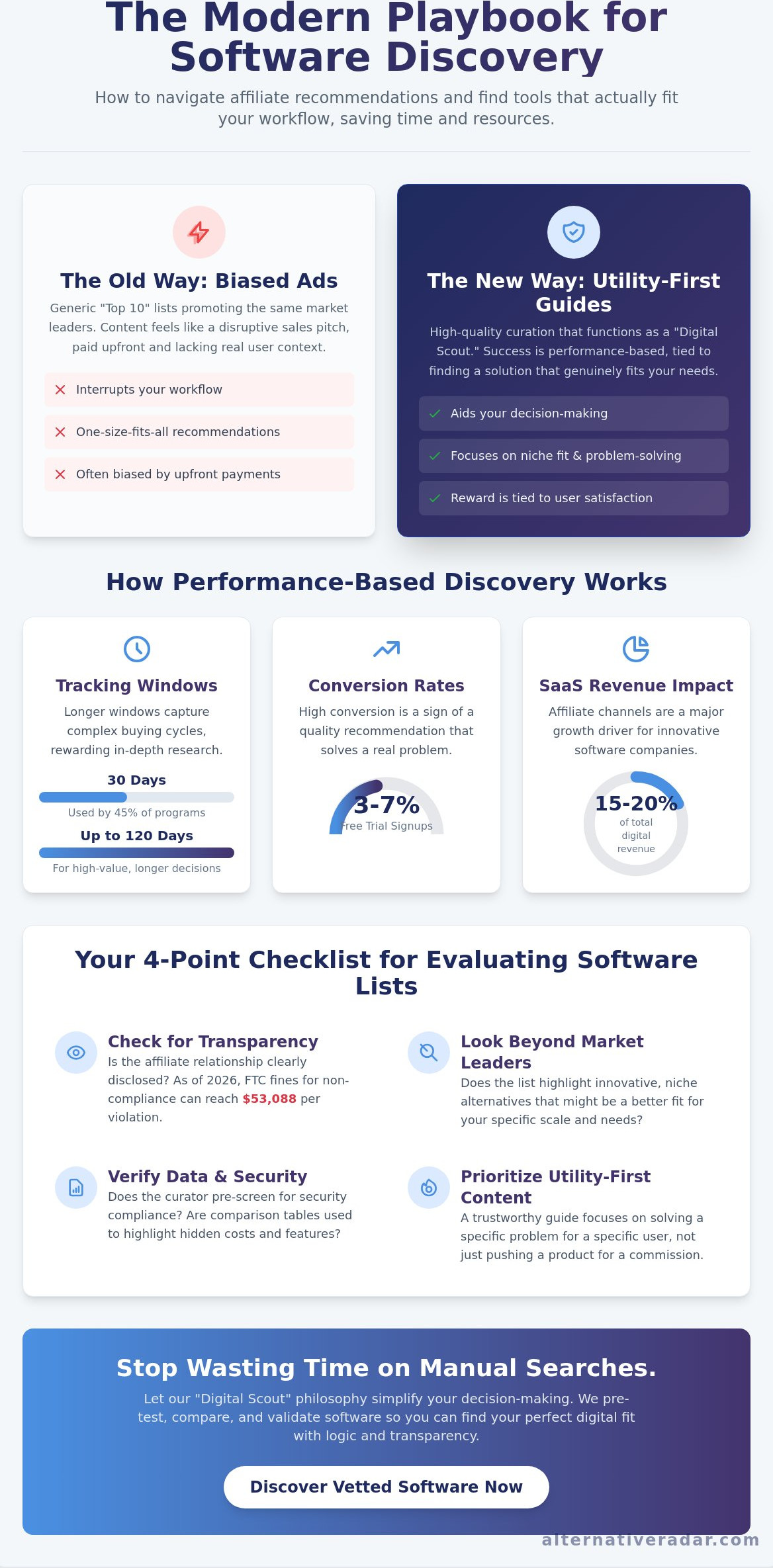
As of April 2026, the FTC enforces affiliate disclosure rules with fines reaching up to $53,088 per violation. You’ve likely felt the exhaustion of scrolling through generic lists that recommend the same three market leaders every time. It’s difficult to find niche alternatives when most content feels like a biased sales pitch. This is why affiliate-linked software recommendations have evolved into high-quality curation filters that bridge the gap between high-growth vendors and users looking for the perfect digital fit.
This strategic guide demonstrates how to identify trustworthy recommendation sources while evaluating the current SaaS market. We’ll explore how performance marketing drives software innovation and why curated lists act as a necessary intervention for your productivity. You’ll learn to recognize the difference between biased ads and utility-first guides that prioritize your specific workflow. Stop wasting time on manual searches and discover how Alternative Radar can simplify your decision-making process through logic and transparency.
Key Takeaways
- Learn how to distinguish between biased marketing lists and high-utility affiliate-linked software recommendations that prioritize your specific workflow requirements.
- Discover why the top-ranked tool on a comparison list is often not the right fit and how to identify niche alternatives that offer better value for your resources.
- Understand the 2026 standards for transparency to ensure the advice you follow is objective and compliant with modern disclosure regulations.
- Explore how performance-based discovery models lower the barrier to entry for innovative SaaS vendors, giving you access to tools beyond the standard market leaders.
- See how a “Digital Scout” philosophy simplifies your decision-making process by pre-testing software so you don’t have to waste time on manual searches.
What Are Affiliate-Linked Software Recommendations?
Modern software discovery has moved past the era of intrusive banner ads and generic “Top 10” lists. Today, affiliate-linked software recommendations function as performance-based content curation. Unlike traditional display advertising that interrupts your workflow, these recommendations are utility-first guides. They focus on solving specific problems rather than just filling ad slots. This model ensures that the curator only succeeds when they provide enough value to lead you to a solution that actually fits your needs. It’s a shift from the hard-sell approach to a model where the user’s success is the primary metric.
To understand the foundation of these systems, it’s helpful to look at what is affiliate marketing in its most basic form. In the SaaS landscape of 2026, this has evolved into a “Digital Scout” role. Instead of following the loudest market leaders, you rely on a scout who has already tested the niche alternatives and compared the technical specs. These recommendations differ from sponsored posts because they aren’t paid for upfront; the reward is tied to the long-term satisfaction of the user. Affiliate-linked software recommendations serve as a functional bridge between vendor innovation and specific user needs, ensuring that high-growth tools find the right audience through performance-based validation.
The Mechanics of Performance-Based Discovery
The system relies on precise attribution models to track the value delivered to a user. As of April 2026, 45% of affiliate programs use a 30-day tracking cookie, while more competitive vendors offer windows up to 120 days to capture longer decision cycles. These mechanics ensure that creators are rewarded for the research they provide. High-quality curators prioritize EPC (Earnings Per Click) over raw commission percentages. A high EPC often indicates that the software actually solves the user’s problem, leading to higher conversion rates of 3% to 7% for free trial signups. This data-driven approach forces curators to be honest; if they recommend a poor tool, their conversion rates and reputation drop immediately.
Why Curation is the New Search
Choice paralysis is a significant hurdle for software buyers. With thousands of SaaS options available, standard search engine results often return too much noise. Curated lists act as a necessary first-pass filter for security standards, pricing tiers, and feature sets. For mature companies, these affiliate programs now contribute 15% to 20% of total digital revenue, proving that users prefer vetted suggestions over random searches. Using a best alternative software finder can act as a strategic filter that cuts through unfiltered directories and surfaces tools that genuinely match your workflow and budget.
- Security: Curators pre-screen for compliance and data protection standards.
- Pricing: Comparison tables highlight hidden costs that vendors might bury in their documentation.
- Niche Fit: Lists often feature the best alternative to a market leader, helping you find a tool that matches your specific scale.
By using these curated lists, you stop wasting time on manual testing and move straight to the tools that have already passed a professional audit. This efficiency is why curation has replaced broad searching as the preferred method for professional software buyers.
How Affiliate Recommendations Drive SaaS Growth and User Value
The SaaS ecosystem thrives on a win-win-win dynamic that balances vendor expansion, creator revenue, and user efficiency. High-quality affiliate-linked software recommendations act as the catalyst for this balance. While traditional marketing often feels like a one-way broadcast, performance marketing creates a feedback loop. Vendors receive data-driven insights into which features resonate most with users, allowing them to refine their products based on actual conversion behavior. This model lowers the barrier to entry for innovative, niche software that lacks the massive advertising budgets of industry giants. Instead of outspending competitors, these smaller players out-perform them by providing specific utility to targeted audiences.
There is also a growing synergy between these curated links and programmatic display advertising. While programmatic tools handle broad reach and automated media buying, affiliate content provides the deep-dive context that users require before making a final decision. This combination ensures that a buyer sees a tool when they need it and finds an expert review when they are ready to evaluate it. To maintain this value, reputable curators strictly follow FTC guidelines on affiliate disclosures. Transparency is not just a legal requirement; it is a competitive advantage that builds the trust necessary for high-conversion discovery.
For the Software Buyer: Faster Decision Making
The primary benefit for the buyer is the drastic reduction of the research cycle. Expert comparisons can shrink a research process from several days of manual testing down to just a few minutes of reading. Affiliate-linked software recommendations often include access to exclusive discounts or extended trial periods that aren’t available on a vendor’s public homepage. By using an “alternative to” framework, you can quickly identify modern tools designed to replace clunky legacy systems. If you want to find your next productivity booster without the headache, you can explore our curated software lists to see these comparisons in action.
For the Software Vendor: Scalable Customer Acquisition
Vendors prefer the CPA (Cost Per Acquisition) model because it’s more sustainable than traditional ad spend. They only pay for results, which protects their margins. In early 2026, MarTech and sales tools typically offer 25 percent to 35 percent recurring commissions. This recurring model is highly effective for retention. Programs offering recurring payouts see 38 percent higher affiliate retention than those with one-time payouts. This stability allows vendors to build long-term brand authority through consistent presence on reputable comparison platforms, ensuring they remain visible to high-intent buyers throughout the year. SaaS companies looking to intercept buyers at the peak of their decision-making process can also benefit from understanding how sponsored software placements work alongside affiliate strategies to lower CAC and dominate high-intent search results.
Trust vs. Bias: Navigating the Ethics of Software Advice
Trust is the primary currency in the software discovery market. Many users suspect that affiliate-linked software recommendations are simply biased advertisements disguised as reviews. While commissions can create incentives, the 2026 standard for transparency has shifted the power back to you. High-quality platforms recognize that a single bad recommendation can destroy years of built authority. If a curator suggests a tool that doesn’t solve your problem, you won’t return to their site. This creates a financial incentive for honesty. Sustainable discovery platforms prioritize the right fit over the highest payout because long-term user retention is more valuable than a one-time commission check.
Compliance is no longer a gray area. According to the FTC’s Endorsement Guides, every material connection between a recommender and a brand must be disclosed clearly and conspicuously. In 2026, the FTC enforces these rules with fines ranging from $51,744 to $53,088 per violation. These regulations ensure that you know exactly when a link is part of a performance-based partnership. Ethical curators go beyond the legal minimum by providing balanced comparisons that highlight where a tool might fail, not just where it excels.
Identifying High-Quality Recommendation Sources
To find a reliable advisor, you need to look for specific markers of objectivity. Use this checklist when evaluating a software list:
- Balanced Analysis: Does the site list clear cons and limitations for every tool?
- Recency: Is the “last updated” date within the current quarter? Software features and pricing change too fast for year-old data to be useful.
- Technical Depth: Does the reviewer mention specific integrations or API limitations?
Effective curation requires a neutral perspective. For instance, finding the best alternative to popular software involves looking at technical trade-offs that market leaders often ignore. A scout who only shows you the “best” tools without explaining who they are not for isn’t doing their job.
The Economics of Integrity
Integrity is a practical business strategy. User retention metrics directly punish biased or misleading advice. If a platform pushes a high-commission tool that has a high churn rate, the vendor’s tracking data will eventually flag those leads as low quality. This is why many authoritative sites include “no-link” recommendations. They might suggest an open-source tool or a free competitor that doesn’t offer an affiliate program. Including these options proves the platform values your success over a specific transaction, which builds the trust necessary to keep you coming back for future searches.
Evaluating a Software List: A Buyer’s Checklist
Finding the right tool involves more than clicking the first link you see in a search result. High-utility affiliate-linked software recommendations should provide a structured comparison that respects your time and resources. Most users make the mistake of assuming the tool in the #1 spot is the objective winner for every use case. In reality, the top-ranked option might simply have the largest marketing budget or the most aggressive sales team. A list that doesn’t explain why the third or fourth option might be better for a startup than a legacy enterprise solution is failing its readers. You need a guide that acts as a digital scout, identifying the specific trade-offs of each platform.
To escape vendor lock-in, you should use “alternative to” frameworks. These guides allow you to compare features side-by-side, ensuring you don’t get trapped in a high-cost ecosystem that doesn’t scale with your needs. When a list categorizes products using clear labels like open source, free alternatives, and premium competitors, it proves the curator values utility over a specific commission payout. This level of detail helps you identify niche tools that offer 90 percent of the functionality of a market leader at a fraction of the cost. Dedicated platforms that function as a best alternative software finder are specifically designed to surface these cost-effective equivalents and help you regain control over your budget without sacrificing functionality.
Technical and Functional Criteria
A reliable guide must move beyond general vibes and marketing fluff. It should compare specific feature sets, such as API rate limits, SOC2 compliance, or multi-region data hosting, rather than just listing a “user-friendly interface” as a pro. Pricing transparency is another critical marker of a high-quality list. Even for “contact us” enterprise tools, an authoritative source provides estimated tiers or historical pricing data from verified user reports. Your 2026 tech stack likely relies on seamless automation. Therefore, the list must detail how well a tool integrates with common middleware or first-party data platforms without requiring custom code.
Platform Reliability Indicators
Transparency is the foundation of trust in performance marketing. Look for a clear editorial policy that explains how the platform manages its affiliate-linked software recommendations and maintains objectivity. The writer should demonstrate evidence of actually using the software, such as mentioning specific UI quirks, slow loading times, or workflow bottlenecks. To ensure you aren’t seeing a skewed view, you should cross-reference affiliate lists with open source CRM software comparisons for a balanced view of the market. If you are ready to move past generic rankings and find a tool that actually fits your workflow, start your software comparison now to see the difference that expert curation makes.
How Alternative Radar Optimizes Software Discovery
Alternative Radar operates as your Digital Scout in an increasingly complex SaaS market. We’ve already done the testing and searching so you don’t have to waste your resources on tools that don’t deliver. Our approach to affiliate-linked software recommendations focuses on clarity over marketing hype. We prioritize your time by filtering out software that fails to meet modern standards for performance, security, or integration. By acting as a neutral advisor, we empower you to make smarter choices based on logic rather than just following the market leaders.
We don’t believe in a one-size-fits-all approach. Our platform balances premium affiliate-linked software recommendations with free and open-source options to ensure you see the full picture. If a non-paid tool offers better utility for your specific scale, it receives the same level of detailed analysis as any premium competitor. This commitment to objectivity is what separates a professional curation site from a simple link directory. We provide the momentum you need to move from discovery to implementation without the typical friction of manual software vetting.
Our Methodology for ‘Right Fit’ Recommendations
The search process at Alternative Radar is anchored by our signature “Alternative to” framework. This helps you bypass the noise and compare tools you are already familiar with against new, high-growth innovations. We categorize every tool into ‘Free,’ ‘Open Source,’ or ‘Premium’ labels to provide immediate clarity on the cost of entry. Our vetting process involves a multi-point check that includes looking at API documentation, historical pricing updates, and verified user retention data. This ensures that every recommendation serves as a high-quality filter for your decision-making process.
Start Your Discovery Journey Today
Navigating our categories is designed for speed and precision. Whether you are searching for business productivity suites or creative entertainment tools, our platform moves at the speed of a search engine while providing the depth of an expert review. You get access to detailed insights, specific pros and cons, and pricing comparisons that highlight hidden costs. Stop wasting time searching through biased lists that prioritize commissions over quality. If you are ready to explore our latest software alternatives, you can start comparing your options today to find the perfect digital fit for your 2026 workflow.
Master Your Software Strategy for 2026
The transition toward utility-first discovery is now complete. In 2026, the most effective affiliate-linked software recommendations act as high-quality curation filters that save you hours of manual research. By following the standards of transparency and technical vetting discussed in this guide, you can confidently navigate the SaaS market without falling for biased marketing hype. Trusting a digital scout allows you to focus on implementation rather than endless searching.
Alternative Radar is an independent Dutch media company owned by Madunet, dedicated to providing objective comparisons that prioritize your time. We provide detailed insights on 5,000+ software alternatives, ensuring you see the full picture with objective pros and cons for every listing. Whether you’re looking for a niche startup tool or a robust enterprise solution, our platform helps you identify the right fit immediately. It’s time to take control of your tech stack and stop following the market leaders blindly. Stop wasting time searching and find your perfect software match on Alternative Radar. Your ideal digital environment is waiting to be discovered.
Frequently Asked Questions
Are affiliate-linked software recommendations biased?
While some sources prioritize commissions, the most reliable platforms focus on long-term user trust. If a curator suggests a tool that doesn’t solve your problem, you won’t return to their site. Since recurring commissions account for up to 40 percent of revenue in some SaaS verticals, honesty is a practical business strategy. Professional scouts prioritize the right fit to maintain their reputation and high user retention rates.
Do I pay more for software if I use an affiliate link?
No, you never pay more when clicking an affiliate link; in fact, you often pay less. Commissions are paid by the vendor out of their existing marketing budget. Many affiliate-linked software recommendations provide access to exclusive discounts or extended trial periods that aren’t available on a vendor’s public homepage. This model ensures you get the same or better pricing while supporting the research that helped you find the tool.
How can I tell if a software review is actually an ad?
Look for a clear disclosure statement and a balanced list of pros and cons. Under 2026 regulations, any material connection must be visible before you click a link. A genuine review identifies technical limitations and specific use cases where the tool might fail. If a review only lists positive features without mentioning pricing trade-offs or integration hurdles, it’s likely a biased advertisement rather than an objective curation.
Why do websites use affiliate links instead of just charging for content?
Affiliate revenue allows high-quality technical research to remain free for the end user. Managing a database of 5,000+ software alternatives requires significant resources for testing and updating. By using performance-based links, platforms can fund their operations without implementing restrictive paywalls. This ensures that even small businesses and individual creators have access to professional-grade software discovery tools without an upfront cost.
What happens if I click an affiliate link but don’t buy anything immediately?
A tracking cookie is placed in your browser to record the referral for a specific period. Industry data shows that 45 percent of affiliate programs use a 30-day cookie, though some competitive vendors offer windows up to 120 days. If you return to the site and complete a purchase within that timeframe, the creator still receives credit for the initial discovery. These cookies are strictly for attribution and don’t affect your software’s performance.
Can a software vendor pay to be #1 on a recommendation list?
On reputable curation sites, rankings are based on technical utility and user needs rather than flat fees. Any position that is bought must be clearly labeled as “Sponsored” or “Promoted” to comply with modern transparency standards. Ethical platforms use affiliate-linked software recommendations to highlight tools that actually perform well in testing. Paying for a top spot without meeting performance criteria is a practice that high-authority scouts avoid to protect their credibility.
Are free and open-source tools ever included in affiliate-linked lists?
Yes, comprehensive guides include free and open-source options to provide a complete view of the market. Including “no-link” recommendations proves that a platform values your success over a specific transaction. A digital scout’s job is to find the best alternative, even if that tool doesn’t offer a commission. This balanced approach helps you compare premium features against cost-effective solutions, ensuring you don’t overspend on unnecessary functionality.
How do affiliate recommendations benefit the software industry as a whole?
These recommendations lower the barrier to entry for innovative, niche vendors that lack massive advertising budgets. Performance marketing allows smaller players to compete with industry giants by reaching high-intent users through targeted curation. This competition drives innovation and forces legacy vendors to improve their products. As a result, the industry moves toward better transparency, fairer pricing, and more specialized tools that solve real-world problems for users.