By 2026, industry reports suggest that 70% of companies will replace their customer management software because they chose a tool based on market hype rather than operational utility. You likely already feel the pressure of information overload while staring at an endless crm list, wondering if a feature-heavy enterprise suite will actually serve your team better than a streamlined SMB alternative. It’s a common fear to commit to a platform that fails to scale as your revenue grows by 20% or more annually.
We have done the heavy lifting of testing and filtering to bring you a category-based breakdown of the top-performing CRMs for the upcoming year. You’ll discover how to maximize your ROI by matching specific software capabilities to your unique sales cycle. This guide provides a clear comparison of premium and open source tools alongside a logical framework to help you make a final, confident decision without wasting another hour on trial and error.
Key Takeaways
- Understand how the 2026 landscape shifts from simple contact management to AI-driven customer intelligence.
- Explore a curated crm list segmented by business need to help you avoid the “one-size-fits-all” trap.
- Learn how to distinguish between “marketing-speak” and the actual functional utility required for your daily operations.
- Implement a four-step framework to audit your current tech stack and define your specific requirements before investing.
- Discover why high-performing niche alternatives are often a better fit than market-leading brands for specialized workflows.
Understanding the 2026 CRM Landscape
A crm list functions as a strategic directory designed to centralize fragmented data into a single source of truth. By 2026, the definition of these tools has shifted significantly. We’ve moved from simple contact management to AI-driven customer intelligence. These modern systems don’t just store names; they predict behavior. Stop wasting time searching through generic search engine results that prioritize ad spend over utility. A curated list provides a high-quality filter, allowing you to compare software based on logic and transparency. Success depends on the Right Fit philosophy. This requires matching specific software capabilities to your organizational maturity. Small teams don’t need enterprise bloat; scaling firms can’t survive on basic spreadsheets.
Why a CRM List is Essential for Business Growth
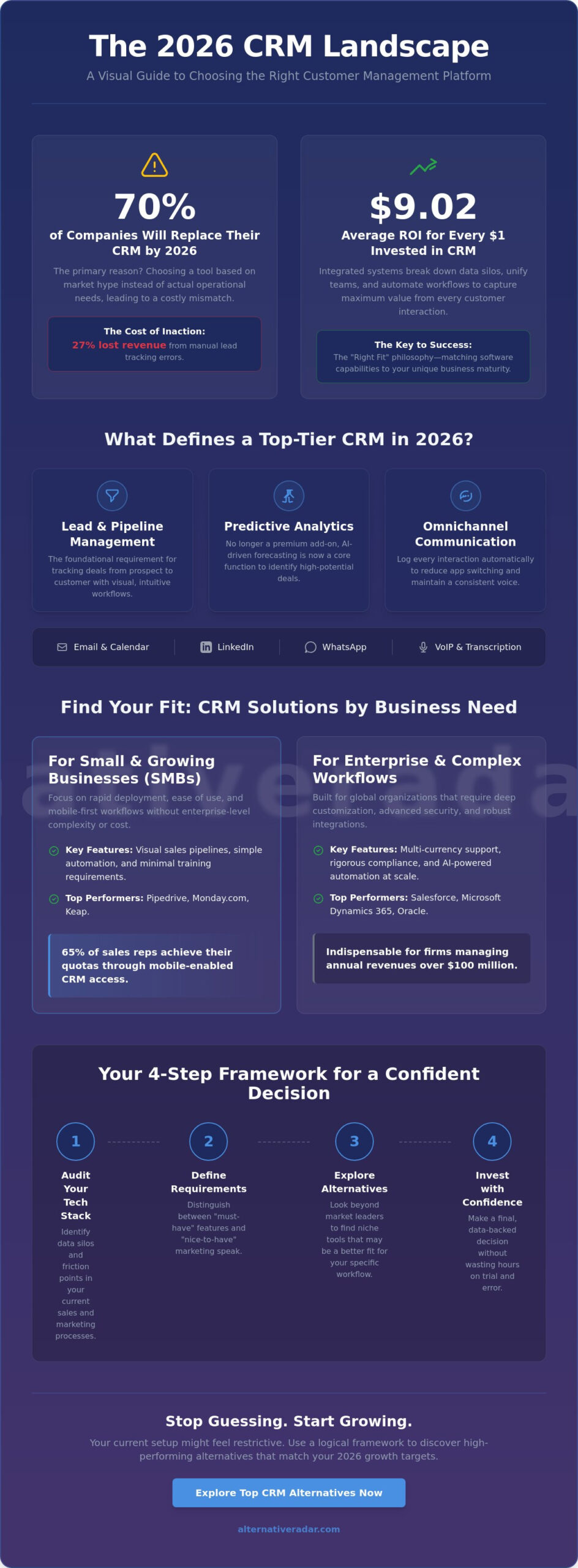
Data silos between sales, marketing, and support teams are the primary killers of efficiency. When information remains trapped in separate departments, the customer experience feels fragmented and slow. Based on 2026 industry benchmarks, the average ROI for integrated Customer Relationship Management (CRM) systems has reached $9.02 for every $1 invested. This return reflects the efficiency gained through automated workflows and unified data. The cost of inaction is measurable and high. Companies still relying on manual lead tracking lose 27% of their potential annual revenue due to missed follow-ups and data entry errors. Centralizing your operations through a vetted crm list ensures you capture every opportunity without the friction of manual labor.
Core Functions of Modern CRM Platforms
Lead and pipeline management remains the foundational requirement for any platform you’ll find today. However, the baseline for what constitutes a standard feature has evolved. Predictive analytics is no longer a premium add-on; it’s a core function that identifies which deals are likely to close based on historical patterns. Modern platforms also prioritize omnichannel communication tracking. This ensures every interaction is logged automatically across several channels:
- Direct Email and calendar synchronization
- LinkedIn outreach and engagement metrics
- WhatsApp Business integration for real-time support
- Voice over IP (VoIP) recording and transcription
These functions allow your team to maintain a consistent voice regardless of where the conversation happens. You’ll find that the best tools in 2026 focus on reducing the toggling tax, which is the productivity loss caused by switching between different apps. By choosing a platform that handles these core functions natively, you empower your team to focus on building relationships rather than managing software. It’s about working smarter, not harder.
Categorised CRM List: Top Solutions by Business Need
Selecting the wrong tool from a generic crm list often leads to software bloat and wasted capital. You don’t need every feature available; you need the features that match your operational scale. For 2026, the focus has shifted toward vendor stability and mobile-first workflows. Since 15% of SaaS startups fail within their first three years, choosing established providers ensures your data remains accessible and supported long-term. Efficiency-driven teams now prioritize tools that balance a shallow learning curve with deep functional capacity.
Best CRM Software for Small Businesses (SMBs)
Small teams require rapid deployment without the burden of heavy technical training. Pipedrive, Monday.com, and Keap are the top-rated options for this segment. These platforms focus on visual pipelines that allow users to manage leads with minimal friction. Pricing models for these tools typically favor growing teams, avoiding the large upfront implementation fees that often exceed $5,000 in enterprise circles. You can explore better alternatives if your current setup feels too restrictive for your 2026 growth targets. These lightweight options ensure that field teams can update records on the go, which is vital as 65% of sales reps now achieve their quotas through mobile-enabled CRM access.
Enterprise-Grade CRM Platforms for Complex Workflows
Global organizations with multi-divisional structures need more than just a contact database. Salesforce, Microsoft Dynamics 365, and Oracle Advertising and CX provide the deep customization required for complex logic. These platforms offer advanced security, multi-currency support, and rigorous compliance features. High-level analysis of the Importance of Customer Relationship Management shows that enterprise success relies on centralizing data across thousands of users. By 2026, these vendors have integrated predictive AI to automate forecasting, making them indispensable for firms managing annual revenues over $100 million. If your organization is on a rapid growth trajectory, understanding the best crm brands for scalability is essential to ensure your platform can handle increasing operational complexity without sacrificing performance. They provide the stability needed for decade-long digital transformation projects.
Open Source and Highly Customizable CRM Options
For businesses with specific niche requirements, a standard crm list might not suffice. Self-hosted powerhouses like Odoo, SuiteCRM, and Vtiger offer unparalleled flexibility. Choosing customizable crm software is a strategic move for 2026 because it prevents vendor lock-in and allows for proprietary feature development. While these options significantly lower licensing costs, they require higher technical maintenance. Odoo, currently supporting over 12 million users, demonstrates that open-source models can compete with premium competitors in terms of reliability. It’s a trade-off: you save on monthly per-user fees but must invest in internal or outsourced engineering talent to maintain the infrastructure.
Feature Breakdown: What Defines a Top-Tier CRM?
Selecting a platform from a crm list requires you to look past the brand name. You must examine the engine under the hood. Many legacy systems rely on marketing-speak to hide outdated architecture. They use terms like “seamless integration” when they actually require complex API work. True functional utility means the software handles 85% of data entry automatically, allowing your team to focus on strategy rather than spreadsheets. A top-tier CRM acts as a central hub for your entire operation, not just a digital Rolodex.
The value of a CRM often depends on its third-party ecosystem. Platforms with robust app marketplaces, such as Salesforce or HubSpot, provide 40% more long-term value by allowing you to plug in niche tools. This flexibility prevents you from outgrowing the software as your business scales. However, user adoption remains the ultimate metric of success. If the interface is clunky or counterintuitive, your investment yields zero return. High-performing teams prioritize tools that reduce friction, ensuring that 90% or more of the staff uses the system daily.
Essential Sales and Marketing Automation
Automation isn’t a luxury; it’s a baseline requirement for efficiency. Workflow triggers should eliminate repetitive manual tasks, such as updating deal stages or sending initial follow-up emails. This shift allows sales reps to spend 35% more time on direct revenue-generating activities. Advanced systems manage complex email sequences and lead scoring based on real-time engagement data. For 2026 AI models, we define Dynamic Lead Scoring as a predictive engine that recalculates prospect priority every 60 seconds by analyzing cross-channel intent signals and historical conversion patterns.
AI-Driven Insights and Predictive Analytics
Modern entries on any crm list must offer more than data storage. They provide foresight. By 2026, top-tier platforms predict revenue with 95.4% precision by analyzing pipeline velocity against external market volatility. These systems offer next-best-action suggestions, telling account managers exactly which deal to prioritize to hit their quarterly targets. Churn prevention has also become more sophisticated. Sentiment analysis tools now scan customer support tickets for specific linguistic markers of frustration. This allows your team to intervene before a 15% dip in account health turns into a permanent cancellation. Stop wasting time searching for basic features and look for these high-utility markers to find your right fit.
How to Choose from This CRM List: A 4-Step Framework
Selecting the right software from a massive crm list requires a tactical approach. Most buyers fail because they prioritize brand recognition over functional utility. Use this four-step framework to filter your options based on objective needs rather than marketing promises.
- Step 1: Define your “Job to be Done.” Before looking at price tags, identify the specific problem you’re solving. Are you automating a chaotic sales pipeline or centralizing customer support? Focus on the outcome, not the bells and whistles.
- Step 2: Audit your current tech stack. The average enterprise used 364 SaaS applications in 2024. Your CRM must integrate seamlessly with your existing email, accounting, and marketing tools to prevent data silos.
- Step 3: Run a trial with “Power Users.” Don’t let executives make the final call in isolation. Give your most active sales reps 14 days to test the interface. If they find the UI frustrating, adoption will plummet across the organization.
- Step 4: Calculate the Total Cost of Ownership (TCO). Look beyond the monthly subscription. Project your costs over a 3-year period, accounting for user growth, data expansion, and potential consultant fees.
Assessing Your Team’s Technical Maturity
Determine if you need a “No-Code” solution or if you have in-house developers to manage complex APIs. Gartner predicts that 70% of new applications developed by organizations will use low-code or no-code technologies by 2025. If your sales team isn’t tech-savvy, “feature bloat” becomes a liability. Excess buttons and complex workflows slow down lead entry and decrease data accuracy. Choose a tool that matches your team’s current skills while offering vendor-provided onboarding resources to bridge any gaps.
Budgeting for Scalability and Hidden Costs
The sticker price is rarely the final cost. Many platforms on any crm list charge extra for data storage, high-volume API calls, or premium support. Review tiered pricing structures carefully. You might find that the “Standard” plan lacks a critical automation feature, making the “Pro” plan mandatory as soon as you hit 500 contacts. Negotiate enterprise contracts early to lock in rates; 15% discounts are common for multi-year commitments. This foresight prevents budget shocks as your database expands. High-growth teams should also evaluate the best crm brands for scalability to ensure modular pricing structures remain cost-predictable as seat counts and data volumes increase.
Stop wasting time searching through endless options and start filtering for your specific needs. Explore the best CRM alternatives to find the perfect match for your workflow.
Navigating Alternatives: Finding the Right Fit
Selecting a platform from a standard crm list often leads businesses toward market leaders like Salesforce or HubSpot by default. Brand recognition feels safe, but it frequently results in paying for enterprise-level complexity that your team won’t use. In 2026, the dominance of the “Big Three” is fading as agile, specialized tools provide a better return on investment. You can often find a tool that delivers 80% of the necessary features for 20% of the price by using Alternative Radar to filter through the noise.
Don’t ignore the importance of an exit strategy. Vendor lock-in is a significant risk that can stall growth. Ensure the software offers full data portability and simple CSV or API-based exports. If you can’t get your data out easily, you don’t truly own your customer relationships. Logic and transparency should drive this decision, not a salesperson’s pitch. Efficiency-driven buyers prioritize software that respects their data sovereignty.
Niche CRM Alternatives for Specific Industries
General-purpose tools often require expensive custom coding to work for Real Estate, Healthcare, or Legal services. Vertical CRMs come pre-configured with industry-specific workflows, such as HIPAA compliance for medical practices or trust accounting for law firms. For technical teams, a popular open source business software 2025 approach offers the ultimate level of customization and control. Stop wasting time fighting with rigid interfaces. Focus on finding the best alternative to legacy systems that slow down your daily operations.
Integration and Future-Proofing Your Choice
A modern CRM cannot exist in a vacuum. It must serve as the central hub for your entire tech stack. Prioritize an “API-First” architecture to ensure seamless communication between your sales data, ERP systems, and marketing automation tools. This connectivity prevents data silos and keeps your reporting accurate. For a technical breakdown of how these tools stack up, consult our open source crm software comparison. Look for these specific traits to ensure long-term viability:
- Restful API: Essential for custom integrations and automated workflows.
- Webhooks: Necessary for real-time data updates across your entire platform.
- Native Connectors: Pre-built links for essential tools like Slack, Gmail, or Quickbooks.
The right crm list for your business isn’t the one with the most famous names; it’s the one that aligns with your specific operational needs. Explore your options carefully to build a stack that scales with your actual requirements rather than following market hype. Efficiency comes from utility and precision.
Future-Proof Your Business Growth for 2026
Selecting the right software shouldn’t feel like a gamble. By 2026, the global CRM market is projected to reach a value of $114 billion according to Gartner, making it more crowded and complex than ever. You’ve now seen how to navigate this crm list by prioritizing modular features and following a structured 4-step framework. Don’t settle for the most expensive option just because it’s popular. Instead, focus on the specific needs of your team and the technical requirements of your existing tech stack to avoid costly implementation errors.
Stop wasting time searching through endless tabs and biased reviews. Our Dutch-based team of software curators has already analyzed the market to provide you with objective pros and cons for both free and premium tools. We offer detailed insights across 100+ CRM categories to ensure you find a solution that actually fits your workflow. It’s time to move beyond the market leaders and discover the tools that offer the best return on investment for your specific scale.
Explore the full directory of CRM alternatives on Alternative Radar
You’re now equipped to make a smarter, data-driven choice for your business’s future.
Frequently Asked Questions
What is the best free CRM list for startups in 2026?
HubSpot Free Tools and Zoho CRM’s Free Edition remain the industry standards for 2026. HubSpot offers unlimited users and storage for up to 1,000,000 contacts without cost. Zoho provides essential lead management and workflow automation for up to 3 users. These options help startups scale without initial overhead. Choosing from this crm list ensures you get core functionality without a monthly bill.
How many CRM software companies are currently active in the market?
There are over 800 active CRM software providers globally as of late 2024. This number includes specialized industry solutions and broad market leaders. While five giants dominate 50 percent of the market share, the remaining 400 plus companies offer niche alternatives. You should explore various options to find the right fit for specific vertical needs instead of just following the crowd.
Is Excel considered a CRM for very small businesses?
Excel functions as a basic contact database but it isn’t a true CRM because it lacks automation and relational data structures. While 15 percent of micro-businesses still use spreadsheets, they often hit a wall once they reach 50 clients. Moving to a dedicated tool on our crm list prevents data silos and manual entry errors. It’s better to start with a scalable platform early to avoid painful data cleanup later.
Which CRM on this list is the easiest to use for non-technical teams?
Pipedrive and Monday.com are the highest rated for user experience in 2026 due to their visual drag and drop interfaces. Pipedrive focuses on a linear sales pipeline that requires zero coding knowledge to set up. Monday.com uses a modular board system that 85 percent of users find intuitive within the first hour. These platforms reduce training time and increase immediate team adoption for faster results.
What is the difference between a CRM and an ERP?
A CRM manages customer relationships and sales, while an ERP handles back-office processes like accounting and supply chains. Think of a CRM as the front-end tool for revenue growth and an ERP as the internal tool for operational efficiency. Most companies implement a CRM first to drive sales before integrating an ERP. This sequence ensures the business has enough revenue to justify more complex internal management systems.
How often should a business re-evaluate its CRM software?
Businesses should conduct a formal CRM audit every 24 months to ensure the tool still meets their growth trajectory. Technology shifts rapidly; a platform that worked for 10 employees often fails when the team hits 50. Stop wasting time searching for features your current tool can’t provide. Regular re-evaluation ensures your software stack remains a productive asset rather than a bottleneck for your sales team.
Can I migrate my data between different CRMs on this list?
Yes, most modern CRMs support data migration via CSV imports or direct API integrations. Tools like Import2 or native migration wizards facilitate the transfer of contacts, deals, and notes. Usually, 90 percent of data remains intact during the transition if the mapping is done correctly. Always perform a backup before starting the migration process to avoid losing critical lead history or customer contact details.
What are the top-rated open-source CRMs for privacy-conscious companies?
SuiteCRM and Odoo Community Edition are the leading open-source alternatives for companies requiring full data sovereignty. These platforms allow for self-hosting on private servers, ensuring 100 percent control over sensitive information. They provide a transparent codebase that security teams can audit. This makes them a reliable choice for firms that must comply with strict regional data protection regulations or specific internal security protocols.