
Paying $18 per user every month for a communication tool is no longer a requirement for high-performing teams. If you’re searching for a Slack alternative to bypass the rising “Slack tax,” you’ve likely realized that the $15 Business+ plan is an expensive way to manage daily chat. Many leaders now find that the pay-per-user model becomes unsustainable as their headcount grows, especially when 54% of employees using more than 10 apps report significant communication friction. It’s frustrating to deal with search history limits or data surveillance concerns when your goal is simply to get work done.
You deserve a platform that scales with your business without locking your data behind a paywall. This guide provides a clear comparison of the most reliable alternatives categorized by privacy, cost, and functionality. We explore options ranging from highly affordable cloud-based solutions to self-hosted, end-to-end encrypted platforms that give you full control. You’ll discover how to reduce digital noise and achieve significant savings while maintaining the professional features your team requires in 2026.
Key Takeaways
- Identify the financial impact of per-seat pricing and learn how to escape the “Slack Tax” with more sustainable cost models.
- Evaluate the strategic benefits of the Matrix Protocol and other decentralized options for enhanced data privacy and control.
- Compare top-rated options like Mattermost and Rocket.Chat to find the ideal slack alternativeto based on your team’s specific technical needs.
- Follow a structured two-step audit to quantify your communication volume and map critical integrations for a seamless transition.
- Discover how to future-proof your choice by prioritizing data portability and avoiding restrictive vendor lock-in.
Beyond the Hype: Why Teams Seek a Slack Alternative in 2026
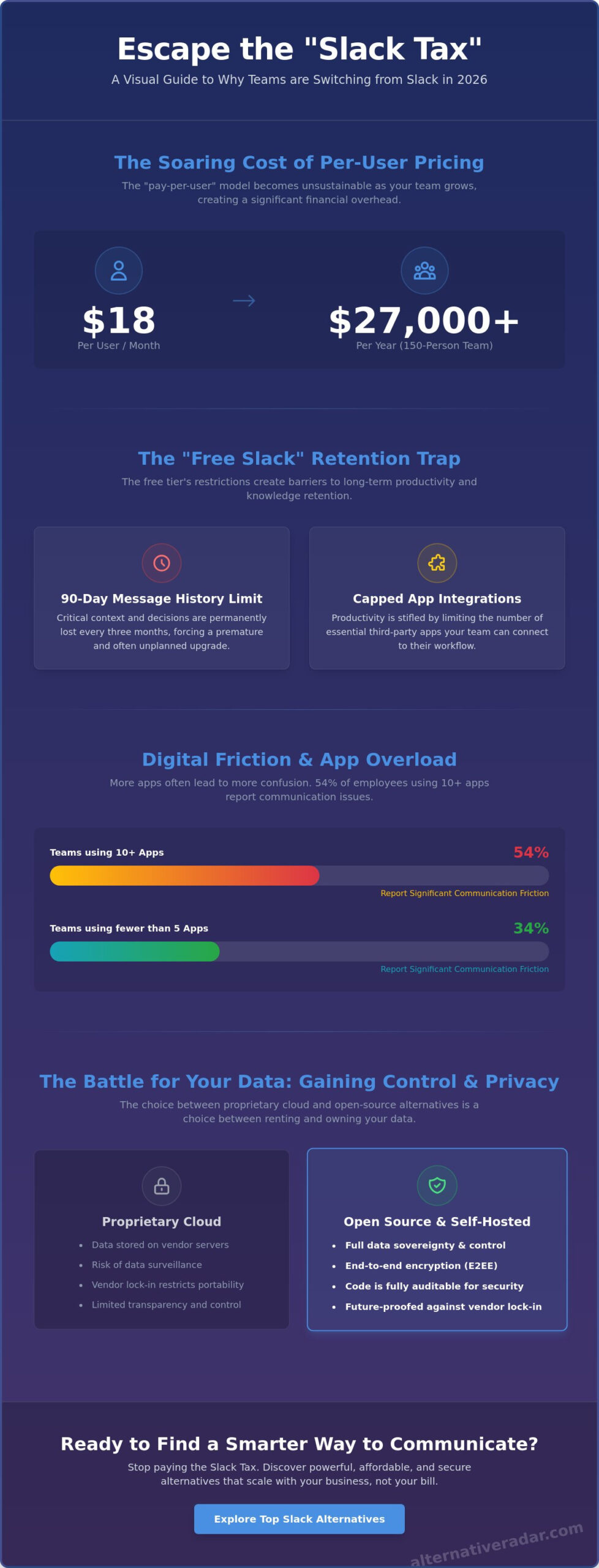
The landscape for team communication has transformed from a winner-take-all race into a specialized ecosystem of SaaS clones and decentralized protocols. Searching for a slack alternativeto manage team workflows often begins with a budget spreadsheet. In 2026, the “Slack Tax” has become a significant overhead for growing companies. With Slack Business+ priced at $15 per user annually, or $18 monthly, a team of 150 people spends at least $27,000 per year on a single tool. This per-seat model forces leaders to choose between their budget and their team’s ability to communicate. You can find a comprehensive list of collaborative software that highlights how many modern tools are moving away from these restrictive pricing structures.
Beyond cost, feature bloat has made “everything-apps” less appealing to efficiency-driven managers. Employees using more than 10 different applications report communication issues 54% of the time, compared to only 34% for those using fewer than five tools. IT departments are now prioritizing data sovereignty, ensuring that corporate intelligence stays within their own infrastructure rather than on a vendor’s cloud. The 2026 shift is about focus; teams want tools that do one thing exceptionally well rather than a platform that tries to be a social network, a project manager, and a chat app all at once.
The Limitations of the “Free Slack” Experience
The free tier of Slack is increasingly restrictive for modern workflows. In 2026, the 90-day message retention limit means your team loses access to critical context and historical decisions every three months. This “retention trap” often forces a premature upgrade to paid plans that your budget might not be ready for. Additionally, integration limits stifle small team productivity by capping the number of external apps you can connect. If you’re struggling with these constraints, see our Free Slack in 2026: A Complete Guide to Features, Limits, and Alternatives for a deeper breakdown of what’s missing and how to bridge the gap. Teams looking to escape the 90-day history wall entirely should also explore free Slack alternatives for teams that offer unlimited message history, such as Pumble and Chanty, without forcing an expensive upgrade.
The Privacy Push: Why Proprietary Isn’t Always Best
Centralized data storage presents a growing risk for corporate communication. When your data lives on a proprietary server, you lose control over who can access it and how it’s analyzed. Selecting a slack alternativeto that offers end-to-end encryption (E2EE) is no longer an optional luxury; it’s a non-negotiable requirement for regulated industries. We’re seeing a massive rise in EU-based software solutions that cater to GDPR-compliant teams. These platforms offer localized hosting and transparent data ownership policies that US-based giants often lack, giving IT departments the peace of mind they need to operate securely.
The Technical Landscape: Open Source vs. Proprietary Tools
Choosing a slack alternativeto often comes down to the architecture of your data. SaaS models offer immediate deployment but lock you into a vendor’s infrastructure. Self-hosting provides total control but requires internal resources. While these tools aim to streamline communication, organizations must be wary of the downsides of excessive collaboration, which can lead to burnout if not managed through proper tool selection. Modern chat apps are shifting toward zero-trust security models. In these architectures, no user or device is trusted by default; this ensures that sensitive corporate intellectual property remains protected even if a single account is compromised.
The Matrix Protocol represents a revolution in how we think about interoperability. It acts as an open standard for real-time communication, much like SMTP does for email. In 2026, this means you aren’t restricted to a single ecosystem. If your developers prefer one tool and your marketing team another, Matrix bridges that gap. This “email for chat” approach is a direct response to the frustration of managing multiple accounts just to talk to different departments or external partners. It’s a fundamental change from the closed-off gardens of the past.
The Power of Open Source Slack Alternatives
Open source software is dominating the enterprise in 2026 because it offers full auditability. Security-conscious firms don’t want to trust a vendor’s marketing claims; they want to see the source code. This transparency allows for internal security audits that proprietary tools simply cannot provide. Community-driven development also ensures that roadmaps focus on user utility rather than meeting venture-backed growth targets. This shift toward open standards is why many IT directors explore detailed insights on Alternative Radar before committing to a new platform.
Self-Hosting: Is the Effort Worth the Reward?
Running your own communication server requires specific technical expertise in Linux administration and network security. You’ll need to manage hardware resources and ensure 99.9% uptime to prevent workflow disruptions. While the software itself might be free, the hidden costs include maintenance time and the critical need for immediate security patches. Many teams now opt for hybrid models. These provide the control of open-source tools with the convenience of managed hosting. This approach balances data sovereignty with operational efficiency, making it a viable slack alternativeto for teams without massive DevOps departments.
Analyzing the Top-Rated Slack Alternatives by Use Case
Finding the right slack alternativeto replace your current stack requires a look at specific use cases rather than just a list of features. Mattermost provides a familiar interface for those migrating from Slack. It excels in technical environments by offering deep integrations with GitHub and Jira while allowing teams to maintain complete control over their database. If your developers need a tool that mirrors their existing workflow but lives behind a firewall, Mattermost is the enterprise standard.
Rocket.Chat acts as a “Swiss Army Knife” for organizations that require extreme customization. It supports everything from omnichannel customer service to internal team chat. However, teams must account for the hidden costs of “free” software. While you eliminate the per-seat license, you might spend 10 to 15 hours a month on server maintenance, security patches, and database optimization. For teams that want the benefits of open source without the management burden, Element and the Matrix protocol offer a decentralized gold standard. It’s built for privacy, ensuring that your data isn’t locked into a single provider’s ecosystem. Discord remains a popular choice for less formal groups, though its lack of corporate administrative controls often makes it a secondary choice for strict business environments.
Best for Budget-Conscious Teams
Small groups often find the break-even point between flat-fee and per-user pricing quickly. Tools like Pumble Pro, priced at $2.49 per user monthly, or Chanty Business at $3 per user, offer significant savings compared to Slack’s $7.25 entry point. These platforms provide essential features like unlimited message history and screen sharing without the high overhead. If you need a quick comparison of these entry-level options, check out our guide on Slack Alternative in Brief: The Best Team Communication Tools for 2026. Zulip is another strong contender here, using a unique threading model that helps teams manage high message volumes without losing context. For small teams specifically seeking no-cost options with permanent message archives, our detailed breakdown of the best free Slack alternatives for teams in 2026 covers how platforms like Pumble and Chanty stack up against Slack’s restrictive free tier.
Best for High-Security Environments
In highly regulated sectors, the Swiss-vault approach of Wire or Threema Work is often necessary. These tools prioritize end-to-end encryption (E2EE) as a core architecture rather than an add-on. It’s important to understand that E2EE can impact searchability and third-party integrations, as the server cannot “read” the content of your messages. However, for teams requiring HIPAA, FINRA, or GDPR compliance, this trade-off is essential. These platforms ensure that even if the service provider is compromised, your team’s internal conversations remain unreadable to outside parties. This level of security is why many firms search for a specialized slack alternativeto handle sensitive legal or financial discussions.
The Evaluation Framework: How to Audit Your Teams Needs
Begin your transition by auditing current usage patterns before committing to a new platform. Finding the right slack alternativeto manage your business operations requires a structured evaluation rather than a gut feeling. Start by quantifying your message volume. If your team generates 5,000 messages daily, you need a tool with high-performance indexing and robust search capabilities. Next, map your essential integrations. Verify that your chosen tool connects seamlessly with GitHub, Jira, and Google Drive without requiring expensive middleware or custom API development.
Define your data sovereignty stance early in the process. Decide if a cloud-based SaaS solution meets your current compliance needs or if your IT policy mandates an on-premises installation for maximum security. Finally, conduct a UI friction test. Give a pilot group of five users across different departments access to the tool for one week. Their feedback on ease of use will predict the success of a company-wide rollout and help you avoid a costly mistake. To make an informed decision, you can compare top-rated communication tools on our platform.
The “Anti-Bloat” Audit
Identify features you pay for but never use. Many organizations pay for enterprise-level automation tools and advanced AI features when they only require reliable group chat and file sharing. Simplifying your communication architecture reduces Slack fatigue and improves overall team focus. Communication Debt is the cumulative cost of missed information and fragmented workflows caused by using overly complex or poorly integrated tools. By trimming the bloat, you ensure your team spends less time managing the application and more time performing high-value tasks.
Planning the Migration Without Downtime
Moving your data requires precision to avoid losing institutional knowledge. Export your Slack archives early; however, you must understand that some proprietary metadata might not transfer perfectly to open-source platforms. Set a firm cut-over date to prevent “split-brain” communication where half the team remains on the old application while others move forward. Train a small group of power users to act as internal ambassadors. These individuals troubleshoot minor issues and encourage adoption during the first 30 days of the transition. A well-planned migration ensures that your search for a slack alternativeto results in a productivity gain rather than a week of technical downtime.
Making the Switch: Implementation and Future-Proofing
Selecting a slack alternativeto manage your organization’s future requires a focus on long-term sustainability. By 2026, the market has matured beyond simple chat clones. High-quality tools now prioritize data portability to ensure you aren’t trapped by proprietary formats. Avoiding vendor lock-in is a strategic necessity; if a provider raises prices or changes terms, your team data must be easily exportable to a new environment. AI integration also plays a vital role in modern selection. Rather than just adding chatbots, sustainable tools use AI for conversation summarization and task automation to reduce the time spent digging through archives.
Alternative Radar helps you navigate this evolving SaaS market by acting as a high-quality filter. We identify tools that offer stable pricing models and robust feature sets before they become mainstream. This proactive approach allows your IT department to stay ahead of market shifts rather than reacting to sudden price hikes, like the 2025 increase in Slack Business+ plans. Our comparison engine focuses on utility and precision, ensuring you find a tool that fits your specific workflow requirements without unnecessary marketing hype.
The Evolution of Team Communication
Modern communication is moving beyond the traditional real-time chat box. We are seeing a significant rise in asynchronous video and voice features that allow teams to collaborate across time zones without the pressure of immediate responses. Alternative Radar identifies these emerging contenders by analyzing user feedback and technical roadmaps. For a deeper dive into the current market leaders, read our guide on The Best Slack Alternatives for 2026: A Complete Team Communication Guide. This shift toward “deep work” friendly tools helps teams maintain productivity without the constant interruption of notifications.
Final Checklist for Your New Tool
Before finalizing your choice for a slack alternativeto, run through this final technical checklist to ensure the platform meets your daily operational standards:
- Mobile Performance: Test the app’s battery drain and sync speed on both iOS and Android devices.
- Notification Granularity: Ensure users can customize alerts for specific channels or keywords to prevent digital burnout.
- Documentation Quality: Verify that the tool has a comprehensive, searchable knowledge base for self-service troubleshooting.
- Uptime History: Check the provider’s historical reliability data to ensure they can maintain 99.9% availability.
Focusing on these practical details ensures that your new communication tool supports your team’s growth for years to come. A tool that excels in both desktop reliability and mobile accessibility will see higher adoption rates and provide a better return on your investment.
Take Control of Your Team’s Digital Workspace
The shift toward decentralized and open-source communication is no longer a niche trend; it’s a strategic necessity for high-growth firms in 2026. Transitioning away from the $18 monthly per-user Slack Business+ fee allows you to reinvest those resources into core business operations. By prioritizing data sovereignty and auditing your team’s actual message volume, you eliminate the bloat that causes communication friction for 54% of heavy app users. Whether your priority is end-to-end encryption or flat-fee cost models, the right tool exists to support your specific workflow without the “Slack Tax.”
Finding a reliable slack alternativeto replace your existing stack requires clear, objective data rather than marketing hype. Stop wasting time searching through unvetted lists and use a scout’s perspective to evaluate your options. Alternative Radar provides the high-quality filters and detailed insights you need to make an empowered choice for your team. Find the right fit with Alternative Radar’s full software database. You’re now equipped to build a more sustainable, focused, and secure communication environment that scales with your success.
Frequently Asked Questions
Is there a 100% free Slack alternative for unlimited users?
Yes, self-hosted open-source platforms like Mattermost and Rocket.Chat offer community editions that support unlimited users at no software cost. While the software itself is free, you’re responsible for the infrastructure and hosting expenses. Cloud-based tools like Pumble also provide free tiers with unlimited users, though they typically gate advanced features like screen sharing behind a paid subscription.
Can I import my Slack chat history into Mattermost or Rocket.Chat?
Both Mattermost and Rocket.Chat provide dedicated migration tools that accept standard Slack export files. You can import public channels, user accounts, and message history directly into your new workspace. It’s important to note that private channels and direct messages often require a corporate-level export from Slack, which is usually only available on their higher-tier Enterprise plans.
Which Slack alternative is best for privacy and encryption?
Element is widely considered the gold standard for privacy because it’s built on the decentralized Matrix protocol. It offers end-to-end encryption by default for all messages and file transfers, ensuring that even the server provider cannot read your data. This architecture makes it a top choice for organizations in regulated industries that prioritize total data sovereignty over simple convenience.
How does Microsoft Teams compare as a Slack alternative for small businesses?
Microsoft Teams is the most cost-effective slack alternativeto for organizations already using the Microsoft 365 ecosystem. With over 320 million monthly active users in 2026, it offers a robust Essentials plan starting at $4.00 per user monthly. This plan includes 10 GB of cloud storage and unlimited group meetings, making it a logical choice for teams that need deep integration with Excel and Word.
What is the most lightweight Slack alternative for low-spec hardware?
Zulip and Chanty are the most efficient options for teams running on older or low-spec hardware. Zulip’s unique threading model and optimized web application use significantly less RAM than Slack’s memory-heavy Electron app. Chanty also maintains a fast, clean interface that prioritizes quick loading times, ensuring that communication remains fluid even on machines with limited processing power.
Are open-source Slack alternatives harder to maintain than SaaS?
Yes, open-source tools require more internal technical resources than standard SaaS platforms. You must manage your own server uptime, perform regular backups, and apply security patches as they’re released. SaaS tools handle these operational tasks automatically, but they charge a premium for that convenience. Many teams find the trade-off worth it to gain full control over their communication data.
Does Discord work as a professional Slack replacement for non-gamers?
Discord can function as a basic communication tool, but it lacks the professional structure required for complex business operations. It doesn’t offer native message threading or the granular administrative permissions found in a dedicated slack alternativeto. While its voice channels are excellent for remote collaboration, the lack of enterprise-grade security certifications often makes it unsuitable for teams handling sensitive client information.
What happens to my data if I switch from Slack to a self-hosted tool?
You gain full ownership and control of your database when you move to a self-hosted environment. Once you complete the migration, your internal conversations and shared files are no longer stored on a third-party vendor’s cloud infrastructure. This migration eliminates the risk of corporate surveillance and ensures that your intellectual property remains within your own managed security perimeter.