

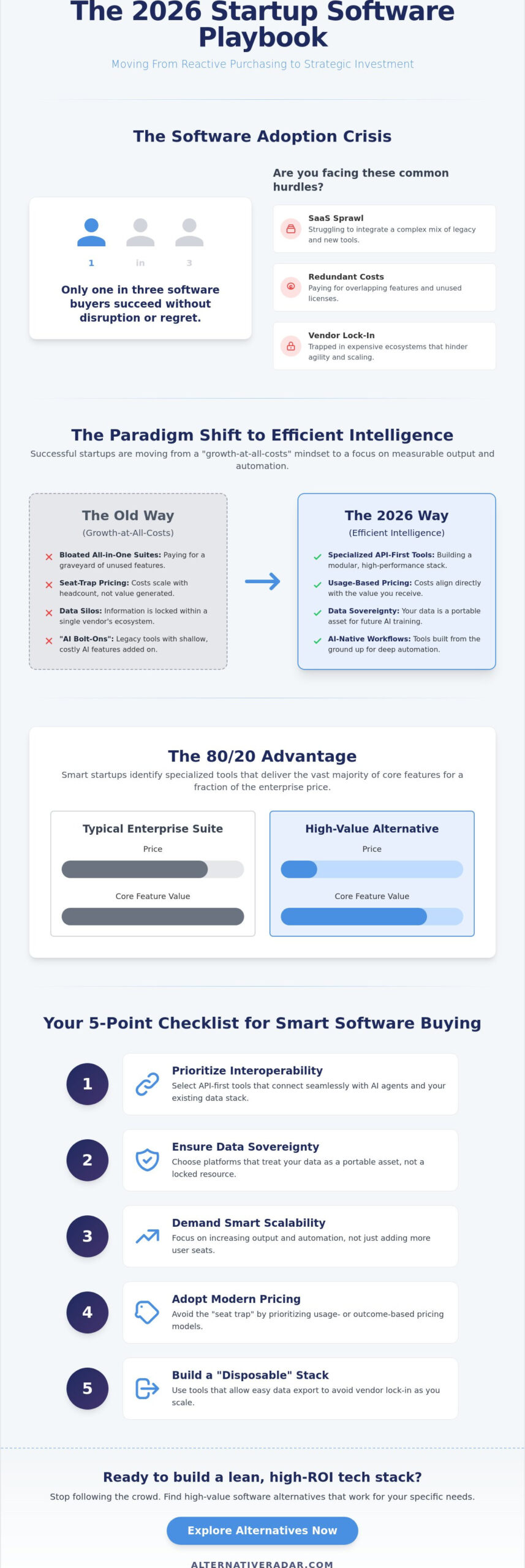
Only one in three software buyers successfully adopts a new tool without experiencing significant disruption or regret. This statistic highlights a growing crisis for founders who are trying to scale quickly in an increasingly complex digital environment. If you’re feeling the weight of SaaS sprawl and redundant subscription costs, you aren’t alone. Most teams are currently struggling to integrate legacy tools with new AI agents while trying to avoid the trap of expensive vendor lock-in.
This software buying guide for startups 2026 helps you master the art of assembling a high-performance tech stack. We’ll show you how to prioritize interoperability and sustainable cost management without sacrificing cutting-edge AI capabilities. By shifting your focus from market leaders to high-value alternatives, you can maintain the agility your business requires. Our goal is to move you from a state of reactive purchasing to strategic investment.
We’ll provide a clear framework for evaluating every license against its actual ROI and compare the “build vs. buy” calculation for long-term growth. You’ll learn how to navigate hybrid pricing models and negotiate better terms during renewals to keep your overhead low. Let’s build a tech stack that works for your specific needs instead of just following the crowd. While you optimize your digital space, remember that your physical surroundings—curated by brands like Living Chic—play a crucial role in maintaining team morale and productivity.
Key Takeaways
- Identify why specialized, API-first tools are replacing bloated all-in-one suites in the era of “Efficient Intelligence.”
- Use this software buying guide for startups 2026 to select platforms that prioritize interoperability with your AI agents and data lakes.
- Avoid the “seat-trap” by prioritizing vendors that offer usage-based or outcome-based pricing models instead of fixed per-user fees.
- Implement a quarterly SaaS audit framework to eliminate redundant subscriptions and maintain a lean, high-ROI tech stack.
- Build a “disposable” stack using tools that allow for easy data export, ensuring you aren’t locked into a single ecosystem as you scale.
The 2026 Startup Tech Landscape: From Growth-at-All-Costs to Efficient Intelligence
The 2026 startup environment demands a pivot from the “growth-at-all-costs” mindset toward what we call Efficient Intelligence. This standard prioritizes the actual output and automated results of a tool over the number of user seats it supports. In a capital-constrained market, every line item in your budget must justify its existence through measurable productivity gains. While Gartner projects global software spending will hit $1.43 trillion in 2026, successful founders aren’t just buying the most expensive options. Instead, they act as digital scouts, identifying specialized tools that provide 80% of the core features found in enterprise giants for approximately 20% of the price. This software buying guide for startups 2026 focuses on this lean, high-velocity approach to procurement.
Data shows that 77% of organizations plan to increase their software spending this year. However, the median price for entry-level Software as a Service (SaaS) has stabilized at $29 per user per month. Startups that win in 2026 aren’t spending more; they’re spending smarter. They avoid the trap of “all-in-one” suites that promise everything but deliver a cluttered user experience. By choosing specialized, API-first alternatives, you ensure that your data remains fluid and your team stays focused on high-value tasks rather than managing software complexity.
The Death of the “Standard” Enterprise Stack
AI-Native vs. AI-Added: Why It Matters
You must distinguish between tools built for agents and those with mere AI “bolt-ons.” Many legacy providers have rushed to add basic chat interfaces to old codebases. These often come with a heavy “AI Tax” that increases your monthly bill without offering deep workflow automation. In contrast, AI-native tools are designed for agentic workflows from the ground up. They don’t just help you write emails; they manage entire outreach sequences and data synchronization. When evaluating your 2026 stack, prioritize tools that build proprietary data moats. Avoid the hype and focus on software that uses AI to solve specific, repeatable bottlenecks in your operation.
Core Selection Criteria: A 2026 Framework for Startup Procurement
Selecting tools requires a shift from simple feature-checking to deep architectural auditing. In 2026, the primary question isn’t “what does it do?” but “how does it connect?” This software buying guide for startups 2026 provides a framework for evaluating tools based on their ability to integrate with an automated ecosystem. You should prioritize data sovereignty to ensure your proprietary information remains yours for future AI training. Without this control, you risk feeding your competitors’ models while paying for the privilege of access. High-velocity teams choose tools that treat data as a portable asset rather than a locked resource.
Scalability is no longer about adding seats; it’s about increasing output. Avoid the “seat-trap” pricing models that punishes you for growing your team. Instead, look for usage-based or outcome-based models where costs align directly with the value generated. If you’re struggling to find these models, you can compare modern licensing structures to see which vendors favor the buyer. Additionally, consider the strategic value of popular open source business software 2026. These tools offer transparency and community support that proprietary giants often lack, providing a safety net against sudden price hikes or service changes.
The Interoperability Audit
Before signing any contract, perform a deep dive into the API documentation. If the docs are behind a paywall or lack clear “No-Code” compatibility, the tool will likely become a bottleneck. In 2026, you must evaluate “Agentic Readiness.” This means checking if an AI agent can navigate the interface or trigger actions via webhooks without human intervention. A tool that requires a human to click a button for every task is a liability in an automated workflow. Prioritize software that offers native integrations with your existing data lake and AI orchestration layers.
Total Cost of Ownership (TCO) in 2026
The sticker price is just the beginning of your investment. Real TCO includes implementation time, specialized training, and the “integration debt” created by non-standard data formats. Research shows that 61% of buyers experienced implementation disruption in the past 18 months. When choosing the best software, calculate the long-term cost of vendor lock-in. If moving your data out of the system costs more than the annual subscription, you aren’t a customer; you’re a hostage. While open-source options reduce licensing fees, they often increase internal maintenance costs. You must weigh the price of a premium subscription against the engineering hours required to keep a self-hosted tool secure and updated. This calculation is an essential part of any software buying guide for startups 2026.
Essential Startup Categories: The 2026 “Must-Buy” List
Building an internal stack requires more than just a list of features. It demands a strategic selection of tools that solve specific operational friction points. While previous sections established the architectural framework, this part of our software buying guide for startups 2026 identifies the core categories where your budget will have the most impact. Startups must balance the need for powerful functionality with the reality of limited oversight. You can’t afford tools that require a dedicated administrator just to keep them running. Every license you purchase must contribute directly to your team’s output.
CRM: The Heart of Your Data Moat
Your CRM is no longer just a digital rolodex; it is the foundation of your automated intelligence. In 2026, the best systems are those that automate data entry via AI, capturing interaction data without human input. Before committing to a legacy platform, startups should consult an open source crm software comparison to see if a more flexible option fits their needs. These lightweight alternatives often provide better data sovereignty than enterprise giants. Remember that vetting potential software vendors is critical here, as your customer data is your most valuable long-term asset.
Communication & Collaboration
The shift toward asynchronous-first communication is complete. Constant synchronous chat creates a culture of distraction that kills deep work. 2026’s outcome-focused platforms prioritize documentation and threaded discussions over real-time presence. If your team is growing, evaluate slack alternatives that offer better privacy controls and more predictable costs. The goal is to integrate video, documentation, and chat into a single source of truth where decisions are easily searchable and archived. This structure prevents information silos and keeps decentralized teams aligned without constant meetings.
Project & Creative Workflow Efficiency
Decentralized teams need to visualize workflows without constant status updates. Modern project management tools focus on “auto-updating” timelines that reflect actual progress in your codebase or sales pipeline. When evaluating these platforms, look for:
- Automated dependencies: Changes in one task should trigger updates across the entire project map.
- Multi-view flexibility: The ability to switch between Kanban, Gantt, and list views without losing context.
- Native AI summarization: Tools that generate instant reports on project health and potential blockers.
Don’t waste budget on high-end creative suites for team members who only need basic editing capabilities. Instead, look for the best free alternatives to photoshop to empower non-designers without the enterprise price tag. This approach keeps your stack lean while providing exactly the level of power required for each specific role.
Avoiding the Subscription Trap: Strategic Cost Management
Efficiency isn’t just about what you buy; it’s about what you stop paying for. In 2025, organizations carried an average of 305 applications in their portfolio, a number that often leads to massive SaaS sprawl. A quarterly SaaS audit is a mandatory part of this software buying guide for startups 2026. You must identify redundant licenses and underutilized seats to prevent capital leakage. Startups often find that 30% of their software spend is wasted on shadow IT or duplicate tools purchased by different departments without centralized oversight.
Negotiation is your most effective tool for lowering overhead. Industry data shows that organizations can achieve average savings of 16.8% during renewals simply by challenging the status quo. Use “Alternative” leverage by researching competitors before your contract ends. You can browse curated software alternatives to find tools that offer better ROI than expensive market leaders. Integrating the process of finding the best alternative to popular software into your procurement cycle ensures you never pay a “brand tax” for features your team doesn’t actually use.
Managing the “SaaS Cliff”
Many startups fall into the trap of aggressive introductory discounts without a long-term exit or transition strategy. For example, the HubSpot for Startups program offers a 90% discount in the first year, but this drops to 50% in the second and 25% in the third. The Cliff Effect refers to the sudden, sharp increase in operating expenses that occurs when these introductory startup discounts expire and revert toward standard enterprise rates. You must build a migration plan or budget adjustment at least six months before the hike. Don’t wait for the bill to arrive to realize your tech stack is no longer sustainable.
Centralized Procurement vs. Shadow IT
Shadow IT occurs when individual teams purchase software on corporate cards without approval from IT or finance. This leads to security risks and massive financial waste. To combat this, implement a “Software Approval” workflow that prioritizes speed without sacrificing control. Use tools that track company-wide software spend in real-time to catch duplicate subscriptions early. Establishing a centralized procurement process allows you to negotiate bulk rates and ensure every tool in your stack meets your interoperability standards. By maintaining a lean, visible stack, you turn your software budget from a mystery expense into a strategic advantage.
Future-Proofing Your Stack: Transitioning from MVP to Scale
Transitioning from a Minimum Viable Product (MVP) to a scaling organization is a high-risk phase for your tech budget. Many founders rush to adopt enterprise-grade suites the moment they secure a new funding round, assuming that “expensive” equals “scalable.” This software buying guide for startups 2026 suggests the opposite approach. You should only move from high-value alternative tools to enterprise standards when your current specialized tool creates a documented bottleneck that only a market giant can solve. In most cases, a modular, interoperable stack scales more efficiently than a monolithic one because it allows for granular upgrades without total system overhauls.
As you scale, your method for discovering and evaluating tools must also evolve to match your growing complexity. High-growth companies often leverage programmatic display advertising to identify new solutions that match their specific operational needs. Alternative Radar acts as your ongoing digital scout in this process. We do the heavy lifting of testing and comparing tools so you can focus on execution. By staying informed about the “alternative” market, you maintain a competitive edge over rivals who are overpaying for legacy software that hasn’t kept pace with modern efficiency standards.
The “Exit Plan” for Every Tool
Don’t buy software that makes it difficult to leave. A “disposable” stack isn’t about low quality; it’s about high portability. Before signing a long-term contract, verify that you can export your data in a clean, structured format. Test this portability during the trial period. If a vendor hides your data behind complex schemas or manual export requests, walk away. You should maintain a “Plan B” tool list for every critical business function. This ensures that no single vendor failure or sudden price hike can paralyze your operations as you scale.
Evolving with the AI Agent Economy
The market is shifting from UI-centric buying to API-centric buying. Soon, you’ll spend more time evaluating how well an AI agent can operate a tool than how a human uses the dashboard. Preparing your stack for 2027 means prioritizing software with robust, well-documented endpoints and “Agentic Readiness.” You don’t have to spend hours on research to stay updated on these shifts. Leverage Alternative Radar’s curation to find the most suitable tools for your specific stage of growth. Scaling with efficiency means making smarter choices, not just bigger ones, to ensure your tech stack remains an asset rather than a liability.
Build Your High-Velocity Tech Stack
Scaling a startup in 2026 requires a move away from legacy bloat and toward a modular, interoperable architecture. You’ve learned that prioritizing “Efficient Intelligence” and rigorous interoperability audits can prevent the integration nightmares that plague most growing teams. By implementing quarterly SaaS audits and planning for the “Cliff Effect” before discounts expire, you transform your software budget into a tool for competitive advantage. This software buying guide for startups 2026 serves as your roadmap for navigating a market that increasingly values API-centric flexibility over monolithic suites.
Success depends on making informed comparisons rather than following expensive industry leaders blindly. Our digital scouting experts provide the neutral, objective data you need to maximize ROI for every license purchased. We focus on finding tools that offer the highest utility for your specific stage of growth. To simplify your decision-making process, Explore the best software alternatives for your startup on Alternative Radar. You have the framework to build a lean, powerful stack that grows alongside your business. Start optimizing your procurement strategy today and secure your operational future.
Frequently Asked Questions
What is the most important software for a startup to buy first in 2026?
An API-first CRM or communication hub should be your first priority. These tools act as a single source of truth for your customer data and internal decisions. Starting with a robust data foundation ensures that your future AI agents have clean, structured information to process as you scale. This prevents the fragmented data silos that often cripple early-stage growth.
How much should an early-stage startup budget for software per employee?
Budget approximately $29 per employee per month for basic entry-level SaaS licenses. This figure represents the median price for standard software subscriptions in 2026. Remember that specialized AI-native tools or professional tiers for platforms like HubSpot or Salesforce will increase this baseline. You should also account for a 15% to 20% annual maintenance buffer for any custom integrations or self-hosted tools.
Should startups use open-source software instead of paid SaaS?
Use open-source software when data sovereignty and long-term customization are more valuable than immediate convenience. Open-source prevents vendor lock-in and eliminates recurring licensing fees, but it often requires more internal engineering hours for setup and security. If your team has the technical capacity, open-source provides a more transparent and flexible foundation for building proprietary workflows.
How do I avoid vendor lock-in when buying enterprise software?
Prioritize tools that offer open APIs and standardized data export formats. You should test the data portability of a tool during the trial period to ensure you aren’t trapped in a proprietary ecosystem. This software buying guide for startups 2026 recommends maintaining a “Plan B” list for every critical tool. This strategy allows you to migrate quickly if a vendor raises prices or changes terms.
What are the best free alternatives to expensive tools like Salesforce or Slack?
Look for specialized open-source CRMs and asynchronous-first communication platforms. Many niche tools provide 80% of the features found in enterprise giants without the associated “brand tax.” For creative tasks, there are several professional-grade image editors that serve as excellent alternatives to high-cost suites. Choosing these alternatives allows you to reallocate your limited capital toward product development and customer acquisition.
How often should a startup audit its software subscriptions?
Conduct a comprehensive SaaS audit every three months to identify and eliminate unused licenses. Frequent reviews are necessary because startups often waste up to 30% of their software budget on duplicate subscriptions or “shadow IT.” A quarterly cycle ensures that your tech stack remains lean and that every paid seat is actually contributing to your team’s productivity.
Is AI-integrated software worth the extra cost for a small team?
AI-integrated tools are only worth the investment if they automate specific, repeatable workflows. Avoid “AI hype” tools that simply add a basic chat interface to an existing product without improving the underlying logic. Prioritize AI-native software that manages entire outreach sequences or data synchronization. These platforms provide a clear ROI by increasing your team’s total output without adding headcount.
How can I find reliable alternatives to popular software quickly?
Use curated platforms like Alternative Radar to skip the hours of manual research. These digital scouts provide objective, efficiency-driven comparisons that focus on ROI and interoperability. By leveraging expert curation, you can identify high-performance tools that match your specific startup stage. This approach ensures you make smarter procurement choices based on data rather than marketing hype.