

The most capable AI writing assistant may be the one that creates the least extra editing work, not the one with the longest feature list. If you’re looking for an AI writing assistant for marketing copy, it’s easy to get lost in bold claims and templates that don’t reflect your brand voice, audience, or campaign goal. The practical test is whether a tool fits the work your team needs to do.
This comparison helps you shortlist tools by marketing task, workflow, and review needs. See how general-purpose assistants compare with marketing-focused platforms and SEO-integrated tools, and what to check before adopting one. Human review remains essential for refining brand voice, checking claims, and adding creative judgment. Alternative Radar compares software features, pricing, and pros and cons to support informed decisions. Some recommendations use affiliate links, which should be clearly disclosed. Focus on tools that fit your process, not just those with the most features.
Key Takeaways
- Choose an AI writing assistant for marketing copy based on the task it needs to support, from campaign drafts to product content and workflow coordination.
- Give the tool a clear brief with the audience, offer, channel, objective, tone, and constraints to make its drafts more relevant.
- Compare tools by capability, review burden, collaboration needs, and plan type, not by feature lists alone.
- Keep human review in the workflow for editing, fact-checking, and final approval.
- Test your shortlist on one campaign and track time to approved copy, revisions, accuracy issues, and consistency with the brief.
What an AI Writing Assistant for Marketing Copy Can, and Cannot, Do
An AI writing assistant for marketing copy is software that generates, rewrites, or structures text in response to instructions. It can turn a clear brief into draft material, but it doesn’t automatically know which message will resonate with an audience or meet a campaign’s goals.
These tools use artificial intelligence, a broad field focused on systems performing tasks associated with human intelligence. Understanding the basics of Artificial intelligence helps explain why an assistant responds to the context and instructions it receives rather than making independent marketing judgments. Its usefulness depends on the task, the quality of your input, the editing required, and how consistently it follows your brand guidelines.
Which marketing copy tasks can AI help with?
Use an assistant to create a first draft, explore alternatives, or reshape copy you already have. For example, it can draft an email announcement, suggest social post variations for different channels, create a product description from supplied specifications, or generate several ad headlines around one approved offer.
It can also help with preparation: summarizing a campaign brief, brainstorming message angles, or making a paragraph clearer or more concise. These bounded tasks provide a useful starting point. Share the source material, explain what you want changed, and assess whether the result serves its purpose.
That’s different from strategy-heavy campaign planning. An assistant can organize ideas you provide, but your team still needs to decide whom to target, what the campaign should achieve, and which offer or message supports that goal. A specific prompt can produce options, but it can’t replace the decisions behind the brief.
Where does human judgment still matter?
Generated text can sound polished and plausible without being accurate, distinctive, or appropriate for your audience. Review every factual claim against reliable source material. Give extra scrutiny to regulated messaging, sensitive audience topics, product details, and promises about results. A fluent sentence isn’t evidence that its claim is true.
Brand voice also needs a human check. A draft may follow broad directions such as “friendly” or “confident” but still miss the words, formality, or nuance your brand uses with customers. Compare it with approved examples and revise anything generic, exaggerated, or out of step with the relationship you want to build.
- Define: Set the copy task, audience, channel, objective, and constraints.
- Generate: Request options or a draft using approved context.
- Edit: Shape the strongest version for clarity, voice, and audience fit.
- Verify: Check claims, details, and required messaging against source material.
- Approve: Have the responsible person sign off before publication.
Use the assistant to speed up drafting, not to skip decisions or review. The best fit supports a real recurring task while keeping editing and approval manageable.
How AI Marketing Copy Moves from Brief to Reviewed Draft
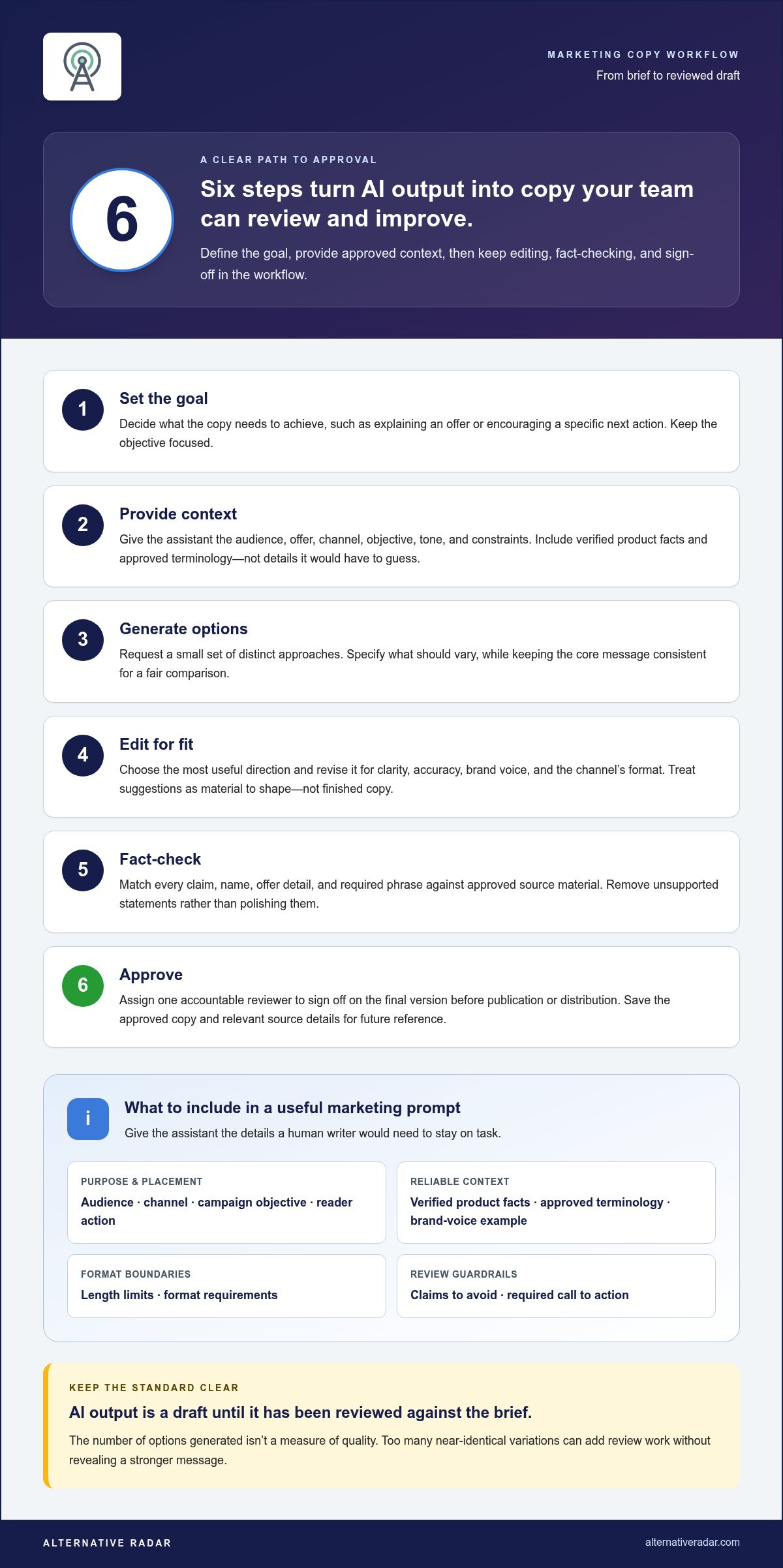
A reliable workflow turns an AI-generated response into copy your team can assess and improve. Start with a defined goal, then give the assistant the context and constraints a human writer would need. A clear prompt reduces guesswork; a consistent review process catches what the prompt cannot.
Use these six steps to move from brief to approval:
- Set the goal. Decide what the copy needs to achieve, such as explaining an offer or encouraging a specific next action. Keep the objective focused so the draft has a clear purpose.
- Provide context. Describe the audience, offer, channel, objective, tone, and constraints. Include verified product facts and approved terminology, not details the tool would have to guess.
- Generate options. Ask for a small set of distinct approaches, such as different opening lines or calls to action. Specify what should vary, and keep the core message consistent for a fair comparison.
- Edit for fit. Select the most useful direction and revise it for clarity, accuracy, brand voice, and the channel’s format. Treat suggestions as material to shape, not finished copy.
- Fact-check. Match every claim, name, offer detail, and required phrase against approved source material. Remove unsupported statements rather than polishing them.
- Approve. Assign one accountable reviewer to sign off on the final version before publication or distribution. Save the approved copy and relevant source details for future reference.
AI output is a draft until it has been reviewed against the brief. The number of options generated isn’t a measure of quality. Too many near-identical variations can add review work without revealing a stronger message. Request alternatives that test a specific difference, then compare them against the same objective and criteria. For a practical overview of different applications, AI Writing Assistants in Marketing offers additional context.
What should a useful marketing prompt include?
A strong prompt gives an AI writing assistant for marketing copy the details needed to stay on task. Specify who the copy is for, where it will appear, the campaign objective, and the action readers should take. Add verified product facts, approved terminology, and a short example of your brand voice. Set limits for length and format, claims to avoid, and any required call to action. These constraints make outputs easier to compare and edit.
How should teams review AI-generated copy?
Review factual accuracy, brand fit, clarity, originality, and channel requirements. Name the human reviewer before drafting begins so approval isn’t left implicit. Track recurring edits, such as removing unsupported benefits or shortening copy to fit the channel. Use those patterns to improve the brief or reusable prompt next time. If you’re comparing assistants for a repeatable workflow, software comparison criteria can help you weigh features, pricing, and pros and cons.
Compare AI Writing Assistants by Marketing Task and Team Fit
The right fit depends on what your team produces and how much oversight each output needs. A tool designed for quick captions may not support product-content workflows or team approvals. Compare assistants by task, review burden, collaboration needs, and plan type before weighing feature lists.
Shortlist tools against the campaign task and the review effort they create. Use the table to compare categories, then verify individual tools’ current features, plan limits, and pricing in their vendor information.
Which tool category fits each marketing task?
Dedicated generators can suit a single, repeatable output, such as subject lines or social captions. Broader writing platforms may fit teams producing several types of copy. Keep adjacent functions distinct: SEO analysis and workflow automation can complement writing, but they aren’t the same as generating or editing marketing copy.
| Marketing task | Relevant capability to compare | Review burden | Collaboration needs | Plan type to assess |
|---|---|---|---|---|
| Short-form campaign copy | Templates and controls for headlines, subject lines, captions, and ad variations | Check offer details, audience fit, and whether variations are meaningfully different | Shared drafts or comments may help teams coordinate campaign versions | Free or entry-level access for an individual task; team access if multiple reviewers are involved |
| Product content | Reusable input for product facts and support for consistent descriptions across items | Higher if specifications, benefits, or claims need close verification | Shared source material and review processes can help maintain consistency | Assess whether the plan supports the team’s content volume and collaboration requirements |
| Rewriting supplied copy | Controls for tone, length, clarity, and preserving required terminology | Check that meaning and factual details haven’t shifted | Document sharing can be useful when writers and editors revise the same copy | Individual access may suit occasional edits; compare team options for regular shared use |
| Workflow support | Brand-context features, reusable templates, integrations, or automation | Review setup, permissions, and outputs across the workflow | Look for shared workspaces and controls that match how the team approves content | Compare team or business plans against the workflow and access needs |
What comparison criteria reveal practical fit?
Compare the controls that affect everyday work: tone and format settings, brand-context features, collaboration, export options, and supported workflows. Record free-plan limits, paid-plan features, and seat or usage restrictions from current vendor information. A broad platform isn’t automatically a better fit if your team only needs one repeatable output.
Separate core writing from adjacent features. SEO analysis may help optimize content, while automation may coordinate steps around it; neither proves that generated copy will meet your brief. To build a consistent evaluation method across software categories, use this guide to finding software alternatives. Then compare the strongest candidates against a real task and the review work they require.
Choose and Pilot an AI Writing Assistant Without Adding Editorial Risk
A tool can produce a fast first draft and still add work if editors have to correct repeated errors or rebuild the copy. Test a shortlisted AI writing assistant for marketing copy on a small, familiar project before expanding its role. Use one campaign, one audience, and a defined set of deliverables, such as email copy and social variations. A focused pilot makes it easier to compare results and spot problems.
How can a team test a tool fairly?
Give each shortlisted tool the same campaign brief, source facts, and output requirements. Use a shared evaluation rubric so reviewers judge the same qualities instead of favoring the first draft that reads smoothly. Include the time spent prompting and editing, not just the time until the tool produces text.
Track the work that follows. Measure time to approved copy, the volume and type of revisions, accuracy issues, and consistency with the brief. Note recurring corrections, such as missing offer details, generic phrasing, or format changes. These patterns show whether the tool reduces editorial work or shifts it from drafting to cleanup.
Ask reviewers to score each output against clear criteria: factual accuracy, brand fit, clarity, audience relevance, and channel suitability. If the team can’t agree on what “good” means before testing, define those standards first. A consistent rubric makes the comparison more useful than an informal preference for one writing style.
What safeguards belong in the workflow?
Before staff use a tool, review its current vendor documentation for plan terms, data handling, usage rights, and team controls. Policies can differ between plans and change over time, so record which documentation informed the decision. Set internal rules for what information can go into prompts. Keep sensitive or confidential material out unless approved policies allow its use.
Require a human to verify factual claims, statistics, product details, and other assertions against trusted source material. Define who owns approval and where high-impact copy should be escalated, especially if it contains sensitive claims or could materially affect customers. Approval isn’t implied just because a draft came from a tool or passed through an editing step.
- Before the pilot: Choose the campaign, deliverables, brief, reviewers, and scoring criteria.
- During the pilot: Log time, revisions, errors, and where human judgment changes the output.
- After the pilot: Compare results against your existing process and decide whether to adopt, adjust, or reject the tool for that task.
A useful pilot ends with a clear decision. If a tool saves drafting time but increases verification or approval effort, include that trade-off in your assessment. Explore software comparisons on Alternative Radar to compare features, pricing, and pros and cons as you refine your shortlist.
Find an AI Writing Assistant for Marketing Copy That Fits Your Workflow
The right choice isn’t necessarily the tool with the most features. Shortlist an AI writing assistant for marketing copy by starting with your use case, then weighing workflow fit and the human review the output requires. A tool that handles one recurring task well may suit your team better than a broader platform that adds setup or editing work.
Make the next step practical: identify one copy task your team repeats, compare software that supports it, and pilot the strongest candidates on real work. If your main need is adapting campaign messages for different channels, assess how well each option follows the same brief and how much revision each draft needs. Compare the approved result, not just the initial output.
How can Alternative Radar support software discovery?
Alternative Radar helps readers discover and compare software by features, pricing, and pros and cons. Use these criteria to organize your shortlist, then explore relevant comparison pages. Treat a comparison as a starting point for evaluation, not a substitute for checking the vendor’s current documentation. If software licensing is a key requirement, teams considering open-source options can also consult this open-source business software guide.
Recommendations with referral links are clearly identified. Alternative Radar may earn a commission if you purchase or subscribe through those links. That disclosure helps you understand the commercial relationship as you compare options.
How should readers make the final shortlist?
Keep the decision focused. Choose candidates that address your highest-priority marketing task and fit how your team drafts, edits, shares, and approves copy. Compare current plan details and terms using vendor information, including the features and controls your workflow needs. Then run a pilot before committing to broader use.
- Pick one recurring task: Define the deliverables and what a successful result must achieve.
- Compare suitable software: Weigh relevant capabilities against review effort, collaboration needs, and current plan terms.
- Test before expanding: Use the same brief and review criteria, then decide whether the tool improves the full process.
Start with the task that creates the most repeatable drafting work. Explore software comparisons on Alternative Radar, narrow your options using consistent criteria, and test a shortlist against your team’s real workflow before making a decision.
Make Your Next Tool Test Count
Turn your shortlist into a focused decision. Choose one recurring task, define what a useful result looks like for your team, and test potential tools against that standard. The right AI writing assistant for marketing copy supports your workflow without creating more review work than it removes.
Use Alternative Radar’s software comparisons to explore options across categories, including free, open-source, and premium software. Compare features, pricing, and pros and cons to decide which candidates merit a closer look, then use current vendor information to review plan details and terms before committing.
Recommendations that include referral links may earn Alternative Radar a commission if you purchase or subscribe through them. Keep that relationship in view as you evaluate options, and weigh each tool against your team’s needs rather than its claims alone. Start with one practical test, learn from the results, and build a workflow that helps your team create stronger copy with confidence.
Frequently Asked Questions
Can AI-generated marketing copy be copyrighted?
Copyright protection depends on the jurisdiction, the human contribution, and how the work was created. In the United States, the Copyright Office says material generated entirely by AI without meaningful human authorship is not eligible for copyright protection. A person’s creative selection, arrangement, or modification may matter, but simply entering a prompt may not be enough. Check current local guidance and tool terms, and save drafts and records of your contribution.
Can AI writing assistants create copy in more than one language?
Yes, many tools generate text in multiple languages, but performance can differ across languages and copy types. A phrase that works in a direct translation may sound unnatural or carry a different meaning in a local market. Before using a draft in a live campaign, ask a native speaker familiar with the audience to review idioms, regional wording, cultural context, and brand terms. Test the specific language pair and format you plan to use.
Can AI marketing copy include false or made-up facts?
Yes. Fluent output can include inaccurate product details, unsupported benefits, invented statistics, or sources that don’t exist. Verify each factual statement against trusted records, such as approved product documentation or the original research behind a statistic. Give extra attention to testimonials, performance promises, and compliance-related text. Don’t publish citations based solely on a generated reference; locate the original source and confirm it supports the claim.
Is free AI writing software suitable for commercial marketing?
It may be, but free access alone doesn’t establish that commercial use is permitted or appropriate. Review the tool’s current terms for rights to use generated content, attribution requirements, data handling, and limits on prompts or output. A plan that permits business use may still restrict how much content a team can generate. Check these conditions for the specific account and plan you intend to use.
How much does an AI writing assistant cost?
Costs vary by provider, plan, billing period, and usage limits, and vendors can revise their offers. Check current plan pages rather than relying on an older comparison. Compare the limits that affect your workflow, such as seats, generation volume, and access to the features you need. For a limited pilot, a free tier may be enough, but confirm its terms and capacity before basing a wider rollout on it.
Will search engines penalize marketing content written with AI?
AI use alone doesn’t determine how a page performs in search. Focus on whether the content answers readers’ needs, is accurate and original, and adds useful expertise rather than existing only to manipulate rankings. Before publishing, review each page for generic passages, unsupported claims, and missing context that a knowledgeable editor could supply. Search engine guidance can change, so consult current official documentation when setting editorial policies.