

Your project management tool shouldn’t feel like a tax on your team’s growth. As we move through 2026, the era of accepting “per-user” SaaS price hikes and opaque data residency policies is coming to an end. Many organizations now recognize that open source project management software offers the only viable path to true data sovereignty and workflow flexibility without the mounting costs of proprietary “walled gardens.”
We agree that software should empower your team, not constrain your budget or your security protocols. This comparison guide identifies high-performance alternatives to Jira and Monday.com that prioritize user control and technical transparency. We’ve acted as your digital scout, testing these platforms so you can regain 100% ownership of your information and significantly reduce long-term software spend.
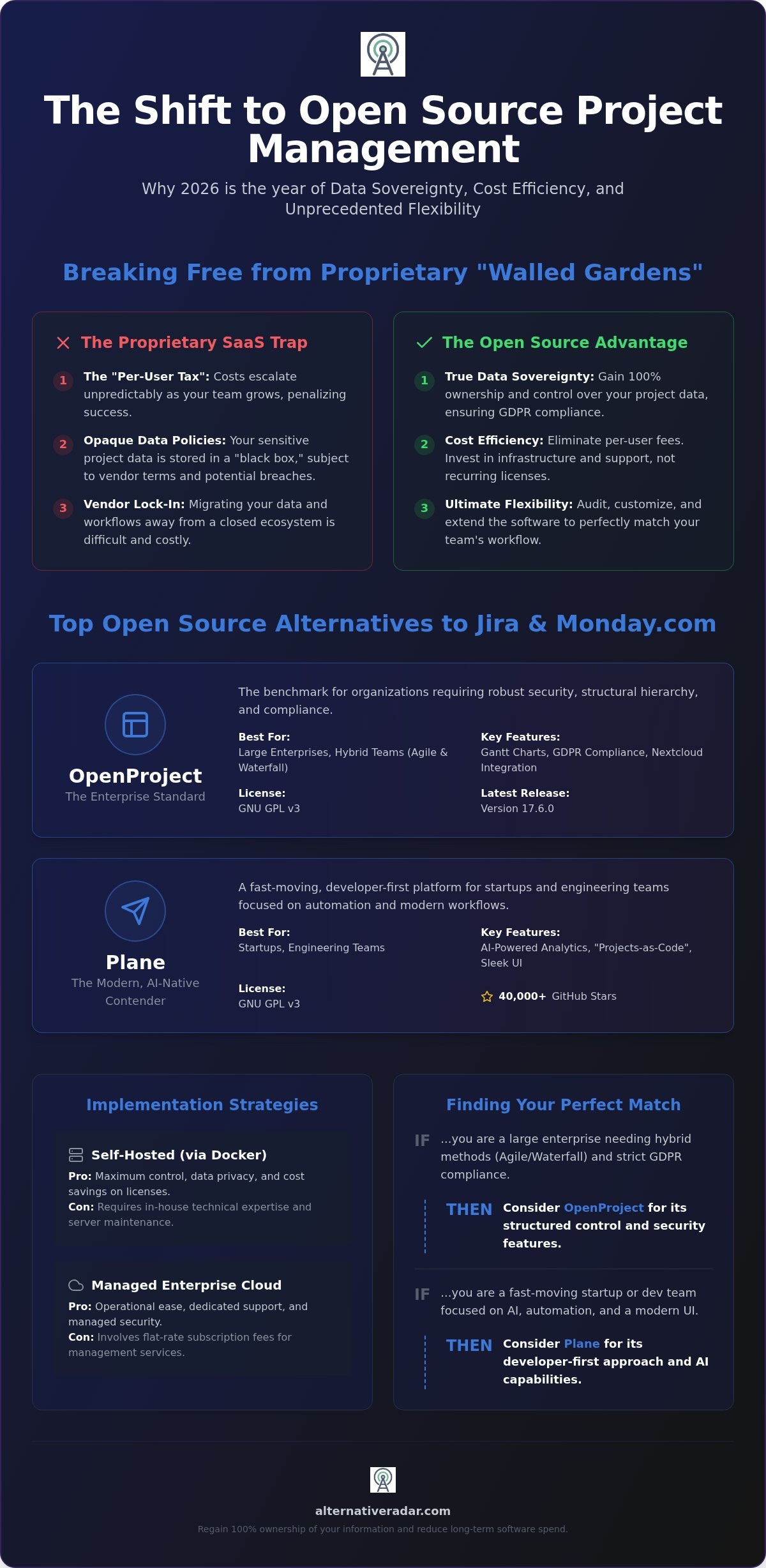
We will evaluate the latest technical releases, including OpenProject 17.6.0 and Plane’s v1.5.0, which currently boasts over 40,000 GitHub stars. You’ll discover how these tools integrate modern AI-powered analytics and flexible licensing to provide a scalable, secure foundation for your organization’s future.
Key Takeaways
- Escape rising per-user SaaS costs by understanding the shift toward “Sovereign Tech” in the enterprise sector.
- Compare the top open source project management software options, including OpenProject, Plane, and Taiga, to find the right functional fit for your team.
- Discover how 2026 tools use local AI agents for automated reporting without compromising your data residency requirements.
- Evaluate the infrastructure requirements for self-hosting via Docker versus the operational ease of managed enterprise cloud deployments.
- Use our “If/Then” framework to match specific project methodologies with the most compatible open-source platform.
The Strategic Shift to Open Source Project Management in 2026
Open source project management software is no longer just a niche preference for developers; it has become a strategic requirement for the modern enterprise. In 2026, the concept of “Sovereign Tech” has gained massive momentum as businesses realize that owning their data is as critical as owning their intellectual property. Unlike proprietary tools where the underlying code is a “black box,” open-source solutions provide full transparency. This allows your IT team to audit the security, customize the functionality, and ensure that your workflows aren’t being quietly used to train a vendor’s proprietary AI models.
The shift away from “SaaS-only” models is accelerating. Many organizations have grown tired of unpredictable subscription hikes and the aggressive data harvesting practices found in closed ecosystems. By leveraging tools under the GNU GPL v3 license, users secure long-term viability. This license protects your freedom to run, study, and modify the software; it ensures that even if a developer stops supporting a tool, the community or your internal team can maintain it indefinitely. This creates a safety net that proprietary vendors simply can’t match.
Data Sovereignty: Why It Matters More Than Ever
Storing sensitive project data in a proprietary cloud carries inherent risks. If a vendor changes their terms of service or faces a security breach, your intellectual property is at the mercy of their response. Open source provides a literal “kill switch” against these vulnerabilities. You can migrate your entire database to a different server at any time because you own the underlying architecture. This level of control is essential for meeting strict GDPR and global data protection standards. For a broader look at how these tools stack up, a Comparison of project management software shows that open-source options now rival or exceed the feature sets of traditional market leaders.
The Cost Efficiency of Open Source in 2026
Pricing models for tools like Jira often penalize growth by charging per user, leading to “subscription bloat” as your team expands. Open source alternatives typically offer a flat-rate enterprise support model or a completely free Community Edition for self-hosting. Selecting an open source project management software allows you to bypass the “per-user tax” that makes traditional SaaS so expensive as you scale. Total Cost of Ownership in the open-source context represents the combined expenditure of server infrastructure, security patching, and internal staff time required to maintain the platform versus recurring license fees. Community editions provide professional-grade features without the entry barrier of monthly fees, making them ideal for high-growth teams focused on efficiency.
Evaluating Top Open Source Alternatives to Jira and Monday.com
Selecting the right open source project management software requires moving past the “one-size-fits-all” mentality of proprietary giants. The market has matured into distinct categories based on project methodology: Agile, Waterfall, or Hybrid. While legacy tools were often criticized for clunky interfaces, the 2026 generation of tools features sleek, intuitive UIs that rival any SaaS competitor. If you aren’t sure where to start, you can explore curated software comparisons to filter results by your specific technical requirements and team size.
OpenProject: The Enterprise Standard for Hybrid Teams
OpenProject remains the benchmark for organizations that cannot compromise on security or structural hierarchy. Version 17.6.0, released in July 2026, continues to emphasize data sovereignty with robust EU-hosting options and GDPR-compliant features. It excels in Hybrid environments where teams need to toggle between Agile Kanban boards and traditional Waterfall Gantt charts. Its deep integration with Nextcloud allows for seamless document management within the project workflow. This tool is the logical choice for large-scale enterprises that require the same level of administrative control found in Jira but with the transparency of open source.
Plane: The Modern, AI-Native Contender
Plane has rapidly become a preferred open source project management software for fast-moving startups and engineering teams. With over 40,000 GitHub stars, its momentum is driven by a developer-first approach called “Projects-as-Code.” The Plane Compose framework allows teams to treat their project structures as programmable entities. Unlike “classic” tools, Plane v1.5.0 is built with an AI-native architecture, making it easier to automate repetitive triage tasks and track billable hours through integrated modules. For teams looking to leave the Atlassian ecosystem, Plane offers a streamlined migration path that imports Jira issues and metadata with minimal friction. According to industry reports on top open source project management tools, Plane represents the next generation of collaborative infrastructure.
Taiga and Penpot: The Design-Centric Agile Choice
Taiga focuses on the intersection of design and development. By maintaining a close synergy with Penpot, an open-source design tool, Taiga enables creative teams to align their Agile sprints with visual assets. It’s intentionally less feature-heavy than OpenProject, prioritizing a “simple and beautiful” interface that reduces cognitive load. Small, creative agencies often choose Taiga because it doesn’t force them into complex enterprise hierarchies. Instead, it provides a focused Agile experience that emphasizes team velocity and visual clarity, ensuring that design and code stay in constant sync.
AI Integration and Data Sovereignty: The New Open Source Standard
In 2026, the functional value of open source project management software has evolved beyond simple code transparency. It now centers on how these tools manage the intersection of artificial intelligence and data privacy. While proprietary platforms often force users into “black box” AI models that process data on remote, third-party servers, open-source alternatives provide a high-quality filter for security-conscious buyers. You can now deploy sophisticated Large Language Models (LLMs) within your own perimeter, ensuring that your strategic roadmaps and intellectual property never leave your control. This shift allows teams to leverage automation without the risk of their private data being used to train a vendor’s global model.
AI Agents vs. Manual Workflows
Traditional project management relies on humans to manually triage issues and update statuses. Modern open-source platforms are shifting this burden to AI agents that act as active collaborators within your workspace. These agents can automatically break down large epics into granular tasks by analyzing existing project context and historical team velocity. AI-driven summarization reduces meeting fatigue in project teams by distilling hours of recorded discussions into concise, actionable task lists without the need for manual oversight. Predictive scheduling has also become a standard feature; AI identifies potential project blockers before they happen by flagging resource conflicts in real-time. This transition from passive databases to “Agents-as-Collaborators” ensures that your PM tool drives productivity rather than just recording it.
Privacy-First AI: Keeping Your Context Private
The primary risk of proprietary AI is the lack of a “kill switch” for data sharing. When you use integrated AI in tools like Jira or Monday.com, your private project context often enters a training pool for public models. Selecting a privacy-first open source project management software solves this problem by supporting local AI integrations. You have the choice between using external APIs for convenience or integrating self-hosted models like Llama 3 for maximum security.
- Local LLM Support: Run models on your own hardware to ensure zero data leakage.
- Air-Gapped Deployment: Platforms like Plane allow for completely isolated AI environments.
- Contextual Control: Explicitly define which data sets the AI can access for task automation.
By choosing self-hosted model integrations, you maintain full authority over your data residency. This flexibility allows your organization to scale its AI capabilities while meeting the strictest compliance requirements of the enterprise sector.
Implementation Strategies: Self-Hosted vs. Managed Enterprise Cloud
Deploying open source project management software requires a clear choice between two distinct paths: infrastructure autonomy or operational convenience. This decision dictates your long-term technical overhead and your team’s ability to scale without friction. While the software core remains the same, the method of delivery changes how you manage security, updates, and costs. You must evaluate whether your organization possesses the internal DevOps resources to maintain a server or if your priority is a zero-config environment that allows you to start working immediately.
The Case for Self-Hosting (On-Premises)
Self-hosting offers the ultimate level of data residency. By running the software on your own hardware, you ensure that sensitive project metadata never leaves your internal network. Technical requirements for a 2026 deployment typically involve a Linux environment, Docker for containerized management, and a robust SQL database like PostgreSQL. This model eliminates recurring license fees, but it introduces the “hidden risk” of maintenance debt. You’re responsible for manual security patching, database backups, and hardware uptime. If your team lacks the expertise to manage a production-grade server, the “free” cost of a Community Edition can quickly be outweighed by the internal labor required to keep it stable. Before committing to a specific deployment model, compare open-source software providers to see which offers the best balance of hosting flexibility and enterprise support.
Managed Open Source Cloud: The Best of Both Worlds?
Many enterprises now opt for managed cloud versions of tools like OpenProject or Plane to bypass the complexities of server administration. These “Enterprise Cloud” tiers provide the transparency of open source with the reliability of a professional SaaS platform. For example, OpenProject’s Basic plan starts at $7.25 per user, providing a managed environment that includes automated backups and guaranteed uptime. Plane offers a similar Pro tier at $6 per user, which is significantly more cost-effective than the higher tiers of proprietary competitors. This approach ensures you receive expert technical support and immediate access to the latest features, such as AI-native triage tools, without the burden of managing Docker images or SQL migrations yourself.
Scaling your infrastructure is the final consideration. A self-hosted instance for 10 users can run on a modest VPS, but moving to 1,000+ users requires a transition to high-availability clusters and load balancers. Security protocols must also tighten as you grow. Implementing mandatory 2FA, securing your instance behind a VPN, and configuring strict firewalls are non-negotiable steps for protecting your project data in an open-source environment. Managed providers handle this scaling automatically, allowing your infrastructure to expand alongside your team’s headcount without manual intervention.
Finding Your Perfect Match: Which Open Source Tool Fits Your Workflow?
Selecting the right open source project management software requires matching your operational bottlenecks to the architectural strengths of the tool. A generic choice leads to poor adoption; a tailored choice drives a competitive advantage. For teams also looking to secure their sales pipeline, check our open source CRM software comparison. Once you’ve secured your project data, the next logical step is ensuring your customer data remains equally sovereign.
Use this “If/Then” framework to narrow your search. If your team prioritizes developer experience and AI-driven automation, then Plane is your strongest contender. If you manage complex physical infrastructure or public sector projects with strict hierarchy needs, then OpenProject is the necessary choice. If you run a small creative agency where design and code must stay in sync, then Taiga provides the most fluid experience. This decision shouldn’t be based on popularity but on functional suitability.
Workflow Matching for Different Industries
For software development teams, integration is the primary currency. Plane wins here because it treats projects as code and interacts natively with GitLab and GitHub repositories. Construction and engineering firms face different challenges, specifically the need for precise scheduling and resource allocation. OpenProject’s enterprise-grade Gantt charts are essential for these sectors, providing the granular visibility required for multi-year physical builds. Creative agencies often find traditional tools too rigid. Taiga’s visual boards and design-first philosophy allow designers to stay within their creative flow while keeping project managers informed of sprint progress.
Building Your Sovereign Business Stack
A project tool is only as effective as the ecosystem surrounding it. You can pair your PM tool with a Slack alternative for unified communication, ensuring that chat logs and task updates remain within your private infrastructure. You can explore the broader ecosystem in our popular open source business software 2026 guide to replace every proprietary link in your value chain. We recommend starting with a pilot project involving a single department before a full org-wide rollout. This allows you to test your Docker configurations and internal workflows without disrupting the entire company.
Migration Checklist from Proprietary Software
- Audit Your Data: Identify which Jira or Monday.com fields are essential and which are legacy clutter.
- Test the Import: Use the migration scripts provided by Plane or OpenProject to verify that metadata and attachments transfer correctly.
- Configure SSO: Ensure your open source project management software integrates with your existing identity provider for secure access.
- Run a Pilot: Execute one full sprint or project phase on the new platform to identify friction points.
- Set a Cut-off Date: Once the pilot is successful, set a hard date to move the remaining teams and archive your old SaaS subscriptions.
Secure Your Infrastructure with Sovereign Tools
Transitioning to open source project management software is no longer just a cost-saving measure; it’s a strategic move to secure your data residency. By choosing tools like OpenProject for enterprise stability or Plane for AI-native automation, you eliminate the risks associated with proprietary clouds. You’ve seen how local AI deployment and flexible hosting models allow your team to scale without the mounting pressure of per-user subscription fees. This shift ensures that your intellectual property remains your own while providing the same feature parity as legacy market leaders.
To continue optimizing your business stack, explore all open-source alternatives on Alternative Radar. Our platform acts as your digital scout, providing objective, efficiency-driven reviews across 100+ software categories. We help professional buyers make smarter, privacy-focused choices by filtering out the marketing hype and focusing on technical utility. Take control of your workflows today and build a technical foundation that prioritizes your team’s autonomy and long-term security.
Frequently Asked Questions
Is open source project management software really free?
The core software is often free, but you must account for infrastructure and maintenance costs. Self-hosted “Community Editions” of open source project management software like OpenProject or Redmine have no license fees. However, you’ll still pay for server hosting, storage, and the internal labor required for security updates and backups. If you don’t want to manage hardware, managed cloud versions usually charge a per-user fee that is still lower than proprietary SaaS.
Can I migrate my data from Jira or Monday.com to an open source tool?
Most modern tools provide dedicated migration paths to import your existing data with minimal friction. Plane includes a specialized Jira importer that transfers issues, labels, and metadata directly into your new workspace. For tools like Monday.com, you can use CSV or JSON exports to map your data into open-source alternatives. Some complex board views might require manual reconfiguration, but the underlying task data transfers reliably.
Is self-hosted project management more secure than cloud SaaS?
Self-hosting is potentially more secure because it grants you total control over data residency and network access. You can keep your project data behind a private VPN and implement custom firewall rules that proprietary clouds don’t allow. This eliminates the risk of a third-party vendor’s data breach affecting your intellectual property. The actual security level depends on your team’s diligence in applying patches and managing 2FA protocols.
Do open source project management tools have mobile apps?
Yes, many leading platforms offer native mobile applications for iOS and Android to keep teams connected. Plane v1.5.0 features a dedicated mobile app for tracking tasks and updating statuses on the go. Other tools like OpenProject use highly responsive web designs that function effectively on mobile browsers. This ensures your team stays productive regardless of their device or location without sacrificing the power of the desktop experience.
What is the best open source project management software for small teams?
Plane is an excellent choice for teams of up to 12 users because its free tier includes most core features. Taiga is another strong contender for small, Agile-focused groups that value a simple and visual interface. These tools allow small teams to scale their workflows without the high per-user costs associated with proprietary software. They provide professional-grade functionality while keeping the learning curve manageable for non-technical users.
How does AI work in open source project management tools?
AI in these tools focuses on automating manual triage and status reporting through integrated agents. You can use these agents to summarize long comment threads or predict potential project blockers based on historical velocity. Unlike proprietary tools, open source project management software often allows you to integrate local LLMs. This keeps your project context private while still benefiting from automated task generation and predictive scheduling.
What technical skills are needed to maintain an open source PM tool?
You typically need basic knowledge of Linux server administration and Docker container management for self-hosted instances. Setting up a tool like OpenProject requires familiarity with SQL databases for backups and configuration files for environment variables. If your team lacks these DevOps skills, opting for a managed enterprise cloud version is a more efficient choice. This provides the benefits of open source without the burden of server maintenance.
Can I use open source project management for client-facing projects?
Yes, these tools are designed for professional collaboration with external stakeholders and clients. You can create guest accounts or public-facing project boards to share progress without granting full access to your internal workspace. Using open-source tools for client work also demonstrates your commitment to data privacy and professional transparency. It allows you to provide a branded, secure environment for project updates that you fully control.