

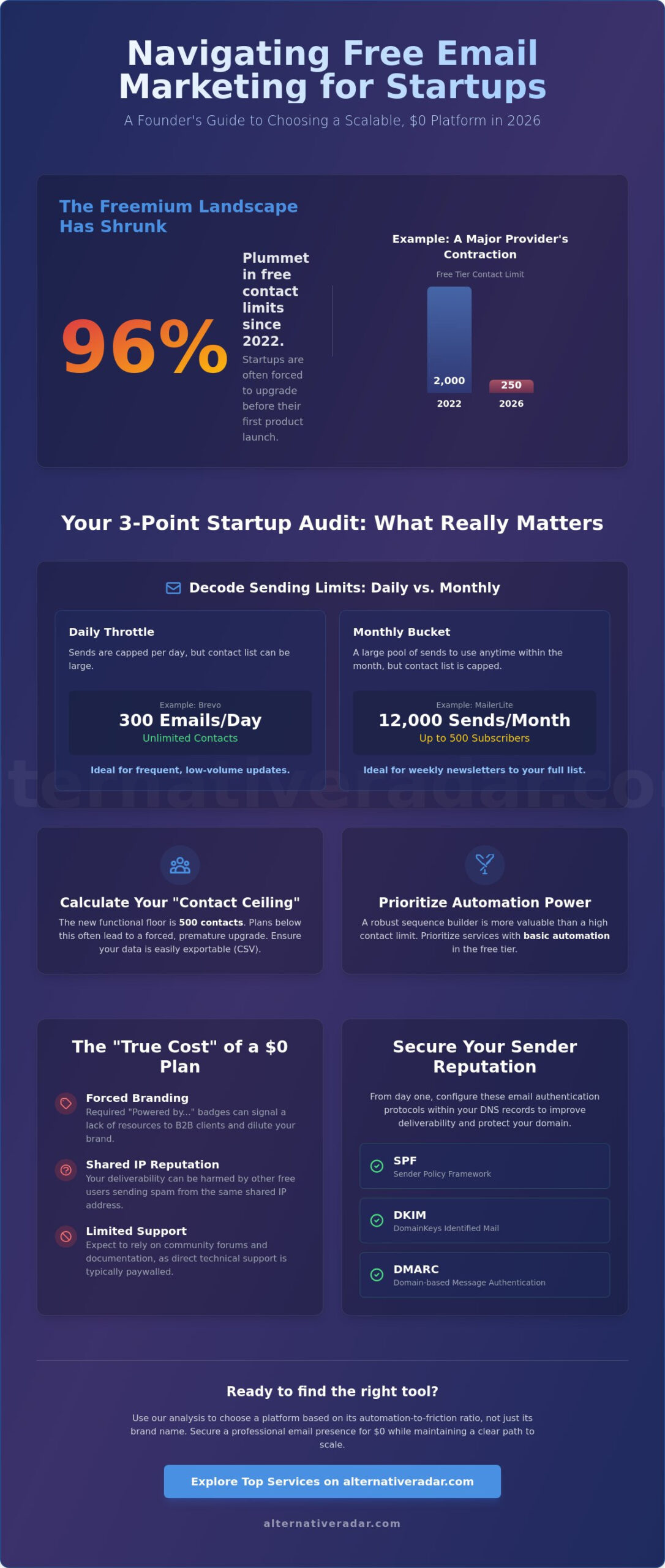
Did you know that since 2022, the industry’s most recognizable free contact limit has plummeted by 96%, often leaving founders with a plan that expires before their first major product launch? It is a common trap for new businesses. You search for free email marketing services for startups only to find hidden automation caps, poor deliverability on shared IPs, or the looming threat of a forced migration once you hit a few hundred subscribers. You need a setup that looks professional and functions autonomously without draining your initial capital.
We agree that your focus should stay on product-market fit, not managing technical debt in your marketing stack. This evaluation identifies the most scalable tools available in 2026 and teaches you how to audit free tiers for long-term efficiency. You will discover how to secure a professional email presence for $0 while maintaining a clear path to scale. We have analyzed the top providers to help you choose a platform based on its automation-to-friction ratio rather than just its brand name.
Key Takeaways
- Distinguish between daily and monthly sending caps to ensure your email volume aligns with your specific startup growth model.
- Evaluate the top free email marketing services for startups by prioritizing automation features and deliverability over high contact limits.
- Protect your sender reputation from day one by configuring SPF, DKIM, and DMARC protocols within your free tier.
- Calculate your “Contact Ceiling” early to anticipate the exact cost of scaling your list beyond the initial 1,000 subscribers.
- Integrate your email platform with open source CRM tools to prevent manual data migration headaches as your operations expand.
Navigating Free Email Marketing Services for Startups in 2026
The landscape of free email marketing services for startups has shifted from generous “freemium” models to highly restricted entry tiers. As of early 2026, the industry has largely abandoned the idea of unlimited growth on a zero-dollar budget. For instance, Mailchimp’s free tier has contracted by 96% since 2022, now supporting just 250 contacts. This trend signals that providers are prioritizing rapid conversion over long-term free hosting. Startups must look past the “free forever” label and evaluate the automation-to-friction ratio. A platform that offers 2,000 contacts but zero automated workflows is often less valuable than one with 500 contacts and a robust sequence builder.
Founders should watch for “bait-and-switch” red flags. Some platforms, such as Moosend, have transitioned to 30-day trials rather than permanent free plans. This is a tool for testing, not a foundation for growth. If a service hides its “per-day” sending limits in the fine print, it’s likely to fail you during a high-traffic launch. Efficiency-driven founders prioritize tools that allow for basic automation on day one, even if the contact ceiling is lower.
The Difference Between Marketing and Transactional Email
Startups often confuse marketing blasts with transactional triggers. Marketing emails include newsletters and promotional campaigns designed to drive engagement. Transactional emails are system-generated alerts like password resets, purchase receipts, or API-driven notifications. Because these serve different purposes, a single free plan rarely handles both well. Many founders find success by splitting their stack; they might use Brevo for its 300-per-day transactional limit while utilizing MailerLite for automated marketing sequences. Understanding the technical nuances of email marketing helps you avoid hitting unexpected API caps during a critical product launch.
Evaluating the ‘Cost’ of Free Services
Choosing a free tier involves hidden trade-offs that impact your brand’s authority. Platform branding is the most visible cost. Most free plans require a “Powered by” badge in the footer, which can signal a lack of resources to sophisticated B2B buyers. Beyond aesthetics, the technical infrastructure presents risks. Free users typically send from shared IP addresses with lower reputation scores. If other free users on that IP send spam, your deliverability suffers. Support is another bottleneck. You will likely rely on community forums rather than direct technical assistance. Identify which features are gated behind a paywall before you integrate your data to ensure your “free” setup doesn’t become a manual migration nightmare later.
The Startup Audit: Contacts, Sending Volume, and Automation
Auditing free email marketing services for startups requires looking beyond the “Free” label to the specific constraints of the service. While 2,000 contacts used to be the industry standard for entry-level tiers, 500 has become the new functional floor in 2026. Choosing a plan with fewer than 500 contacts often leads to a forced upgrade within months of your first lead magnet launch. Beyond the list size, verify your data portability. Ensure the platform allows easy CSV exports without gating your own subscriber data behind a paywall. If you can’t leave easily, you aren’t using a free tool; you’re accumulating technical debt.
Decoding Sending Limits
Sending limits generally follow two distinct patterns: daily throttles and monthly buckets. Brevo utilizes a daily throttle, allowing unlimited contacts but capping sends at 300 emails per day. This model suits startups with large lists who send frequent, low-volume updates. Conversely, MailerLite uses a monthly bucket system, providing 12,000 sends per month for up to 500 subscribers. This is ideal for weekly newsletters where you need to reach your entire audience simultaneously. Match your choice to your expected frequency. If you plan to blast 1,000 people once a week, a daily cap of 300 will break your workflow. For more technical comparisons of growth tools, you can explore our software evaluations to find the right fit for your stack.
Essential Free Automation Features
Automation is the primary driver of efficiency for lean teams. You should prioritize a welcome sequence above almost any other feature. An automated “hello” ensures immediate engagement with new leads without manual intervention. Many free plans now gate multi-step sequences, so confirm that your chosen provider allows at least three consecutive triggers. Tagging and segmentation are equally vital. These features allow you to categorize users based on behavior, keeping your data clean from day one. Following SBA email marketing basics, startups should also look for A/B testing capabilities. Even on a $0 budget, testing subject lines helps you optimize for higher open rates before you ever commit to a paid subscription. MailerLite and Sender remain rare examples that still offer these advanced optimization tools within their free tiers.
Top 5 Free Email Marketing Services by Startup Type
Selecting the right platform requires matching your technical requirements to your business model. Most founders fail because they choose a household name rather than a tool built for their specific workflow. Implementing essential marketing strategies for startups often starts with a zero-dollar budget, but the technical debt of a poor choice can cost you weeks of migration later. We have audited the top free email marketing services for startups to identify which providers offer the best utility for different operational needs.
Best for SaaS: Loops & Resend
Software startups often need event-driven communication rather than traditional list-based blasts. Loops has emerged as a modern favorite for SaaS founders because it focuses on user behavior. Instead of just sending a weekly newsletter, you can trigger emails based on specific in-app actions, like a user completing their profile or hitting a feature milestone. For teams that prioritize a developer-first experience, Resend offers an API-first approach with React-based templates. This allows your engineering team to manage transactional and marketing emails within the same codebase. Both platforms offer generous free tiers that prioritize clean code and high deliverability over flashy drag-and-drop builders, making them ideal for product-led growth models.
Best for E-commerce & B2B: Brevo & MailerLite
If your startup relies on lead generation and high-volume contact acquisition, Brevo and MailerLite are the industry benchmarks. Brevo is unique because its free plan allows for unlimited contacts. You only face a restriction on your daily sending volume, which is capped at 300 emails. This is a massive advantage for B2B startups that need to maintain a massive database but only send targeted, low-frequency updates. MailerLite, on the other hand, is the gold standard for marketing automation. Its free tier includes a sophisticated drag-and-drop editor and landing page builders that rival many paid competitors. While it limits you to 500 subscribers as of 2026, it provides the most comprehensive set of “pro” features for zero cost, including multi-step automated sequences that are typically gated by other providers.
For founder-led newsletters or content-heavy startups, Kit (formerly ConvertKit) remains a top contender. It prioritizes simplicity and high text-to-image ratios, which often leads to better primary inbox placement. While its automation features are more restricted on the free plan compared to MailerLite, its “Creator Network” helps startups find new subscribers through recommendations. By choosing a tool based on your specific industry type, you ensure that your marketing stack supports your growth rather than creating a bottleneck.
Maximizing ROI on $0: Deliverability and Integration
A zero-dollar budget only works if your messages actually reach the inbox. Many founders assume that free email marketing services for startups are plug-and-play, but skipping the technical foundation often leads to the spam folder. Deliverability is not a “pro” feature; it is a technical requirement. If your emails don’t land, the time you spent designing them is wasted capital. You must treat your sender reputation as a core business asset from your very first send.
Technical Setup for High Deliverability
Authentication is your first priority. You need to configure three specific DNS records: SPF, DKIM, and DMARC. These protocols prove to receiving servers that you are the legitimate sender. In 2026, major providers like Google and Yahoo have made these records mandatory for high-volume senders. Never send marketing campaigns from a @gmail.com or @outlook.com address. Using a free consumer address triggers DMARC “reject” policies, causing your emails to be blocked entirely. Always use a custom domain. Use free diagnostic tools like Mail-Tester or MXToolbox to check your “Spam Score” before every blast. These tools identify broken links or “spammy” keywords that could trigger filters before you hit send.
Building a Unified Startup Stack
Efficiency increases when your tools talk to each other without manual data entry. Your email platform shouldn’t exist in a vacuum. It should sync directly with your primary database. If you use a lean setup, consult our open source crm software comparison to find a database that integrates with your email tool via API or webhooks. You can also push engagement alerts to your team. Connecting your email signup triggers to various slack alternatives ensures your sales team knows the moment a high-value lead opens a proposal.
Building a stack doesn’t require a paid subscription to Zapier or Make. Most integration platforms offer a free tier that supports several hundred “tasks” per month. Use these to push engagement data, such as link clicks or form completions, back into your CRM. Stack synergy occurs when autonomous data flows between marketing, sales, and communication tools to eliminate manual entry and accelerate lead response times. To optimize your entire operations budget, compare the latest efficiency tools in our curated directory.
Finally, practice strict list hygiene. Free plans have tight contact caps, so don’t waste space on “ghost” subscribers who haven’t opened an email in 90 days. Scrubbing your list improves your open rates and protects your sender reputation. A smaller, engaged list is always more valuable than a large, unresponsive one that damages your deliverability over time.
Scaling Beyond Free: When to Upgrade Your Marketing Stack
The transition from free email marketing services for startups to a paid ecosystem is a strategic milestone, not a technical failure. This shift typically occurs at the “Contact Ceiling.” If you utilize a plan capped at 500 subscribers, your 501st lead represents a potential revenue loss if you aren’t prepared to upgrade. Calculate the cost of your next 1,000 subscribers before you hit this limit. Some providers jump from $0 to $30 per month instantly. If your current conversion rate doesn’t justify that jump, your platform has become a growth bottleneck rather than a facilitator.
Branding is another critical factor. While a “Powered by” badge is acceptable for a pre-seed startup, it can diminish credibility during a Series A round or a major B2B push. Removing this badge almost always requires a paid tier. Similarly, advanced branching logic acts as a common trigger for upgrading. If your onboarding sequence requires “if/then” triggers based on specific user behavior within your app, you’ve likely outgrown the linear sequences found in most free tiers. Paid plans unlock the multi-step automation necessary for a truly hands-off marketing engine.
The Upgrade Checklist
Determine if your manual work-arounds are costing more than the subscription fee. If you spend several hours each month manually syncing data or cleaning lists because your free tier lacks specific integrations, you’re losing valuable founder time. Mission-critical campaigns also require premium support. When a launch email fails at midnight, a community forum is an insufficient resource. You need a ticket system or live chat with a guaranteed response time. High-volume senders should also evaluate the need for dedicated IP addresses to ensure consistent deliverability, a feature almost never included in free email marketing services for startups.
Future-Proofing Your Choice
Select a tool with a fair middle-tier pricing structure. Don’t just evaluate the $0 price; analyze the $50 price point. Some tools scale linearly, while others impose “success taxes” that penalize rapid growth. To ensure you’re making a sustainable choice, you can consult our guide on finding the best alternative to popular software in 2026. When you eventually migrate, ensure your chosen tool supports full engagement history exports. Losing data on who opened your previous ten emails can set your segmentation strategy back by months.
The final verdict for 2026 is clear. Start with MailerLite for the best automation-to-price ratio or Brevo if you need a large contact database immediately. If you’re building a SaaS product, Resend or Loops provides the developer-centric flexibility you need. Focus on the tool that offers the least friction for your specific business model and allows you to scale without technical debt.
Optimizing Your Marketing Stack for 2026
Success in startup email marketing depends on choosing a platform that matches your specific business model. This evaluation shows that selecting free email marketing services for startups requires looking beyond the subscriber count to the depth of automation and data portability. By prioritizing technical authentication and selecting tools based on industry-specific needs, you protect your sender reputation from the very first send. Efficiency remains your greatest asset during the early stages of growth. Don’t let a free tool become a manual burden that drains your time. As your list grows, stay ahead of the “Contact Ceiling” by auditing your stack against current market standards and deliverability requirements.
For more objective software comparisons updated with 2026 pricing tiers, you can find the best email marketing alternatives for your startup on Alternative Radar. Our platform focuses on startup scalability so you can make smarter choices without following market hype. Build your foundation with precision and start scaling your reach today.
Frequently Asked Questions
Can I really use email marketing for free forever?
Yes, you can use these tools at no cost for as long as you stay within the plan’s specific subscriber and sending limits. Most “free forever” tiers are designed to support early-stage growth, but they impose caps on advanced features like multi-step automation or white-labeling. You will likely face a forced upgrade once your list exceeds 500 to 1,000 contacts or your sending frequency increases beyond the daily allowance.
What is the best free email marketing service for a SaaS startup?
Loops and Resend are the premier choices for SaaS founders who prioritize product-led growth. These platforms focus on event-driven triggers rather than traditional manual blasts, allowing you to automate messages based on user actions within your application. They offer developer-friendly APIs and React-based templates that integrate seamlessly with your existing codebase, providing a more technical foundation than standard newsletter tools.
Do free email tools include landing pages and sign-up forms?
Most reputable free plans include embeddable sign-up forms, but landing page availability is often restricted. MailerLite remains the industry leader in this category, offering up to 10 landing pages on its free tier as of 2026. Other providers may allow you to build pages but will gate custom domain mapping or advanced tracking pixels behind a paid subscription.
How many contacts can I have on a free email marketing plan in 2026?
The contact limit varies significantly by provider, with 500 being the current industry average. While Sender offers a generous limit of 2,500 subscribers, Mailchimp has reduced its free tier to just 250 contacts as of February 2026. Always verify if the plan limits are based on total subscribers or unique monthly recipients, as this affects your long-term free email marketing services for startups strategy.
Will my emails go to spam if I use a free service?
Using a free service does not automatically result in spam placement, but it does require more diligent technical setup. Because free users send from shared IP addresses, your deliverability depends on the collective reputation of everyone on that IP. You can protect your reach by configuring SPF, DKIM, and DMARC records and avoiding the use of consumer @gmail.com addresses for your sender identity.
Can I remove the provider’s logo from my emails on a free plan?
Removing the “Powered by” branding is almost never an option on a free plan. This mandatory badge is the primary trade-off for using the service at zero cost. If your startup requires a fully white-labeled experience to maintain high-end B2B credibility, you should budget for an upgrade to the first paid tier, where branding removal is a standard feature.
Is Mailchimp still the best free option for startups?
Mailchimp is no longer the most efficient choice for startups due to its increasingly restrictive free tier. Since 2022, the platform has cut its free contact limit by 96%, making it difficult for growing businesses to stay on the $0 plan for long. Competitors like MailerLite and Brevo now offer more robust automation and higher sending caps for founders who need to maximize their initial resources.
How do I switch from one free email provider to another?
Switching providers involves exporting your subscriber data as a CSV file and importing it into your new platform. You must manually recreate your automated sequences and segments to ensure continuity. It is also critical to update your DNS settings with the new provider’s authentication records to prevent a sudden drop in deliverability during the transition period.