

Paying for customer insights is often an unnecessary tax on your business growth. Most “free” platforms lure users in with sleek templates, only to lock the actual data behind a paywall once the results exceed 25 entries. If you are searching for the best free survey tools for customer feedback, you’ve likely experienced the frustration of hitting a response limit mid-campaign or finding that a simple CSV export requires a premium subscription. It’s an inefficient way to work, and in 2026, it’s completely avoidable.
We agree that your data should belong to you from the start. This comparison identifies the tools that offer at least 100 free responses and professional, mobile-responsive interfaces without demanding a credit card. You’ll discover which platforms provide the most generous limits and which ones are merely free-to-try traps designed to force an upgrade. We evaluate the 2026 performance of Tally, Google Forms, and Zoho Survey to ensure you choose a tool that scales with your needs rather than obstructing your progress.
Key Takeaways
- Identify the “Response Ceiling” of popular platforms to avoid hitting limits mid-campaign and ensure your sample size remains valid.
- Learn which specific tools allow for unrestricted CSV and Excel data exports without requiring a hidden premium subscription.
- Compare the best free survey tools for customer feedback based on their functional suitability for academic research versus e-commerce pulse checks.
- Distinguish between genuine free tiers and “free-to-try” models that lock professional features behind a paywall.
- Leverage objective comparisons to bypass market leader bias and build a software stack tailored to your specific efficiency goals.
Evaluating the 2026 Landscape of Free Survey Tools for Customer Feedback
Free survey tools for customer feedback are software platforms that allow you to build questionnaires and collect user data without paying an upfront subscription fee. In 2026, these tools are no longer just “lite” versions of professional software; they are essential instruments for teams that need to conduct market validation or sentiment pulse checks on a lean budget. Choosing the right platform requires looking past the brand name to see how much data you can actually access without hitting a paywall. Efficiency in data collection starts with knowing exactly when a “free” tool will start charging you for the results you’ve already gathered.
The industry has shifted significantly this year. Most providers have adopted freemium models that prioritize AI-driven survey construction over high response volumes. While you might get an AI assistant to write your questions for free, you’ll often find your data locked away once you cross a small response threshold. This guide evaluates the market based on three pillars: response limits, data exportability, and UI quality. For a broader look at how these platforms stack up against one another, this comprehensive comparison of survey tools provides a baseline for the technical features you should expect in a modern stack.
Why Customer Feedback is Non-Negotiable in 2026
Privacy-first regulations have made traditional third-party tracking less effective, placing a premium on zero-party data. This is information your customers provide willingly and directly. Developing a consistent feedback loop is the most effective way to reduce churn and sharpen your product-market fit. You don’t always need thousands of entries to make a smart decision. Even a small, qualitative dataset of 30 to 50 responses can highlight friction points in a checkout process or reveal why a new feature isn’t gaining traction. High-utility software allows you to capture these insights quickly so you can act before your competitors do.
The Evolution of the Freemium Survey Model
We’ve moved away from the “unlimited free” era of the early 2020s. Today, the most popular platforms use feature-restricted tiers to encourage upgrades. The current standard for free accounts usually includes AI-assisted builders that can draft a 10-question survey in seconds based on a simple prompt. While this saves time during the setup phase, it often masks the limitations found in the analysis phase. The response ceiling is the primary barrier for free accounts, acting as a hard cap that prevents you from viewing or exporting data once you reach a specific number of participants. Understanding these ceilings is the difference between a successful campaign and a wasted effort.
The Top 5 Free Customer Feedback Tools: Features and Limits
Selecting the right free survey tools for customer feedback requires matching your specific volume needs with the platform’s data restrictions. Our team at Alternative Radar acted as a digital scout to filter these options, ensuring you don’t waste time on tools that lock your results behind hidden paywalls. The following five platforms represent the best utility for different business use cases in 2026.
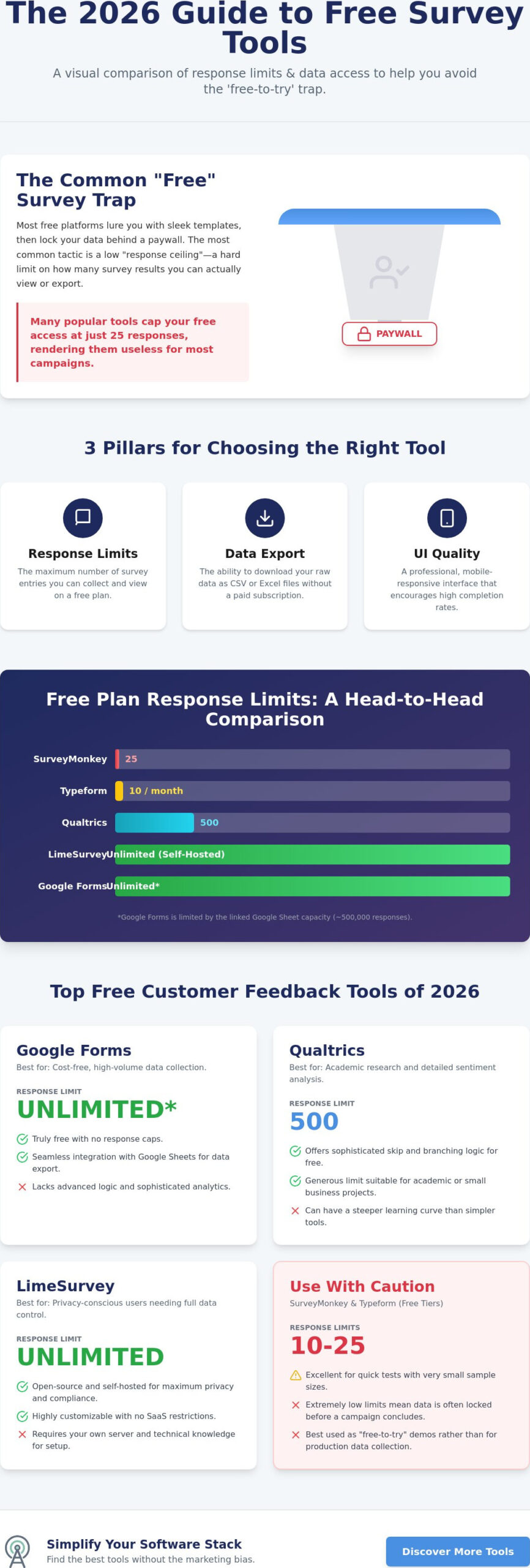
- SurveyMonkey: This remains the standard for speed and professional templates. It is best for quick, 10-question pulse surveys. However, the free “Basic” plan is highly restrictive, allowing you to view only 25 responses per survey. If you expect a higher volume, you’ll find your data inaccessible almost immediately.
- Qualtrics: This platform offers the most sophisticated logic on a budget. It allows for skip and branching logic that most competitors reserve for paid tiers. With a 500-response limit on its free version, it’s the gold standard for academic research and detailed sentiment analysis.
- LimeSurvey: This is the top choice for privacy-conscious users. As an open-source platform, it offers transparency and data ownership that SaaS competitors cannot match. It’s ideal for organizations that must host their own data to meet strict compliance standards or international privacy laws.
- Google Forms: This is the only truly “unlimited” free tool in the group. While it lacks advanced analytics and complex logic, it has no hard response cap. Your only limit is the 10 million cell capacity of the linked Google Sheet, which accommodates roughly 500,000 responses.
- Typeform: Typeform focuses on the mobile experience and high design. Its “one question at a time” interface helps achieve a 47% average completion rate, which is significantly higher than the industry norm of 21.5%. It is the best option for e-commerce feedback where completion rates are the priority.
SaaS Giants vs. Open Source Alternatives
SaaS tools offer a “set it and forget it” experience, but they often come with data lock-in. Open source alternatives like LimeSurvey provide total control over your database. This mirrors the decision-making process found in our open source CRM software comparison, where technical teams often trade initial setup ease for long-term data sovereignty. If you have the resources to self-host, open source is usually the better “forever free” choice. If you prefer a faster setup, Alternative Radar can help you identify which SaaS providers offer the most generous free response limits.
User Experience: How Design Impacts Response Rates
Survey fatigue is a real barrier to data collection. Modern UI combats this by using mobile-responsive layouts and clean aesthetics that reduce cognitive load. For higher completion rates, use “Z-pattern” layouts that guide the eye naturally across the screen from left to right. Ensure your chosen free survey tools for customer feedback render perfectly on smartphones. Over 60% of respondents now complete surveys on mobile devices, and a non-responsive interface will cause your abandonment rates to spike instantly.
The Free Trap: Comparing Response Limits and Data Export Capabilities
Most vendors market their free survey tools for customer feedback by highlighting “unlimited surveys,” but this is often a tactical distraction. The real value of your data is governed by the response ceiling and export permissions. If a tool allows you to build a complex questionnaire but restricts you to seeing only 25 results, your campaign’s utility is effectively zero. Understanding these hard caps before you distribute a link is essential for maintaining an efficient workflow.
The export paywall is the most common “gotcha” in the software industry. Many platforms allow you to collect hundreds of responses but lock the CSV and Excel download features behind a premium subscription. This forces users into a difficult choice: manually copy-paste data into a spreadsheet or pay for a month of service just to access their own information. Tools like Google Forms and Tally are outliers in 2026 because they permit full data portability without a credit card. Other features, such as skip logic and white-labeling, are also frequently gated. While Qualtrics offers sophisticated branching on its free tier, almost no free plan allows you to remove the vendor’s logo from the survey interface.
Calculating Your Required Sample Size
Determine your needs by distinguishing between qualitative insights and quantitative significance. If your goal is to find friction points in a user journey, a 50-response limit from a tool like Qualaroo is often sufficient. These small datasets provide high-value “why” answers. However, if you need to prove a statistical trend to stakeholders, you’ll likely need at least 300 to 500 responses. In these cases, using a tool with a 100-response cap like Zoho Survey will leave you with an incomplete picture. Don’t waste time cleaning data to stay under a limit; choose a tool that matches your required volume from day one.
Hidden Costs of Free Software
Free software isn’t truly free if it creates a data silo or forces a platform migration mid-project. The “time cost” of rebuilding a survey and notifying respondents about a new link can outweigh the price of a paid subscription. Learning how to navigate the market by finding the best alternative early in your search prevents these productivity bottlenecks. Using multiple free survey tools for customer feedback simultaneously might seem like a clever workaround, but it usually results in fragmented data that is difficult to analyze. Aim for a single, scalable platform that respects your data export needs.
Strategic Selection: Matching Survey Tools to Your Feedback Goals
Efficiency in data collection depends on selecting a platform that aligns with your specific outcome. A tool that works for a quick retail check-in might fail during a complex academic study. When evaluating free survey tools for customer feedback, you must prioritize the features that serve your primary objective rather than just looking at the response limit. Selecting the wrong tool early creates friction that slows down your decision-making process later.
Academic Research: Qualtrics remains the standard for university-linked users. It offers the statistical rigor and complex skip logic required for peer-reviewed studies. While the free tier is limited, the sophisticated branching ensures that respondents only see relevant questions. This precision maintains data integrity and prevents the collection of junk data that can skew research results. For researchers looking to synthesize their findings into high-quality papers, Clarami provides an intelligent workspace to streamline the academic writing process.
E-commerce Feedback: Post-purchase satisfaction thrives on high completion rates. Typeform is the leader here because its “one question at a time” interface feels conversational and mobile-friendly. Specialized online retailers, such as Matrachuzat by Revotica, rely on these streamlined forms to collect specific customer requirements for custom-sized mattress covers without creating friction. SurveyMonkey is a strong alternative for those who need pre-built templates to launch a campaign in minutes. These tools prioritize the user experience to ensure you don’t lose customers halfway through the form.
Internal Employee Surveys: For pulse checks on company culture, Google Forms is often the most practical choice. It offers low friction for employees and ensures anonymity without requiring them to create new accounts. For B2B lead generation, consider using surveys as interactive quizzes. This allows you to segment potential clients based on their answers, turning a simple feedback form into a high-utility sales filter.
Data Sovereignty and GDPR Compliance
Data residency is a critical factor for European businesses. GDPR requires that customer feedback data be handled with specific security protocols, particularly concerning where that data is physically hosted. LimeSurvey is a standout choice because it offers hosting in Germany, providing a level of digital sovereignty that US-based cloud providers often lack. If your feedback contains personally identifiable information (PII), ensure your chosen tool provides a Data Processing Agreement (DPA) even on their free tier. This prevents legal complications and protects your brand reputation.
Workflow Integration: Connecting Surveys to Your Stack
A survey is only as useful as the actions it triggers. High-utility software should connect to your existing stack via Zapier or native API access. You can push new survey responses directly into your CRM to update customer profiles or trigger an alert in a team channel. If you are looking to streamline these notifications, checking out the best Slack alternatives for 2026 can help you build a more efficient communication loop. To find the perfect match for your specific tech stack, browse the curated comparisons at Alternative Radar.
Beyond the Big Names: How Alternative Radar Simplifies Your Software Stack
Finding the most efficient free survey tools for customer feedback often requires looking past the platforms with the largest marketing budgets. Market leader bias can lead you to adopt software that is overly complex or restrictive simply because it is the most visible. Alternative Radar acts as a digital scout, performing the heavy lifting of testing and comparison so you can focus on data analysis. By providing a neutral filter for information, we empower you to choose tools based on technical utility rather than brand recognition.
Objective reviews are essential in a software market that changes monthly. A tool that offered unlimited responses last year might implement a strict paywall tomorrow. Our role is to monitor these shifts and identify high-utility alternatives, such as Tally, which currently offers unlimited responses while others tighten their limits. When making your final selection, prioritize the tool that offers the easiest data export. Accessing your results in a CSV or Excel format without a credit card is the ultimate litmus test for a truly free platform.
The Future of Software Discovery
The software you encounter during a search is frequently influenced by programmatic display advertising. This automated media buying process determines which brands appear in your feed based on bidding algorithms rather than objective quality. This reality makes third-party curators like Alternative Radar a necessary intervention for productivity. We bypass the noise of sponsored placements to highlight software that actually serves your workflow. Explore our full directory to find your next productivity upgrade and ensure your tech stack remains lean and effective.
Making the Final Decision
Your choice of free survey tools for customer feedback should depend on your primary goal. If you need speed and templates, SurveyMonkey is a reliable starting point for small samples. For academic rigor and complex logic, Qualtrics is the superior choice. If data sovereignty is your priority, an open-source solution like LimeSurvey prevents vendor lock-in. Use the following checklist to launch your first survey today:
- Confirm the response limit matches your required sample size.
- Verify that data can be exported to CSV or Google Sheets for free.
- Test the survey link on a mobile device to ensure high completion rates.
- Check for GDPR compliance if you are collecting data from European users.
For more niche software comparisons and tailored results, visit the Alternative Radar homepage. We provide the clarity you need to make smarter software choices without the market leader bias.
Take Control of Your Feedback Strategy
Selecting the right platform is the first step toward building a high-utility data loop. Your choice of free survey tools for customer feedback should empower your decision-making, not restrict it with hidden export fees or response ceilings. By prioritizing data sovereignty and mobile-responsive design, you ensure that every insight remains actionable and portable. It’s vital to remember that the most famous software isn’t always the most efficient for your specific business goals. A lean, effective stack values utility over marketing hype.
Efficiency thrives on clarity and comparison. We act as your digital scout, providing expert-led comparisons across 500+ software categories with a strict focus on free and open-source utility. This objective approach helps you avoid common industry pitfalls and “free traps” that slow down your momentum. Stop following market leaders and start building a stack that actually serves your workflow. Find the perfect software alternative on Alternative Radar and gain the objective perspective needed to make smarter choices. You have the power to optimize your software stack today.
Frequently Asked Questions
What is the best free survey tool with no response limit?
Google Forms and Tally are the leading options for users who require unlimited responses without a subscription. Google Forms allows you to collect data until you reach the 10 million cell limit of a linked Google Sheet, which is sufficient for most high-volume campaigns. Tally offers a more modern, block-based interface and also permits unlimited responses on its free tier, making it a high-utility alternative for those who find the Google ecosystem too restrictive.
Can I export data from SurveyMonkey for free in 2026?
No, SurveyMonkey typically locks data export features like CSV or Excel downloads behind its paid tiers. While you can view your results within the platform’s dashboard, you won’t be able to move that data into your own spreadsheets without an upgrade. If data portability is a priority, you should select free survey tools for customer feedback that offer unrestricted exports, such as Tally or Google Forms, to avoid this common export paywall.
Is Google Forms better than SurveyMonkey for customer feedback?
Google Forms is superior for high-volume data collection, but SurveyMonkey offers more professional design templates. Use Google Forms if you need to gather thousands of responses without hitting a cap. Choose SurveyMonkey only if you have a very small sample size of under 25 people and need a specific, pre-built template. For most growing businesses, the response limits on SurveyMonkey’s free plan make Google Forms the more efficient choice for longitudinal feedback.
How do I ensure my free survey is GDPR compliant?
Ensure your chosen platform offers a Data Processing Agreement (DPA) and provides options for data residency within the European Union. You must also include a clear privacy notice and obtain explicit consent if you collect personally identifiable information. Tools like LimeSurvey are excellent for compliance because they offer hosting in Germany, which satisfies many strict digital sovereignty requirements that US-based cloud providers might struggle to meet on their free tiers.
What is the difference between a poll and a survey tool?
A poll is a single-question tool designed for immediate sentiment snapshots, while a survey tool supports multiple questions and complex data analysis. Polls are ideal for quick engagement on social media or Slack. Surveys are necessary when you need to cross-reference data or use skip logic to understand the “why” behind customer behavior. If you need to segment your audience or track satisfaction over time, a dedicated survey tool is the only viable option.
Can I use a free survey tool for academic research?
Yes, but you need a tool that supports sophisticated logic and high data integrity. Qualtrics is the gold standard for academic research because its free version includes advanced skip and branching logic. This ensures that your respondents only see relevant questions, which is critical for maintaining the validity of your dataset. Always check if your specific institution requires you to use a university-licensed account to meet internal ethics board and data security standards.
Do free survey tools allow skip logic and branching?
Most free plans gate skip logic as a premium feature, but Qualtrics and Zoho Survey are notable exceptions. These platforms allow you to create “If/Then” scenarios that guide respondents through different paths based on their previous answers. Google Forms also offers basic section-based branching. If your research depends on complex respondent paths, verify these logic features before you start building to ensure you don’t hit a paywall during the design phase.
How can I remove the “Powered by” branding on a free survey?
Removing vendor branding is almost always a paid feature across the SaaS industry. Free tiers act as marketing channels for the provider, so they keep their logos visible to every respondent. If you require a white-label experience for your brand, your best option is to use an open-source tool like LimeSurvey. By self-hosting the software, you gain total control over the interface design and can remove all third-party logos without paying a monthly licensing fee.