Most “free” social media plans are just elaborate countdown clocks designed to force an upgrade before you’ve even posted your first reel. You’ve likely felt the frustration of hitting a paywall the moment you try to connect a third account or check basic engagement metrics. Finding a reliable social media scheduling tools free tier that doesn’t bait-and-switch you is increasingly difficult in a market saturated with restrictive freemium models. It’s time to stop settling for tools that limit your basic workflow and start using platforms that provide actual value for $0.
This guide identifies the platforms that offer genuine, free-forever utility in 2026. You’ll discover how to schedule at least a week of content across three or more platforms without a monthly fee, utilizing providers like Buffer or Zoho Social. We’ll break down the specific limitations on accounts and analytics; this ensures you know exactly when a free plan will become a bottleneck. By comparing the most generous tiers available today, such as Metricool’s 50-post monthly limit and Publer’s three-account allowance, you can maintain a consistent brand presence while keeping your resources focused on growth rather than software subscriptions.
Key Takeaways
- Analyze how 2026 API shifts on platforms like X and Meta have impacted the availability of free publishing features.
- Identify the specific account and queue limits that determine if a social media scheduling tools free tier can support your current content volume.
- Compare simplicity-focused tools like Buffer against visual-first planners like Later to find the right interface for your brand.
- Master the “Hybrid Approach” to bypass restrictive limits by strategically distributing your social profiles across multiple free platforms.
- Learn content batching techniques that allow you to maintain a consistent presence without hitting monthly post caps.
The State of Social Media Scheduling Tools Free Tiers in 2026
Finding a functional social media scheduling tools free tier in 2026 requires more than a quick search. Most results you’ll find are actually time-limited trials disguised as free plans. A true free tier remains accessible indefinitely without a credit card, though it typically carries strict usage caps. Understanding The State of Social Media Scheduling Tools Free Tiers in 2026 is vital because business social media use has evolved from a luxury to a technical necessity for brand survival. While the landscape is more restrictive than it was five years ago, several platforms still offer high-utility plans for users who know where to look.
The industry recently underwent what experts call the “Free Tier Purge.” This shift followed the 2026 API updates from major networks like X, Meta, and LinkedIn, which significantly increased the cost of data access for third-party developers. Many legacy tools that once offered generous limits either shuttered their free versions or reduced them to the point of obsolescence. Alternative Radar acts as your digital scout during this transition. We verify the current stability of these free tiers against the latest API restrictions so you don’t waste time setting up a tool that will demand a subscription next month.
Why “Free Forever” is Disappearing
Developers face rising overhead because every time a tool pushes a post to your profile, the developer pays a micro-fee to the social network. To recover these costs, brands use a “freemium-to-premium” pipeline strategy. They give you just enough features to get started, then restrict the specific tools you need for growth, like advanced analytics or team collaboration. You can often find these tiers hidden at the very bottom of pricing pages in small, grey text. They are frequently labeled as “Individual” or “Legacy” plans to discourage professional users from choosing them over paid subscriptions.
The Minimum Viable Free Tier (MVFT)
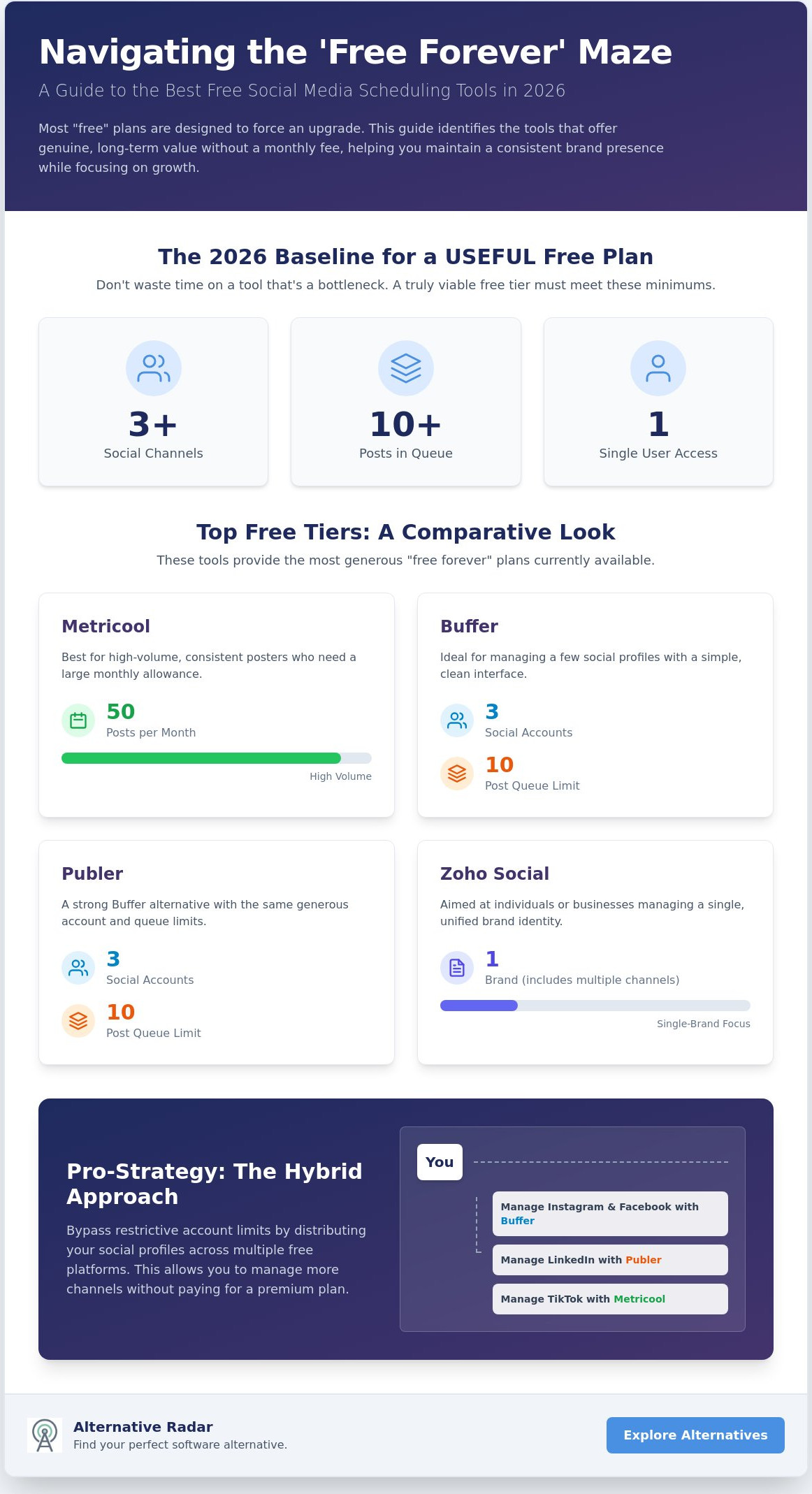
A tool must meet a baseline of utility to be worth your setup time. If a plan limits you to a single social account or prevents you from scheduling more than two posts at once, it’s a bottleneck rather than a solution. Common deal-breakers include the lack of basic image cropping or the inability to see a 30-day history of your published content. You need enough “room” to manage a standard weekly workflow without constant manual intervention. For 2026, the MVFT is defined as a platform that supports at least 3 social channels and a 10-post scheduling queue for a single user.
Critical Criteria for Evaluating Free Scheduling Software
Selecting a social media scheduling tools free tier involves more than just looking at the price tag. You must evaluate how the platform’s constraints align with your specific content strategy. The most common restriction is the account limit; most providers allow between one and three social profiles. For instance, Buffer and Publer currently permit up to three channels, while Zoho Social limits users to a single brand. If you manage a presence across Facebook, Instagram, and LinkedIn, a tool that only supports one profile will immediately fail your needs. You should also consult curated lists of the best social media management tools to see how these limits compare across the broader 2026 market.
Beyond profile counts, check for network compatibility. A free plan is useless if it doesn’t support modern formats like Instagram Reels or TikTok. While many tools now include these, some still gate-keep direct publishing for short-form video behind a paywall. Multi-user access is another major hurdle. Almost every free tier is restricted to a single login. If you have a business partner or an intern, you’ll likely have to share credentials, which poses a security risk. If you need a more secure way to collaborate, you might want to explore specialized alternatives that offer better seat flexibility.
Post Limits vs. Queue Limits
You’ll encounter two types of scheduling restrictions: monthly post volume and queue capacity. Metricool offers 50 posts per month, which is generous for daily posters. Conversely, Buffer and Publer use a queue limit of 10 posts at a time. For content creators who “batch” their work once a month, a 10-post queue is a significant bottleneck. It forces you to log back in every few days to refill the slots. If you prefer to set and forget your entire month’s content in one session, a tool with a high monthly volume is superior to one with a small rolling queue.
The Analytics and Reporting Gap
Data is usually the first feature to be removed from a free tier. Most platforms provide “live” stats but block historical reporting or PDF exports. Metricool is a notable exception in 2026, offering three months of analytics data for free. If your chosen tool lacks reporting, you’ll need to rely on native insights directly from Meta or LinkedIn. For those who find these limitations too restrictive, reading about finding the best alternative to popular software in 2026 can help you identify tools that balance free scheduling with better data access.
Top 5 Social Media Scheduling Tools with Robust Free Tiers
Identifying a functional social media scheduling tools free tier requires looking past marketing headlines to the actual API constraints. Many platforms claim to be free but restrict you to a single profile, which is insufficient for most modern brands. The following five tools represent the most reliable options available in 2026 for users who need consistent publishing without a financial commitment. Alternative Radar has evaluated these based on their “queue stability” and network compatibility to ensure they meet professional standards.
Buffer remains the industry benchmark for streamlined workflows. Its free plan allows you to connect up to three channels and maintain a queue of 10 scheduled posts per channel. It’s ideal for those who prioritize a clean interface over deep data. Later serves as the best option for visual-first creators. While its limit of 5 posts per profile is tighter than its competitors, its visual grid planner for Instagram and Pinterest is unmatched in the free market. Zoho Social offers a unique advantage for small businesses by supporting a wide range of networks, including LinkedIn and Google Business Profile, for one brand with no monthly post limit. Publer provides excellent flexibility by allowing three social accounts and 10 scheduled posts at a time. Finally, Metricool stands out for high-volume users, offering 50 posts per month and three months of analytics, making it the most data-rich free option currently available.
Comparison Table: Free Plan Features 2026
| Tool Name | Max Accounts | Max Scheduled Posts | Best For |
|---|---|---|---|
| Buffer | 3 Channels | 10 per channel | Text and Link Sharing |
| Metricool | 1 Social Set | 50 per month | Data and Analytics |
| Zoho Social | 1 Brand | Unlimited | Small Business SEO |
| Publer | 3 Accounts | 10 total | Multi-Platform Use |
| Later | 1 Social Set | 5 per profile | Instagram Aesthetics |
The Open Source Alternative
If you possess basic technical skills, you can bypass SaaS limitations entirely by using self-hosted software like Mixpost. This approach requires you to manage your own server, but it removes the artificial caps on accounts and post volume imposed by commercial vendors. Bypassing traditional providers gives you total control over your data and API connections. For those interested in expanding their self-hosted toolkit, exploring popular open source business software 2026 provides a roadmap for building a fully independent marketing stack. While open-source tools require more initial effort, they offer the only true way to scale your social presence without eventually hitting a subscription paywall.
Maximizing a Free Tier: Strategies for 2026
Maximizing a social media scheduling tools free tier requires a shift from a “one-tool” mindset to a distributed ecosystem. Because most free plans in 2026 restrict you to three channels or small rolling queues, you should adopt a “Hybrid Approach.” This involves assigning specific networks to the platforms that handle them best. For example, use Later for its superior Instagram visual planner while reserving your Buffer slots for LinkedIn and X. By spreading your social profiles across multiple providers, you can bypass the three-account limit without spending a dollar. You should also compare specialized software options to see which combinations offer the most seamless workflow for your specific platform mix.
Batching content is another essential tactic for managing small queue limits. If your tool restricts you to 10 scheduled posts at a time, don’t try to schedule the entire month at once. Instead, schedule content for Monday through Wednesday, then refill the queue on Thursday morning. To further reduce the load on your third-party tools, use native platform schedulers. Meta Business Suite allows for unlimited scheduling on Facebook and Instagram, while LinkedIn’s native tool has become increasingly stable. Use these free native options for your high-volume daily updates and save your third-party “slots” for complex cross-platform campaigns or networks that lack robust internal scheduling.
When to Actually Pay for a Tool
You’ll eventually reach an “ROI Trigger” where the time spent managing multiple free logins costs more than a subscription. This usually happens when you need team collaboration or advanced approval workflows. If you find yourself manually sharing login credentials or emailing content drafts for approval, your efficiency is suffering. Professional plans offer centralized communication and secure “seat” management that free tiers intentionally exclude. If your team is growing, you might also need the best Slack alternatives for 2026 to coordinate these workflows alongside your scheduling software.
Avoiding the “Free Tier Trap”
Stay alert for signs that a provider is about to sunset its free plan. Common indicators include a sudden increase in “upgrade” pop-ups, a lack of updates to the mobile app, or the rebranding of the free tier as a “Legacy” or “Personal” plan. To protect your work, always keep a master content calendar in a separate spreadsheet or database. Most tools allow you to export your scheduled posts as a CSV file. Perform this export monthly so you can quickly migrate to a new social media scheduling tools free tier if your current provider changes its terms. Never build your entire brand strategy on a single free API connection that you don’t control.
Finding Your Perfect Social Media Alternative with Alternative Radar
Selecting a social media scheduling tools free tier involves navigating a landscape of shifting API costs and hidden limitations. There is no universal “best” tool because every brand maintains a unique platform mix. A creator focusing on Instagram aesthetics requires a different interface than a B2B consultant managing a professional presence on LinkedIn. You’ll likely find that a single tool doesn’t cover every base perfectly. We encourage you to test two or three of the platforms highlighted in this guide to see which dashboard aligns with your daily habits. Testing these tools side-by-side for a week reveals the small friction points, like slow media uploads or confusing calendar views, that specs alone cannot convey.
Alternative Radar exists to filter through the noise of the SaaS market. We recognize that your time is a finite resource and spending hours comparing pricing pages is inefficient. Our role is to act as your digital scout, identifying high-utility software that offers genuine value without predatory upselling. By focusing on objective data and functional comparisons, we empower you to make smarter software choices that preserve your budget for actual business growth. Don’t let market leaders dictate your workflow; instead, use our research to find the tools that respect your resources.
The Radar Methodology
We verify every social media scheduling tools free tier through direct testing and quarterly audits of developer documentation. Our team monitors API changes from networks like Meta and X to ensure our recommendations remain technically viable. We maintain strict objectivity by prioritizing user utility over affiliate partnerships. Our research process involves creating test accounts to confirm that features haven’t been quietly moved behind a paywall since our last update. In 2026, the outlook for free social media software is defined by specialized utility rather than all-in-one dominance.
Next Steps for Your Social Strategy
Building an efficient marketing stack requires more than just scheduling software. If you’re looking to integrate your social leads into a broader sales funnel, check out our open source CRM software comparison to find the best alternatives for 2026. This will help you manage your audience relationships without the high overhead of proprietary enterprise tools. You can also sign up for our newsletter to receive alerts when new software alternatives enter the market or when existing free tiers undergo significant changes. Staying informed ensures you’re always using the most efficient tools available for your brand’s specific needs.
Scale Your Social Presence Without the Overhead
Managing your digital presence without a budget requires a strategic mix of platforms and a clear understanding of current API constraints. You’ve learned that a functional social media scheduling tools free tier is still accessible if you prioritize essential features like multi-channel support and reliable queue management. By leveraging the specific strengths of tools like Metricool for data or Later for visual planning, you can maintain a professional brand presence while keeping your resources focused on growth. For businesses in the UAE looking to scale further, check out EmirAds to explore expert digital marketing solutions.
Finding the right combination of software shouldn’t be a full-time job. We’ve done the heavy lifting by verifying these platforms against the latest 2026 API standards. Join the 100,000+ monthly software seekers who use our database to bypass marketing hype and access objective comparisons of over 50 social media management tools. Find the best social media tool alternatives on Alternative Radar and build a tech stack that works for your specific business goals. Start optimizing your distribution today and reclaim your time for higher-impact content creation.
Frequently Asked Questions
Which social media tool has the best free tier in 2026?
Buffer and Metricool are the top contenders for a social media scheduling tools free tier in 2026. Buffer provides the best balance for multi-platform users with its three-channel limit and efficient interface. Metricool is superior for high-volume creators who need up to 50 posts per month. Your choice depends on whether you value channel variety or monthly post volume more. Both platforms maintain stable API connections that ensure your content reaches your audience reliably.
Is there a free social media scheduler that allows unlimited posts?
Meta Business Suite and Zoho Social are the primary options for unlimited scheduling. Meta Business Suite allows infinite posts for Facebook and Instagram without any monthly restrictions. Zoho Social offers unlimited scheduling for one brand across several networks, including LinkedIn and X. Most other third-party tools impose a monthly cap or a rolling queue limit to encourage paid upgrades. These unlimited options are ideal for brands with high-frequency posting schedules.
Can I schedule to Instagram for free without a third-party tool?
You can schedule to Instagram for free using Meta Business Suite. This native tool supports both Facebook and Instagram, allowing you to plan posts, stories, and reels without a third-party subscription. It provides a reliable alternative for users who only focus on Meta’s ecosystem and want to avoid the account limits of external software. Using native tools often ensures better compatibility with new features like trending audio or specific reel filters.
Do free social media tools include analytics?
Analytics are rarely included in a social media scheduling tools free tier, but exceptions exist. Metricool stands out by providing three months of historical data on its free plan, which is highly generous for the current market. Zoho Social also offers basic performance overview metrics for your connected brand. If your chosen tool lacks reporting, you’ll need to use the native insights dashboards provided directly by platforms like LinkedIn, Pinterest, or X.
How many social accounts can I connect on a Buffer free plan?
The Buffer free plan allows you to connect up to three social channels at once. You can mix and match platforms like Instagram, Facebook, LinkedIn, Mastodon, or Pinterest based on your strategy. Each channel has a limit of 10 scheduled posts at any given time. If you manage more than three profiles, you’ll need to utilize a hybrid approach by distributing your accounts across multiple free software providers.
What is the best open-source alternative to Hootsuite?
Mixpost is currently the most robust open-source alternative to Hootsuite for technical users. It allows you to self-host your scheduling dashboard on your own server, which removes the artificial account and post limits found in SaaS models. While it requires server management knowledge to set up, it offers total control over your data and API connections without monthly licensing fees. It’s an excellent choice for agencies or developers seeking independence.
Why do social media tools keep removing their free tiers?
Rising API access costs are the primary reason developers are sunsetting free plans in 2026. Social networks like X and Meta have significantly increased the fees they charge third-party tools for data access. When these operational costs exceed the marketing value of maintaining free users, companies move toward paid-only models or severely restricted tiers to protect their profit margins. This shift makes finding stable free tiers more difficult.
Are free scheduling tools safe for my social media accounts?
Free scheduling tools are safe as long as they use official API connections provided by the social networks. Avoid any service that asks for your direct password or uses “automated” browser extensions to post on your behalf. Tools listed on official partner directories, such as those for LinkedIn or Meta, follow strict security protocols to protect your account credentials and ensure your data remains private and secure.