

If your legacy real estate management software requires more manual data entry than it automates, it isn’t a tool; it’s a liability. You likely feel the daily friction of fragmented systems that refuse to communicate, leaving your team buried in administrative tasks instead of focusing on portfolio growth. Managing a modern property mix in 2026 requires more than just a digital filing cabinet. It demands an integrated ecosystem that provides real-time financial transparency and removes the bottlenecks common in traditional enterprise platforms.
We’ve done the heavy lifting to filter out the marketing noise and identify the tools that actually deliver on their promises. You’ll discover the most efficient real estate management software alternatives designed to streamline your property operations and automate complex leasing workflows. This comparison breaks down the best options for every portfolio size, focusing on AI-driven forecasting and digital experiences that keep your tenants happy. We’ll examine how these platforms compare on automation depth and total cost of ownership to give you a clear roadmap for replacing high-cost legacy systems with a centralized, high-velocity solution.
Key Takeaways
- Shift your property operations from static databases to intelligent systems that leverage AI for predictive financial forecasting and automated workflows.
- Identify the critical features of modern real estate management software, focusing on real-time financial transparency and tenant portals that prioritize digital experience.
- Compare the performance of established enterprise giants against agile mid-market disruptors to find the best fit for your specific portfolio scale.
- Execute a stress-free software migration by following a structured roadmap that emphasizes data auditing and cross-departmental stakeholder alignment.
The Evolution of Real Estate Management Software in 2026
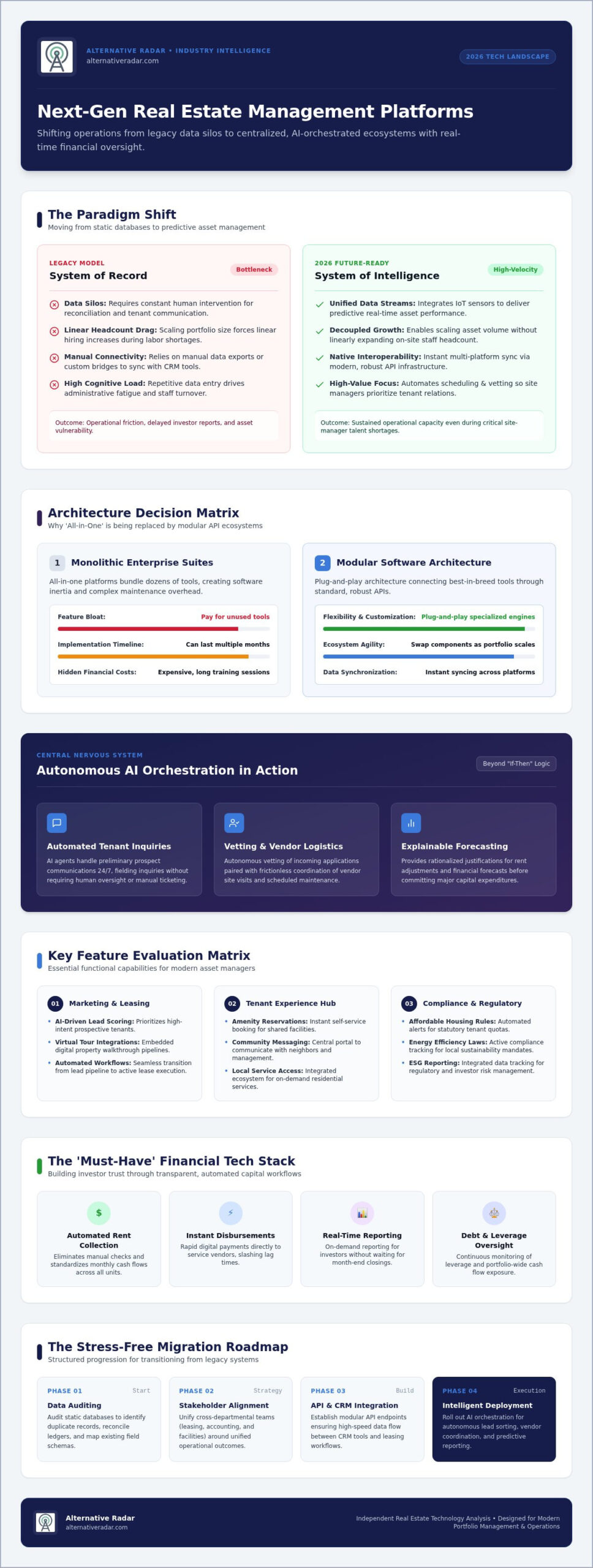
Real estate management software has moved past the era of simple ledger keeping. In 2026, the industry has transitioned from a “System of Record” to a “System of Intelligence.” Legacy platforms often act as data silos, slowing down growth by requiring constant human intervention for basic tasks like reconciliation and tenant communication. Modern property management systems now integrate IoT sensors and unified data streams to provide a predictive view of asset performance. Transitioning to a modern real estate management software framework allows you to scale without linearly increasing your headcount. This evolution is critical for addressing the persistent labor shortages in the sector; automation isn’t just a luxury, it’s a necessity for maintaining operational capacity when qualified site managers are scarce.
From Data Entry to AI Orchestration
Manual leasing and maintenance scheduling are becoming obsolete. AI agents now handle initial tenant inquiries, vet applications, and coordinate vendor visits without human oversight. These agents don’t just follow simple “if-then” logic. They use explainable AI to justify financial forecasting and rent adjustments, ensuring that managers can trust the underlying data before making major capital expenditures. AI Orchestration acts as the central nervous system of modern property management. By moving away from repetitive data entry, your team can focus on high-value tenant interactions and long-term portfolio strategy. This shift reduces the cognitive load on employees, leading to higher job satisfaction and lower turnover.
Why ‘All-in-One’ Isn’t Always the Answer
The era of the monolithic software suite is ending. Many enterprise platforms suffer from feature bloat, where you pay for dozens of tools your team never uses. In 2026, agile managers prefer modular software architectures that connect via robust APIs. This allows you to “plug and play” the best specialized tools for your specific needs, whether that’s a niche accounting engine or a high-end tenant engagement app. The hidden costs of enterprise bloat often include expensive training sessions and slow implementation timelines that can last months.
To determine if your current real estate management software is a legacy bottleneck or future-ready, evaluate its connectivity. Future-ready systems allow for instant data syncing across multiple platforms. If your software requires manual exports or custom-coded bridges just to share data with your CRM, it’s a legacy system. Modern alternatives prioritize interoperability, giving you the freedom to swap out individual components of your tech stack as your portfolio grows or market conditions change.
Key Features to Evaluate in a Real Estate Platform
Selecting the right real estate management software requires a shift in focus from basic data storage to operational automation. Modern platforms must handle the complex property and real estate manager responsibilities that define the 2026 market, including rigorous financial oversight and local regulatory compliance. You shouldn’t settle for a system that only processes payments; you need a solution that manages the entire lifecycle of an asset, from marketing and leasing to facilities maintenance and ESG reporting.
- Marketing and Leasing: Look for AI-driven lead scoring that prioritizes high-intent prospects and integrates seamlessly with virtual tour platforms.
- Tenant Experience: Portals must evolve into community engagement hubs where residents can book amenities, communicate with neighbors, and access local services.
- Compliance Tracking: Automated alerts for affordable housing requirements and local energy efficiency laws are now non-negotiable for risk management.
The ‘Must-Have’ Financial Tech Stack
Financial transparency is the foundation of investor trust. Your software should offer automated rent collection and instant digital disbursements to vendors, reducing the lag time associated with manual checks. Real-time investor reporting and debt oversight tools allow you to monitor leverage and cash flow across the entire portfolio without waiting for month-end closings. For those managing complex lead pipelines, ensure your platform offers a high-performance integration with an open source crm software comparison to maintain data integrity between your marketing efforts and lease executions. Efficiency in these areas directly impacts your bottom line.
Operational Intelligence and IoT
Smart building integration is no longer a futuristic concept. Modern real estate management software connects directly with WiFi networks, access control systems, and energy management sensors. This connectivity enables predictive maintenance, where sensors detect anomalies in HVAC or plumbing systems before they lead to expensive failures. By addressing repairs proactively, you reduce long-term CapEx costs and improve resident satisfaction. Additionally, resident-facing AI agents can resolve common inquiries instantly, which significantly boosts retention rates by providing the immediate response times modern tenants expect. If you’re unsure which features align with your specific asset class, you can explore our curated software guides to find a tailored match.
Comparing the Top Real Estate Software Alternatives
Choosing the right real estate management software often feels like a choice between two extremes: the “all-in-one” enterprise giant or a fragmented collection of niche apps. Global leaders like Yardi and RealPage continue to dominate the enterprise space, offering massive ecosystems that handle everything from procurement to investment management. However, mid-market disruptors are gaining ground by offering agile, API-first architectures that deploy in weeks rather than months. Alternative Radar’s “Digital Scout” evaluations show that the most user-friendly interfaces of 2026 prioritize mobile-first dashboards and natural language search over traditional menu-heavy navigation. Your specific portfolio niche remains the primary driver of this decision.
Best for Multifamily and Residential Portfolios
Residential management in 2026 focuses on the “Business of Living.” Modern platforms now prioritize resident retention through integrated rewards programs and rent reporting that helps tenants build credit. Deposit alternatives have also become a standard feature, allowing you to reduce move-in friction and fill vacancies faster. If you manage high-volume residential assets, look for alternatives that automate the entire resident lifecycle, from the first lead inquiry to the final move-out inspection. These systems should prioritize the user experience for both the manager and the tenant.
Best for Commercial and Industrial Assets
Commercial management demands deeper financial modeling and precise lease administration. Unlike residential leases, commercial agreements often involve complex CAM reconciliations and varied escalation clauses that require specialized accounting logic. Effective software must provide tenant self-service portals where commercial clients can upload insurance certificates or view maintenance schedules. To ensure you’re meeting industry standards for risk mitigation and tech adoption, consult the National Association of REALTORS® property management guide. This resource outlines the best practices for maintaining industrial and retail assets while leveraging modern automation tools.
Lightweight and Open-Source Alternatives
For smaller landlords or those with specialized technical teams, the question often arises: can you manage properties with popular open source business software 2026? DIY PropTech stacks offer high customization and lower licensing fees, but they require significant internal oversight to maintain. If you find yourself spending more time managing your spreadsheets and disconnected apps than your properties, it’s time to graduate to a dedicated real estate management software solution. Dedicated tools provide the centralized data integrity that “hacked-together” systems lack, ensuring your financial reporting remains audit-ready and your operations stay efficient.
The 2026 Migration Roadmap: Switching Without the Stress
Switching your real estate management software shouldn’t feel like a leap of faith. Most of the friction associated with new technology comes from a lack of preparation rather than technical limitations. If you’re currently tethered to a legacy platform, the cost of staying put often outweighs the temporary stress of a move. A successful transition requires a structured approach that treats the migration as a strategic upgrade rather than a simple data transfer. By following a clear roadmap, you can minimize downtime and ensure your team is ready to leverage new tools on day one.
- Step 1: Data Auditing. Clean your records before the move. Migrating “dirty” data only replicates existing errors in a newer interface, so take the time to purge duplicate entries and outdated tenant files.
- Step 2: Stakeholder Alignment. Get buy-in early. Your site managers and accounting teams must understand how the new workflows will reduce their daily administrative burden to prevent resistance during rollout.
- Step 3: Pilot Programs. Test the new platform on a single asset or a small cluster. This allows you to refine settings and user permissions before a portfolio-wide implementation.
- Step 4: Full Scale Implementation. Once the pilot succeeds, move the rest of your assets and initiate intensive training sessions.
- Step 5: Post-Migration Optimization. Don’t try to use every feature at once. Activate the AI and automation layers gradually as your team becomes comfortable with the core system.
Overcoming the ‘Fear of Switching’
Modern data migration tools have largely eliminated the “blackout” periods that once plagued software transitions. These tools map legacy data structures to modern schemas with high precision, ensuring that historical records and financial trails remain intact. Most firms identify a clear ROI within the first 6 months as labor costs stabilize and rent collection efficiency increases. Real estate firms that switch to AI-integrated platforms report substantial efficiency gains in their operational throughput due to the reduction of manual task cycles. If you’re ready to start your transition, compare the best migration-friendly software options to see which platforms offer the smoothest onboarding experience.
Training Your Team for the AI Era
Implementation is only half the battle; your team must evolve from software operators to software orchestrators. Instead of manually entering data, they should be trained to audit the outputs of AI agents and make high-level decisions based on real-time analytics. Utilize built-in learning management systems (LMS) to provide self-paced onboarding that doesn’t pull managers away from their properties for days at a time. Establishing a culture of data-driven decision making ensures your new real estate management software becomes a driver of value rather than just another line-item expense. This shift in mindset is what separates modern property managers from those still stuck in the era of manual spreadsheets.
Conclusion: Finding Your Perfect Real Estate Match
The 2026 landscape for real estate management software has shifted permanently toward intelligence-led operations. You’ve seen how legacy bottlenecks can stifle growth and how modern PropTech stacks leverage AI and IoT to drive efficiency. Choosing a platform isn’t just about matching your current portfolio size; it’s about anticipating where your assets will be in five years. By prioritizing interoperability and automation, you remove the administrative friction that limits your team’s potential. Understanding the process of finding the best alternative to popular software gives you a strategic advantage over competitors who remain tethered to rigid, high-cost enterprise suites.
Before you sign a new contract, run through this final checklist to ensure the platform solves your specific 2026 pain points:
- Does the software provide real-time financial transparency for all stakeholders?
- Are the AI agents capable of handling maintenance and leasing workflows without constant supervision?
- Can the system integrate with your specific IoT hardware and external CRM tools?
- Is the pricing model scalable as your unit count grows?
Once you’ve narrowed your list, request live demos that focus on your most frequent tasks. Vet each vendor’s roadmap to ensure they have a clear vision for the 2026-2030 period. A platform that doesn’t have a plan for evolving AI capabilities will quickly become the next legacy bottleneck.
The Alternative Radar Verdict
Our analysis shows that the best fit depends entirely on your operational goals. Multifamily portfolios require high-velocity tenant engagement, while commercial assets demand rigorous lease administration and financial modeling. We’ve identified the top picks for each category by filtering out marketing hype and focusing on actual utility. Choosing a vendor with a transparent development roadmap is essential; you don’t want to migrate to a system that will become legacy technology in two years. Use Alternative Radar as your ongoing discovery tool to stay ahead of PropTech trends and ensure your stack remains optimized.
Take Action Today
Don’t let inefficient systems dictate your growth strategy. Start your evaluation process by reviewing our top-rated alternatives and identifying the features that align with your portfolio’s needs. Sign up for our newsletter to receive the latest insights on software efficiency and PropTech innovation. If you’re ready to make a move, compare the best real estate management software alternatives now to find a solution that empowers your team and streamlines your operations.
Future-Proof Your Portfolio with the Right Tech Stack
The shift toward intelligent orchestration is the new standard for competitive property management. By moving away from legacy bottlenecks and adopting modular, AI-driven platforms, you position your portfolio for scalable growth and improved tenant retention. Transitioning to a modern real estate management software ecosystem allows your team to stop being data entry clerks and start being strategic orchestrators. Focus on platforms that offer real-time financial transparency and a clear development roadmap through 2030.
Alternative Radar acts as your digital scout. We provide an expert comparison of 50+ PropTech tools based on objective, commission-supported research updated for 2026 market trends. We’ve done the hard work of testing so you can make an efficiency-driven choice without the marketing hype. Don’t let fragmented tools or high-cost enterprise bloat slow your momentum.
Discover the Best Real Estate Management Software Alternatives and take the first step toward a more centralized, automated future. Your portfolio deserves a system that works as hard as you do.
Frequently Asked Questions
What is the best real estate management software for small portfolios in 2026?
Small portfolios in 2026 benefit most from cloud-native platforms that prioritize mobile accessibility and automated leasing. Systems that offer a “pay-as-you-go” unit structure allow for cost-effective scaling without high upfront costs. Look for tools that automate basic tasks like rent collection and tenant screening without requiring the complex licensing fees of enterprise suites. These agile alternatives provide a professional tenant experience similar to larger platforms but with a much faster implementation timeline.
How much does real estate management software typically cost?
Pricing for real estate management software generally follows a per-unit monthly model or a tiered subscription based on portfolio size. While entry-level tiers for small landlords may start at a low base fee, enterprise-grade solutions often involve significant implementation costs and annual maintenance fees. You should account for hidden expenses like data migration, staff training, and third-party integrations. Always request a detailed fee schedule that includes any potential surcharges for premium AI features or advanced reporting.
Can real estate software integrate with my current accounting tools?
Most modern platforms offer direct integrations with popular accounting tools like QuickBooks and Xero through secure APIs. This connectivity ensures that your financial data syncs in real time, reducing the risk of manual entry errors. If a platform lacks native integration, check if it supports universal data connectors like Zapier. Reliable software should act as a central hub that pulls data from your bank accounts and pushes it to your tax preparation tools seamlessly.
What are the benefits of AI in property management software?
AI provides immediate operational throughput by automating routine resident inquiries and maintenance triage. In 2026, predictive maintenance sensors use AI to identify equipment failures before they occur, significantly reducing long-term capital expenditures. Additionally, AI-driven lead scoring helps leasing teams prioritize prospects with the highest conversion probability. These tools don’t just save time; they provide the data-driven insights necessary for accurate financial forecasting and improved tenant retention through much faster response times.
Is there a free or open-source alternative to Yardi or RealPage?
There are several open-source frameworks, such as Odoo with specialized property modules, that serve as cost-effective alternatives to legacy enterprise giants. While these tools offer high customization and lower licensing costs, they often require internal technical expertise to maintain and secure. Small landlords might also consider “freemium” cloud platforms that offer basic features for a limited number of units. As your portfolio grows, the data integrity and support provided by dedicated real estate management software usually outweigh the initial savings.
How long does it take to migrate to a new real estate management platform?
Migration timelines depend heavily on the size of your portfolio and the state of your existing data. For small to mid-sized portfolios, a clean data transfer typically takes two to four weeks. Enterprise-level migrations involving complex historical records and multiple stakeholders can span three to six months. You can accelerate this process by conducting a thorough data audit before the move. Most modern vendors provide dedicated onboarding specialists to help map your legacy data to the new system schema.
What security features should I look for in a cloud-based real estate tool?
You should prioritize platforms that offer SOC 2 Type II compliance and end-to-end data encryption. Essential security features include Multi-Factor Authentication (MFA) for all users and granular, role-based access controls to protect sensitive financial data. Since cloud-based software handles large volumes of personal tenant information, ensure the vendor provides regular security audits and transparent data backup protocols. These safeguards are critical for maintaining regulatory compliance and protecting your firm from potential cyber threats and data loss.
Does real estate management software help with ESG compliance?
Modern platforms now include dedicated modules for tracking energy consumption, water usage, and carbon footprints across your assets. These tools automate the collection of utility data and generate standardized reports that meet local and national ESG reporting requirements. By integrating with smart building sensors, the software provides the granular data needed to identify energy-saving opportunities. This transparency helps with regulatory compliance and increases asset value by appealing to environmentally conscious investors and institutional partners who prioritize sustainable operations.