
Why does your software force you to change your business process instead of the other way around? Most teams settle for rigid platforms that dictate how they should sell, leading to cluttered interfaces and low adoption rates. You’ve likely felt the frustration of paying for a bloated suite of unused features just to access basic customization. When searching for the best crm for startups, the priority shouldn’t be the longest feature list; it should be the least amount of friction between your process and your data in a market projected to reach $126.2 billion this year.
We agree that your technology should mirror your specific sales cycle. This guide helps you move beyond one-size-fits-all solutions to find a CRM that actually adapts to your unique workflows. You’ll discover how to implement a scalable architecture that grows with your team while reducing manual data entry through custom automation. We will evaluate the shift toward composable CRM systems and compare the top customizable platforms to help you make a logical, efficiency-driven choice for 2026.
Key Takeaways
- Understand why 60% of CRM implementations fail and how to avoid the “process friction” common in rigid, out-of-the-box platforms.
- Identify the best crm for startups by prioritizing flexible data models and UI tailoring that match your specific industry terminology.
- Evaluate the trade-offs between proprietary SaaS licensing and open-source data ownership to maximize your long-term return on investment.
- Use our five-question customization audit to map your ideal lead-to-cash journey and identify critical data bottlenecks.
- Leverage Alternative Radar’s comparison framework to filter through market noise and find agile, customizable alternatives to legacy software.
Why Out-of-the-Box Solutions Fail: The Rise of Customizable CRM Software
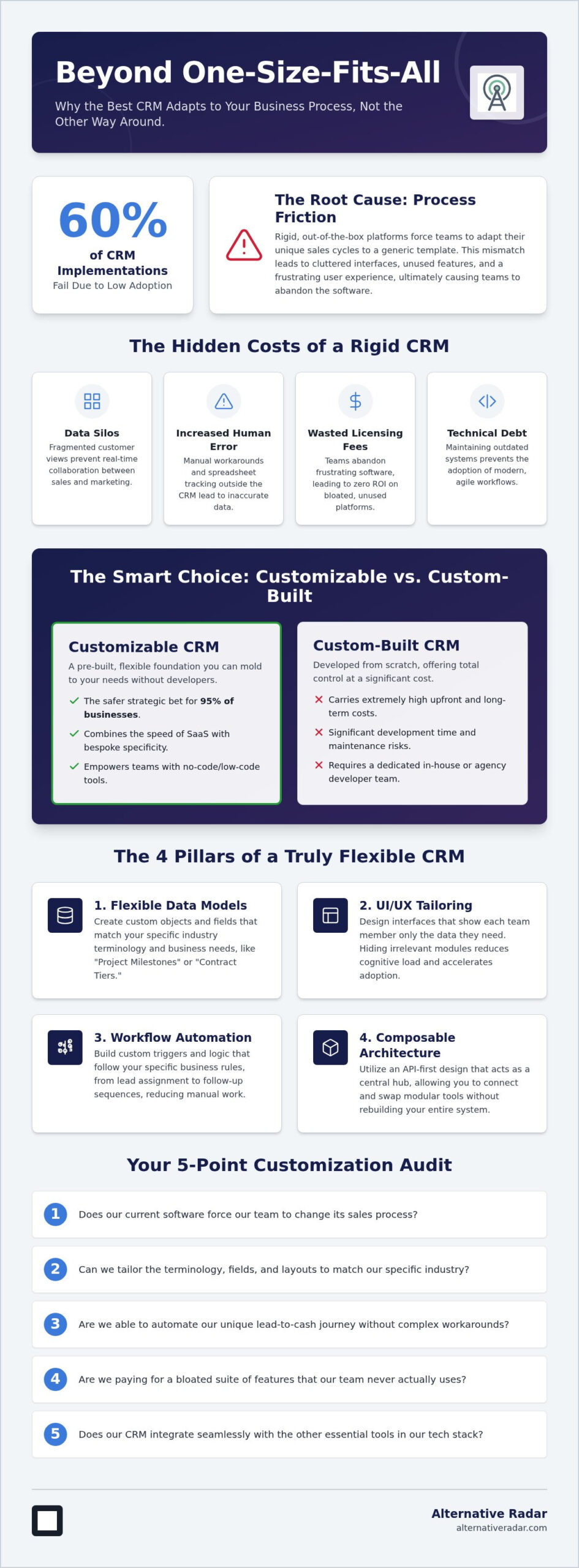
60% of CRM implementations fail because the software forces the team to work for the tool rather than the tool working for the team. This “Process Friction” occurs when a business tries to squeeze its unique sales cycle into a rigid SaaS template. A customizable CRM serves as the necessary middle ground between a generic, out-of-the-box platform and a prohibitively expensive custom build. Teams that prioritize flexibility over branding often see significantly higher user adoption rates within the first six months of deployment.
Modern Customer Relationship Management (CRM) systems are no longer just static databases for storing contact info. In 2026, the market has shifted toward dynamic hubs where AI agents and automated workflows require a flexible data architecture to function. If your CRM cannot adapt to these new inputs, your data becomes a liability rather than an asset. Finding the best crm for startups involves choosing a platform that prioritizes this structural agility over preset configurations.
Customizable vs. Custom CRM: Knowing the Difference
Understanding the distinction between these two paths is vital for resource allocation. A customizable CRM provides a pre-built, flexible foundation that you can mold through no-code interfaces. You can add fields, change layouts, and automate logic without hiring a developer. Conversely, a custom-built CRM is developed from scratch. While it offers total control, it carries high costs and significant long-term risk. For 95% of businesses, the customizable model is the safer strategic bet because it offers the speed of SaaS with the specificity of a bespoke tool. It allows you to build the best crm for startups environment without the technical overhead of managing a proprietary codebase.
The Cost of Rigidity in Modern Business
Rigid systems carry a hidden price tag. When a CRM doesn’t fit the workflow, employees revert to manual spreadsheet tracking or third-party workarounds. These habits create data silos, leaving sales and marketing teams with fragmented views of the customer journey. This lack of visibility kills user adoption and erodes ROI. Consider the following consequences of system rigidity:
- Silos prevent real-time collaboration between departments, leading to missed follow-ups.
- Manual workarounds increase the risk of human error in data entry and reporting.
- Static interfaces frustrate users, leading to abandoned software and wasted licensing fees.
Technical debt in legacy CRM systems is the accumulated cost of maintaining rigid, outdated codebases that prevent the adoption of modern, agile workflows. Selecting a platform that evolves alongside your business prevents this friction and ensures your technology remains an asset as you scale.
The Core Pillars of a Truly Flexible CRM Platform
A truly flexible platform rests on four structural pillars that ensure the software scales with your operations. First, flexible data models allow you to create custom objects and fields that match your specific industry jargon. If you sell specialized services, you need fields for “Project Milestones” or “Contract Tiers” rather than generic placeholders. Second, UI/UX tailoring ensures your team only sees the data they need. Hiding the noise of irrelevant modules reduces cognitive load and accelerates adoption among sales reps who value speed over complexity.
Workflow automation serves as the third pillar. It enables you to build triggers that follow your specific business logic, such as automatically assigning a lead to a specific regional manager based on IP location. Finally, the shift toward composable architecture in 2026 means software is no longer a monolith. Instead, the best crm for startups acts as a central hub that connects modular tools. This design allows you to swap components without rebuilding your entire database.
No-Code and Low-Code: The Engines of Modern Customization
Modern customization is driven by drag-and-drop builders. These tools empower non-technical managers to update workflows in real-time without writing a single line of code. 2026 is the year of the Citizen Developer in CRM management, where the person closest to the sales process also manages the tool. This evolution creates a balance where systems are easy to change but remain hard to break due to built-in governance layers. You gain the ability to iterate on your sales process weekly rather than waiting for a quarterly developer cycle.
API-First Design: Connecting Your Entire Tech Stack
Deep integrations are a practical form of customization. An API-first design ensures your CRM talks to your popular open source business software through webhooks and bi-directional data syncing. This connectivity eliminates manual data entry and keeps your entire tech stack synchronized. When searching for the best crm for startups, prioritize platforms that offer robust documentation and open endpoints. If you need to verify which tools integrate best with your current stack, you can compare technical specs on our platform to find a seamless fit.
Customizable vs. Open Source: Evaluating the Best Path for ROI
In 2026, finding the best crm for startups requires a clear choice between two distinct deployment models: proprietary SaaS and open source. Proprietary platforms like Salesforce and HubSpot provide high-end support and polished interfaces but often come with high long-term licensing fees. For instance, HubSpot Professional plans can start at $500 to $890 per month, not including onboarding fees. Open-source alternatives such as Odoo and SuiteCRM offer unlimited customization and total data ownership. While they eliminate per-user fees, they require your team to manage hosting and security infrastructure.
Calculate your Total Cost of Ownership (TCO) by looking beyond the monthly subscription. You must consider implementation costs, third-party integration fees, and the “rigidity tax” mentioned in previous sections. Security and compliance also differ across these models. SaaS providers manage global regulations like GDPR and CCPA updates automatically. In contrast, open-source users must configure these protections manually, which provides more control but increases the administrative burden on your technical team.
The Power of Open Source CRM Customization
Accessing the source code represents the ultimate level of flexibility for niche industries with non-standard sales cycles. If your business model doesn’t fit a traditional funnel, open source allows you to rewrite the logic from the ground up. Community-driven plugins often provide the same functionality as paid marketplace add-ons at a fraction of the cost. If you need full control over where your data lives and how it’s handled, this is the logical path. Read our full open source CRM software comparison for a deeper dive into these technical trade-offs.
SaaS Customization: When Convenience Wins
Convenience often wins when your priority is speed to market. Managed platforms handle the infrastructure, allowing your team to focus on selling rather than maintenance. Modern SaaS providers have evolved their “Sandbox” environments, letting you test major workflow changes in a safe staging area before going live. This reduces the risk of breaking active pipelines during a busy quarter. While vendor lock-in remains a concern, the high-end feature sets and seamless AI integrations often justify the premium for teams that lack dedicated technical staff. Choosing the best crm for startups in this category means balancing ease of use with the long-term scalability of their customization tools.
The Customization Audit: 5 Questions to Ask Before You Switch
Switching to a new platform without a clear roadmap leads to the same “process friction” mentioned earlier. Before you commit to a vendor, you must perform a self-audit to ensure the software aligns with your operational reality. The best crm for startups isn’t just a repository for contacts; it’s a tool that should actively remove bottlenecks from your sales cycle. Answer these five questions to determine your specific needs.
- What is your Golden Path? Map the ideal journey from the moment a lead enters your system to the final cash collection. If the CRM can’t automate the transitions between these stages, it isn’t flexible enough.
- Where are your Bottleneck Fields? Identify the specific data points you are currently missing. If your team is forced to use “Notes” sections for critical data because there isn’t a dedicated field, you have a structural gap.
- What is your technical bandwidth? Determine if you have a dedicated developer or a non-technical admin. Some platforms require code for deep changes, while others use no-code drag-and-drop builders.
- Which Anchor Apps are non-negotiable? List the legacy software, such as accounting or project management tools, that must stay. Your CRM must integrate with these “anchor” applications via bi-directional syncing.
- What does your 3-year growth look like? Forecast your team size and lead volume. A tool that works for five people might become a cluttered liability when you scale to fifty.
To find a platform that matches your specific technical capacity, use our tool to compare customizable CRM software based on your audit results.
Determining Your Customization Tier
Not every business needs deep architectural changes. Startups typically fall into Tier 1, which focuses on basic field and layout adjustments to keep the interface clean. Scaling SMBs usually require Tier 2, involving workflow and logic automation to handle increasing lead volumes without adding headcount. Tier 3 is reserved for enterprise-level needs, requiring deep API access and data model restructuring. Choosing the best crm for startups means finding a tool that lets you start at Tier 1 but provides a clear path to Tier 2 as you grow.
Avoiding the Over-Customization Trap
Complexity is the primary enemy of user adoption. If you add too many custom fields or mandatory steps, your sales reps will find workarounds outside the system to save time. This is especially true for mobile CRM interfaces, where a “less is more” rule applies. Only show the most critical data points on mobile screens to ensure reps can update records on the go. The 80/20 rule for CRM features suggests that 80% of your team’s daily productivity is driven by just 20% of the platform’s core functional capabilities. Focus your customization efforts on that 20% to maximize ROI and keep the user experience fast.
Discovering Your Perfect Fit: How Alternative Radar Filters the Noise
The CRM market is projected to reach $126.2 billion in 2026, yet much of that value is locked behind monolithic platforms that don’t prioritize your specific workflows. Market leaders often focus on broad enterprise appeal, leaving agile teams to struggle with bloated interfaces and high licensing costs. Alternative Radar acts as your digital scout, filtering through the noise to find high-utility tools that the big directories often overlook. Finding the best crm for startups requires moving past marketing hype to look at raw utility and structural flexibility.
Our platform provides side-by-side comparisons of pricing, pros, and cons, allowing you to evaluate software based on your audit results from the previous section. We prioritize transparency and logic, ensuring you see the hidden gems in the market rather than just the highest bidders. Our commitment to objective curation means we focus on finding the best alternative that fits your specific niche, whether you require an open-source powerhouse or a lightweight SaaS solution.
Navigating the 2026 CRM Landscape
We evaluate customizability using ranking algorithms that weigh no-code flexibility and API depth. 2026 has become the year of the Specialist CRM, where industry-specific templates are replacing generic “one-size-fits-all” databases. We look for platforms that offer pre-configured schemas for sectors like fintech, healthcare, and creative agencies. This specialization reduces the time you spend on initial setup and ensures the best crm for startups in your category is ready for deployment on day one. Our data-driven approach highlights tools that offer high ROI through reduced manual entry and improved data quality.
Take Action: Find Your Next CRM Today
Stop settling for software that slows your team down. Use our comparison tools to filter by licensing type, choosing between the total control of open-source or the managed convenience of SaaS. If you are also looking to optimize your internal collaboration, check out our latest the best Slack alternatives for 2026 to ensure your communication stack is as agile as your CRM. Your technology should be an intervention for productivity, not a source of technical debt. Start your search now to find a platform that mirrors your business logic and scales with your ambition.
Strategic Implementation for a Scalable Future
Selecting a CRM is no longer about finding the most popular brand; it’s about finding the tool that creates the least friction for your specific team. You’ve seen how rigid platforms lead to technical debt and why a customization audit is the necessary first step before any migration. Whether you choose the managed convenience of a SaaS provider or the total data ownership of an open-source solution, your priority must remain structural flexibility. The best crm for startups in 2026 is one that evolves alongside your sales cycle without requiring a complete rebuild every few years.
We’ve done the work of testing and categorizing these platforms so you don’t have to. You can find your perfect customizable CRM on Alternative Radar. Our database provides objective pros and cons for every tool, alongside a comprehensive list of open-source and free alternatives specifically updated for the 2026 software market. Stop fighting against your software and start leveraging a platform that mirrors your business logic. Empower your team with a system that actually supports their daily productivity and long-term growth.
Frequently Asked Questions
What is the main difference between a custom CRM and a customizable CRM?
A custom CRM is built from scratch with unique code tailored to one company; a customizable CRM is a pre-built platform that allows structural changes through settings or no-code tools. Custom builds carry high development costs and long-term maintenance risks. Customizable platforms offer a flexible foundation that you can mold to your sales cycle. This makes customizable software the safer choice for 95% of businesses looking for the best crm for startups.
Do I need a developer to customize my CRM software in 2026?
You don’t necessarily need a developer because 2026 is the year of the Citizen Developer. Most modern platforms use no-code drag-and-drop builders for field changes and workflow automation. While deep API integrations or source code modifications in open-source systems might require technical expertise, basic tailoring is now accessible to non-technical managers. This shift reduces the overhead costs associated with maintaining an agile database without sacrificing functionality.
How much does it typically cost to customize a CRM platform?
Costs vary based on the platform and the depth of changes. Basic field and layout updates are often included in your standard subscription. However, deep structural changes or complex automation can require professional services. For example, HubSpot Sales Hub Professional starts at $500 per month for five users but requires a $3,000 onboarding fee. Open-source options eliminate licensing fees but involve costs for hosting and technical configuration. Always calculate the Total Cost of Ownership before switching.
Can I switch from a rigid CRM to a customizable one without losing data?
Yes, you can switch if you use standardized CSV exports or API-based migration tools. Most customizable CRMs offer dedicated import wizards that map your old fields to the new architecture. To avoid data loss, perform a data audit to identify “bottleneck fields” and ensure your new system has a destination for that information. Clean your data before the move to prevent carrying over duplicates or incomplete records that could clutter your new interface.
What are the risks of over-customizing my CRM system?
Over-customizing creates “Process Friction” and kills user adoption rates. If a system has too many mandatory fields or complex steps, sales reps will find workarounds outside the software to save time. This clutter makes the interface difficult to navigate, especially on mobile devices. Follow the 80/20 rule: focus your customization on the 20% of features that drive 80% of your team’s daily productivity to keep the system fast and efficient.
Is open-source CRM more customizable than SaaS options like Salesforce?
Open-source CRM is technically more customizable because you have full access to the source code. This allows for niche modifications that SaaS providers might not support. However, SaaS platforms have evolved significantly with low-code tools and “Sandbox” testing environments. While open source offers unlimited flexibility, SaaS providers like Salesforce, which holds 21% of the market share, manage global compliance updates like GDPR automatically. This reduces the administrative burden on your internal team.
Which customizable CRM is best for a small business with no IT team?
The best crm for startups without an IT team is a managed SaaS platform with a strong no-code interface. Tools like Zoho or HubSpot allow you to drag and drop fields without technical knowledge. These platforms handle the infrastructure, security, and updates, so you can focus on selling. Look for a tool that offers Tier 1 customization, focusing on basic layout and field changes that keep the interface clean and the learning curve short.
How does AI improve the customization of modern CRM software?
AI improves customization by automating lead scoring, predictive analytics, and routine tasks like follow-up scheduling. In 2026, AI agents can suggest workflow improvements based on how your team actually uses the software. This dynamic approach moves beyond static databases to create “agent-led” hubs. Instead of manually building every trigger, you can use AI to build triggers that follow your specific business logic. This ensures your CRM adapts in real-time to changing market conditions.