

Paying $20,000 for buyer intent data might actually be the most expensive way to lose a lead in 2026. While the largest directories offer massive reach, the signal-to-action gap has never been wider for teams trying to scale efficiently. You’ve likely noticed that traditional software review sites for vendors are becoming increasingly crowded. This saturation drives CPC rates to unsustainable levels while your lead-to-customer conversion rates continue to stagnate.
It’s frustrating to watch a marketing budget disappear into a pay-to-play ecosystem where even responding to a customer review requires a $2,999 annual commitment. We’ll show you how high-growth vendors are bypassing this directory trap by leveraging affiliate referral commissions and strategic sponsored placements to secure high-intent traffic. You’ll discover how to identify high-converting platforms and reduce your total customer acquisition costs. This guide breaks down the 2026 pricing structures for major players, compares the ROI of PPC versus affiliate models, and explains how to navigate the recent consolidation of G2 and Capterra to your advantage.
Key Takeaways
- Evaluate the shift from static directories to dynamic discovery to understand why third-party presence is now a requirement for B2B credibility.
- Compare the entry costs and visibility packages of leading software review sites for vendors to optimize your platform selection.
- Analyze the financial impact of affiliate referral commissions versus PPC models to protect your marketing margins and improve lead quality.
- Examine a strategic case study where a mid-market vendor scaled 300% by shifting spend toward performance-based recommendations.
- Identify how alternative-intent networks help you capture high-growth traffic that traditional directories don’t reach.
Beyond the Directory: The Evolution of Software Review Sites for Vendors
The software discovery landscape has undergone a fundamental shift. In 2026, buyers no longer scroll through endless static lists of hundreds of tools. They demand dynamic discovery that aligns with their specific operational constraints. software review sites for vendors have transitioned from simple feedback loops into comprehensive buyer enablement platforms. This evolution is driven by a market that is more consolidated than ever, following the acquisition of Capterra, GetApp, and Software Advice by G2 in January 2026. This merger created a massive ecosystem where visibility is highly competitive and expensive.
Presence on these platforms isn’t a luxury for B2B brands; it’s a baseline requirement for credibility. Buyers view your internal marketing materials with skepticism. They look to American review websites to verify your claims through the lens of their peers. If your product doesn’t appear where they’re researching, you effectively don’t exist in their selection set. The search intent has moved away from generic “best software” queries toward highly specific “alternatives to [Market Leader]” searches. Buyers aren’t just looking for a tool; they’re looking for a better way to solve a specific pain point that their current provider has failed to address.
The Role of Third-Party Validation in the 2026 Sales Funnel
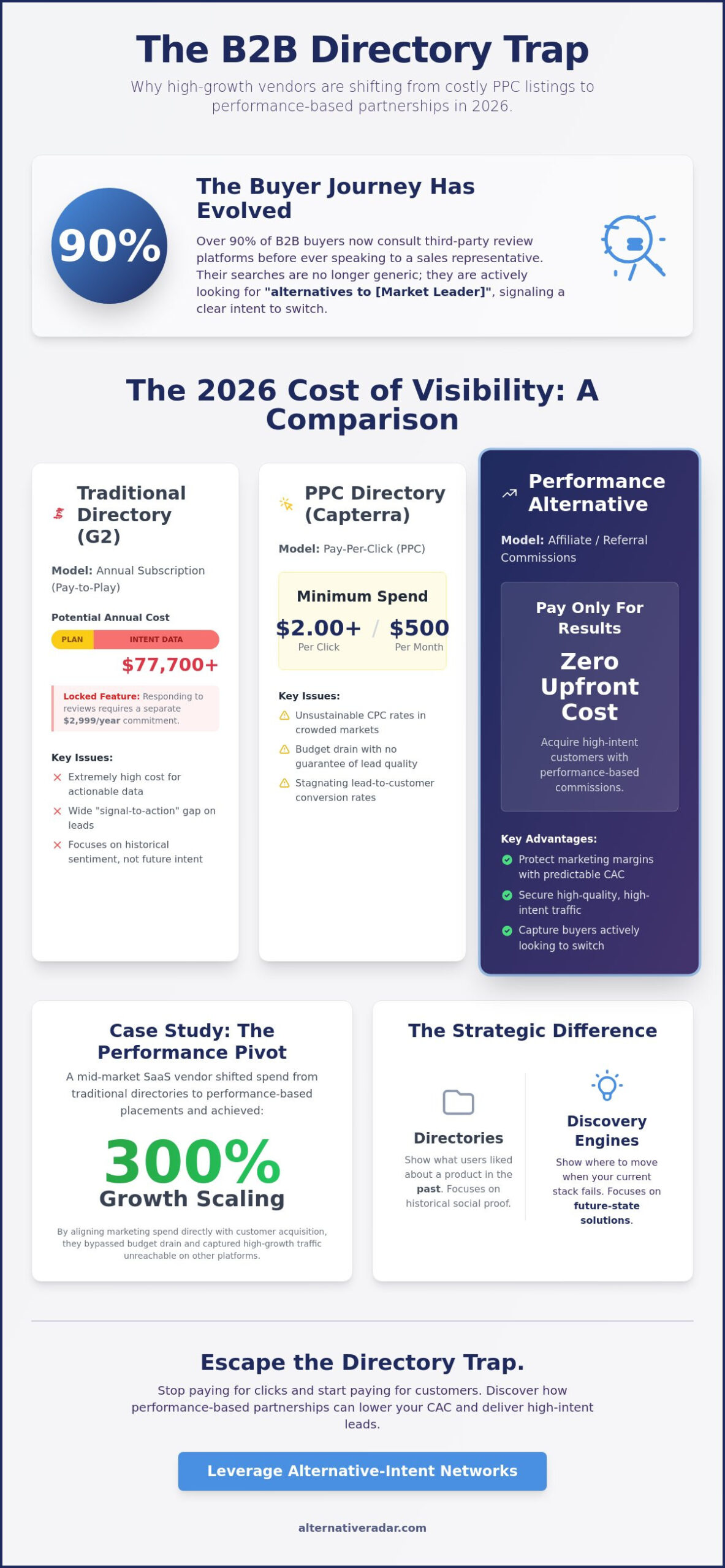
Industry data suggests that over 90% of B2B buyers consult at least one review platform before ever engaging with a sales representative. These sites act as a digital scout. They filter out noise and present high-quality options to time-strapped IT managers who can’t afford to waste hours on discovery calls. The psychological impact of “Alternative” branding is powerful. It creates a shortcut for buyers looking for agility and better ROI. When a vendor is positioned as a viable alternative to a legacy player, it immediately inherits a level of trust that traditional advertising can’t replicate.
Software Review Sites vs. Discovery Engines
Traditional software review sites for vendors like G2 primarily focus on historical data and user sentiment. They excel at showing what users liked about a product in the past. However, modern discovery engines like Alternative Radar focus on future-state solutions and strategic pivots. While a directory shows you what exists, a discovery engine shows you where to move when your current stack fails.
Vendors need a presence in both ecosystems to capture full-funnel intent. You need the historical social proof of a directory to build long-term trust, but you need the performance-based visibility of a discovery engine to capture buyers who are actively looking to switch. This strategy allows you to meet the buyer at the exact moment they decide their current tool is no longer sufficient. Relying on organic reviews alone is no longer enough to stand out in a crowded category; you must leverage sponsored software placements to ensure your brand remains part of the conversation.
Evaluating the Big Three: G2, Capterra, and the Rise of Performance Alternatives
Choosing between software review sites for vendors requires a clear understanding of the financial and operational trade-offs involved in 2026. G2 and Capterra remain the market heavyweights, especially following G2’s acquisition of the Gartner Digital Markets brands in January 2026. However, high-growth vendors are increasingly looking toward performance-based alternatives to escape the rising costs of these established platforms. While the “Big Three” offer massive reach, they also present significant barriers to entry that can drain a marketing budget before a single lead converts.
Entry costs on G2 are structured around annual subscriptions. A Starter plan for small businesses typically ranges from $2,700 to $3,000, while the Professional tier often scales to $17,700. If you want to unlock Buyer Intent data, you’ll need to budget an additional $20,000 to $60,000 per year. In contrast, Capterra uses a pay-per-click (PPC) model with a minimum rate of $2.00 per click and a $500 monthly budget requirement. These costs reflect a “pay-to-play” environment where even basic functions, like responding to reviews on G2, are locked behind a $2,999 annual paywall. This financial pressure highlights the potential pitfalls of review sites that prioritize vendor spend over organic discovery.
G2 and Capterra: The Established Giants
The PPC-heavy model on Capterra provides immediate visibility but often suffers from “review fatigue.” When every category has hundreds of listed products, quantity no longer guarantees quality. Vendors frequently find that while click volume is high, lead-to-customer conversion rates are low because the traffic is too broad. The 2026 landscape shows that being one of 500 options on a massive directory is often less effective than being one of five curated recommendations on a specialized site. You must decide if your goal is raw traffic or high-intent engagement.
The Alternative Discovery Advantage
Users who search for specific alternatives are fundamentally closer to a purchase decision than those browsing general categories. They’ve already identified a problem with their current stack and are actively looking for a pivot. This is where best alternative software finder tools excel. By positioning your product as a direct solution for “disgruntled” competitor customers, you capture intent that is much narrower and more likely to convert.
Alternative discovery platforms allow you to bypass the noise of the giants. Instead of buying generic clicks, you can invest in sponsored software placements that target users at the exact moment they seek a change. This alignment between user frustration and your solution is the most efficient way to reduce customer acquisition costs in a crowded market.
Comparing Conversion Models: PPC Listings vs. Affiliate Referral Commissions
Directly funding clicks without guaranteed outcomes is a risk most SaaS margins can’t absorb indefinitely. While traditional software review sites for vendors like Capterra rely on a pay-per-click (PPC) model starting at $2.00 per click, the market is shifting toward more accountable structures. For many, the bidding wars on major directories have made the cost-per-acquisition (CPA) unsustainable. Vendors who leverage review sites strategically often find that the specific conversion model they choose is more important than the platform’s total traffic volume.
The economics of affiliate referral commissions in 2026 offer a compelling alternative to the “pay-to-play” subscription fees seen on G2. In an affiliate model, you aren’t paying for impressions or clicks; you’re paying for results. This model aligns the incentives of the discovery platform with the vendor’s growth. Research indicates that competitive SaaS affiliate programs now offer up to 45% of the first year’s revenue or even recurring lifetime commissions to secure premium placement. This performance-based approach protects your marketing margin by ensuring that capital is only deployed after a sale is finalized.
The ROI of Performance-Based Marketing
Affiliate referral commissions act as a risk-free scaling lever because you only pay for verified customer acquisition. Compare this to G2, where an average contract value of $27,000 provides access to the platform but doesn’t guarantee a single lead. By shifting to a CPA model on discovery sites, you convert your marketing spend from a fixed overhead into a variable cost that scales with your revenue. This predictability is vital for mid-market vendors trying to outmaneuver enterprise competitors with larger budgets.
- Predictable CAC: You define the commission rate based on your product’s lifetime value.
- High-Intent Traffic: Affiliate partners are incentivized to send qualified buyers rather than raw click volume.
- Technical Simplicity: Launching this strategy typically requires only a standard tracking pixel or an integration with common affiliate platforms like Impact or PartnerStack.
Sponsored Placements and Programmatic Synergy
An affiliate strategy works best when it’s part of a multi-layered approach. High-growth vendors often use sponsored software placements to maintain top-of-page visibility within specific “Alternative to” categories. This ensures you’re seen by users at the peak of their search intent.
To maximize this reach, you can integrate programmatic display advertising to retarget users who visited your profile on a review site but didn’t immediately convert. This creates a “Halo Effect” where your brand appears across multiple trusted platforms, reinforcing credibility and keeping your solution top-of-mind throughout the buyer’s decision-making process. This combined strategy allows software review sites for vendors to function as both a lead source and a long-term brand builder.
Case Study: How a SaaS Vendor Scaled 300% Using Performance-Based Placements
Scaling a B2B software brand in 2026 requires more than just a large budget; it requires surgical precision in lead acquisition. One mid-market CRM vendor found itself trapped in a cycle of diminishing returns on the largest software review sites for vendors. Despite a healthy marketing spend, their average cost-per-click (CPC) had surged past $150, making it nearly impossible to maintain a profitable customer acquisition cost (CAC). The volume was there, but the quality wasn’t. They needed a way to capture users who were actively looking to switch providers rather than just browsing a general category.
The vendor shifted 40% of its directory budget toward affiliate-linked software recommendations. Instead of bidding on broad keywords, they targeted high-intent “Alternative to [Competitor]” pages. This move fundamentally changed their financial profile. They stopped paying for the privilege of being seen and started paying for the outcome of being chosen. This strategy relied on a specific framework designed to bridge the gap between discovery and conversion.
Step-by-Step: The Performance Listing Framework
- Step 1: Identifying high-overlap competitor “alternative” pages. They mapped out exactly where their product offered a clear functional advantage over legacy systems.
- Step 2: Negotiating affiliate referral commissions. By offering a competitive commission for every verified customer, they secured premium positioning on specialized discovery engines.
- Step 3: Optimizing the landing page for “Switching” intent. The messaging focused on the specific pain points of moving data from a competitor’s system, reducing friction in the sales process.
- Step 4: Monitoring programmatic ad performance. They used retargeting to stay in front of users who had viewed their alternative profiles but hadn’t yet signed up for a trial.
Analyzing the Impact on CAC and LTV
Within six months, the CRM vendor reduced its CAC by 45%. Because the traffic came from users already looking for a pivot, the lead-to-close rate improved significantly compared to generic directory clicks. These performance-based leads also demonstrated a higher Lifetime Value (LTV). Users who actively seek an alternative are often more committed to the transition and less likely to churn early in the contract. They aren’t just testing the waters; they’re solving a known problem. If you’re ready to lower your acquisition costs and reach buyers at the point of decision, you can list your software on Alternative Radar to start capturing this high-intent traffic.
Strategic Partnerships: Leveraging Alternative Radar for Vendor Growth
Traditional software review sites for vendors often prioritize the highest bidder, creating an artificial barrier for high-growth tools that offer superior functionality but lack enterprise-level marketing budgets. Alternative Radar functions differently. We act as a digital scout, filtering the noise to connect buyers with specific, high-performance pivots. Our platform bridges the gap between broad discovery and final conversion by focusing on “Alternative” search intent. This specific intent represents a buyer who is ready to move away from a legacy system and is looking for a validated reason to switch.
Joining a network focused on alternative intent allows you to bypass the saturated general categories found on larger directories. Instead of being lost in a list of hundreds, you appear where it matters most: in front of users looking for your specific competitive advantages. We provide multiple layers of visibility to ensure your brand remains part of the decision-making process. From affiliate-linked software recommendations to sponsored software placements, our model is built around utility and precision rather than marketing hype.
The Alternative Radar Difference
Our audience consists of efficiency-driven professionals who value their time. They don’t want to browse; they want to compare and decide. We use programmatic display advertising to retarget these high-intent visitors, keeping your brand top-of-mind as they move through their evaluation phase. Unlike the opaque pricing models found on some software review sites for vendors, our referral model is transparent and performance-based. You gain access to a curated ecosystem where your position is earned through suitability and performance rather than just the size of your annual subscription plan.
Getting Started: Your 2026 Visibility Audit
Diversifying your acquisition strategy starts with a clear assessment of your current footprint. If you’re currently spending $15,000 to $20,000 on a single platform’s Professional plan without seeing a direct correlation to revenue, it’s time to pivot. Follow these steps to audit your visibility:
- Audit your directory spend: Calculate your true CPA on major directories versus the potential ROI of a performance-based model.
- Claim your “Alternative To” spot: Identify which legacy competitors your product beats on features or price and target those specific categories.
- Optimize for conversion: Ensure your profile messaging speaks directly to the “switching” pain points discussed in our earlier CRM case study.
If you’re ready to move beyond the directory trap, contact our team to discuss a tailored sponsored placement strategy. We’ll help you identify the high-intent categories where your brand can achieve the highest ROI in the 2026 landscape. Stop buying generic clicks and start earning trust through strategic, performance-driven discovery.
Mastering the Shift to Performance-Based Discovery
The 2026 landscape requires a transition from buying visibility to earning conversion. Relying solely on the major software review sites for vendors often leads to unsustainable CPC rates and diluted lead quality. By prioritizing performance-based models over broad PPC bidding, you align your marketing spend with actual revenue growth. Capturing “alternative” intent allows you to meet buyers exactly when they’re ready to pivot, which significantly reduces your customer acquisition costs. This strategic shift protects your margins while ensuring your brand remains visible where it matters most.
Diversifying your acquisition channels ensures you don’t overpay for generic traffic in an increasingly consolidated market. Alternative Radar offers a global reach across 50+ software categories, providing a specialized environment for high-growth SaaS tools. Our partners experience a 300% average increase in conversion for alternative-intent traffic by moving away from directory noise toward curated comparisons. Partner with Alternative Radar to scale your software leads through performance-driven placements. We’ve already done the hard work of filtering the market; it’s time for you to capture the results.
Frequently Asked Questions
How do affiliate referral commissions work for software vendors?
Vendors pay a pre-negotiated fee or percentage to a platform only when a referred user completes a specific action, such as a trial sign-up or a paid subscription. This model shifts the financial risk from the vendor to the discovery platform. It relies on tracking pixels or affiliate IDs to attribute the sale correctly. It’s a performance-driven approach that ensures you only deploy capital for verified results.
Which software review sites for vendors offer the best ROI in 2026?
ROI depends on your specific category and budget, but discovery engines focusing on alternative intent often provide the highest returns. While massive directories offer volume, specialized software review sites for vendors that use performance-based models protect your margins. These platforms filter out casual browsers. They focus on high-intent buyers who are ready to switch providers immediately.
Is it better to pay for PPC or use an affiliate model on review sites?
An affiliate model is generally superior for protecting marketing margins because you only pay for outcomes. PPC requires a constant budget to maintain visibility and charges you for every click, regardless of conversion. For vendors with established sales funnels, the affiliate model provides a more predictable customer acquisition cost. It eliminates the waste associated with low-intent clicks.
How can a new SaaS vendor compete with established brands on G2 or Capterra?
Competing on broad categories is difficult due to the bidding power of legacy brands, so focus on niche “Alternative to” pages instead. Position your tool as a specific solution for users unhappy with market leaders to capture high-intent traffic at a lower cost. Leveraging discovery platforms that prioritize suitability over total review count levels the playing field for newer, more agile tools.
What are sponsored software placements and how do they differ from ads?
Sponsored software placements are native integrations that position your tool at the top of relevant discovery lists. Unlike traditional display ads that often feel intrusive, these placements appear as curated recommendations within the user’s natural search path. They focus on providing immediate utility to buyers who are actively comparing solutions. This integration improves the user experience while driving higher engagement.
Can I manage multiple affiliate programs across different review platforms?
Yes, most vendors use centralized affiliate management software to track performance across various sites. This allows you to maintain consistent commission rates and monitor which software review sites for vendors are driving the highest lifetime value. Centralization prevents attribution errors. it also simplifies the payout process for multiple partners across your entire discovery network.
What is the average commission rate for software referral programs in 2026?
Current industry data shows that SaaS commission rates often range between 20% and 45% of the first year’s revenue. Some programs offer recurring lifetime commissions to incentivize long-term partner support. The specific rate usually depends on your product’s price point and the competitiveness of your software category. High-margin products typically offer more aggressive rates to secure premium placement.
How do software discovery engines differ from traditional review directories?
Discovery engines focus on future-state solutions and specific pivots rather than just historical user sentiment. While a directory acts as a static library of feedback, a discovery engine uses real-time data to suggest alternatives based on a buyer’s current pain points. This approach moves the user from broad exploration to specific action more quickly. It prioritizes the “what’s next” over the “what was.”