Did you know that under the latest 2026 tax regulations, domestic software development costs can now be 100% expensed in the year they are incurred? While Gartner forecasts global IT spending to hit $6.15 trillion this year, many teams still struggle with how to justify software cost to management amidst aggressive budget freezes and demands to reduce SaaS sprawl. You likely know your team needs better tools to stay competitive, but translating an “improved workflow” into a language your CFO understands often feels like an uphill battle.
We understand that securing a budget requires more than just a list of features; it requires a strategic demonstration of ROI. This article provides a data-driven framework to help you master the art of translating technical requirements into clear business value. You will learn how to secure approvals and build lasting credibility with leadership by focusing on logic and precision. We will break down the impact of Section 174A tax relief, show you how to quantify productivity gains, and provide a comparison-based approach to prove that your chosen solution is the most efficient use of company resources.
Key Takeaways
- Shift your procurement strategy from departmental “wants” to a centralized, value-driven model that resonates with 2026 C-suite priorities.
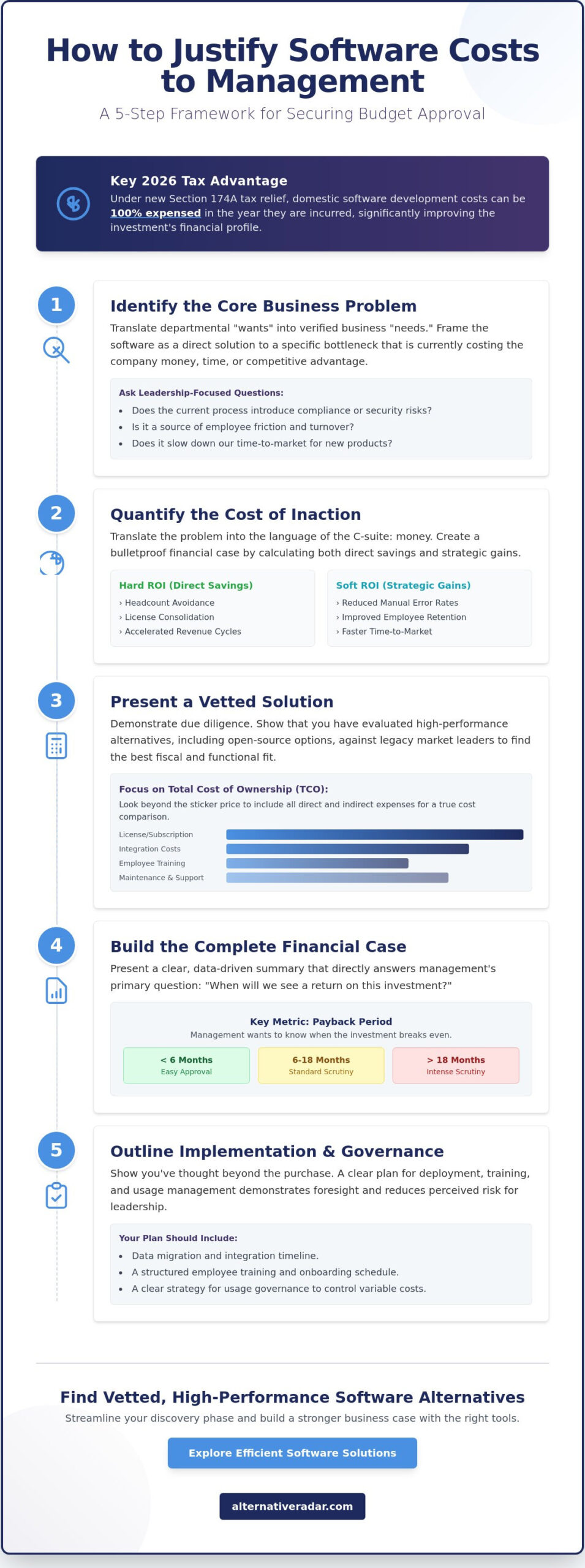
- Master a 5-step strategic framework on how to justify software cost to management by leading with bottom-line impact rather than technical features.
- Learn to quantify both hard ROI, such as headcount avoidance, and soft ROI like reduced error rates to build a bulletproof financial case.
- Discover why legacy market leaders may be draining your budget and how to vet high-performance alternatives that offer better fiscal alignment.
- Implement a structured discovery phase to identify vetted open-source and alternative software that maximizes team efficiency while eliminating license sprawl.
Moving Beyond “We Need This”: The Reality of Software Budgeting in 2026
The days of securing a budget by presenting a list of “cool features” or a slick user interface are over. In 2026, management views software requests with a high degree of skepticism. This resistance stems from years of aggressive SaaS sprawl that left many organizations with redundant tools and underutilized licenses. Management isn’t buying features; they’re buying outcomes. Understanding how to justify software cost to management starts with recognizing that the C-suite no longer views software as a departmental utility. Instead, they see it as a strategic investment that must compete for capital alongside every other business initiative.
The shift from departmental spending to centralized, ROI-driven procurement is now the standard. Every new subscription must survive a “rationalization” phase where its existence is questioned against the current tech stack. To get an approval, you must look past the immediate functionality and identify the hidden drivers that leadership actually cares about: security, compliance, and long term scalability. If a tool doesn’t explicitly mitigate a risk or align with a corporate KPI, it will likely be labeled as “nice-to-have” and discarded during the next budget review.
The CFO Perspective: Software as an Asset
CFOs now evaluate software through the lens of Total Cost of Ownership (TCO). This calculation goes far beyond the monthly sticker price. It includes the cost of integration, employee training, and the potential security debt a new vendor might introduce. In 2026, “improved productivity” is no longer a sufficient justification on its own. You must provide hard data. If you claim a tool saves time, you need to show how that time translates into reduced headcount costs or accelerated revenue cycles. If the data isn’t there, the justification fails.
The 2026 Procurement Landscape
The rise of usage-based pricing has fundamentally changed budget forecasting. Management is wary of “variable” costs that can spike unexpectedly. When you present your case, you must account for these fluctuations and demonstrate a clear plan for usage governance. In a lean economy, the distinction between “mission-critical” and “nice-to-have” is sharper than ever. How to justify software cost to management in this environment requires proving that the tool is an essential pillar of the business infrastructure. You are no longer just asking for a tool; you are proposing a solution to a verified bottleneck that is currently costing the company money.
Building the Business Case: Quantifying ROI and the Cost of Inaction
Securing budget approval in 2026 requires a transition from emotional pleas to mathematical certainty. When you determine how to justify software cost to management, your presentation must lead with Hard ROI. This includes direct financial impacts like license consolidation, revenue growth, and headcount avoidance. If a tool allows your current team to handle a 20% increase in workload without new hires, that’s a tangible saving. Soft ROI, while harder to track, remains vital; it covers improved employee retention, lower error rates, and faster time-to-market. High performing teams don’t just work harder. They use better tools to eliminate friction.
The most persuasive business cases also include a clear payback period. Management wants to know exactly when the initial investment will break even. To simplify the discovery phase of your proposal, consider evaluating efficient software alternatives that offer faster deployment cycles. A six-month payback period is often an easy win for leadership. Anything extending beyond 18 months will likely face intense scrutiny regarding its long term strategic fit.
Hard Costs vs. Strategic Gains
Transparency builds trust with the C-suite. You must present the full financial picture, including implementation, training, and data migration fees. Total Cost of Ownership (TCO) is the comprehensive sum of all direct and indirect software expenses, including initial acquisition, deployment, long term maintenance, and the opportunity costs of internal resources. Use the table below to contrast immediate outlays with anticipated gains.
| Expense Category | Direct Cost (Licensing/Fees) | Strategic Gain (Efficiency/ROI) |
|---|---|---|
| Infrastructure | Monthly subscription fees | Reduction in legacy server maintenance |
| Operations | One-time setup and training | 15% to 20% increase in billable hours |
| Compliance | Security certification costs | Mitigation of data breach financial risks |
Measuring the Cost of Inaction (COI)
Most proposals fail because they ignore the Cost of Inaction (COI). This metric quantifies what the company loses every month by maintaining the status quo. If your team spends 10 hours a week manually syncing data because they lack the right tool, that’s a recurring financial leak. COI creates the urgency necessary to bypass budget freezes. It shifts the conversation from “What does this software cost?” to “How much are we losing by not having it?”
Quantifying technical debt and the maintenance of legacy systems is essential for a complete COI analysis. Outdated workflows don’t just slow people down; they actively drive away talent and result in missed revenue opportunities. By presenting the monthly cost of doing nothing, you force management to choose between a calculated investment or a guaranteed, ongoing loss. Use data to show exactly where the current bottleneck is strangling growth.
The Strategic Pivot: Justifying Alternatives Over Legacy Market Leaders
Choosing a market leader isn’t always a sign of expertise; often, it’s a sign of a missed opportunity for optimization. When you analyze how to justify software cost to management, you must address the “brand tax” associated with industry giants. Just because a tool is the industry standard doesn’t mean it’s the best fit for your specific team requirements or your budget. In many cases, legacy software carries legacy costs that no longer align with a lean 2026 business model.
The “Good Enough” Principle is a powerful tool for modern budget justification. It encourages teams to match software features to their actual daily needs rather than paying for a bloated feature set they will never touch. Proving that an alternative tool is as secure and scalable as the market leader removes the final barrier to approval. This shift in focus from name recognition to functional utility is the hallmark of a data-driven business case.
Breaking the “Nobody Ever Got Fired for Buying IBM” Cycle
Management often defaults to legacy names to avoid perceived risk. You can disrupt this cycle by presenting a detailed slack alternatives comparison that emphasizes fiscal responsibility. Showing that you’ve vetted other options demonstrates a commitment to the company’s bottom line rather than just following market trends. It positions you as a strategic thinker who prioritizes value over convenience.
Moving toward open-source or leaner options also reduces long-term vendor lock-in. A thorough open source crm software comparison can reveal how to scale operations without the exponential cost increases typical of proprietary platforms. This flexibility is a strategic asset during budget reviews. It proves you’re looking for a solution that grows with the company without becoming a financial anchor.
Feature-to-Value Mapping
Start by auditing which “premium” features your team actually uses. For example, creative departments often find that best free alternatives to photoshop can save thousands of dollars while providing 100% of the necessary functionality. This isn’t about being “cheap.” It’s about being lean and targeted. If a feature doesn’t contribute to a primary KPI, it shouldn’t be part of your budget request.
Use specialized alternative to discovery platforms to find vetted, budget-friendly tools that management might not have considered. Presenting these options as a strategic pivot shows that you are actively seeking the most efficient path to productivity. This level of due diligence is exactly what makes a budget request successful. It transforms the conversation from a request for spending into a plan for optimization.
Mastering the Pitch: A 5-Step Framework for Management Approval
Management has five minutes. If your pitch begins with a technical deep dive into API documentation, you’ve already lost the room. Learning how to justify software cost to management involves structuring your request as a business solution rather than a technical upgrade. In 2026, where usage-based pricing and AI-driven modules can cause budget volatility, your pitch must be precise, data-heavy, and focused on long-term stability. Use this five-step framework to build a compelling narrative that aligns with executive priorities.
- Step 1: Executive Summary. Lead with the bottom-line impact. State the expected ROI and the primary business goal the software will achieve in the first sentence.
- Step 2: The Problem Statement. Use concrete data to identify the bottleneck. Instead of saying the team is “slow,” state that “manual data entry is currently causing a 12% delay in project delivery.”
- Step 3: The Solution and Alternatives. Show your due diligence by presenting 2-3 vetted options. To simplify this phase, use Alternative Radar to discover vetted software options that provide the same utility as market leaders at a lower TCO.
- Step 4: The Financials. Provide a detailed breakdown of ROI, COI, and TCO. Explicitly address how usage-based pricing will be managed to avoid budget overruns.
- Step 5: The Roadmap. Outline the implementation timeline and risk mitigation strategies. Management needs to see that you’ve planned for the transition period.
Speaking the Language of Management
High-level decision-makers prioritize risk and revenue. You must replace technical jargon with business terms to maintain their attention. “Latency” should be described as “customer churn risk.” “Technical debt” is “increased maintenance overhead.” When management objects with “it’s not in the budget,” pivot back to the Cost of Inaction (COI). Remind them that delaying the purchase costs the company a specific dollar amount every month in lost efficiency. Use social proof, such as case studies from similar firms in your industry, to show that the tool is a proven asset rather than an experiment.
The “Pilot Program” Strategy
A full-scale rollout is often too risky for a skeptical CFO. Propose a low-risk pilot program to prove ROI before committing to a multi-year contract. This trial phase should include 5 to 10 power users and have clearly defined success metrics, such as a 15% reduction in task completion time. A successful pilot removes the fear of failure. It provides the “hard data” management requires to move from a tentative trial to a full budget approval. By the time you ask for the full amount, the software has already paid for itself in the pilot phase.
Optimizing the Stack: How Alternative Radar Streamlines Cost Justification
The discovery phase is the most critical part of your business case. If you only look at market leaders, you’re likely overpaying for features your team doesn’t need. When you research how to justify software cost to management, the most effective strategy is showing that you’ve scanned the entire market for the best value. Alternative Radar acts as your digital scout. It filters through thousands of options to find tools that offer the highest ROI. This data-driven approach ensures your business case is built on logic rather than just following industry trends.
Using Alternative Radar, you can identify popular open source business software 2026 that provides enterprise-grade functionality without the restrictive licensing fees of proprietary giants. Objective comparisons are your best defense during a management Q&A session. When a CFO asks why you didn’t choose the “standard” tool, you can provide a side-by-side analysis of performance, security, and TCO. This transparency transforms you from a requester into a reliable advisor who values company resources.
Before you head into your meeting, use this final checklist to ensure your software proposal is ready for the board:
- Does the proposal lead with a clear “Bottom Line” impact statement?
- Have you quantified the monthly Cost of Inaction (COI) using current bottleneck data?
- Is there a side-by-side comparison between the market leader and a leaner alternative?
- Does the TCO include training, migration, and long-term maintenance costs?
- Have you addressed the 2026 tax implications for domestic software development mentioned earlier?
Data-Driven Discovery
Comparison platforms help you find hidden gems that offer better ROI than bloated legacy suites. You aren’t just looking for a cheaper tool; you’re looking for a more efficient one. Validating vendor claims with objective, third-party reviews prevents expensive mistakes and ensures the software actually delivers on its promises. This level of scrutiny empowers your team to make smarter choices. It builds your credibility with leadership by showing you prioritize evidence over marketing hype.
Ready to Justify Your Next Tool?
Success in software procurement requires an ROI-first mindset. Management will approve budgets when they see a clear path to value and a thorough analysis of the options. Don’t settle for the first name you see in a search result. Explore the Alternative Radar directory to find budget-friendly picks that align with your specific workflow requirements. You have the framework and the data. Now it’s time to secure the tools your team deserves.
Find the perfect software alternative for your team today.
Secure Your Software Budget with Data
Transitioning from a requester to a strategic partner requires a focus on measurable outcomes. You’ve seen that mastering how to justify software cost to management in 2026 involves more than just listing features; it demands a clear calculation of Hard ROI and the Cost of Inaction. By presenting a data-backed business case that prioritizes efficiency over legacy brand names, you align your technical needs with the company’s financial goals. This approach builds trust and positions your team for long-term success.
Don’t let budget freezes stop your team’s progress. Use the right resources to validate your choices and prove their value. Our digital scouts have already done the heavy lifting by vetting over 5,000 tools for performance and cost-effectiveness. Whether you need open-source flexibility or streamlined SaaS, the right data makes the approval process seamless. You’ve now got the framework to turn a “no” into a strategic “yes.”
Explore the best software alternatives to build your business case. With objective comparisons and a focus on 2026 performance, you can confidently present the most efficient tools for your workflow. Start optimizing your stack today.
Frequently Asked Questions
What is the most important metric when justifying software cost?
The most critical metric is the Payback Period, which indicates how quickly the software investment will return its initial cost through savings or revenue. Management typically looks for a return within 12 to 18 months to fit standard 2026 fiscal cycles. You should combine this with a clear Total Cost of Ownership (TCO) calculation to show that you’ve considered long term maintenance and integration expenses.
How do I justify software that doesn’t have a direct revenue impact?
Justify software without direct revenue impact by focusing on risk mitigation and operational efficiency. Explain how the tool prevents expensive compliance failures or allows your current staff to manage a higher workload without additional hiring. This approach frames the software as a protective asset that reduces the company’s exposure to human error and departmental burnout.
Should I always present a free alternative to management?
Presenting a free or open-source alternative is a strategic move that demonstrates thorough due diligence. It shows leadership that you’ve scanned the market for the most cost-effective solution rather than simply requesting the market leader. Even if you don’t choose the free option, using it as a benchmark highlights the specific value and security features that justify the cost of your preferred tool.
How do I handle the objection that “Excel can do this”?
Address the “Excel” objection by highlighting the high cost of manual data management and the lack of a secure audit trail. Spreadsheets are prone to version control issues and human error, which can lead to significant financial discrepancies. Explain that dedicated software provides the scalability, real-time data accuracy, and security protocols that Excel simply cannot match in a modern enterprise environment.
What is the “Cost of Inaction” and why does it matter?
The Cost of Inaction (COI) represents the monthly financial burden of maintaining the status quo. Quantifying these hidden losses is a powerful way how to justify software cost to management because it shifts the focus from the price tag to the cost of doing nothing. If staying with a legacy system costs the company money in lost productivity or missed opportunities, the new software becomes a necessary intervention.
How can I prove that a cheaper software alternative is secure?
Prove the security of a cheaper alternative by providing documentation for industry standards like SOC2 Type II or ISO 27001 certifications. Many modern, lean software providers prioritize security transparency and offer more frequent patches than legacy giants. Focus on the vendor’s encryption standards and their compliance with relevant 2026 data privacy regulations to alleviate management’s fear of a security breach.
What should be included in a software business case template?
A standard software business case should include a concise executive summary, a data-backed problem statement, and a comparison of at least three solutions. You must also provide a detailed financial breakdown covering ROI, COI, and TCO. Finally, include a risk mitigation plan and a clear implementation roadmap to show that you’ve planned for a smooth transition with minimal downtime.
How do I explain SaaS subscription costs vs. one-time licenses?
Explain the difference using the framework of operational flexibility and long term value. SaaS subscriptions shift costs from capital expenditure (Capex) to operating expenditure (Opex), which often aligns better with 2026 corporate tax strategies. Emphasize that subscriptions include continuous security updates, cloud hosting, and technical support, whereas one-time licenses often lead to “version lock” and expensive, manual upgrade cycles.