

Why does your reward for hitting growth milestones often feel like a financial penalty from your software provider? It’s a common trap where the best crm for marketing automation you selected as a startup suddenly becomes a bottleneck of data silos and success taxes as you scale. You shouldn’t have to choose between system performance and your bottom line just because your database hit a new tier.
We’ve analyzed the 2026 landscape to find platforms that maintain operational velocity without the exponential price hikes. You’ll discover which brands provide predictable pricing at higher tiers and which ones offer the robust API support needed for custom integrations. This guide compares the technical modularity and cost structures of leaders like HubSpot, Salesforce, and Zoho. From the 44x price jump between HubSpot tiers to the mid-market ROI of Zoho Professional, we provide the objective data you need to choose a CRM that grows with you, not against you.
Key Takeaways
- Define CRM scalability as a ratio of operational capacity to cost to avoid the expensive mistake of outgrowing your system.
- Evaluate the four critical pillars of infrastructure, focusing on data architecture and API maturity, to ensure your software handles peak loads.
- Identify the best crm for marketing automation by comparing how brands like HubSpot and Salesforce handle mid-market versus global enterprise requirements.
- Calculate the “Success Tax” within 2026 pricing models to prevent your software bill from outpacing your actual team growth.
- Use objective filters to compare premium SaaS ecosystems against open-source alternatives for a more modular and cost-effective growth path.
Beyond the User Count: Defining CRM Scalability in 2026
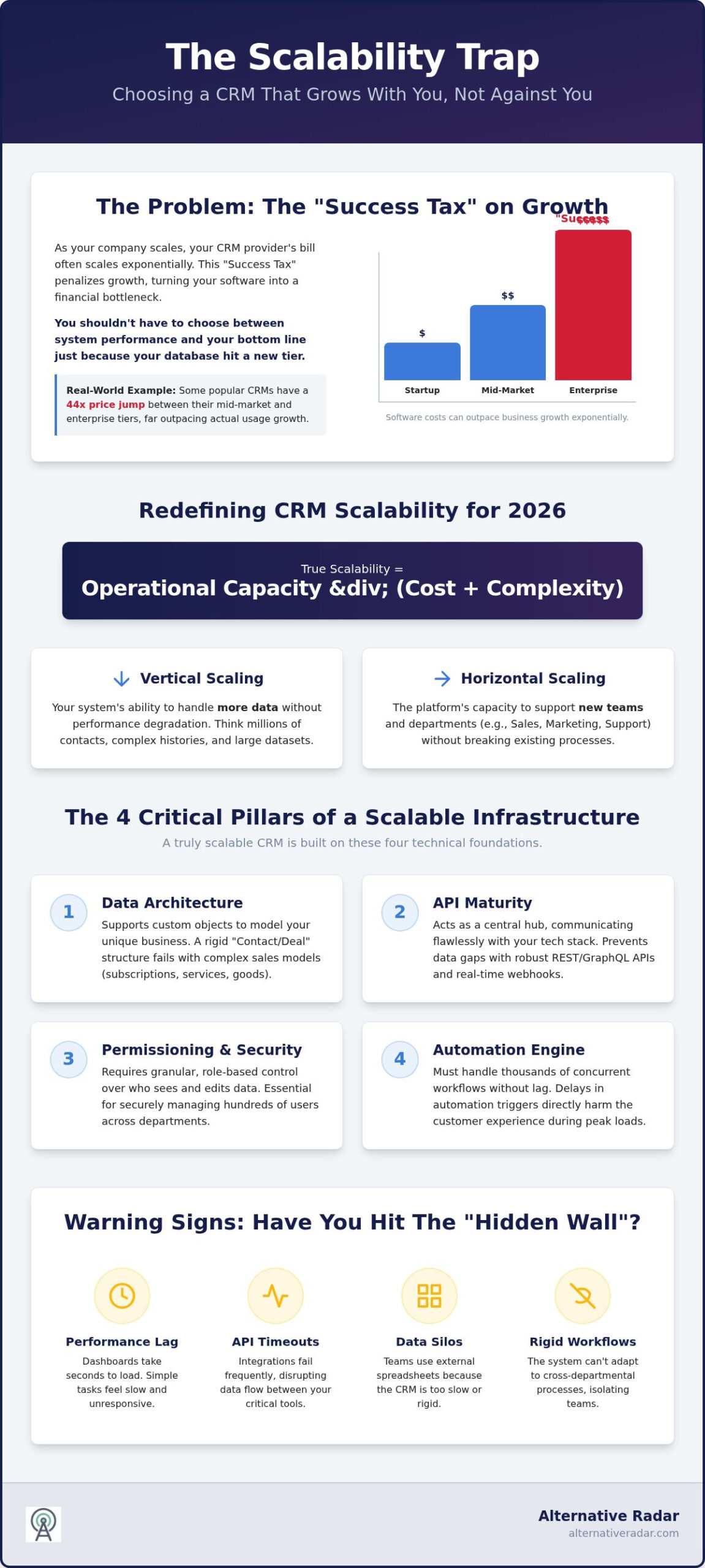
Many business leaders mistake “adding seats” for scaling. In 2026, true scalability is measured as the ratio of operational capacity to cost and complexity. If your software expenses double every time you add a new department, you aren’t scaling; you’re simply paying a growth tax. Selecting the wrong platform early on often leads to a total system migration, which is one of the most expensive mistakes a mid-market company can make. These transitions frequently cost six figures in consulting fees and result in months of lost data and productivity.
Effective scaling requires a balance between vertical and horizontal expansion. Vertical scaling is your system’s ability to handle more data, such as millions of contacts or complex deal histories. Horizontal scaling is the platform’s capacity to support new departments, like customer success or finance, without breaking existing processes. The modern Marketing automation landscape now leverages AI to maintain this balance. Top-tier systems use automated data hygiene to prune inactive records and ensure that database size doesn’t degrade system performance. Identifying the best crm for marketing automation requires looking past the sales deck to see how the underlying architecture handles these stressors.
The ‘Hidden Wall’: Signs Your Current CRM is Failing
Performance lag and frequent API timeout issues are the earliest warning signs that you’ve hit a “hidden wall.” When a dashboard takes ten seconds to load or a simple workflow trigger fails, your team loses trust in the tool. This friction creates the “Data Silo” effect. Users move their work to external spreadsheets or private Slack channels because the CRM has become a hindrance rather than a help. Rigid workflows that cannot adapt to cross-departmental collaboration eventually isolate your marketing team from sales and support, killing your growth momentum.
Scalability vs. Adaptability: Why You Need Both
Scalability provides the engine’s power, but adaptability is the steering wheel. You need a system that allows for easy modification without requiring a team of developers for every custom field or workflow change. A scalable system must also be modular to avoid feature bloat, which confuses users and inflates costs. CRM modularity is the ability to toggle features based on team maturity. This ensures that your interface remains clean while providing the best crm for marketing automation experience tailored to your specific growth stage.
The 4 Critical Pillars of a Scalable CRM Infrastructure
Selecting the best crm for marketing automation requires looking under the hood at the technical foundation. Many platforms look identical on the surface but fail when your database grows. Scalability depends on four architectural pillars that determine if your system will thrive or throttle your growth. It’s not just about adding users; it’s about maintaining data integrity and system speed as complexity increases.
- Data Architecture & Custom Objects: You must be able to model your specific business. If you sell subscriptions, physical goods, and services, a standard “Contact and Deal” structure isn’t enough.
- API Maturity: Your CRM must act as a central hub. It needs to communicate flawlessly with your entire tech stack to prevent data gaps.
- Permissioning & Security: Managing 500 users is a different beast than managing five. You need granular control over who sees and edits specific data sets.
- Automation Engine: High-performance systems handle 10,000 concurrent workflows without lag. If your automation triggers delay by minutes during peak loads, your customer experience suffers.
Finding the right CRM and marketing automation platforms involves verifying these technical specs before signing a multi-year contract. If the underlying structure is rigid, you’ll eventually face an expensive migration.
API-First Design: The Key to Future-Proofing
In 2026, REST and GraphQL APIs are non-negotiable for modern tech stacks. These protocols allow for flexible data retrieval and faster response times. Webhooks are equally vital. They provide real-time data synchronization by pushing updates the moment an action occurs. This level of connectivity is essential for advanced strategies like programmatic display advertising, where data-driven growth relies on instant audience updates. Without an API-first approach, you’ll find your marketing data trapped in a silo.
Managing Complexity with Custom Objects
Custom objects are the secret sauce of scaling. They allow you to create entirely new data categories beyond leads and accounts. For example, a real-time tracking object for “Product Usage” can trigger specific automation workflows based on actual customer behavior. Some brands offer unlimited custom objects within their enterprise tiers, while others charge a premium for each one. When evaluating the best crm for marketing automation, use this checklist:
- Does the platform support many-to-many relationships?
- Can custom objects trigger automated emails or SMS?
- Is there a limit on the number of custom fields per object?
- Does the reporting engine natively support custom object data?
If you’re unsure which architecture fits your 2026 growth plan, compare platform specifications side-by-side to see the technical reality behind the marketing claims.
Best CRM Brands for Marketing Automation: 2026 Comparison
Selecting the best crm for marketing automation requires matching your growth trajectory to a platform’s specific architectural strengths. While every vendor claims to offer “unlimited scale,” the reality depends on how they handle data volume and user complexity. In 2026, the market has bifurcated between high-touch enterprise ecosystems and agile, automation-first platforms. Understanding these distinctions is critical for defining CRM scalability within your own organization.
Enterprise Giants: Salesforce vs. HubSpot
Salesforce remains the benchmark for global enterprises with massive budgets. Its customization depth is unmatched; however, the learning curve is steep and often requires dedicated admins. For 2026, Salesforce has doubled down on its Einstein AI to manage predictive workflows at a massive scale. Conversely, HubSpot offers the “Seamless” scale. It’s the preferred choice for mid-market teams prioritizing user experience. While HubSpot is easier to adopt, its seat-based pricing can lead to significant cost jumps. For instance, moving from the Marketing Hub Professional plan at $890 per month to the Enterprise tier at $3,600 per month represents a substantial financial commitment that includes a mandatory $7,000 onboarding fee.
The Open-Source Advantage for Scale
For businesses looking to avoid the “Success Tax” of per-user fees, this open source crm software comparison highlights why self-hosted options are gaining traction. Platforms like Odoo and Bitrix24 allow you to scale your workforce without your software bill growing at the same rate. Odoo’s “Open” scale is particularly effective for companies needing ERP-level integration. By hosting the system on your own infrastructure, you maintain total control over data residency and API limits, which is a major advantage for high-volume data operations that would otherwise trigger overage charges on SaaS platforms.
Agile Challengers: Pipedrive and Freshworks
Pipedrive and Freshworks represent the “Agile” scale, designed for teams that need to move fast without the bloat of enterprise suites. Pipedrive’s Leadbooster is a standout for scaling inbound sales volume through automated chat and prospecting tools. Freshworks excels in multi-channel support, making it a strong contender for CX-heavy teams. These tools are excellent for rapid expansion, but they do reach functional limits when you require deep custom object relationships or complex, multi-departmental workflows. When your needs move beyond standard sales pipelines, you may find these agile tools lack the modular depth found in the best crm for marketing automation leaders like Salesforce or Odoo.
If your marketing workflows involve high complexity, ActiveCampaign offers the “Automation” scale. It focuses on granular behavioral triggers that most standard CRMs struggle to execute without third-party add-ons. Choosing between these brands isn’t about finding the market leader; it’s about finding the structural fit for your 2026 roadmap.
Calculating the True Cost of Scaling: Avoiding the ‘Success Tax’
The “Success Tax” is a silent profit killer. It occurs when your software expenses grow faster than your actual revenue or team size. Finding the best crm for marketing automation requires looking beyond the initial “per-user” price tag to see how the vendor captures value as you expand. Many platforms entice you with low entry costs but implement aggressive pricing jumps once you rely on their ecosystem. For instance, the transition from HubSpot’s Marketing Hub Starter to the Professional tier represents a price increase of roughly 44 times. This isn’t just a step up; it’s a structural shift in your overhead.
To avoid these traps, you must analyze three primary pricing models. Seat-based models charge per user, which can penalize growing sales teams. Record-based models charge for every 1,000 marketing contacts, making high-volume lead generation expensive. Usage-based models, often tied to API calls or data storage, can lead to unpredictable monthly bills. A mid-sized business with 50 users on Salesforce’s Enterprise Edition can expect annual costs to reach $120,000 to $150,000 when setup and support are included. You must also account for the “Data Ransom” effect. This is the hidden cost of extracting your data from a legacy system. Proprietary data formats and high egress fees can make switching brands feel financially impossible once you’ve scaled.
Tiered Pricing Pitfalls to Watch For
Feature migration is a common tactic where essential tools like advanced reporting or custom objects are moved to “Enterprise” tiers. You might start on a “Pro” plan only to find that the one integration you need requires a $2,000 monthly upgrade. API call limits are another bottleneck. As you connect more third-party tools, you may exceed your daily limit, forcing you into a higher cost bracket. Use this formula to calculate your 3-year Total Cost of Ownership (TCO): (Monthly License x 36) + Mandatory Onboarding Fees + Partner Consulting Rates + Estimated API Overage Charges. Before committing to a high-tier contract, audit your software stack to identify where you are overpaying for unused features.
The Cost of Implementation and Migration
A major CRM shift is not just a software change; it’s a resource drain. Implementation usually requires months of downtime and heavy lifting from your internal ops team. Enterprise-grade systems like Salesforce or HubSpot often require “Certified Partners” for setup. HubSpot, for example, mandates a one-time onboarding fee of $3,000 for Professional and $7,000 for Enterprise plans. These fees don’t include the actual labor of mapping your workflows. You must perform a comprehensive Data Migration Audit before switching brands to identify potential mapping conflicts and API bottlenecks. If you don’t account for these soft costs, your search for the best crm for marketing automation will result in a system that is technically capable but financially unsustainable.
Finding Your Scalable Match with Alternative Radar
Choosing the best crm for marketing automation shouldn’t feel like a high-stakes gamble with your company’s future. Most platforms use aggressive marketing to obscure their long-term cost creep and technical limitations. Alternative Radar acts as an objective scout, doing the hard work of testing and comparison so you don’t have to. We prioritize clarity over hype, focusing on how a system actually performs under peak data loads rather than how many awards it has won. By evaluating popular open source business software alongside the industry’s SaaS giants, we give you the full picture of the 2026 market.
Our role is to provide a high-quality filter for your decision-making process. We understand that the “market leader” isn’t always the “best fit” for a mid-market company trying to maintain high velocity. We categorize software based on technical labels and licensing structures that matter to professional buyers. This allows you to see exactly where a platform like HubSpot might become too expensive or where an open-source tool like Odoo might require more technical oversight than your team can handle.
Leveraging Comparison Tools for Strategic Decisions
Use our feature-by-feature breakdowns to identify potential scaling bottlenecks before they impact your operations. Our database includes user-reported pros and cons that highlight real-world performance issues, such as API timeouts or rigid workflow engines. Scaling isn’t just about your CRM; it requires a holistic approach to your entire tech stack. If your communication tools don’t scale alongside your automation, you’ll face internal friction. Check our guide on slack alternatives to ensure your team’s communication infrastructure is as robust as your marketing database.
Building a High-Velocity Tech Stack
A high-velocity tech stack relies on the synergy between your CRM and adjacent automation tools. Alternative Radar excels at identifying “hidden gems” that offer enterprise-level features without the enterprise-level price tag. We look for platforms that offer modularity, allowing you to toggle features as your team matures. This prevents the bloat that often slows down departments using legacy systems. Stop following the crowd and start building a stack that serves your specific revenue goals. Discover the best alternatives to popular software and select the best crm for marketing automation for your 2026 growth strategy today.
Future-Proofing Your Marketing Infrastructure
Selecting the best crm for marketing automation is a decision that dictates your operational velocity for years to come. You’ve seen how the “Success Tax” can erode margins and how rigid data architectures create bottlenecks that stifle innovation. The most effective scaling strategies in 2026 prioritize Total Cost of Ownership and modularity over simple brand name recognition. Whether you require the infinite customization of an enterprise giant or the cost-efficiency of a self-hosted platform, your choice must align with your specific growth milestones rather than market hype.
Don’t let hidden fees or data silos compromise your expansion. Alternative Radar provides expert analysis of open-source versus SaaS ecosystems and an objective comparison of 50+ CRM tools to help you navigate these complexities. We focus on the technical reality of software so you can avoid expensive migrations down the road. Discover the best CRM brands for your growth stage on Alternative Radar and secure a tech stack that actually empowers your team. You have the data; now make the smarter choice for your bottom line.
Frequently Asked Questions
What is the best CRM for a company planning to double in size this year?
HubSpot is often the best crm for marketing automation for teams doubling in size due to its seat-based flexibility and ease of adoption. It allows you to add users quickly without a six-month implementation cycle. However, you must account for the required onboarding fees, which start at $3,000 for Professional tiers. If budget control is your priority during rapid headcount growth, Odoo offers a more modular path with lower per-user friction.
Can open-source CRM software really scale to enterprise levels?
Yes, platforms like Odoo and Bitrix24 are designed to handle enterprise-level data volumes and complex departmental structures. These tools allow for deep customization via source code access, which is essential for unique business models. By opting for self-hosting, you avoid the “Success Tax” of per-user fees that often plague SaaS giants. This makes open-source a viable, high-performance alternative for companies with the internal technical resources to manage their own infrastructure.
How much should I expect to pay for a scalable CRM as I add more users?
Costs vary significantly by brand and tier. Salesforce Pro starts at $100 per user monthly, while Zoho CRM Enterprise is $40 per user monthly when billed annually. A mid-sized company with 50 users should budget $120,000 to $150,000 annually for Salesforce Enterprise once you include support and setup. Always calculate the three-year Total Cost of Ownership rather than just the initial sticker price to avoid budget shocks as you scale.
What is the difference between vertical and horizontal CRM scaling?
Vertical scaling refers to a system’s ability to handle increased data volume, such as millions of contacts or high-frequency transaction logs. Horizontal scaling is the platform’s capacity to support expansion across new departments, like customer success or finance, without breaking existing workflows. A truly scalable system manages both, ensuring that performance doesn’t degrade as your database grows and that new teams can integrate their processes without creating data silos.
When is the right time to migrate from a small-business CRM to an enterprise brand?
You should consider migrating when your current system experiences frequent performance lag or hits its daily API limits. Other warning signs include the “Data Silo” effect, where different departments start using external spreadsheets because the CRM is too rigid. If your automation triggers delay by minutes during peak loads, your customer experience will suffer. Migration is a resource-heavy process, so it’s better to move six months too early than a day too late.
Do all scalable CRMs require a dedicated IT team for implementation?
No, but enterprise-grade systems like Salesforce or the higher tiers of HubSpot usually require a dedicated admin or a certified implementation partner. Agile tools like Pipedrive or Freshworks are more “admin-lite” and can be managed by a tech-savvy marketing manager. However, as your complexity grows, the need for professional oversight increases. Even “user-friendly” platforms require a clear data strategy to prevent your automation engine from becoming a tangled mess of broken triggers.
How do API limits affect the scalability of a CRM brand?
API limits define your technical ceiling and total cost. When your marketing stack exceeds a brand’s daily call limit, you’re often forced into an “Enterprise” tier regardless of your actual user count. This makes the best crm for marketing automation one that offers high or negotiable API thresholds. Failing to check these limits before signing a contract can lead to unexpected monthly overage charges as your data integration volume grows.
Is Salesforce still the gold standard for scalability in 2026?
Salesforce remains the benchmark for global enterprises that require “infinite” customization and deep AI integration through Einstein. Its ecosystem is unmatched in terms of third-party apps and certified consultants. However, it’s no longer the only choice for high-growth companies. HubSpot and Odoo now compete on functional depth while offering better user experiences or more transparent pricing models. Salesforce is the gold standard for complexity, but it may not be the most efficient choice for every scaling scenario.