

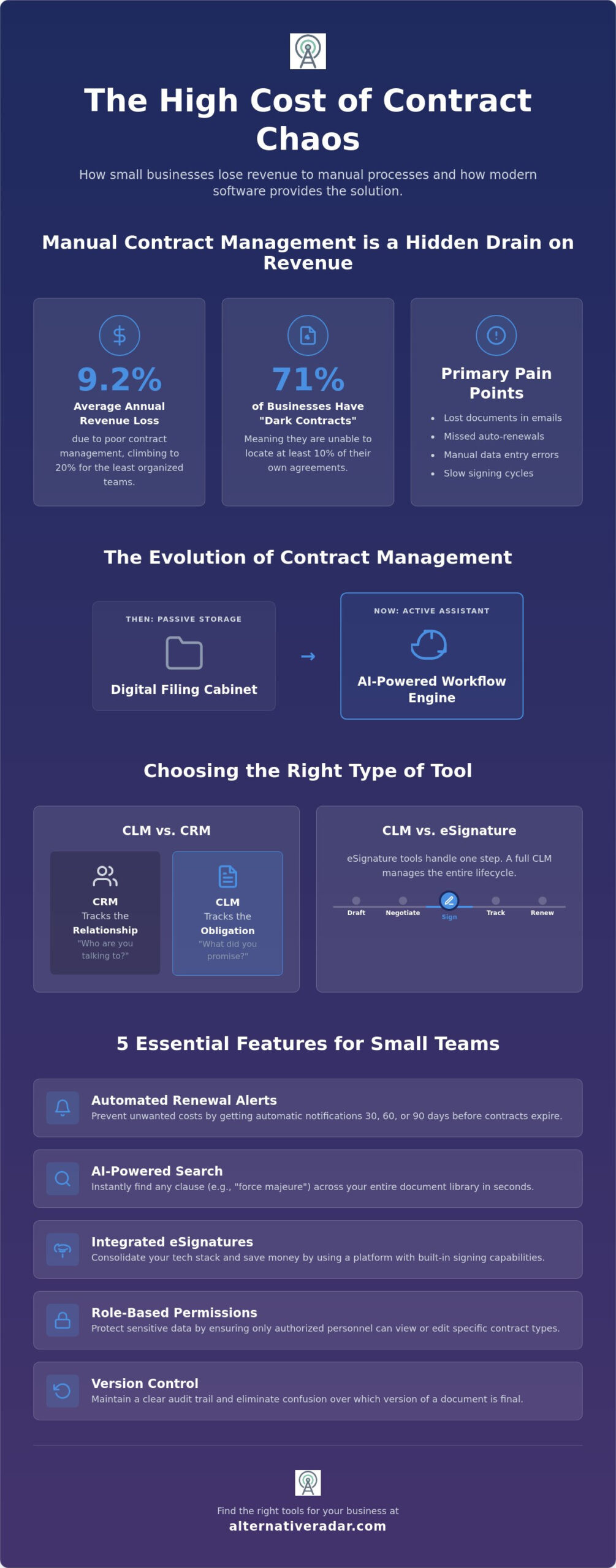
Did you know the average business loses 9.2% of its annual revenue due to poor contract management? According to 2026 data from World Commerce & Contracting, that loss can climb as high as 20% for the least organized teams. You likely feel this friction every time you’re digging through endless email threads for a lost PDF or realizing an auto-renewal deadline quietly passed you by. It’s exhausting to watch manual data entry errors and slow signing cycles stall your company’s momentum.
We agree that your time is better spent growing your brand than playing digital detective. The key to fixing these bottlenecks isn’t just buying more tech; it’s choosing the right contract management software for small business that offers a low friction-to-adoption score. You need a tool that works immediately, not a complex system that requires a three-month training program. Small teams require agility, not more administrative overhead.
This guide provides a curated comparison of the most efficient, AI-driven management tools available in 2026. We’ll show you how to establish a centralized source of truth for all legal documents and implement automated alerts for key dates. We have done the research so you can stop searching and start scaling with a platform that delivers faster signing cycles and total document visibility.
Key Takeaways
- Modern systems have evolved from simple digital filing cabinets into active AI assistants that automate complex legal workflows.
- Learn how to prevent unwanted costs by using automated renewal alerts and AI-powered search to locate critical clauses instantly.
- Evaluate the “Big Three” providers alongside niche winners to find the best contract management software for small business.
- Use our selection framework to assess your contract velocity and ensure your chosen tool can go live in 48 hours rather than four weeks.
- Discover why market leaders aren’t always the right choice and how to use Alternative Radar to filter for your specific industry needs.
What is Contract Management Software for Small Business?
At its core, What is Contract Management Software? It’s a digital hub designed to store, track, and automate legal agreements throughout their entire lifecycle. In 2026, this technology has shifted from being a passive digital filing cabinet to an active AI assistant. For a growing firm, contract management software for small business acts as a centralized “Source of Truth.” Without it, you’re exposed to legal liability because you can’t verify what you’ve signed, who is responsible for the next step, or when a specific obligation expires.
Many teams confuse simple eSignature tools with a full CLM (Contract Lifecycle Management) platform. While eSignature tools focus purely on the moment of signing, a CLM manages the before and after. It handles everything from initial drafting and internal negotiations to post-sign compliance and automated renewals. If your current process ends the moment a signature is collected, you’re only solving half the problem.
The 2026 Small Business Contract Crisis
Relying on manual PDF management is now a significant security risk for small firms. If your contracts live in scattered folders or email attachments, you’re dealing with “Dark Contracts.” These are agreements that exist but remain invisible to your reporting. According to a 2026 study by Loio, 71% of businesses cannot locate at least 10% of their contracts. This lack of visibility leads to missed deadlines and unbudgeted costs that eat into your margins.
AI-driven OCR (Optical Character Recognition) has changed the entry barrier for small teams. Previously, moving to a digital system required weeks of manual data entry. Now, modern tools can scan old paper or image-based PDFs and instantly turn them into searchable, actionable data. This allows you to find specific clauses, such as liability caps or termination windows, across hundreds of documents in seconds.
CLM vs. CRM: Why Your Sales Tool Isn’t Enough
Your CRM is excellent for tracking leads and sales activity, but it isn’t built for legal precision. A CRM tracks the relationship, while a CLM tracks the obligation. While you should integrate these systems to sync customer data, keeping the legal “Source of Truth” in a dedicated platform prevents sensitive clauses from being altered by non-legal staff. It ensures that the version of the contract your sales team sees is the same one your legal or operations team is monitoring for compliance.
A CRM manages who you’re talking to, while a CLM manages exactly what you’ve promised to do for them.
Essential Features: What Small Teams Actually Need
Identifying the right contract management software for small business requires looking past marketing hype to find tools that solve specific operational friction. While enterprise systems offer endless bells and whistles, small teams need a high “utility-to-cost” ratio. The goal is to eliminate the 9.2% revenue loss typically caused by poor contract administration by focusing on five core pillars of functionality.
- Automated Renewal Alerts: This is your first line of defense against the “auto-renew” trap. Instead of tracking SaaS or vendor expirations in a spreadsheet, the system sends notifications 30, 60, or 90 days out.
- AI-Powered Search: You shouldn’t have to open 500 documents to find one clause. Modern AI allows you to query your entire library for specific terms like “force majeure” or “termination for convenience” in seconds.
- Integrated eSignatures: Consolidating your stack saves money. Choosing a CLM with native signing capabilities removes the need for a separate Docusign or HelloSign subscription, which can save a small team hundreds of dollars annually.
- Role-Based Permissions: Privacy is paramount when handling sensitive salary or equity contracts. These settings ensure that only authorized personnel can view or edit specific document categories.
- Version Control: Stop guessing if “Final_v4_REVISED” is actually the latest copy. A robust system tracks every change and comment, providing a clear audit trail of who modified what and when.
If you’re overwhelmed by the options, you can compare specific feature sets to see which tool aligns with your current team size and budget.
The Power of Automated Workflow Triggers
Efficiency comes from “If-This-Then-That” logic. For example, you can set a trigger so that any contract over $10,000 automatically routes to the CEO for approval, while smaller agreements go straight to the department head. This reduces the “Legal Bottleneck” where documents sit on a desk for weeks. Using standardized templates also ensures that every document maintains brand and legal consistency without requiring a lawyer’s review every single time.
AI and Data Extraction for Non-Legal Users
You don’t need a law degree to manage contracts in 2026. Modern AI automatically extracts key dates, parties, and obligations from uploaded PDFs. For firms exploring government contracting for small businesses, these tracking features are often a prerequisite for compliance. Current 2026 standards for AI data privacy ensure that your sensitive information is processed in secure, encrypted environments that comply with evolving GDPR and CCPA requirements. This automation allows non-legal staff to maintain a professional “Source of Truth” with minimal manual effort.
When scaling your team to manage these specialized agreements, Alpha.jobs provides a direct link to professionals who understand the nuances of the public sector.
Top Contract Management Software Alternatives for 2026
Selecting the right contract management software for small business involves balancing immediate costs against long-term functional depth. With 64% of small and medium-sized enterprises (SMEs) citing high costs as a primary barrier to adoption according to 2026 Tracking Contracts Research, finding a tool that fits your budget without sacrificing essential AI features is critical. The market in 2026 offers three distinct paths: sales-focused document generation, secure centralized repositories, and browser-native negotiation platforms.
The “Best Overall” Picks for Small Teams
PandaDoc remains a top choice for sales-heavy organizations. Its Essentials plan starts at $19 per user, per month when billed annually, offering unlimited documents and custom branding. You’ll need the $49 Business tier to unlock CRM integrations and the analytics needed to track document performance. Be wary of the “Freemium” trap; while their free eSign plan is useful for basic signatures, it lacks the templates and workflow automation that actually eliminate bottlenecks.
ContractSafe takes a different approach by acting as a high-speed, secure repository. Their Organize plan starts at $450 per month and includes unlimited users, which makes it more cost-effective than per-seat models as your team grows. It’s a leader for firms that need a simple “Source of Truth” without complex drafting tools. For those who prioritize negotiation, Juro offers a browser-native experience that keeps everyone on the same page. While its Team plan starts at approximately $15,000 per year, it removes the friction of switching between Word and email during the redlining process.
Specific industries often require specialized logic. Healthcare firms should look for HIPAA-compliant repositories, while construction teams benefit from tools that handle project-based subcontracts. Even service-oriented businesses, like those specializing in HVAC repair San Antonio, find that automated workflows help manage client service agreements and equipment warranties without the administrative bloat. Tech startups often favor Juro or PandaDoc for their API-first approach to managing high contract volumes. Using Alternative Radar’s comparison tools can help you filter these niche winners by their specific licensing and feature sets.
Open Source and Privacy-First Alternatives
For businesses with high privacy requirements or strict data sovereignty needs, open-source alternatives offer a way to host legal data on your own servers. This path removes the risk of third-party data breaches but requires more technical oversight. If you’re building a fully integrated stack, you might consider an open source crm software comparison to see how these tools sync with your legal repository. Utilizing popular open source business software 2025 can provide a strategic advantage for firms that want to avoid vendor lock-in while maintaining total control over their legal tech infrastructure.
Selection Framework: How to Choose Without Regret
Choosing the right contract management software for small business requires a cold-eyed assessment of your actual needs versus marketing promises. Many firms fail because they buy for the business they hope to be, rather than the one they are today. To avoid regret, evaluate your “Contract Velocity,” which is the total number of documents you sign and manage monthly. If you’re processing fewer than 15 agreements, a heavy enterprise tool will likely sit unused. Focus instead on the “Implementation Time” test. Can your team be live in 48 hours? If a platform requires a four-week setup, it’s probably too complex for a lean organization.
Watch for hidden costs that inflate your initial budget. Per-seat pricing can escalate quickly as your team grows. For instance, a 10-seat Business team on PandaDoc can expect to pay around $5,880 per year. Beyond licensing, check for limits on API calls or storage tiers that could trigger surprise invoices. User adoption is the primary reason software fails in small businesses. If the interface feels clunky, your staff will revert to the chaos of email threads and shared folders. To find a tool that passes the implementation test, browse our vetted software comparisons.
Calculating the ROI of Contract Software
Calculating the ROI involves more than just counting saved minutes. Use this simple formula: (Weekly hours spent on follow-ups x average hourly rate) + (Value of avoided auto-renewal penalties). The “Single Missed Deadline” metric is often enough to pay for the software itself. By preventing one unwanted vendor renewal or one missed billing milestone, the tool achieves immediate cost-neutrality. To justify the cost to a CFO, position the software as a risk-mitigation tool that plugs the 9.2% revenue leak caused by poor contract administration while ensuring compliance with 2026 data privacy standards.
Migration Strategy: Moving from Folders to Software
Your migration strategy determines your long-term success. Test the “Bulk Upload” capability early. How does the software handle your existing PDF backlog? Modern AI should extract key dates and parties automatically, but this only works if your legacy data is relatively clean. Spending a few hours organizing your current folders before the move will save days of troubleshooting later. Finally, verify mobile-responsiveness. In a fast-paced environment, the ability to grant approvals on-the-go is the difference between a closed deal and a lost opportunity. A tool that doesn’t work on a smartphone isn’t a modern solution.
Finding Your Perfect Fit with Alternative Radar
Selecting a contract management software for small business isn’t just about picking the name with the largest marketing budget. Market leaders often build their roadmaps for enterprise-level clients, which means you might end up paying for complex features your team will never use. Instead of following the crowd, use Alternative Radar to filter options based on your specific operational needs. Our platform allows you to categorize tools by licensing models, seat-based pricing, and critical feature sets like AI-driven OCR or native eSignatures. This targeted approach ensures you find a tool that matches your current scale while providing a clear path for growth.
Commitment is the enemy of agility in a fast-paced market. Before you sign a long-term agreement, it’s essential to consult our guide on finding the best alternative to popular software. This resource helps you identify high-utility tools that offer the same security as big-name providers but with a lower “friction-to-adoption” score. The goal is to establish your “Source of Truth” without getting stuck in a three-week sales cycle or a restrictive multi-year contract that doesn’t account for your changing contract velocity.
Your Digital Scout for Software Discovery
We act as your digital scout by vetting every platform for reliability, security compliance, and actual user value. We prioritize “underdog” tools that often provide better pricing and more responsive support for small firms than the industry giants. This curated curation saves you the dozens of hours typically spent sitting through repetitive demos. If you’re looking to optimize your entire operational stack, you can also check out the best slack alternatives to ensure your internal communication flows as smoothly as your legal approvals. We do the hard work of searching and testing so you can focus on making smarter, data-driven choices.
Stay Agile in 2026
The tech landscape in 2026 changes quickly, and a tool that’s a leader today might be outpaced by a more efficient AI model tomorrow. Flexibility is your most valuable asset when building a legal tech stack. We encourage you to use our comparison insights to “test-drive” multiple platforms. Most modern providers offer self-service trials that let you upload a few legacy PDFs and test their search precision without needing a credit card. If the interface doesn’t feel intuitive for your non-legal staff within the first hour, it’s not the right fit for your business.
Explore more software alternatives on Alternative Radar to find the precise tools you need to eliminate bottlenecks and protect your revenue today.
Secure Your Firm’s Future with Smarter Contract Workflows
Modernizing your legal stack is no longer an optional upgrade; it’s a necessary defense against the 9.2% revenue loss caused by unmanaged agreements. By shifting from scattered email threads to a centralized “Source of Truth,” you eliminate the risk of missed auto-renewals and manual data entry errors. The right contract management software for small business in 2026 should offer immediate utility without the burden of a long implementation cycle. Efficiency thrives when your team can locate critical clauses in seconds rather than hours.
Focus on tools that provide clear ROI through automated alerts and AI-powered search capabilities. Our objective, data-driven software comparisons prioritize efficiency and cost-effectiveness to help you outpace market leaders who might not fit your specific niche. We’ve updated our research for 2026 trends to ensure you have the most precise information available. Stay agile by testing platforms that align with your actual contract velocity.
Find the best contract management alternative for your business on Alternative Radar and start streamlining your operations today. You have the power to turn your legal department from a bottleneck into a competitive advantage.
Frequently Asked Questions
Is contract management software secure for sensitive legal data?
Modern platforms use enterprise grade encryption and comply with 2026 data privacy standards such as SOC 2 Type II and GDPR. Most systems ensure that your data is encrypted both at rest and in transit, providing a higher level of protection than standard email or local folder storage. These tools also include detailed audit trails that track exactly who accessed or modified a document and when.
Can small businesses use free contract management tools effectively?
Free tools are generally limited to basic e-signatures and lack the robust lifecycle features needed for true efficiency. While they work for occasional signing, they don’t offer the automated alerts or AI search capabilities required to prevent revenue leaks. Most growing firms find that free plans quickly become administrative bottlenecks as their document volume and team size increase.
How does AI help in contract management for small teams?
AI automates the extraction of key metadata like expiration dates, party names, and renewal terms from uploaded documents. This technology allows small teams to query their entire library using natural language to find specific clauses instantly. It eliminates hours of manual data entry and significantly reduces the risk of human error in your legal reporting and obligation tracking.
Do I need a lawyer to set up my contract management software?
You don’t need a lawyer for the technical setup, though legal counsel should review the standardized templates you upload. Most contract management software for small business is designed for non-legal users to implement via intuitive self-service portals. The software provides the organizational infrastructure, while your legal team or advisor provides the approved language for your agreements.
What is the difference between eSignature and CLM software?
eSignature software only handles the execution of a document, while CLM manages the entire process from drafting to renewal. CLM includes version control, automated approval workflows, and obligation tracking that a standalone signing tool lacks. It acts as a comprehensive “Source of Truth” for the post-signature phase, ensuring you never miss a critical deadline or compliance milestone.
Will contract management software integrate with my existing CRM?
Most modern platforms offer native integrations with popular CRMs to sync customer data and streamline document generation. This connection allows your sales team to launch contracts directly from a deal record, which reduces manual data entry and speeds up the closing process. You should always verify that a specific tool supports your CRM version during the trial phase.
How much does contract management software typically cost for a small business?
Pricing varies based on user count and feature sets, ranging from per-user monthly fees to flat-rate annual subscriptions. Some entry-level plans start around $19 per user, while more comprehensive platforms offer unlimited user models for a higher monthly flat fee. Always look for transparent pricing structures that clearly define limits on storage, templates, and API calls to avoid surprise costs.
What happens to my contracts if I decide to switch software providers?
You can typically export your documents and associated metadata in standard formats like PDF and CSV. Reputable providers offer bulk export tools to ensure you maintain data sovereignty and can move your records to a new system if your needs change. It’s vital to check the data portability terms in your service agreement to ensure a smooth transition without data loss.