

Best Free CRM for Startups in 2026: Beyond the SaaS Paywall

Most “free” CRM plans are actually sophisticated traps designed to lock your data behind a paywall the moment your team hits its fourth hire. It’s a common cycle where you invest months into a platform only to find your growth stalled by artificial user caps or a $1.2 trillion communication gap caused by disconnected tools. You deserve a system that scales with your ambition, not one that taxes your success.

We understand the frustration of seeing your operational agility limited by proprietary ecosystems and hidden fees. This guide cuts through the marketing hype to help you find the best free crm for startups in 2026, focusing on platforms that guarantee zero-cost operations for your first 12 to 24 months. You’ll learn how to maintain full ownership of your customer records and ensure seamless data migration before you ever sign a contract.

We have vetted the latest offerings from 2026, comparing the AI-driven features of SaaS leaders against the sovereignty of open-source alternatives. This analysis provides the clarity you need to choose a tool that prioritizes your startup’s long-term efficiency over a vendor’s quarterly earnings.

Key Takeaways

  • Identify the structural differences between SaaS freemium and self-hosted open-source models to avoid common scaling traps.
  • Evaluate the total cost of ownership to ensure your chosen free crm for startups doesn’t introduce surprise server or maintenance fees.
  • Protect your business’s future by prioritizing data sovereignty and ensuring full portability of relational customer records.
  • Explore vetted 2026 software picks that offer high utility and API extensibility without forcing early paid upgrades.
  • Implement a friction-free migration strategy to move your sales pipeline from manual spreadsheets to an automated system.

The Landscape of Free CRM for Startups in 2026

The definition of a free crm for startups has evolved significantly. In 2026, it’s no longer just a stripped-down trial version of a premium product. It’s a strategic choice between SaaS freemium models and self-hosted open-source platforms. SaaS options offer immediate utility and zero maintenance, but they often lead to “SaaS fatigue.” This trend stems from a growing resentment toward monthly per-user fees that effectively punish a startup for growing its team. Efficiency is the goal. You need a system that supports your workflow without becoming a line-item liability.

Alternative Radar acts as your digital scout in this crowded market. We look past the polished marketing hype to find tools that offer genuine technical value. AI is now a baseline expectation rather than a luxury. Even the most basic free crm for startups now includes automated lead scoring or content assistance. However, the true value lies in how these tools handle your data and whether they allow you to scale without friction. We prioritize utility and transparency so you can make a decision based on logic, not a salesperson’s pitch.

The Problem with Proprietary “Free” Tiers

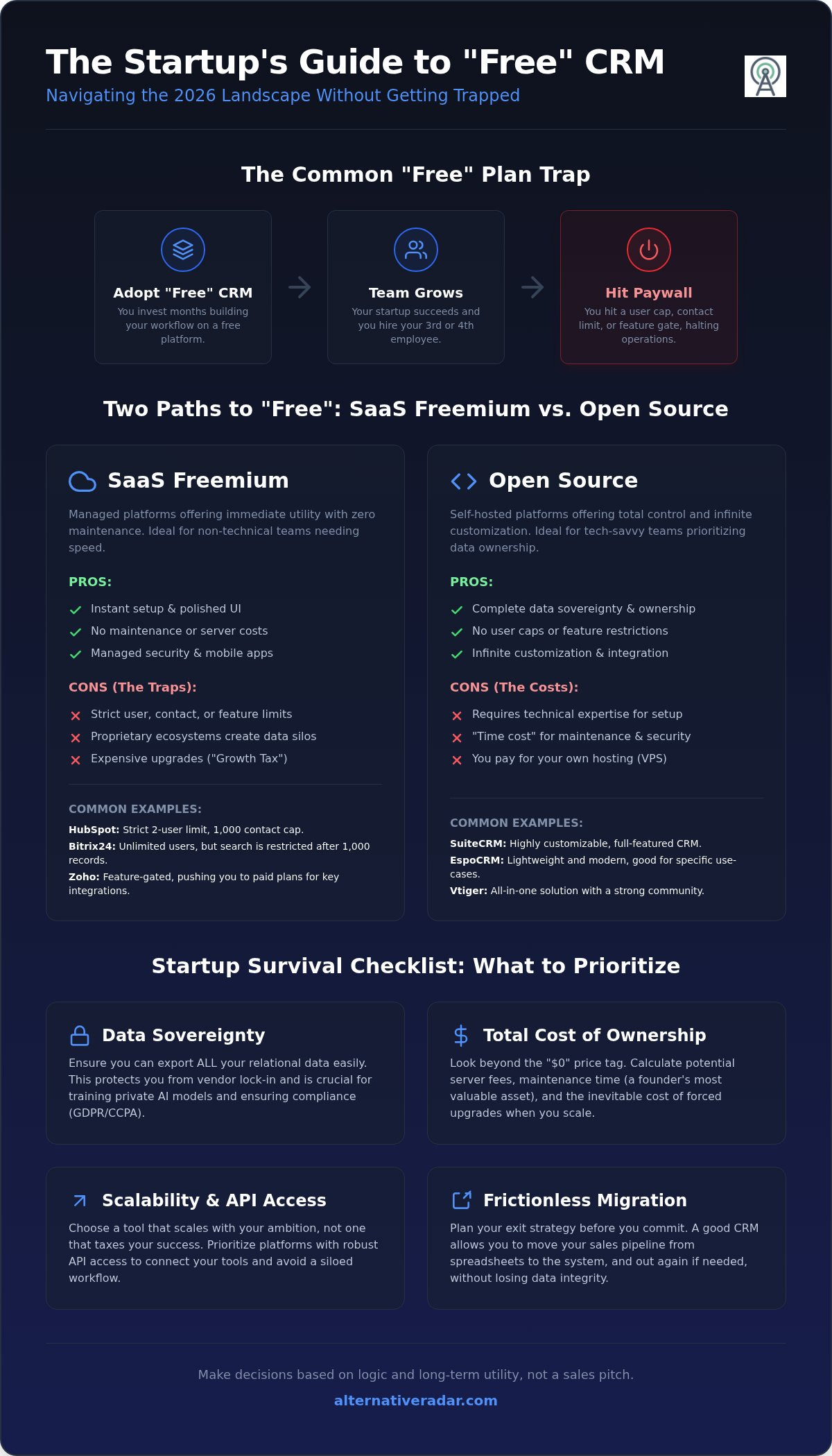
Feature gating is the primary momentum killer for modern founders. You build your entire sales process around a tool only to find that a critical API connection or reporting view is locked behind a paywall. This creates a hidden cost of moving your data later. Proprietary “free” tiers are often designed as lead magnets rather than long-term solutions. User limits are the most common trap. A plan that is “free for 2 users” forces an expensive upgrade the moment you hire your third employee. This creates an artificial ceiling on your team’s collaboration and growth.

Why 2026 is the Year of Data Sovereignty

2026 marks a decisive shift toward data sovereignty. Smart startups now prioritize owning their customer records to train private, local AI models. Using an open-source CRM provides “free as in speech” advantages, allowing you to modify the source code and host data on your own infrastructure. This approach simplifies compliance with evolving GDPR and CCPA requirements because you aren’t transmitting sensitive records to a third-party cloud. You maintain full control over your most valuable asset: your customer relationships. This independence is vital for long-term scalability and security.

Evaluating “Free”: SaaS Freemium vs. Open Source

Choosing a free crm for startups requires looking beyond the sticker price. Total Cost of Ownership (TCO) is the metric that matters most for early-stage companies. SaaS tiers offer zero licensing fees but often impose indirect costs through restrictive user caps and data silos. Conversely, open-source platforms demand hardware and time investments but eliminate the “growth tax” associated with per-seat billing. You’re trading money for time, or time for autonomy.

Maintenance overhead is the silent killer of startup productivity. A founder’s time is their most expensive resource. If you spend four hours a month patching a server, that’s time stolen from customer acquisition. SaaS models eliminate this burden entirely. However, if your business model relies on high-security data or custom API deep-links, the rigidity of a SaaS “free” tier might actually slow you down more than managing your own instance would.

The SaaS Freemium Model (HubSpot, Zoho, Bitrix24)

This model prioritizes speed and professional polish. You can deploy a functional interface in minutes without managing security patches. Platforms like HubSpot and Zoho provide excellent mobile apps and managed uptime. The trade-off is the ceiling. For example, HubSpot’s 2026 free tier enforces a strict 2-user limit and a 1,000-contact cap. Bitrix24 offers unlimited users but restricts your search capabilities once you exceed 1,000 records. These are best for solo founders or non-technical teams needing immediate utility. If you’re unsure which path to take, you can compare these SaaS providers against niche competitors to see which fits your specific workflow.

The Open Source Model (SuiteCRM, EspoCRM, Vtiger)

Open-source solutions like SuiteCRM or EspoCRM offer infinite customization and zero user caps. You own the database, the code, and the infrastructure. This is the ultimate hedge against the SaaS price hikes we’ve seen throughout 2026. The “time cost” is the primary barrier; you’ll need technical expertise to handle the initial setup, backups, and security hardening. While the software is free, you’ll pay for a Virtual Private Server (VPS) to host it. This model is ideal for tech-heavy startups or those with high-security requirements that mandate keeping data on-premises.

Integration capabilities vary by model. SaaS tools usually offer a “one-click” marketplace for popular apps like Slack or Gmail. Open-source tools require more manual API configuration but offer deeper access to the underlying data architecture. Security responsibility also shifts. With SaaS, the vendor handles encryption and uptime. With open source, your team is responsible for patching vulnerabilities. When a system goes down, the SaaS user waits for a status page update, while the open-source user checks their own server logs.

Top Free CRM Solutions for Startups (Vetted for 2026)

Selecting a free crm for startups involves more than just checking a feature list. You need a platform that offers a clear path from your first lead to a scaled operation without hitting a technical or financial wall. Alternative Radar has vetted the following tools based on three 2026 benchmarks: architectural stability, active community support, and AI readiness. We prioritize tools that allow you to maintain momentum as your team grows.

Evaluate these options based on your specific technical resources. While SaaS platforms provide immediate access, open-source alternatives offer superior long-term flexibility. For a deeper technical breakdown of licensing and server requirements, consult our Open Source CRM Software Comparison. Use this analysis to filter out software that prioritizes vendor lock-in over user utility.

Best for B2B Sales: SuiteCRM

SuiteCRM remains the most robust alternative for startups managing complex, multi-stage B2B sales cycles. It provides deep workflow automation that typically requires a high-tier Salesforce subscription. You can build custom modules and intricate relationship maps without paying a per-user tax. The 2026 SuiteCRM community is particularly active, offering a vast library of third-party plugins and local LLM integrations. This allows you to deploy advanced lead scoring while keeping your data on your own infrastructure.

Best for Lightweight Agility: EspoCRM

EspoCRM is the optimal choice for teams that value speed and a modern, responsive interface. It follows an API-first philosophy, making it the perfect anchor for a decentralized startup stack. You can customize the entire UI to match your specific niche, from real estate to SaaS. Because it’s lightweight, it runs efficiently on low-cost VPS hosting, keeping your overhead minimal. Choose EspoCRM if you need a fast, intuitive system that doesn’t overwhelm your team with legacy bloat.

Best for All-in-One Utility: Bitrix24 (Free Tier)

Bitrix24 offers the most comprehensive feature set for teams needing integrated project management, communication, and CRM in a single interface. The free plan supports unlimited users and includes 5 GB of storage along with the AI assistant, CoPilot. However, be aware of the 2026 limitations: the free tier imposes a 1,000-record search ceiling. This “everything included” approach is highly efficient for early-stage operations, but it can become a distraction if your team only needs a dedicated sales tool. Monitor your record count closely to avoid hitting the search limit during critical growth phases.
Best Free CRM for Startups in 2026: Beyond the SaaS Paywall

Scalability and Data Ownership: The Startup Survival Guide

The “Day 365” problem is a looming threat for every founder. You outgrow your free tier on your first anniversary, and the vendor immediately hikes the price to a level your cash flow can’t support. If your free crm for startups doesn’t allow for a full relational data export, you’re effectively a hostage. A flat CSV file containing names and emails is insufficient. You need the underlying connections; the history of every interaction, every deal stage, and every associated task. Without these links, migrating to a new system is a manual nightmare that costs hundreds of man-hours.

Your CRM is the heart of your operation, but it shouldn’t be an island. It must connect seamlessly to your communication channels. If you’ve moved away from mainstream platforms to use Slack alternatives, your CRM needs an open API to push real-time notifications and pull activity logs. This connectivity ensures that your sales data and team discussions remain synchronized without manual data entry. Data is your leverage. You must own the infrastructure that holds it.

Building an API-First Startup Stack

Building an API-first stack is the most effective way to maintain flexibility as you scale. Modern founders use automation platforms like Zapier or Make to bridge the functional gaps in free tiers. If a tool lacks a native integration for your specific marketing stack, a robust REST API is your necessary backup plan. We’re seeing a rise in “Headless CRM” for 2026 startups. This architectural choice treats the CRM as a database accessed via API, while the team interacts through custom or specialized front-end tools. Before committing, have your technical lead evaluate the documentation. If the API docs are poorly maintained, the software is a legacy risk. To avoid these traps, explore vetted software options that prioritize long-term independence over short-term convenience.

The Future-Proofing Checklist

Use this future-proofing checklist to evaluate any potential tool before you input a single customer record. First, check for multi-currency and global time zone support; scaling often means hiring or selling across borders. Second, verify the limit on custom fields. Many proprietary tools let you add five fields for free but charge a premium for the sixth. Finally, look at the integration marketplace. An active community building third-party modules is a strong indicator of platform longevity. You can find more detailed vetting criteria in our guide on Finding the Best Alternative to Popular Software in 2026.

Implementation: Getting Started Without the “Free” Friction

Transitioning from a chaotic spreadsheet to a dedicated free crm for startups is a critical inflection point for your growth. Research indicates that 71% of small businesses already use a CRM to manage relationships, yet many struggle with the initial setup. Start by auditing your current data. Scrub your spreadsheets for duplicates and standardize your column headers before you attempt an import. This preparation prevents “garbage in, garbage out” scenarios that often kill early adoption.

Deploy a web-to-lead form on your primary landing pages immediately. This connection ensures that every inquiry flows directly into your pipeline without manual data entry. For team training, skip the expensive consultants. Instead, identify an internal power user to document three core workflows: lead entry, deal progression, and activity logging. Adoption succeeds when the tool feels like a shortcut, not a chore. The Digital Scout suggests testing at least two options simultaneously to see which interface actually matches your team’s natural rhythm.

The 30-Day CRM Pilot Program

Don’t commit your entire operation to a single platform on day one. Run a 30-day pilot program using a sandbox environment with a small subset of real data. This allows you to test how the software handles your specific sales cycle without risking your entire database. Measure success through objective KPIs:

  • Reduction in hours spent on manual data entry.
  • Accuracy of weekly pipeline forecasts compared to previous months.
  • Team engagement metrics and frequency of log-ins.

For a broader perspective on how these tools fit into a modern enterprise stack, review our guide to Popular Open Source Business Software 2026. This helps you align your CRM choice with your long-term infrastructure goals.

Take Control of Your Software Roadmap

Alternative Radar exists to provide the clarity you need to bypass the SaaS paywall. We empower you to choose software based on technical utility and data sovereignty rather than a vendor’s marketing budget. Your CRM must remain a scalable asset that supports your team’s velocity, never a monthly liability that drains your runway. If you’re ready to explore other categories, view our full list of SaaS alternatives to build a truly independent tech stack. Make a choice that keeps you in control of your data and your future.

Securing Your Growth Beyond the Paywall

Selecting a free crm for startups is a strategic decision that determines your operational flexibility for years to come. You now have the framework to distinguish between the immediate utility of SaaS freemium models and the long-term autonomy of open-source platforms. Your priority must remain data sovereignty. Ensure your records are portable and your workflows are automated before you hit the inevitable scaling ceiling of proprietary systems.

Alternative Radar acts as your neutral advisor in this search. We provide objective, commission-neutral scouting and 2026-ready technical analysis across a global database of over 1,000+ software alternatives. We do the hard work of testing so you can focus on building your business. Our goal is to empower you to make smarter choices that value your time and resources without following biased market leaders.

Take the next step in optimizing your operations today. Discover more powerful software alternatives on Alternative Radar and build a tech stack that serves as an asset, not a liability. You have the strategy; now choose the tool that scales with your ambition.

Frequently Asked Questions

Is a free CRM actually enough for a growing startup in 2026?

A free CRM is sufficient for most early-stage operations if you carefully manage its specific technical constraints. Many 2026 platforms now bundle AI-powered lead prioritization and basic automation that were previously locked behind paywalls. Success depends on your ability to work within user caps and record ceilings. If your team plans to stay under five members, these tools provide enough utility to run professional operations without a monthly subscription.

What are the main differences between HubSpot Free and open-source CRM?

HubSpot Free offers a polished, managed experience with zero setup time but imposes rigid limits on custom fields and user seats. In contrast, open-source models provide infinite flexibility and full data sovereignty without per-user fees. The decision between them hinges on your technical resources. Choosing a free crm for startups requires balancing the convenience of a managed cloud against the long-term autonomy of owning your database.

Do I need a developer to set up an open-source CRM for my startup?

You will generally need someone with server management experience to handle the initial deployment and security configuration of open-source software. While many modern hosting services provide automated installers, a developer is essential if you require custom modules or complex API connections. Tech-heavy startups often prefer this model because it trades upfront technical effort for the total elimination of monthly per-user licensing costs as the team expands.

Can I migrate my data from a free CRM to a paid one later?

Data migration is possible on most platforms, but the complexity depends on how the software stores relational information. Most SaaS tools offer a seamless upgrade path within their own ecosystem. However, moving to a different vendor often results in the loss of interaction history or deal timestamps. Prioritize tools with robust API access or full SQL export capabilities to ensure your most valuable customer insights aren’t trapped in a silo.

Are free CRMs secure enough for sensitive customer data?

Security is a function of implementation rather than software cost. SaaS providers handle the heavy lifting of encryption, server maintenance, and compliance audits, making them a safe choice for non-technical teams. If you choose a self-hosted open-source tool, the responsibility for patching vulnerabilities and managing backups falls on your internal team. Both models are highly secure as long as you enforce strong password policies and enable two-factor authentication for all users.

What are the hidden costs of using a “free” self-hosted CRM?

The hidden costs of self-hosting include your monthly VPS hosting fees and the significant time cost of system administration. While the software license is free, you’re responsible for the infrastructure it runs on. Founders often overlook the opportunity cost of spending hours on server maintenance instead of customer acquisition. You must calculate whether the monthly savings on user seats outweigh the technical overhead required to keep the system running efficiently.

Do free CRMs include mobile apps for sales teams?

Most SaaS freemium providers include functional mobile apps that allow your sales team to manage leads and update deals on the go. Open-source platforms sometimes lack native apps, relying instead on mobile-responsive web interfaces that may not support push notifications. If your sales workflow requires field work, test the mobile experience of your chosen free crm for startups before committing your data. Mobile accessibility is often a deciding factor for remote teams.

Which free CRM has the best AI features for startups?

Bitrix24 currently offers the most comprehensive AI suite for free users in 2026 through its CoPilot assistant. It assists with task descriptions, lead scoring, and content generation without requiring a paid add-on. Other providers like HubSpot and Zoho have integrated basic AI tools for email drafting and predictive analytics into their free tiers to stay competitive. Evaluate these features based on how well they automate your specific, repetitive sales and marketing tasks.


Best Free CRM for Startups in 2026: Beyond the SaaS Paywall

Most “free” CRM plans are actually sophisticated traps designed to lock your data behind a paywall the moment your team hits its fourth hire. It’s a common cycle where you invest months into a platform only to find your growth stalled by artificial user caps or a $1.2 trillion communication gap caused by disconnected tools. You deserve a system that scales with your ambition, not one that taxes your success.

We understand the frustration of seeing your operational agility limited by proprietary ecosystems and hidden fees. This guide cuts through the marketing hype to help you find the best free crm for startups in 2026, focusing on platforms that guarantee zero-cost operations for your first 12 to 24 months. You’ll learn how to maintain full ownership of your customer records and ensure seamless data migration before you ever sign a contract.

We have vetted the latest offerings from 2026, comparing the AI-driven features of SaaS leaders against the sovereignty of open-source alternatives. This analysis provides the clarity you need to choose a tool that prioritizes your startup’s long-term efficiency over a vendor’s quarterly earnings.

Key Takeaways

  • Identify the structural differences between SaaS freemium and self-hosted open-source models to avoid common scaling traps.
  • Evaluate the total cost of ownership to ensure your chosen free crm for startups doesn’t introduce surprise server or maintenance fees.
  • Protect your business’s future by prioritizing data sovereignty and ensuring full portability of relational customer records.
  • Explore vetted 2026 software picks that offer high utility and API extensibility without forcing early paid upgrades.
  • Implement a friction-free migration strategy to move your sales pipeline from manual spreadsheets to an automated system.

The Landscape of Free CRM for Startups in 2026

The definition of a free crm for startups has evolved significantly. In 2026, it’s no longer just a stripped-down trial version of a premium product. It’s a strategic choice between SaaS freemium models and self-hosted open-source platforms. SaaS options offer immediate utility and zero maintenance, but they often lead to “SaaS fatigue.” This trend stems from a growing resentment toward monthly per-user fees that effectively punish a startup for growing its team. Efficiency is the goal. You need a system that supports your workflow without becoming a line-item liability.

Alternative Radar acts as your digital scout in this crowded market. We look past the polished marketing hype to find tools that offer genuine technical value. AI is now a baseline expectation rather than a luxury. Even the most basic free crm for startups now includes automated lead scoring or content assistance. However, the true value lies in how these tools handle your data and whether they allow you to scale without friction. We prioritize utility and transparency so you can make a decision based on logic, not a salesperson’s pitch.

The Problem with Proprietary “Free” Tiers

Feature gating is the primary momentum killer for modern founders. You build your entire sales process around a tool only to find that a critical API connection or reporting view is locked behind a paywall. This creates a hidden cost of moving your data later. Proprietary “free” tiers are often designed as lead magnets rather than long-term solutions. User limits are the most common trap. A plan that is “free for 2 users” forces an expensive upgrade the moment you hire your third employee. This creates an artificial ceiling on your team’s collaboration and growth.

Why 2026 is the Year of Data Sovereignty

2026 marks a decisive shift toward data sovereignty. Smart startups now prioritize owning their customer records to train private, local AI models. Using an open-source CRM provides “free as in speech” advantages, allowing you to modify the source code and host data on your own infrastructure. This approach simplifies compliance with evolving GDPR and CCPA requirements because you aren’t transmitting sensitive records to a third-party cloud. You maintain full control over your most valuable asset: your customer relationships. This independence is vital for long-term scalability and security.

Evaluating “Free”: SaaS Freemium vs. Open Source

Choosing a free crm for startups requires looking beyond the sticker price. Total Cost of Ownership (TCO) is the metric that matters most for early-stage companies. SaaS tiers offer zero licensing fees but often impose indirect costs through restrictive user caps and data silos. Conversely, open-source platforms demand hardware and time investments but eliminate the “growth tax” associated with per-seat billing. You’re trading money for time, or time for autonomy.

Maintenance overhead is the silent killer of startup productivity. A founder’s time is their most expensive resource. If you spend four hours a month patching a server, that’s time stolen from customer acquisition. SaaS models eliminate this burden entirely. However, if your business model relies on high-security data or custom API deep-links, the rigidity of a SaaS “free” tier might actually slow you down more than managing your own instance would.

The SaaS Freemium Model (HubSpot, Zoho, Bitrix24)

This model prioritizes speed and professional polish. You can deploy a functional interface in minutes without managing security patches. Platforms like HubSpot and Zoho provide excellent mobile apps and managed uptime. The trade-off is the ceiling. For example, HubSpot’s 2026 free tier enforces a strict 2-user limit and a 1,000-contact cap. Bitrix24 offers unlimited users but restricts your search capabilities once you exceed 1,000 records. These are best for solo founders or non-technical teams needing immediate utility. If you’re unsure which path to take, you can compare these SaaS providers against niche competitors to see which fits your specific workflow.

The Open Source Model (SuiteCRM, EspoCRM, Vtiger)

Open-source solutions like SuiteCRM or EspoCRM offer infinite customization and zero user caps. You own the database, the code, and the infrastructure. This is the ultimate hedge against the SaaS price hikes we’ve seen throughout 2026. The “time cost” is the primary barrier; you’ll need technical expertise to handle the initial setup, backups, and security hardening. While the software is free, you’ll pay for a Virtual Private Server (VPS) to host it. This model is ideal for tech-heavy startups or those with high-security requirements that mandate keeping data on-premises.

Integration capabilities vary by model. SaaS tools usually offer a “one-click” marketplace for popular apps like Slack or Gmail. Open-source tools require more manual API configuration but offer deeper access to the underlying data architecture. Security responsibility also shifts. With SaaS, the vendor handles encryption and uptime. With open source, your team is responsible for patching vulnerabilities. When a system goes down, the SaaS user waits for a status page update, while the open-source user checks their own server logs.

Top Free CRM Solutions for Startups (Vetted for 2026)

Selecting a free crm for startups involves more than just checking a feature list. You need a platform that offers a clear path from your first lead to a scaled operation without hitting a technical or financial wall. Alternative Radar has vetted the following tools based on three 2026 benchmarks: architectural stability, active community support, and AI readiness. We prioritize tools that allow you to maintain momentum as your team grows.

Evaluate these options based on your specific technical resources. While SaaS platforms provide immediate access, open-source alternatives offer superior long-term flexibility. For a deeper technical breakdown of licensing and server requirements, consult our Open Source CRM Software Comparison. Use this analysis to filter out software that prioritizes vendor lock-in over user utility.

Best for B2B Sales: SuiteCRM

SuiteCRM remains the most robust alternative for startups managing complex, multi-stage B2B sales cycles. It provides deep workflow automation that typically requires a high-tier Salesforce subscription. You can build custom modules and intricate relationship maps without paying a per-user tax. The 2026 SuiteCRM community is particularly active, offering a vast library of third-party plugins and local LLM integrations. This allows you to deploy advanced lead scoring while keeping your data on your own infrastructure.

Best for Lightweight Agility: EspoCRM

EspoCRM is the optimal choice for teams that value speed and a modern, responsive interface. It follows an API-first philosophy, making it the perfect anchor for a decentralized startup stack. You can customize the entire UI to match your specific niche, from real estate to SaaS. Because it’s lightweight, it runs efficiently on low-cost VPS hosting, keeping your overhead minimal. Choose EspoCRM if you need a fast, intuitive system that doesn’t overwhelm your team with legacy bloat.

Best for All-in-One Utility: Bitrix24 (Free Tier)

Bitrix24 offers the most comprehensive feature set for teams needing integrated project management, communication, and CRM in a single interface. The free plan supports unlimited users and includes 5 GB of storage along with the AI assistant, CoPilot. However, be aware of the 2026 limitations: the free tier imposes a 1,000-record search ceiling. This “everything included” approach is highly efficient for early-stage operations, but it can become a distraction if your team only needs a dedicated sales tool. Monitor your record count closely to avoid hitting the search limit during critical growth phases.

Best Free CRM for Startups in 2026: Beyond the SaaS Paywall

Scalability and Data Ownership: The Startup Survival Guide

The “Day 365” problem is a looming threat for every founder. You outgrow your free tier on your first anniversary, and the vendor immediately hikes the price to a level your cash flow can’t support. If your free crm for startups doesn’t allow for a full relational data export, you’re effectively a hostage. A flat CSV file containing names and emails is insufficient. You need the underlying connections; the history of every interaction, every deal stage, and every associated task. Without these links, migrating to a new system is a manual nightmare that costs hundreds of man-hours.

Your CRM is the heart of your operation, but it shouldn’t be an island. It must connect seamlessly to your communication channels. If you’ve moved away from mainstream platforms to use Slack alternatives, your CRM needs an open API to push real-time notifications and pull activity logs. This connectivity ensures that your sales data and team discussions remain synchronized without manual data entry. Data is your leverage. You must own the infrastructure that holds it.

Building an API-First Startup Stack

Building an API-first stack is the most effective way to maintain flexibility as you scale. Modern founders use automation platforms like Zapier or Make to bridge the functional gaps in free tiers. If a tool lacks a native integration for your specific marketing stack, a robust REST API is your necessary backup plan. We’re seeing a rise in “Headless CRM” for 2026 startups. This architectural choice treats the CRM as a database accessed via API, while the team interacts through custom or specialized front-end tools. Before committing, have your technical lead evaluate the documentation. If the API docs are poorly maintained, the software is a legacy risk. To avoid these traps, explore vetted software options that prioritize long-term independence over short-term convenience.

The Future-Proofing Checklist

Use this future-proofing checklist to evaluate any potential tool before you input a single customer record. First, check for multi-currency and global time zone support; scaling often means hiring or selling across borders. Second, verify the limit on custom fields. Many proprietary tools let you add five fields for free but charge a premium for the sixth. Finally, look at the integration marketplace. An active community building third-party modules is a strong indicator of platform longevity. You can find more detailed vetting criteria in our guide on Finding the Best Alternative to Popular Software in 2026.

Implementation: Getting Started Without the “Free” Friction

Transitioning from a chaotic spreadsheet to a dedicated free crm for startups is a critical inflection point for your growth. Research indicates that 71% of small businesses already use a CRM to manage relationships, yet many struggle with the initial setup. Start by auditing your current data. Scrub your spreadsheets for duplicates and standardize your column headers before you attempt an import. This preparation prevents “garbage in, garbage out” scenarios that often kill early adoption.

Deploy a web-to-lead form on your primary landing pages immediately. This connection ensures that every inquiry flows directly into your pipeline without manual data entry. For team training, skip the expensive consultants. Instead, identify an internal power user to document three core workflows: lead entry, deal progression, and activity logging. Adoption succeeds when the tool feels like a shortcut, not a chore. The Digital Scout suggests testing at least two options simultaneously to see which interface actually matches your team’s natural rhythm.

The 30-Day CRM Pilot Program

Don’t commit your entire operation to a single platform on day one. Run a 30-day pilot program using a sandbox environment with a small subset of real data. This allows you to test how the software handles your specific sales cycle without risking your entire database. Measure success through objective KPIs:

  • Reduction in hours spent on manual data entry.
  • Accuracy of weekly pipeline forecasts compared to previous months.
  • Team engagement metrics and frequency of log-ins.

For a broader perspective on how these tools fit into a modern enterprise stack, review our guide to Popular Open Source Business Software 2026. This helps you align your CRM choice with your long-term infrastructure goals.

Take Control of Your Software Roadmap

Alternative Radar exists to provide the clarity you need to bypass the SaaS paywall. We empower you to choose software based on technical utility and data sovereignty rather than a vendor’s marketing budget. Your CRM must remain a scalable asset that supports your team’s velocity, never a monthly liability that drains your runway. If you’re ready to explore other categories, view our full list of SaaS alternatives to build a truly independent tech stack. Make a choice that keeps you in control of your data and your future.

Securing Your Growth Beyond the Paywall

Selecting a free crm for startups is a strategic decision that determines your operational flexibility for years to come. You now have the framework to distinguish between the immediate utility of SaaS freemium models and the long-term autonomy of open-source platforms. Your priority must remain data sovereignty. Ensure your records are portable and your workflows are automated before you hit the inevitable scaling ceiling of proprietary systems.

Alternative Radar acts as your neutral advisor in this search. We provide objective, commission-neutral scouting and 2026-ready technical analysis across a global database of over 1,000+ software alternatives. We do the hard work of testing so you can focus on building your business. Our goal is to empower you to make smarter choices that value your time and resources without following biased market leaders.

Take the next step in optimizing your operations today. Discover more powerful software alternatives on Alternative Radar and build a tech stack that serves as an asset, not a liability. You have the strategy; now choose the tool that scales with your ambition.

Frequently Asked Questions

Is a free CRM actually enough for a growing startup in 2026?

A free CRM is sufficient for most early-stage operations if you carefully manage its specific technical constraints. Many 2026 platforms now bundle AI-powered lead prioritization and basic automation that were previously locked behind paywalls. Success depends on your ability to work within user caps and record ceilings. If your team plans to stay under five members, these tools provide enough utility to run professional operations without a monthly subscription.

What are the main differences between HubSpot Free and open-source CRM?

HubSpot Free offers a polished, managed experience with zero setup time but imposes rigid limits on custom fields and user seats. In contrast, open-source models provide infinite flexibility and full data sovereignty without per-user fees. The decision between them hinges on your technical resources. Choosing a free crm for startups requires balancing the convenience of a managed cloud against the long-term autonomy of owning your database.

Do I need a developer to set up an open-source CRM for my startup?

You will generally need someone with server management experience to handle the initial deployment and security configuration of open-source software. While many modern hosting services provide automated installers, a developer is essential if you require custom modules or complex API connections. Tech-heavy startups often prefer this model because it trades upfront technical effort for the total elimination of monthly per-user licensing costs as the team expands.

Can I migrate my data from a free CRM to a paid one later?

Data migration is possible on most platforms, but the complexity depends on how the software stores relational information. Most SaaS tools offer a seamless upgrade path within their own ecosystem. However, moving to a different vendor often results in the loss of interaction history or deal timestamps. Prioritize tools with robust API access or full SQL export capabilities to ensure your most valuable customer insights aren’t trapped in a silo.

Are free CRMs secure enough for sensitive customer data?

Security is a function of implementation rather than software cost. SaaS providers handle the heavy lifting of encryption, server maintenance, and compliance audits, making them a safe choice for non-technical teams. If you choose a self-hosted open-source tool, the responsibility for patching vulnerabilities and managing backups falls on your internal team. Both models are highly secure as long as you enforce strong password policies and enable two-factor authentication for all users.

What are the hidden costs of using a “free” self-hosted CRM?

The hidden costs of self-hosting include your monthly VPS hosting fees and the significant time cost of system administration. While the software license is free, you’re responsible for the infrastructure it runs on. Founders often overlook the opportunity cost of spending hours on server maintenance instead of customer acquisition. You must calculate whether the monthly savings on user seats outweigh the technical overhead required to keep the system running efficiently.

Do free CRMs include mobile apps for sales teams?

Most SaaS freemium providers include functional mobile apps that allow your sales team to manage leads and update deals on the go. Open-source platforms sometimes lack native apps, relying instead on mobile-responsive web interfaces that may not support push notifications. If your sales workflow requires field work, test the mobile experience of your chosen free crm for startups before committing your data. Mobile accessibility is often a deciding factor for remote teams.

Which free CRM has the best AI features for startups?

Bitrix24 currently offers the most comprehensive AI suite for free users in 2026 through its CoPilot assistant. It assists with task descriptions, lead scoring, and content generation without requiring a paid add-on. Other providers like HubSpot and Zoho have integrated basic AI tools for email drafting and predictive analytics into their free tiers to stay competitive. Evaluate these features based on how well they automate your specific, repetitive sales and marketing tasks.

About

AlternativeRadar helps you discover the best alternatives to popular software, tools and products fast, clear, and unbiased.

Guides

Other Alternatives

Alternative to Otter ai

View

Alternative to Thundr omegle alternative

View

Alternative to Peek gif screen recorder for linux

View

Alternative to Google earth

View