

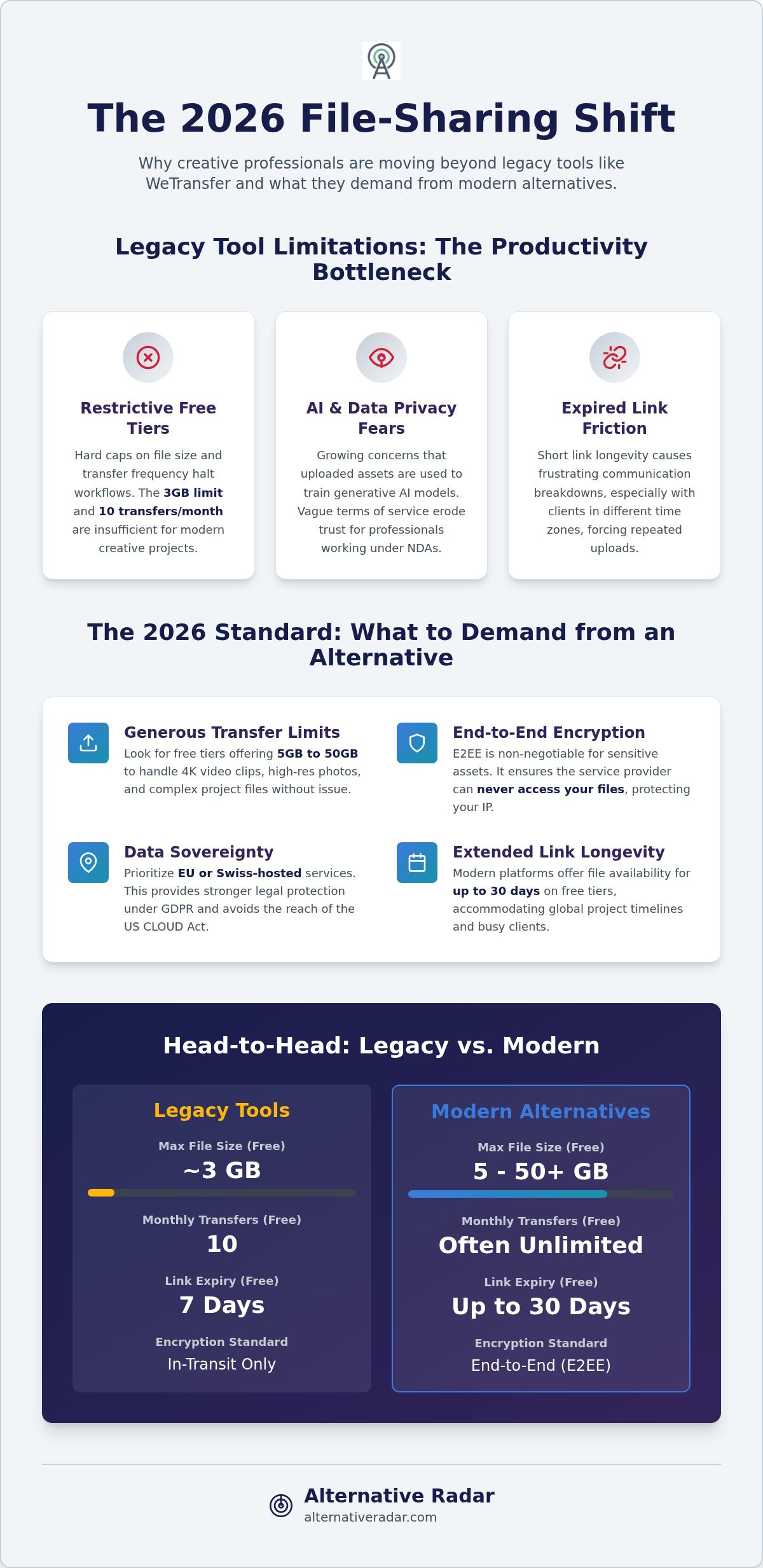
Sticking with legacy file-sharing tools in 2026 is a habit that actively compromises your productivity. You’ve likely felt the friction of WeTransfer’s 3GB monthly cap and 10-transfer limit, which often halts your workflow right when you need it most. Between those tight restrictions and growing concerns about AI models training on your private assets, the search for reliable free wetransfer alternatives has become a priority for high-output creators and teams.
It’s frustrating when a file expires before a client even opens their email. We’ve acted as your digital scout, testing the latest platforms to find tools that offer 5GB to 50GB transfers with no account required. This article compares the top seven options based on transfer limits, link longevity, and data sovereignty. You’ll gain the clarity needed to move away from restrictive legacy platforms and adopt a solution that respects your time and your data.
Key Takeaways
- Reclaim your bandwidth by switching to tools that offer 5GB to 50GB limits. We identify the most reliable free wetransfer alternatives that bypass the 2026 industry-standard caps.
- Secure your intellectual property against unauthorized AI data harvesting. Learn which providers offer Swiss-hosted privacy and end-to-end encryption for sensitive professional assets.
- Eliminate the “expired link” friction in your client communications. Discover platforms that offer up to 30 days of file availability on their free tiers to accommodate global project timelines.
- Optimize your workflow by selecting specialized tools for high-capacity video or secure documents. Use our evaluation criteria to find the right fit for your specific 2026 output requirements.
The 2026 WeTransfer Shift: Why Users are Leaving
For over a decade, WeTransfer was the undisputed default for quick file sharing. However, the landscape shifted significantly following its acquisition by Bending Spoons. What was once a frictionless utility has transformed into a heavily gated ecosystem that prioritizes subscription conversions over user experience. This shift has forced millions of creative professionals and small businesses to actively hunt for free wetransfer alternatives that still respect the concept of a “free tier.”
The Bending Spoons Era and Feature Gating
The acquisition marked a clear pivot in the platform’s roadmap. The most disruptive change was the introduction of a hard 10-transfer monthly cap for non-paying users. In 2026, this limit is often reached within the first few days of a project cycle; effectively rendering the free version useless for active freelancers. Beyond the frequency cap, the 3GB size limit feels increasingly archaic as standard file sizes for video and design continue to balloon. Alternative Radar monitors these industry shifts to ensure you are finding the best alternative to popular software without falling into marketing traps.
Data Privacy and AI Training Fears
Trust became the primary currency in the file-sharing market following the 2025-2026 AI data usage controversy. Users grew wary of vague terms of service that seemed to blur the line between automated moderation and using uploaded assets to train generative AI models. For professionals working under strict NDAs, even the perception of data harvesting is a dealbreaker. This trust erosion has sparked a mass migration toward European-hosted providers that offer localized data residency and stricter GDPR enforcement. When reviewing a Comparison of file hosting services, it becomes clear that modern users now prioritize “data sovereignty” as much as they do transfer speeds.
Relying on a “legacy” brand out of habit has become a genuine productivity bottleneck. A 3GB limit is no longer sufficient for a single 4K ProRes clip or a complex architectural render. When your tools stop serving your workflow and start dictating it, it’s time to move on. Choosing a new platform isn’t just about finding more space; it’s about reclaiming a workflow where the technology stays out of the way. The following sections will guide you through the high-limit, privacy-first tools that have stepped up to fill the void left by WeTransfer’s restrictive new era.
Evaluation Criteria: How to Choose Your Next Transfer Tool
Selecting a file sharing tool based solely on its storage limit is a common mistake. In 2026, efficiency is defined by how well a platform handles the technical nuances of the transfer process. This includes the duration the link remains active and the level of security protecting the contents. While legacy tools have regressed, several free wetransfer alternatives have emerged that prioritize these utility driven features. You need to look for a balance between capacity, speed, and privacy to avoid workflow bottlenecks.
Technical Standards for 2026
End to end encryption (E2EE) is no longer a luxury; it’s a requirement for professional data sovereignty. E2EE ensures that files are encrypted on your device before they even reach the server. This prevents the service provider from accessing your data for moderation or AI training. Server location also plays a critical role in your legal compliance. Tools hosted in the EU provide stronger protection under GDPR compared to those subject to the US CLOUD Act. High security environments, such as those requiring secure file transfer for researchers, set the benchmark for what professional users should expect from their digital tools. Additionally, look for an “Upload Resume” feature. This is vital for transferring 50GB archives over unstable connections, as it prevents you from having to restart a failed upload from zero percent.
The Hidden Cost of “Free”
Every free service has a monetization strategy. You must distinguish between tools that sell your usage data and those that utilize a transparent freemium model. Many high quality platforms stay free by using programmatic display advertising on the download page. This is a fair trade for the user, provided the interface remains clean. Avoid platforms with ad heavy layouts that use “dark patterns” like fake download buttons. These confuse your clients and reflect poorly on your professionalism. At Alternative Radar, we focus on identifying these utility driven features so you can filter out the noise and make a logical choice. We value tools that offer a frictionless experience, meaning no account creation is required for the sender or the recipient. This removes the final barrier to a truly efficient workflow.
- File Capacity: Look for at least 5GB to 50GB per transfer to accommodate 2026 file sizes.
- Link Longevity: Aim for a minimum of 7 to 14 days of availability.
- Security: Prioritize password protection and E2EE.
- Accessibility: Ensure the recipient can download without creating an account.
The Top 7 Free WeTransfer Alternatives for 2026
Finding a reliable utility for large file transfers in 2026 requires looking past marketing claims to find actual bandwidth and privacy. We have vetted dozens of platforms to identify the most effective free wetransfer alternatives that solve the pain of expiring links and restrictive caps. These tools prioritize your time and data sovereignty, ensuring your professional assets reach their destination without the friction of legacy gated features.
SwissTransfer and Smash: For the Heavy Lifters
SwissTransfer stands as the current heavyweight champion of the free market. It offers a massive 50GB limit per transfer and allows links to remain active for up to 30 days. Because it is Swiss-hosted, it provides a level of privacy and legal protection that US-based tools cannot match. Smash takes a different approach by offering no strict file size limit on its free tier. However, there is a caveat: transfers over 2GB are placed in a non-priority queue. During peak hours, this can lead to slower speeds compared to a priority transfer. When comparing the recipient experience, both tools lead with clean, professional interfaces. They allow for file previews, which builds immediate trust with your clients before they hit the download button.
TransferNow and pCloud: For Reliable Daily Use
TransferNow provides a balanced 5GB limit per send. It distinguishes itself by offering robust password protection on its free plan; a feature that legacy competitors often hide behind a paywall. pCloud Transfer also offers 5GB sends without requiring any registration, making it a fast choice for one-off tasks. For users who need immediate, real-time delivery, Send Anywhere utilizes a 6-digit code system. This bypasses the need for link management entirely and is ideal for quick mobile to desktop handoffs. These platforms ensure that your daily administrative tasks don’t become a productivity bottleneck.
Creative Workflow Integrations
HypeShare is a notable 10GB newcomer designed specifically for creators who need higher capacity and better security for work-in-progress assets. In contrast, Dropbox Transfer remains limited to a 100MB cap for free users. This makes it almost exclusively useful for those already deeply embedded in the Dropbox storage ecosystem. Just as you might seek the best free alternatives to photoshop to streamline your creative output, choosing a high-capacity transfer tool prevents technical lag. Transfer Throttling is the intentional reduction of bandwidth by a provider once a file exceeds a specific size threshold, which can turn a high-bitrate 4K video upload into a multi-hour ordeal. Avoiding throttled services is essential for maintaining a professional delivery schedule.
- SwissTransfer: Best for massive 50GB archives and long-term link availability.
- Smash: Best for sending files of any size when speed is not the primary concern.
- TransferNow: Best for 5GB transfers that require password security.
- Send Anywhere: Best for real-time transfers using secure 6-digit codes.
Specialized Guidance: Matching Tools to Use Cases
A tool that works for a quick PDF transfer might fail when you are delivering a 50GB video project. Efficiency in 2026 depends on matching the specific requirements of your file type to the strengths of the platform. While most free wetransfer alternatives offer more space than the legacy leaders, their performance varies based on whether you prioritize encryption, speed, or mobile stability. You shouldn’t settle for a one size fits all approach when specialized utilities are readily available.
- Best for 4K Video: SwissTransfer. Its 50GB limit is the only free tier capable of handling high bitrate raw footage or massive archives in a single link.
- Best for Sensitive Documents: TransferNow or SwissTransfer. Both offer password protection and E2EE, ensuring that legal or financial assets remain private.
- Best for One-Off Clients: Smash or SwissTransfer. These platforms require zero recipient registration, which removes the friction for clients who aren’t tech savvy.
- Best for Mobile: Send Anywhere. Its 6 digit code system is specifically optimized for stable mobile transfers without the browser crashes common in web based tools.
The “Permission Hell” Problem
Google Drive and Dropbox are excellent for long term storage, but they are often poor choices for active file transfers. Sending a shared folder link frequently leads to “Permission Hell,” where the recipient is forced into a “Request Access” email loop. This creates unnecessary delays and frustration. Dedicated transfer links provide a psychological benefit; they signal a completed delivery rather than a collaborative workspace. By using a dedicated transfer tool, you ensure the recipient has immediate, one click access to the files they need. You can find more curated comparisons at Alternative Radar to help you avoid these common workflow bottlenecks.
Speed vs. Security: The Trade-off
When you are moving massive files, you must decide between priority speed and maximum capacity. SwissTransfer is the gold standard for security and size, but Smash offers a unique “no limit” contender for those who don’t mind a non priority queue for files over 2GB. In 2026, browser based transfers have become highly reliable, but for 10GB+ uploads, a desktop client often provides better “Upload Resume” capabilities. To optimize your local network for these heavy lifts, always use a wired connection. This prevents the packet loss that often causes large uploads to fail on Wi-Fi, ensuring your free wetransfer alternatives perform at their maximum theoretical speed.
Maximizing Your Efficiency with Alternative Radar
In a market where terms of service change overnight, relying on a single legacy tool is a risk to your daily productivity. We act as your digital scout, filtering through marketing hype to provide objective comparisons that prioritize your time and resources. By utilizing our curated lists of free wetransfer alternatives, you can pivot quickly when a platform introduces restrictive caps or shifts its data privacy policies. We recommend keeping at least one backup transfer tool in your bookmarks. This ensures that if your primary service experiences downtime or priority throttling, your project delivery remains on schedule. Relying on habit is a bottleneck; staying agile is a competitive advantage.
Your Digital Scout in a Changing Market
Our team identifies the hidden risks that brands often bury in their documentation, such as silent speed caps or AI training clauses. This research spans the entire SaaS ecosystem, from an open source crm software comparison to the simplest file sharing utilities. We prioritize utility and logic over external partnerships, giving you a neutral perspective on which tools actually deliver on their promises in 2026. Staying informed about these programmatic shifts allows you to optimize your toolkit without the constant pressure of subscription price hikes. We believe that a well-informed user is an empowered one who can’t be coerced into unnecessary upgrades.
Based on our 2026 testing, the top resources you should use today are SwissTransfer for massive archives, Smash for size flexibility, and Alternative Radar for staying updated on the latest software shifts. We act as your ongoing filter for the SaaS market, ensuring you never get stuck with a tool that no longer serves your needs. These tools represent the best balance of speed, capacity, and data sovereignty currently available to free users.
Next Steps: Testing Your First Alternative
Before fully migrating your workflow, conduct a quick test upload with your team. Use this 3-point checklist to ensure the tool meets your professional standards:
- Bandwidth Check: Verify the upload speed matches your local network capacity without being throttled.
- Recipient Friction: Confirm the recipient can download the file in a single click without account prompts or fake “Download” ads.
- Timeline Alignment: Check if the link expiry settings align with your typical project feedback loops and client response times.
Ask your recipients for honest feedback on the new experience. If they encounter confusing interfaces or slow download speeds, move to the next contender on our list. Efficiency isn’t just about your upload; it’s about their download experience. Discover more high-performance software alternatives on Alternative Radar to ensure your digital toolkit remains sharp, secure, and cost-effective throughout 2026.
Upgrade Your Workflow Beyond Legacy Limits
The 2026 shift in the file-sharing market has made one thing clear; sticking with restrictive legacy tools is a choice that costs you time. By moving beyond WeTransfer’s 3GB cap and monthly transfer limits, you can adopt a workflow that prioritizes speed and data sovereignty. Whether you need the 50GB capacity of SwissTransfer or the frictionless experience of Smash, the right free wetransfer alternatives are already available to support your most demanding projects.
We provide expert analysis of 2026 SaaS trends to ensure you stay ahead of programmatic shifts and price hikes. Our objective, data-driven software comparisons help you cut through the marketing noise to find tools that actually deliver on their promises. If you value no-hype, efficiency-focused reviews that respect your resources, Find your next favorite tool on Alternative Radar. Reclaiming your productivity starts with choosing software that stays out of your way. You have the power to build a more resilient digital toolkit today.
Frequently Asked Questions
Is WeTransfer still free to use in 2026?
WeTransfer maintains a free tier in 2026, but it’s significantly more restrictive than in previous years. You can send files up to 3GB, but you’re capped at 10 transfers per month. Unlike most free wetransfer alternatives, you must create an account to use the service. These limitations often push professional users toward other platforms that offer higher capacity and fewer frequency restrictions without requiring any registration.
What is the best WeTransfer alternative for files over 20GB?
SwissTransfer is the primary recommendation for files exceeding 20GB. It allows for single transfers up to 50GB on its free plan without requiring an account. This makes it ideal for video professionals or those archiving massive datasets. While Smash also allows large files, it throttles speeds for transfers over 2GB, making SwissTransfer the more efficient choice for high-capacity needs where upload speed is a priority.
Do I need to create an account to use SwissTransfer or Smash?
You don’t need to create an account or provide personal information to use SwissTransfer or Smash. Both platforms prioritize a frictionless user experience by allowing you to upload files directly from your browser. This is a major advantage over legacy tools that use account creation as a gatekeeping mechanism. Recipients can also download your assets immediately without signing up, which removes unnecessary barriers in your client communication.
Why did WeTransfer change its free plan limits?
The shift in WeTransfer’s free plan limits followed its acquisition by Bending Spoons. This change is part of a broader programmatic strategy to drive users toward paid subscription models. By gating features like higher transfer frequency and larger file sizes, the platform aims to convert casual users into recurring customers. This monetization pivot has created a market gap that several free wetransfer alternatives have successfully filled with more generous free tiers.
Are these free alternatives safe for confidential client work?
Most modern alternatives are safer than legacy tools because they offer advanced security features on their free tiers. Look for providers like SwissTransfer, which is Swiss-hosted and follows strict data residency laws, or TransferNow, which includes password protection for free. End-to-end encryption (E2EE) is also becoming a standard feature. These protocols ensure that your confidential assets aren’t accessed by the service provider or used for unauthorized AI training.
What happens if my file transfer is interrupted?
If your connection drops during a transfer, the outcome depends on whether the tool supports an “Upload Resume” feature. High-quality platforms like SwissTransfer and pCloud allow the upload to pause and restart from the same point once your connection is restored. This is essential for large files where a full restart would be a massive productivity bottleneck. Always check for this technical standard before committing to a platform for massive archives.
Can I password-protect my files on a free plan?
Yes, several platforms allow you to add password protection without a paid subscription. TransferNow and SwissTransfer are two notable examples that include this security layer on their free plans. This feature is often hidden behind a paywall on other services. Using a password adds an extra level of control, ensuring that only your intended recipient can access the download link, even if the email is forwarded to someone else.
How do these services make money if they are free?
Most transfer tools monetize through programmatic display advertising on their download pages or by offering freemium upgrades for power users. This allows them to provide high-capacity limits without charging an upfront fee. Similarly, Alternative Radar remains a free resource by earning revenue through programmatic display advertising and affiliate-linked software recommendations. We earn commissions when users find a solution through our lists, ensuring we can continue providing objective, data-driven comparisons.