

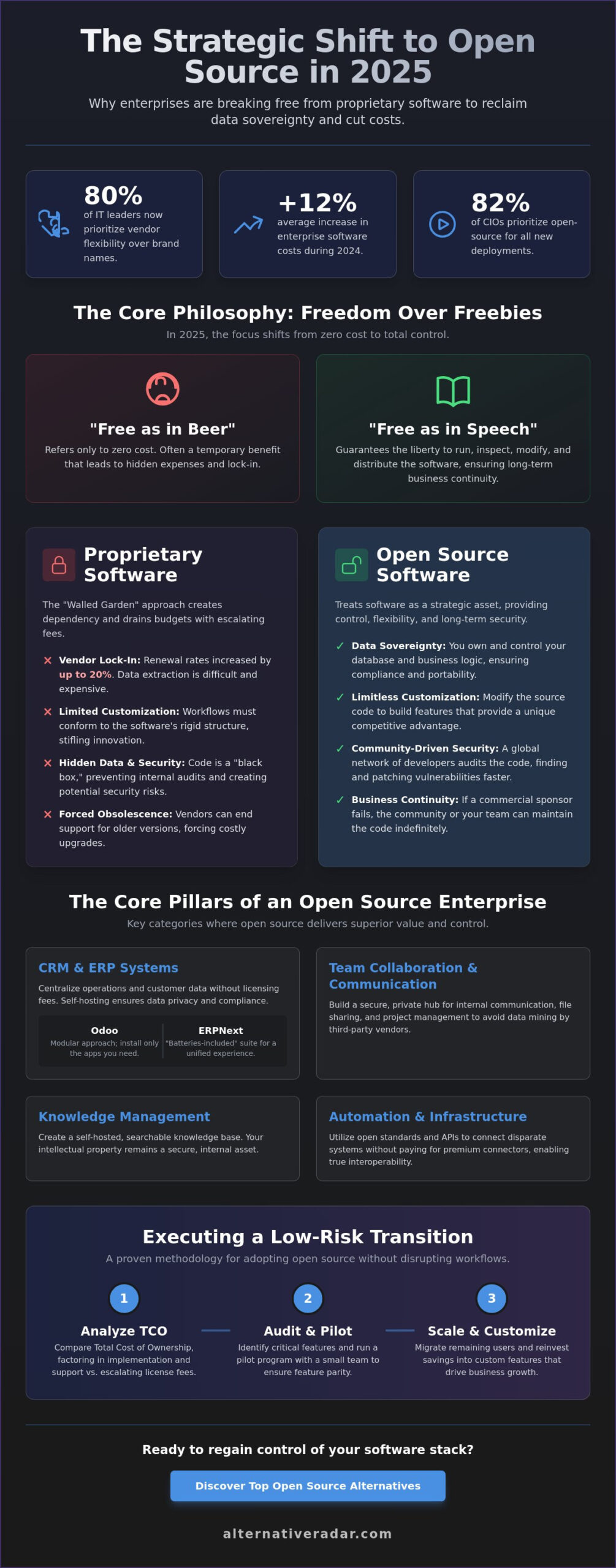
Your current SaaS subscription model is likely acting as a hidden tax on your company’s growth. As we move through the year, the shift toward popular open source business software 2025 has accelerated because 80% of IT leaders now prioritize vendor flexibility over name-brand recognition. You’ve likely noticed that enterprise software costs rose by an average of 12% across major providers in 2024. It’s a cycle that forces you to pay more for tools you don’t fully own and can’t easily customize.
We agree that your software should serve your bottom line, not drain it. Stop wasting time searching through thousands of repositories; this guide helps you discover the most reliable, scalable, and cost-effective open-source tools that have redefined business operations this year. You’ll learn how to regain ownership over your company data and slash operational costs without sacrificing performance. We’ve done the testing to provide clear comparisons of the top-rated options for CRM, project management, and infrastructure management.
Key Takeaways
- Understand why the market is shifting toward data sovereignty and how to treat software as a strategic enterprise asset.
- Identify the most popular open source business software 2025 options for ERP, CRM, and team collaboration to break away from restrictive vendor lock-ins.
- Apply a strategic decision framework to compare Total Cost of Ownership (TCO) and determine if customization potential outweighs standard proprietary features.
- Execute a low-risk transition using a proven audit-and-pilot methodology to ensure feature parity without disrupting your current workflow.
- Explore our top-rated productivity pick for 2025 and learn how the “Radar” methodology filters for the most reliable enterprise-grade tools.
What is Popular Open Source Business Software & Why It Dominates 2025
Open source business software (OSBS) has evolved from a niche alternative into a high-performance strategic asset. In 2025, the enterprise market recognizes that OSBS is defined by its license, which grants users the right to run, study, change, and distribute the software. This shift marks a transition from seeking “free of charge” tools to demanding “freedom of data.” Businesses no longer prioritize the zero-dollar price tag as their primary motivator. Instead, they focus on the ability to control their own digital infrastructure.
2025 is the tipping point for enterprise adoption. Recent data indicates that 82% of CIOs now prioritize open-source solutions for new deployments. This surge is driven by a need for agility that proprietary vendors can’t match. When a company uses popular open source business software 2025, they gain access to community-driven security. This model protects intellectual property by allowing internal teams to audit every line of code. It eliminates the risk of hidden backdoors and ensures that security patches are released by a global network of contributors rather than waiting for a single vendor’s quarterly update.
The Core Philosophy: Beyond the Price Tag
Understanding the difference between “Free as in Beer” and “Free as in Speech” is essential for modern decision-makers. The former refers to cost, while the latter refers to liberty. OSBS provides the right to inspect the “engine” of your business operations. This transparency reduces the risk of software becoming obsolete. If a commercial sponsor fails, the community or your internal team can maintain the code. You can explore the breadth of these tools by reviewing a list of popular open source software that features robust commercial support and long-term viability. This community-backed longevity ensures business continuity for decades, not just the length of a contract.
Vendor Lock-in: The Multi-Billion Dollar Problem
Proprietary SaaS costs reached record highs by early 2025, with some enterprise suites increasing renewal rates by 20% or more. These ecosystems create “walled gardens” that make data extraction difficult and expensive. Open standards solve this by ensuring that data remains portable. When tools use open formats, migrating from one platform to another becomes a technical task rather than a legal or financial nightmare. Vendor lock-in is the primary driver for open-source migration, representing a state where the cost of switching away from a proprietary provider is so high that the customer is essentially stuck. Choosing popular open source business software 2025 allows companies to reclaim their budget and reinvest it into custom features that actually drive growth. If you’re feeling trapped by your current tools, our complete guide to finding the best alternative to popular software in 2026 provides a structured approach to evaluating and migrating to better-fit solutions.
- Data Sovereignty: You own your database and the logic that processes it.
- Customization: Modify the interface or functionality to fit your specific workflow.
- Interoperability: Use standard APIs to connect different tools without paying for “premium” connectors.
The Core Pillars: Essential Open Source Categories for 2025
The adoption of popular open source business software 2025 centers on four critical pillars: operations, communication, knowledge management, and automation. These tools no longer serve as mere backups for budget-strapped startups. They’re now primary choices for enterprises seeking to avoid vendor lock-in and high licensing fees. By 2025, 80% of IT leaders plan to increase their use of open source for critical workloads. This shift is driven by the need for transparency and the ability to customize code to fit specific business logic.
CRM and ERP: Odoo vs. ERPNext
Odoo and ERPNext have emerged as the primary challengers to legacy systems like SAP and Salesforce. Odoo uses a modular approach, allowing businesses to install only the apps they need, such as inventory, manufacturing, or HR. This modularity prevents the bloat often found in enterprise suites. ERPNext takes a different route by offering a comprehensive, “batteries-included” suite out-of-the-box. It’s often easier to manage for teams that want a unified experience without picking and choosing modules. Choosing these platforms allows companies to self-host sensitive customer data, which is a major advantage for compliance. For a deeper look at how these platforms stack up against other leading options, our open source CRM software comparison breaks down the most reliable and customizable alternatives available. You can also explore more open source alternatives to see how these stack up against proprietary giants.
Knowledge Management and Privacy
Graph-based thinking is transforming how organizations handle internal documentation. Instead of rigid folders, modern tools use bidirectional linking to mimic how the human brain connects ideas. This “Second Brain” approach ensures information isn’t lost in deep directory structures. Logseq in 2026: The Ultimate Privacy-First Second Brain Guide highlights how local-first architecture prevents data leaks. Because the data stays on company servers or encrypted local drives, it provides a level of security that cloud-only tools can’t match. This is vital for protecting internal IP and trade secrets.
Collaboration Tools: Mattermost and Nextcloud
Breaking the Slack and Microsoft Teams monopoly is a priority for high-security environments. Mattermost provides a familiar chat interface but gives IT departments total control over the server environment. It’s built specifically for technical teams that need to integrate with DevOps workflows. For those needing a full replacement for Google Workspace, Nextcloud is the standard. Its “Hub” feature integrates mail, file storage, and video chat into a single interface. Recent reports on the coolest open-source software tools of 2025 suggest that these integrated platforms are becoming the default for privacy-conscious firms. These tools streamline digital workflows by keeping all communication internal and audited, preventing the “shadow IT” problems that plague many organizations. If you’re evaluating whether Mattermost or another platform is the right fit, our guide to the best Slack alternatives for 2026 provides a detailed comparison of privacy-first and open-source team communication tools.
Proprietary vs. Open Source: The Strategic Decision Framework
Choosing the right popular open source business software 2025 requires more than a simple feature list. It demands a rigorous comparison between closed ecosystems and open architectures. While proprietary vendors offer “plug-and-play” simplicity, they often lock users into rigid roadmaps. Open source provides the blueprint; your team builds the house. This flexibility is the primary reason 78% of enterprises now run at least some part of their operations on open-source stacks.
Total Cost of Ownership (TCO) extends far beyond the initial purchase price. Proprietary software often hides costs in per-user scaling fees that balloon as your company grows. Open source shifts these expenses toward hosting, security hardening, and maintenance. If your workflow requires 15% or more deviation from standard industry processes, off-the-shelf tools usually fail. Customization in the open-source world isn’t a messy workaround; it’s a native feature that prevents vendor lock-in.
Security isn’t a trade-off in this framework. Open source code undergoes constant peer review from a global community, making it easier to meet GDPR and SOC2 standards through total transparency. The “Support Gap” is a 2010s myth. By 2025, professional OS support has evolved into a $20 billion service industry. Organizations can now secure enterprise-grade SLAs from third-party providers that rival or exceed the responsiveness of traditional software giants.
Calculating Real-World ROI
Consider a 50-seat CRM deployment over a three-year period. A leading proprietary CRM might cost upwards of $90,000 in licensing fees alone. In contrast, a self-hosted version of popular open source business software 2025 removes those recurring licenses but adds approximately $15,000 for high-availability hosting and part-time DevOps oversight. The hidden cost is the requirement for specialized talent to manage the stack. In 2025, ROI is measured in agility, not just dollars.
Risk Assessment: When NOT to Choose Open Source
Don’t choose open source for highly niche requirements, such as specialized legal discovery tools used by a tiny fraction of the market. These projects often lack the community density needed for long-term stability. Success depends heavily on your internal technical literacy. If your IT department lacks sysadmin experience, “free” software quickly becomes an expensive burden. To mitigate the risk of “abandonware,” avoid projects with fewer than 50 active contributors or those that haven’t seen a core update in the last six months. It’s better to pay for a proprietary license than to build your business on a dead repository. When evaluating your options, a structured methodology for identifying a reliable alternative to legacy or unsupported software can help you make a more confident, data-driven decision.
Implementation & Security: Navigating the Open Source Transition
Adopting popular open source business software 2025 requires more than just a technical install. It demands a structured migration strategy. Start with a cold audit of your current proprietary stack. Identify tools with high per-seat licensing fees or those that lock your data in restrictive formats. Focus on the 20% of tools that consume 80% of your software budget. These are your primary candidates for replacement.
Before a full rollout, run parallel systems. This pilot phase allows your team to test for feature parity without risking operational downtime. Data migration is the most technical hurdle. You’ll need to perform deep data cleaning and precise schema mapping to ensure legacy information fits the new database structure perfectly. Avoid “dirty” data transfers; they lead to system crashes and user frustration later.
Manage the human element through targeted training. User resistance usually centers on interface changes rather than functionality. Use short, role-specific tutorials instead of broad, day-long sessions. Finally, build a maintenance schedule that automates update and backup cycles. This prevents the “set it and forget it” mentality that often leads to security vulnerabilities in self-hosted environments.
Security Hardening for Self-Hosted Tools
Securing a self-hosted Nextcloud or Odoo instance involves layers. Implement a reverse proxy and mandatory Multi-Factor Authentication (MFA) from day one. Use Docker or Kubernetes to containerize your applications. This isolation simplifies deployment and ensures that a single compromised service won’t bring down your entire server. Modern 2025 security standards rely on Zero Trust architectures. This means every user and device must be continuously verified, regardless of whether they’re inside the corporate firewall.
The Hybrid Approach: The Best of Both Worlds
You don’t need an all-or-nothing strategy. Use open-source middleware like n8n or Apache Camel to connect legacy proprietary databases with your new open-source stack. This maintains continuity while you phase out expensive vendors. Some enterprises even leverage programmatic display advertising tools to generate supplemental revenue that funds their internal tech transitions.
Real-world results prove this works. A 2024 case study of a mid-sized logistics firm revealed a 40% reduction in annual overhead after they switched only their CRM and internal chat to open-source alternatives. They kept their specialized accounting software but used open APIs to sync data. This selective migration minimizes risk while maximizing cost efficiency. Development teams making this transition often also replace bloated API clients with lightweight tools like Hoppscotch, a self-hostable open-source API development platform that eliminates mandatory cloud logins and high enterprise fees. Engineering teams looking to further accelerate their workflows should also evaluate the best Roo Code alternatives for AI coding, as autonomous orchestrator agents are rapidly replacing manual mode-switching tools in modern development pipelines.
Stop overpaying for restrictive licenses. Explore and compare the best open source alternatives to find the right fit for your business today.
Alternative Radar Picks: The Best Open Source Business Software for 2025
Selecting the right tech stack shouldn’t feel like a gamble. Our Radar methodology filters tools based on three strict criteria: active community health, security compliance, and enterprise scalability. We don’t focus on marketing budgets or venture capital backing. Instead, we look at codebase commits and real-world deployment success. For organizations evaluating popular open source business software 2025, these picks represent the most stable and high-performing options currently on the market.
- Top Pick for Productivity: Nextcloud Hub. Nextcloud is the 2025 winner because it successfully merges file sharing, collaborative editing, and secure communication into a single sovereign environment. It’s the primary choice for firms that need to escape the high costs of proprietary cloud suites.
- Top Pick for CRM: Odoo. With a modular ecosystem that covers everything from sales to inventory, Odoo remains the king of customization. Its ability to grow alongside a company makes it a more flexible choice than rigid, subscription-based competitors. If you’re evaluating your options, our detailed open source CRM software comparison for 2026 provides an in-depth look at how Odoo and its top rivals perform across key enterprise criteria.
- Top Pick for Development: VS Code and GitLab. VS Code continues to lead the market with a massive extension library, while GitLab provides the essential CI/CD infrastructure for modern DevOps teams. Together, they form a dominant, open-source-driven development pipeline. Development teams seeking to further enhance their AI-assisted coding capabilities can explore the best Roo Code alternatives for AI coding in 2026, which covers autonomous agent tools that integrate directly into VS Code-based workflows.
Emerging Stars to Watch in 2026
Automation is shifting toward AI-integrated, self-hosted solutions. Activepieces is gaining significant traction as an open-source alternative to Zapier, allowing teams to automate workflows using local AI models to maintain data privacy. We’re also seeing a 30% increase in migrations toward privacy-centric analytics like Plausible and Matomo. These tools are evolving to handle decentralized business models where data ownership is distributed rather than centralized. They provide the insights businesses need without the ethical or legal baggage of traditional tracking scripts.
Final Verdict: Making the Switch
The Alternative Radar approach saves time by cutting through the noise of paid search results. You don’t have to overhaul your entire infrastructure in a single day. Most successful digital transformations start with a single department. Transitioning a specific team to popular open source business software 2025 allows you to test compatibility and measure ROI before a full-scale rollout. This incremental strategy reduces risk while providing immediate cost relief. Stop wasting time searching for the perfect tool and start using the ones that actually work for your specific needs.
Ready to optimize your tech stack? Explore our full database of software alternatives to find the right fit for your organization.
Future-Proof Your Enterprise Tech Stack
Adopting popular open source business software 2025 is no longer a niche experiment; it’s a core requirement for companies that value data sovereignty and rapid innovation. We’ve explored how a structured framework helps balance the flexibility of open source with the stability of enterprise support. Transitioning successfully requires prioritizing security protocols and implementation roadmaps that align with your 2025 growth targets. Finding the right balance between cost and customizability defines the modern enterprise tech stack, especially as proprietary lock-in becomes a greater risk for scaling firms.
Finding the right tool shouldn’t take weeks of manual research or endless tabs. Alternative Radar streamlines this process by providing objective pros and cons for every alternative. Our database features detailed insights on 500+ business tools, ensuring you have the data needed to make an informed choice. Everything is already updated for the 2026 software landscape, so your decisions remain relevant long after the initial deployment. You’ll get clear comparisons that cut through the marketing noise and focus on actual utility.
Stop wasting time searching; find your perfect software fit on Alternative Radar
Take control of your digital infrastructure and start building a more efficient, transparent future for your organization today.
Frequently Asked Questions
Is open-source software really free for large businesses?
The software license itself is free, but enterprise implementation involves costs for hosting, customization, and maintenance. Large organizations often opt for “Open Core” models where the base code is free but advanced features require a subscription. For example, Odoo charges for its Enterprise version while keeping the Community version free. You’ll spend your budget on infrastructure and talent rather than recurring seat licenses.
Can open-source business software be as secure as Microsoft or Google?
Open-source software provides equal or superior security because the code is open for public audit. Proprietary vendors rely on “security by obscurity,” whereas open projects allow thousands of developers to spot vulnerabilities simultaneously. The 2024 Synopsys report found that 84% of codebases contain at least one vulnerability, but open-source communities often patch these within hours of discovery. It’s a transparent approach that reduces long-term risk.
What happens if the community stops supporting an open-source project?
You retain full ownership of the source code even if the original developers walk away. This eliminates the risk of “vendor lock-in” seen with proprietary tools. If a project loses steam, your IT team can maintain the code internally or hire a third-party agency. History shows that popular open source business software 2025 projects with large user bases are usually “forked” by new contributors if the original lead abandons the work.
How much technical expertise is required to maintain open-source tools?
Maintenance requirements vary based on whether you choose self-hosting or a managed cloud service. If you host tools like Nextcloud on your own servers, you’ll need a sysadmin familiar with Docker or Linux. However, 70% of popular open source business software 2025 providers now offer “SaaS” versions. These managed options eliminate the technical burden, allowing your team to focus on usage rather than server patches or database backups.
Are there open-source alternatives for specialized industries like accounting or CAD?
Mature open-source alternatives exist for nearly every specialized industry. For accounting, ERPNext and GnuCash provide robust double-entry systems used by thousands of small businesses globally. For engineering and design, FreeCAD and LibreCAD offer professional-grade tools that handle standard file formats. These options let you bypass high annual subscription fees while maintaining compatibility with industry standards. They’re reliable tools for technical professionals who need precision.
How do I migrate my data from Salesforce to an open-source CRM?
Migration typically involves exporting your data to CSV or JSON files and using a dedicated import tool. Most modern CRMs like SuiteCRM or Odoo provide migration modules to map Salesforce fields to their own architecture. You’ll need to clean your data first to ensure a smooth transition. Professional migration services can handle complex relational data, ensuring you don’t lose customer history or lead tracking during the move.
Is there professional support available for popular open-source software?
Commercial support is widely available through official vendors and independent consultants. Companies like Red Hat, Canonical, and MariaDB Foundation provide 24/7 technical assistance and service level agreements (SLAs) for their software. You aren’t limited to a single vendor’s support desk. This competitive market for support services often results in faster response times and more transparent pricing compared to proprietary software monopolies.




23 thoughts on “Popular Open Source Business Software 2026: The Strategic Enterprise Guide”
Comments are closed.