
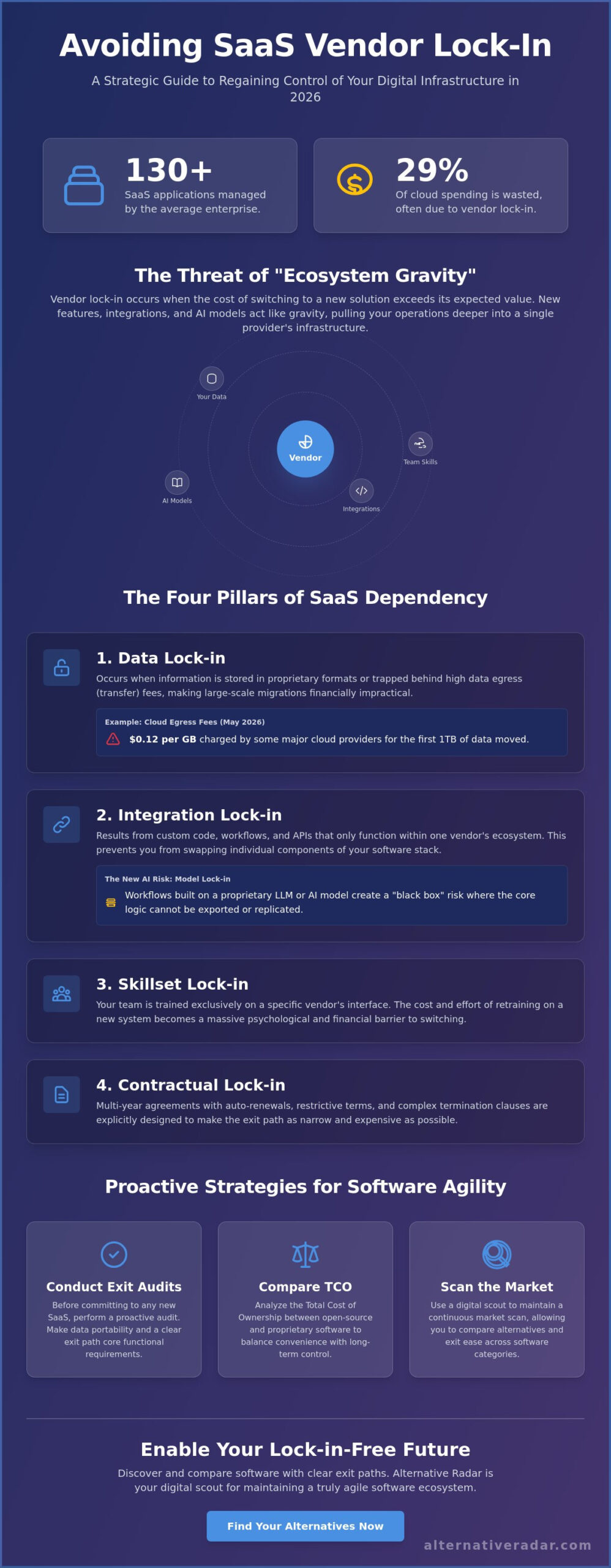
With the average enterprise now managing over 130 separate SaaS applications, your software stack has likely become a web of dependencies rather than a suite of tools. You’ve likely felt the sting of rising subscription costs and the frustration of realizing your most critical data is trapped in a proprietary format. In an era where 29% of cloud spending is wasted, avoiding vendor lock-in with SaaS products isn’t just a technical preference; it’s a financial necessity for 2026. You shouldn’t have to choose between modern functionality and the freedom to switch providers when a service no longer meets your needs.
This guide provides the frameworks you need to regain control over your digital infrastructure. We’ll show you how to build a proactive exit strategy for every tool in your stack, ensuring your team isn’t tethered to a single platform by specialized training or rigid workflows. You’ll learn how to lower your long-term total cost of ownership and maintain operational flexibility, even as AI models add new layers of complexity to vendor relationships. From auditing API portability to navigating the latest NIST standards, we’ve mapped out the path to a truly agile software ecosystem.
Key Takeaways
- Analyze how ecosystem gravity creates hidden dependencies and why the true cost of switching now includes AI model behavior and specialized team training.
- Identify the four primary pillars of dependency, focusing on proprietary data formats and custom API integrations that act as technical hurdles to migration.
- Implement a proactive exit strategy audit to ensure avoiding vendor lock-in with SaaS products remains a core functional requirement before you commit to any new subscription.
- Compare the total cost of ownership between open-source and proprietary software to find the right balance between operational convenience and long-term control.
- Use Alternative Radar as a digital scout to maintain a continuous market scan, allowing you to compare exit ease across different software categories.
What is Vendor Lock-in and Why is it Worse in 2026?
Modern Vendor lock-in isn’t just about a contract you can’t cancel. In 2026, it’s defined by the moment the technical and financial cost of switching exceeds the expected value of a superior new solution. This “Ecosystem Gravity” effect is more powerful than ever. When you adopt an integrated suite, every new feature you activate acts like a hook, pulling your operations deeper into a single provider’s infrastructure. While these all-in-one platforms promise convenience, they often hide a high price tag. You’re trading long-term flexibility for a short-term reduction in setup time. True strategy for avoiding vendor lock-in with SaaS products starts with recognizing that “convenience” is often a euphemism for dependency.
The landscape changed significantly after the 2026 shift toward integrated AI services. Providers no longer just store your files; they process your logic through proprietary models. This creates a deeper layer of “gravity” where the effort to move your data is secondary to the effort of rebuilding your automated workflows. If you can’t move the intelligence behind your operations, you’re effectively stuck, regardless of how much you’re paying in monthly fees.
The Psychology of the SaaS Trap
Enterprise software decisions are frequently clouded by the sunk cost fallacy. After spending months on implementation and thousands on seat licenses, leaders feel obligated to stay, even when performance dips. Feature creep complicates this further. A minor tool used by one department can quietly become mission-critical, making the entire suite indispensable. Resistance often comes from the teams themselves. If your staff is only trained on a specific proprietary interface, the perceived effort of learning a new system becomes a massive psychological barrier to change. You aren’t just locked into a tool; you’re locked into a habit.
New Forms of Lock-in in the AI Era
The rise of proprietary AI training data has fundamentally changed the stakes. In 2026, model lock-in is the new reality. If your business workflows are deeply integrated with a specific Large Language Model (LLM), you aren’t just using a tool; you’re building your intellectual property on a foundation you don’t own. This creates a “Black Box” risk where algorithms cannot be exported or replicated elsewhere. Data sovereignty is also under threat. Many cloud-native AI processors require data to stay within their ecosystem to function, making it nearly impossible to pull your information out without breaking your automated processes. Effective strategies for avoiding vendor lock-in with SaaS products must now account for these architectural dependencies before the first AI agent is deployed.
The Four Pillars of SaaS Dependency: Identifying Your Risks
Identifying where your vulnerabilities lie is the first step toward avoiding vendor lock-in with SaaS products. While many leaders focus solely on the monthly bill, the true potential impact of vendor lock-in extends across your entire operational architecture. Dependency typically manifests in four distinct pillars:
- Data Lock-in: This occurs when your information is stored in proprietary formats or hidden behind exorbitant egress fees. For instance, as of May 2026, Google Cloud Storage charges $0.12 per GB for the first 1TB of data moved, making large-scale migrations a significant financial hurdle.
- Integration Lock-in: Custom code and APIs that only function within one specific ecosystem create a “gravity” that prevents you from swapping individual components of your stack.
- Skillset Lock-in: If your team is only trained on a specific vendor’s interface or logic, the cost of retraining becomes a massive hidden expense that deters switching.
- Contractual Lock-in: Multi-year agreements with complex termination clauses are designed to make the exit path as narrow and expensive as possible.
You can’t manage what you don’t measure. Auditing these four pillars during the procurement phase ensures you aren’t walking into a trap disguised as a solution.
Data Portability: The Foundation of Freedom
Data should always be stored in or easily convertible to standardized formats like JSON, CSV, or SQL. Proprietary “binary blobs” are a red flag; they essentially hold your files hostage. When negotiating your Service Level Agreement (SLA), insist on robust bulk export features that allow you to pull all your data at any time. This is especially critical in creative and technical fields. For example, when moving to the best free alternatives to photoshop, professionals must ensure they don’t lose vital layer data or metadata during the transition. If your data isn’t portable, it isn’t truly yours.
Technical Debt and Integration Gravity
Deep integration with a single-vendor ecosystem might feel efficient today, but it builds massive technical debt for tomorrow. To mitigate this, use middleware as a buffer. Neutral tools can connect your software stack, allowing you to swap out one SaaS product without breaking the entire chain. Be particularly wary of “low code” platforms. While they empower non-technical teams, they often use proprietary logic that is impossible to export. This results in high lock-in because you can’t simply copy and paste the underlying code to a new provider. Before committing to a new tool, it’s helpful to compare exit ease across different categories to see how other organizations have maintained their agility.
Open Source vs. Proprietary SaaS: A Comparison for 2026
Deciding between open-source and proprietary software is no longer a simple debate about budget. It’s a strategic choice between control and convenience. While proprietary SaaS offers immediate utility and “best-of-breed” features, it often comes with a higher risk of dependency. Avoiding vendor lock-in with SaaS products requires you to evaluate the Total Cost of Ownership (TCO) beyond the initial subscription. You must factor in the long-term price of data extraction and the technical debt of building workflows on closed systems. Community-driven development serves as a vital hedge here; if a vendor goes bankrupt or is acquired, the open-source community can maintain the codebase, ensuring your operations don’t grind to a halt.
Hybrid models are becoming the standard for 2026. Many organizations now use open-source cores for their most sensitive data while opting for professional managed hosting to handle the day-to-day maintenance. This approach provides the agility of the cloud with the safety net of portable code. It allows you to benefit from high-velocity updates without surrendering the keys to your infrastructure.
When Open Source Wins for Portability
In industries where data sovereignty is a regulatory requirement, open source is often the only viable path. Self-hosting capabilities allow you to maintain complete ownership of your database, which is essential for compliance with the latest NIST standards or the EU AI Act. For example, conducting an open source crm software comparison helps you identify platforms that allow you to move your entire customer history without paying the data egress fees typically charged by major cloud providers. Open standards like SQL and REST APIs ensure that as you scale, your technical debt remains manageable because your stack is built on universal languages rather than proprietary logic.
The Strategic Use of Proprietary SaaS
There are times when the advanced features of a proprietary tool outweigh the inherent risks. High-velocity teams often prioritize the out-of-the-box integrations and polished user experiences that managed services provide. However, you shouldn’t commit without evaluating vendor stability and roadmap transparency. Avoiding vendor lock-in with SaaS products in this context means setting “Sunset Clauses” during the procurement phase. A Sunset Clause defines a specific date or trigger event to re-evaluate the tool’s necessity. This prevents a temporary solution from becoming a permanent, unmovable fixture in your tech stack. Always demand a clear export path before signing, ensuring that if the vendor’s roadmap deviates from your needs, your exit is already mapped out.
Proactive Strategies to Maintain Software Agility
Software agility isn’t a byproduct of luck; it’s the result of intentional architectural choices. Avoiding vendor lock-in with SaaS products requires an “Exit Strategy Audit” conducted before you sign the first invoice. This process shifts your focus from what a tool can do today to how easily you can replace it tomorrow. You must prioritize interoperability by selecting tools with robust, standard REST APIs. This ensures your data doesn’t just sit in a silo but remains accessible to the rest of your stack. Verifying this through regular portability testing is essential. If you can’t successfully extract and re-upload your data into a test environment today, you are already locked in.
A common mistake is falling into the “Single Pane of Glass” trap. While centralizing all operations into one dashboard seems efficient, it creates a single point of failure and massive integration gravity. A multi-vendor strategy distributes risk. By using specialized tools for different functions, you ensure that a price hike or service outage in one area doesn’t paralyze your entire business. To start building a more resilient stack, you can compare software exit ease across multiple categories.
The Pre-Purchase Portability Checklist
Before committing to a new subscription, put the vendor through a rigorous evaluation. This “Alternative-First” approach ensures you maintain the upper hand in the relationship. Use these three questions to grade every potential tool:
- Data Format: Does the vendor offer a full data export in a non-proprietary format like JSON or CSV?
- Third-Party Ecosystem: Are there established connectors like Zapier or Make that support this tool without custom coding?
- Migration Cost: What is the estimated timeline and budget required for a complete migration to a direct competitor?
Building a Modular Tech Stack
Modular architecture is the most effective defense against ecosystem gravity in the 2026 market. Unlike monolithic suites that force you into a “take it or leave it” scenario, a modular stack allows you to swap individual components. For example, using slack alternatives prevents communication silos and keeps your team’s internal logic portable. Adopting a “Scout Mindset” means you are constantly scanning the horizon for popular open source business software 2026 to see where community-driven tools can replace proprietary ones. This modularity ensures your business logic remains independent of any single provider’s roadmap.
How Alternative Radar Enables a Lock-in-Free Future
Maintaining a portable tech stack requires constant vigilance. Alternative Radar acts as your proactive market scanner, ensuring that avoiding vendor lock-in with SaaS products is a continuous process rather than a one-time audit. With the average enterprise now managing over 130 SaaS applications, the risk of hidden dependency is at an all-time high. We provide a high-quality filter for software information, helping you identify which providers value data portability and which are building walled gardens.
Our platform categorizes tools by their “Exit Ease,” evaluating licensing models and data export capabilities with clinical objectivity. Whether you are searching for open-source peers to proprietary giants or self-hosted alternatives for sensitive data, our comparisons get straight to the point. We track 2026 market shifts, such as the impact of the EU AI Act and updated NIST API guidelines, so you don’t have to monitor regulatory changes yourself. This enables you to stay informed on emerging competitors that prioritize interoperability over ecosystem gravity.
The Digital Scout Approach to Software
Our methodology is built on utility and precision. We don’t just list features; we evaluate how a tool fits into a modular ecosystem. This digital scout approach empowers you to challenge market leaders who rely on legacy dependency rather than innovation. By using our data-driven comparison frameworks, you can make smarter choices that prioritize your long-term operational flexibility over a vendor’s quarterly growth. We’ve done the heavy lifting of testing and categorization. This allows you to move with high velocity from discovery to implementation without the fear of getting stuck.
Your Resource for Continuous Comparison
Navigating the complex SaaS market requires moving from broad discovery to specific, actionable tool lists. Many directory sites are funded by the very vendors they list, which often leads to biased results. Alternative Radar is the preferred alternative to these platforms because we prioritize user needs over external partnerships. We focus on personalized suitability, ensuring that the results you see match your specific technical requirements and compliance needs. Avoiding vendor lock-in with SaaS products is much easier when you have a reliable curator in your corner.
Start building your modular stack on Alternative Radar today to secure your software independence and lower your long-term total cost of ownership.
Securing Your Software Sovereignty in 2026
Mastering the art of avoiding vendor lock-in with SaaS products requires shifting from a passive consumer to a proactive architect. You’ve seen that modern dependency isn’t just about contracts; it’s about the data formats, API integrations, and AI models that underpin your daily operations. By prioritizing modularity and conducting rigorous exit audits, you ensure your business remains agile enough to pivot when the market demands change. Don’t let ecosystem gravity dictate your long-term roadmap.
Since 2012, Alternative Radar has operated as an independent, Dutch-owned platform dedicated to providing objective, efficiency-driven software comparisons. We offer detailed insights on both open-source and premium tools, acting as a digital scout so you don’t have to perform the heavy lifting of market research alone. Our data-driven frameworks help you filter through the noise to find tools that respect your operational freedom. Find your next software alternative on Alternative Radar and start building a tech stack that works for you, not your vendors. You have the power to reclaim your technical independence today.
Frequently Asked Questions
What is the most common cause of vendor lock-in?
Proprietary data formats and a lack of standardized export tools are the primary drivers of dependency. When a provider stores your information in a “black box” format that other tools can’t read, the labor required to manually reformat that data creates a massive financial barrier. This technical debt often makes the cost of switching exceed the potential value of a better solution.
How can I tell if a SaaS product has high switching costs?
Check for the absence of a self-service “Bulk Export” feature and a lack of public API documentation. High switching costs are also evident when a tool requires “deep integration,” meaning it forces you to adopt several other products in the same ecosystem to function correctly. If you can’t test a full data extraction during your trial period, the lock-in risk is high.
Is open-source software always the best way to avoid lock-in?
Open-source software provides excellent code portability and protects you from vendor bankruptcy, but it isn’t a universal fix. While it grants you complete ownership of the underlying logic, you still face the challenges of hosting, security maintenance, and skillset dependency. You must weigh the control of an open-source core against the operational convenience of a managed service.
What should I look for in a SaaS contract to ensure portability?
Demand a “Data Return” clause that legally mandates the vendor to provide your data in a machine-readable format within 30 days of termination. You should also negotiate for shorter notice periods and avoid multi-year bundles that tie different departments to a single provider. Clear exit terms are just as important as the initial features and pricing.
Can AI features increase my dependency on a specific vendor?
AI features create a new layer called “Model Lock-in” by embedding proprietary intelligence into your specific workflows. If your automated business processes rely on a vendor’s fine-tuned model or a specific “black box” algorithm, simply moving your raw data won’t be enough to replicate your operations elsewhere. This makes avoiding vendor lock-in with SaaS products an architectural challenge rather than just a data one.
How often should I audit my tech stack for vendor lock-in risks?
Conduct a formal audit of your software stack at least once a year or whenever a tool’s usage expands into a new department. Regular audits are a vital part of avoiding vendor lock-in with SaaS products because they help you catch “feature creep” before a minor utility becomes a mission-critical dependency. Consistent reviews ensure your modular architecture remains flexible as your company scales.
What are data egress fees and why do they matter?
Data egress fees are the costs cloud providers charge to move your data out of their network. While some modern providers like Cloudflare R2 have moved to a $0 egress model, others like AWS S3 still charge $0.09 per GB for the first 10TB. These fees act as a “digital tax” on migration, making it expensive to move large datasets to a competitor.
How do I handle Skillset Lock-in when my team only knows one tool?
Focus your team’s training on industry-standard principles rather than vendor-specific buttons and interfaces. When staff understand the fundamental logic of a category, such as relational databases or agile project management, they can adapt to new tools with minimal friction. Investing in versatile skills reduces the psychological and operational resistance to switching providers when a better alternative emerges.