

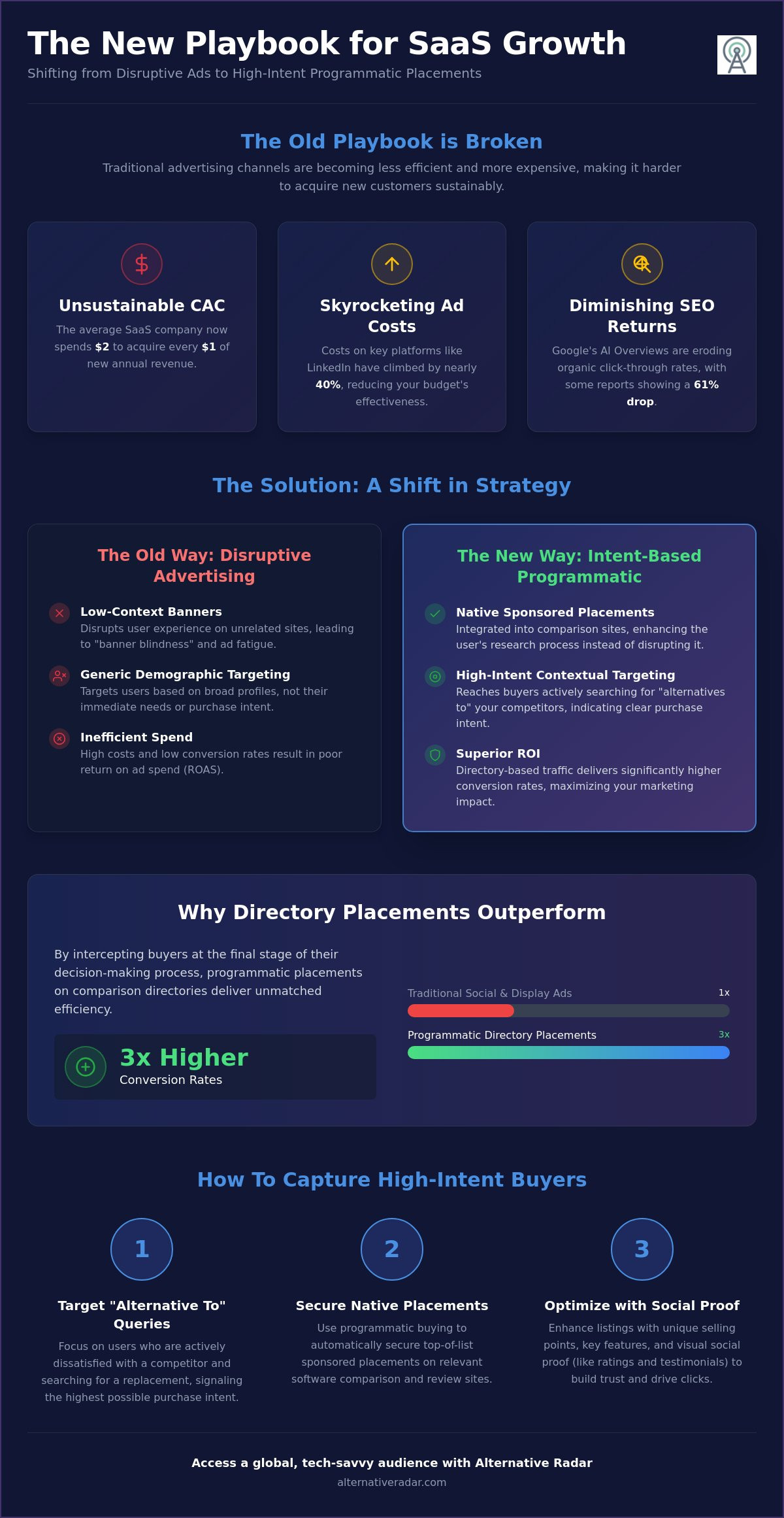
Did you know that for every dollar of new annual revenue, the average SaaS company now spends two dollars just to acquire it? It is a staggering reality that highlights why traditional channels are no longer the efficient engines they once were. You have likely noticed your LinkedIn ad costs climbing by nearly 40% while Google’s AI Overviews continue to erode your organic reach. It’s frustrating to watch your budget disappear into platforms where banner blindness and skyrocketing competition make intercepting high-intent users feel nearly impossible.
We agree that the old playbook of simply outspending the market is no longer sustainable. This guide will show you how to leverage programmatic advertising for saas to intercept buyers at the exact moment they are ready to make a decision. By focusing on strategic sponsored placements on comparison platforms, you can capture traffic that is actively looking for alternatives to your competitors. We will examine how to use these navigational cues to lower your acquisition costs and dominate your category through precise, data-driven visibility.
Key Takeaways
- Understand how programmatic advertising for saas has transitioned from disruptive banners to native, automated placements on high-intent comparison sites.
- Identify the mechanics of using sponsored placements as navigational cues to intercept buyers during the final decision-making phase.
- Analyze the efficiency of directory-based traffic, which frequently delivers conversion rates three times higher than traditional social or display ads.
- Learn to optimize software listings by prioritizing unique selling points and visual social proof over generic marketing descriptions.
- Discover how partnering with a digital scout like Alternative Radar provides access to a global, tech-savvy audience through established programmatic networks.
What is Programmatic Advertising for SaaS in 2026?
Programmatic advertising for saas is the automated acquisition of high-intent ad inventory specifically for software products. It has moved far beyond the simple real-time bidding models of the previous decade. In 2026, it represents a shift toward context-aware placements that prioritize the user’s current decision stage over generic demographic data. This evolution is necessary because traditional display advertising is failing software brands. With LinkedIn ad costs climbing by 40% and Google’s organic click-through rates dropping by 61% due to AI Overviews, vendors need a more efficient way to capture attention.
The broader concept of programmatic advertising has matured, moving from simple ad servers to complex ecosystems that value placement quality over raw volume. Traditional display ads often suffer from ad fatigue; a user reading a news article rarely wants to see a banner for an enterprise CRM. This lack of context leads to wasted spend and poor conversion. Instead, the primary growth lever for challenger brands is now “Intent-Based Programmatic.” This strategy focuses on securing top-of-list placements on review and comparison sites where the user’s intent is already established.
The Shift to Discovery-Based Marketing
User behavior has changed. Buyers don’t just search for “features” anymore; they search for “alternatives.” They want to know how your tool compares to the market leader they’re currently using. This shift means your marketing must intercept them during the evaluation phase. Curated directories act as the modern scout for these buyers, providing a neutral environment for comparison. Mastering the art of finding the best alternative to popular software is now a critical touchpoint. It allows smaller SaaS vendors to compete directly with giants by appearing exactly where the comparison happens, often at a lower cost than traditional search ads.
Native vs. Traditional Programmatic Display
Native sponsored listings provide a clear psychological advantage. They don’t disrupt the user experience; they enhance it by providing a relevant option within a list of similar tools. These placements often bypass ad-blockers because they are integrated into the site’s functional content rather than being served as external scripts. Programmatic SaaS advertising is the strategic intersection of automated media buying and high-intent user context. By using this approach, you can:
- Target users based on specific competitor interests.
- Bypass the banner blindness associated with traditional display networks.
- Scale your reach across niche software directories without manual outreach.
- Maintain a presence in “alternative to” categories that drive the highest conversion rates.
This automated approach ensures that your software is visible exactly when a buyer is ready to switch or upgrade, maximizing your return on ad spend in an increasingly expensive market.
The Mechanics of Sponsored Software Placements
Sponsored software placements function as high-velocity navigational cues rather than traditional commercials. When a decision-maker visits a comparison platform, they are in “search mode,” actively looking for a path to a solution. The technical bridge that enables this involves connecting Demand Side Platforms (DSPs) directly to niche software directories. This setup allows for the automated delivery of native listings that match the site’s design and user expectations. It’s the most effective application of programmatic advertising for saas because it aligns the promotional message with the user’s immediate intent.
Real-time bidding (RTB) provides the engine for category-specific dominance. Unlike traditional direct-buy sponsorships that lock you into a static position for a month, programmatic native ads allow you to adjust your presence based on live demand. If traffic spikes in a specific category, the system bids higher to secure the top spot. This ensures your brand remains the first choice for users during peak search periods. It removes the friction of manual negotiations and allows for a more fluid, responsive growth strategy that adapts to market shifts instantly.
This level of agility is often supported by advanced data science. For instance, Nodal Marketing leverages AI-powered marketing technology to optimize digital performance, helping SaaS brands navigate these complex bidding environments with precision.
Intercepting High-Intent Traffic
The highest conversion potential in the SaaS sector lies within “Alternative To” search queries. These users have already identified a problem with their current tool and are actively looking for a replacement. For example, appearing on a curated list of Slack alternatives allows a challenger brand to intercept a buyer at the exact moment they’re evaluating a switch. Programmatic algorithms analyze these behavioral signals to identify users in the “switch” phase of the buyer lifecycle, delivering your listing when it’s most likely to drive an action.
Data-Driven Audience Targeting
Precision is the key to maintaining a low CAC. You can use firmographic data to filter traffic, ensuring your sponsored placements only appear to users who fit your Ideal Customer Profile (ICP). This includes targeting by industry vertical, department size, or geographic location. By integrating first-party data, you can further refine your listing’s copy to address the specific technical requirements of your target audience. Evaluating the technical compatibility of your DSP with directory platforms is essential for seamless ad delivery. If you’re looking to scale efficiently, you can consult with a digital scout like Alternative Radar to identify the most productive placement opportunities for your specific software category.
Calculating the ROI: Why Directory Placements Outperform Traditional Display
Measuring the efficiency of your marketing spend requires looking at the Cost-Per-Acquisition (CPA) across different channels. While a qualified lead from Google Ads for a B2B SaaS company now costs between $150 and $250, directory-driven traffic often yields a much lower CPA. This is because users on comparison platforms have already bypassed the awareness stage. They aren’t just browsing; they’re filtering. This high-intent behavior is why comparison site traffic often converts at a rate three times higher than traditional social or display ads. When you implement programmatic advertising for saas, you’re buying access to this filtered audience rather than casting a wide, expensive net.
Beyond immediate conversions, there’s a long-tail brand value in being listed alongside industry giants. Appearing in the same category as market leaders establishes instant credibility. It signals to the buyer that your software is a legitimate contender in the space. To capture this value, attribution modeling must move beyond simple last-click logic. Native placements often serve as the final nudge in a multi-touch journey, meaning their true ROI is reflected in the overall shortening of the sales cycle and the reduction of friction during the final decision phase.
Key Metrics for SaaS Sponsored Placements
Focusing on “Trial Sign-up Velocity” allows you to see how quickly comparison table traffic moves through your funnel. You should also measure your “Share of Voice” within specific software categories. If you’re only appearing 10% of the time, you’re leaving high-intent leads to your competitors. Using programmatic display advertising helps you scale these successful placements by automating the bidding process across multiple directories simultaneously. This ensures you maintain a consistent presence without overpaying for low-value impressions.
Cost Models: CPC vs. Flat-Fee Sponsorship
Choosing between Cost-Per-Click (CPC) and flat-fee models depends on your current growth stage. Flat-fee sponsorships provide predictable costs and consistent visibility, which is ideal for established brands seeking category dominance. Conversely, performance-based CPC models offer better flexibility for challengers testing new markets or managing tight budgets. ROI in 2026 is measured by the quality of the lead, not just the volume of clicks. High-competition categories benefit from these performance-based models because they allow you to pay specifically for the users who are most likely to convert into long-term subscribers, ensuring every dollar spent is tied to a potential revenue outcome.
Strategic Implementation: Optimising Your SaaS Listings for High-Velocity Growth
Optimization is the bridge between traffic and revenue. While programmatic advertising for saas provides the volume, your listing copy determines the velocity of your growth. Don’t waste high-intent traffic with generic descriptions. Instead, focus on the specific pain points your software resolves that the market leader ignores. Every word should drive the user toward a comparison that favors your unique architecture or pricing model.
Visual social proof acts as a trust accelerator. High-intent buyers look for ratings, industry badges, and clean interface screenshots before they ever click a call-to-action. Testing your CTAs is equally vital. While “Start Free Trial” is a standard goal, a “Compare Features” button often captures users who are still in the final evaluation phase. This allows you to nurture them more effectively. Synchronize these placements with your product launches or seasonal software deals to maximize impact during periods of high market activity.
Positioning Against the Market Leader
Users often suffer from “Leader Fatigue,” where bloated features and rising prices make them search for leaner, more agile alternatives. You can exploit this by identifying the specific frustrations your software solves. If you are framing an open source CRM software comparison, emphasize privacy and cost-transparency. This validates your software’s superior user experience by highlighting exactly what the incumbent lacks. Use the “Alternative To” context to prove your tool is not just a replacement, but an upgrade.
Technical Optimization and Freshness
Listings must remain current to maintain credibility. Real-time pricing and feature updates prevent user frustration and high bounce rates. Successfully implementing programmatic advertising for saas requires dynamic tracking parameters to ensure your ROI reporting is granular and accurate. For instance, if you’re positioning a free Photoshop replacement, focus on browser-based accessibility and speed rather than just deep technical editing tools. This level of specific targeting ensures you meet the user’s immediate need while maintaining technical freshness across all your active placements.
To start building a high-velocity listing strategy that converts, partner with Alternative Radar to access high-intent software categories and specialized programmatic inventory.
Partnering with Alternative Radar: Intercepting High-Intent Buyers
Alternative Radar functions as a neutral curator in the 2026 software market. Users trust the platform because it prioritizes clarity and utility over traditional marketing hype. By providing access to a global audience of tech-savvy decision-makers, we help vendors reach buyers who’ve already moved past the discovery phase. This access is facilitated through Madunet, ensuring that your sponsored software placements are delivered with precision and scale. It’s a system built for vendors who value efficiency and want to avoid the diminishing returns of generic display networks.
The synergy between our editorial depth and your sponsored growth goals creates a unique environment for conversion. While traditional directories often feel like pay-to-play lists, Alternative Radar maintains a professional distance that empowers users to make smarter choices. This objectivity is what drives our high engagement rates. When you implement programmatic advertising for saas through our platform, you’re not just buying an impression; you’re securing a position within a trusted decision-making framework.
The Alternative Radar Advantage
Our approach leverages over a decade of media buying expertise. Madunet has been active since 2012, providing a deep understanding of how users interact with comparison content. Unlike standard directories that often present a cluttered list of options, Alternative Radar acts as a digital scout. We’ve already performed the heavy lifting of searching and testing, which creates a higher level of engagement from users who value their time. We develop tailored placement strategies for every category, from productivity suites to specialized developer tools. This ensures your presence is contextually relevant, which is the most critical factor in successful programmatic advertising for saas.
Getting Started with Your SaaS Placement
Joining our high-intent software lists involves a specific evaluation process. We focus on objective suitability, ensuring that every software we recommend provides genuine value to the end user. This commitment to quality maintains the trust of our audience and increases the conversion potential for our partners. We don’t just list products; we position them to intercept the right buyer at the exact moment of decision. By aligning your growth goals with our editorial depth, you create a sustainable acquisition channel that avoids the volatility of traditional search networks.
Efficiency remains the core of our operations. We provide the technical bridge between programmatic buying and native listings that many competitors overlook. This synergy allows for real-time adjustments and granular reporting, giving you full control over your acquisition costs. If you’re ready to move beyond disruptive ads and capture high-intent traffic, contact Alternative Radar to discuss your sponsored software placement and start scaling your SaaS presence today.
Future-Proof Your SaaS Growth Strategy
Success in 2026 requires moving beyond the high costs of traditional search and social networks. You’ve seen how native sponsored placements act as critical navigational cues that intercept buyers during their final decision phase. By shifting your focus toward intent-based programmatic advertising for saas, you can lower your acquisition costs while maintaining a dominant presence in “alternative to” categories. This transition ensures your software remains visible where the comparison happens, rather than being lost in the noise of a crowded feed.
Leveraging expert curation by Madunet provides the technical bridge needed for data-driven programmatic advertising integration. This approach connects you with a global audience of software decision-makers who value clarity and precision. It’s time to stop fighting rising ad costs and start investing in placements that align with how modern buyers actually discover tools. Drive high-intent traffic to your SaaS with Alternative Radar and secure your place as a category leader. Your growth depends on making smarter choices, and the right partnership is the first step toward sustainable revenue expansion.
Frequently Asked Questions
What is the difference between a sponsored placement and an affiliate link?
Sponsored software placements are paid positions that guarantee visibility within a specific category list, often managed via automated bidding. Affiliate links are performance-based tracking mechanisms that generate a commission only when a user completes a specific action, such as a trial sign-up or purchase. While both drive traffic, sponsored placements offer vendors more control over brand positioning and consistent exposure in high-intent categories.
How do sponsored software placements affect a site’s editorial objectivity?
Editorial objectivity remains intact because sponsored positions only influence where a software appears in a list, not the actual content of the review or the technical rating. Alternative Radar functions as a neutral advisor, ensuring that all evaluations are based on functionality and user suitability. This clear separation between paid visibility and editorial opinion preserves the trust of the decision-makers using the platform.
Are sponsored placements clearly labeled for users on Alternative Radar?
Yes, every sponsored placement is clearly labeled to maintain transparency and comply with data privacy and advertising regulations. We prioritize user trust by ensuring that any paid intervention in a list is easily identifiable. This approach empowers users to distinguish between organic editorial picks and vendors who have invested in programmatic advertising for saas to increase their reach during the discovery phase.
How much do sponsored software placements typically cost in 2026?
Costs depend on the specific software category, the volume of high-intent traffic, and the current level of competition for “alternative to” keywords. Factors like seasonal demand and the technical niche of the software also influence the bidding environment. Most platforms utilize a real-time bidding model or performance-based pricing, allowing vendors to scale their spend based on the quality of leads generated rather than just raw impressions.
Can small SaaS startups compete with enterprise brands in sponsored listings?
Small SaaS startups can compete effectively by targeting niche sub-categories where enterprise giants are less dominant. Since programmatic advertising for saas allows for granular audience targeting, a smaller vendor can focus their budget on specific user needs or challenger categories. This strategy allows agile brands to intercept buyers looking for lean, specialized solutions rather than bloated enterprise suites with higher price points.
What kind of conversion rates can I expect from a software directory placement?
Conversion rates from software directories are typically higher than traditional display channels because the traffic possesses established intent. While specific results vary by software type, many vendors report that comparison site traffic converts at a rate three times higher than social ads. This is because users on these platforms are actively searching for a replacement or a new solution rather than passively browsing a social feed.
How do I track the ROI of my programmatic SaaS advertising campaigns?
Tracking ROI requires implementing dynamic UTM parameters and integrating your CRM with the placement platform’s reporting tools. You should monitor metrics like Trial Sign-up Velocity and Customer Acquisition Cost specifically for directory traffic. Moving beyond last-click attribution allows you to see how these placements influence the final decision in a multi-touch buyer journey by providing a necessary trust signal.
Is it better to sponsor a specific category or a general software list?
Sponsoring a specific category is generally more efficient for driving high-intent conversions. While a general software list provides broader reach, a category-specific placement ensures you are seen by users with a defined technical problem. This precision reduces wasted spend and ensures your software is presented as a direct solution to the user’s current search query, leading to higher quality leads and better conversion velocity.