88% of non-profits operate with annual budgets under $500,000, yet many are still paying enterprise-level fees for tools that don’t fully serve their mission. You’ve likely felt the frustration of managing data silos where fundraising, accounting, and communication tools refuse to sync. It’s exhausting to waste hours on manual administrative tasks because your current software for non-profit organizations is either too complex for your team or too expensive to upgrade. You shouldn’t have to choose between modern efficiency and your program’s bottom line.
We’ve done the heavy lifting to find a better way. This 2026 comparison guide highlights the most efficient software solutions available today, moving beyond the standard industry giants to find high-value alternatives that actually work. You’ll discover how to reduce manual work, improve donor retention with better data, and maintain secure, compliant systems without the typical enterprise pricing. We’ll walk you through the top-tier options for donor management, accounting, and productivity to help you build a tech stack that empowers your mission rather than draining your resources.
Key Takeaways
- Learn why shifting from monolithic suites to specialized, best-of-breed tools eliminates data silos and reduces manual administrative tasks.
- Identify the most cost-effective software for non-profit organizations by comparing famous “Big Tech” brands against high-value, niche alternatives.
- Discover the essential 2026 tech stack components for donor management and accounting that prioritize security and regulatory compliance.
- Use our 5-point evaluation checklist to audit your existing data requirements and distinguish between critical workflows and expensive, unnecessary features.
- Find out how to leverage Alternative Radar as a neutral digital scout to stay ahead of emerging software trends and avoid budget waste.
Navigating the 2026 Non-Profit Software Landscape
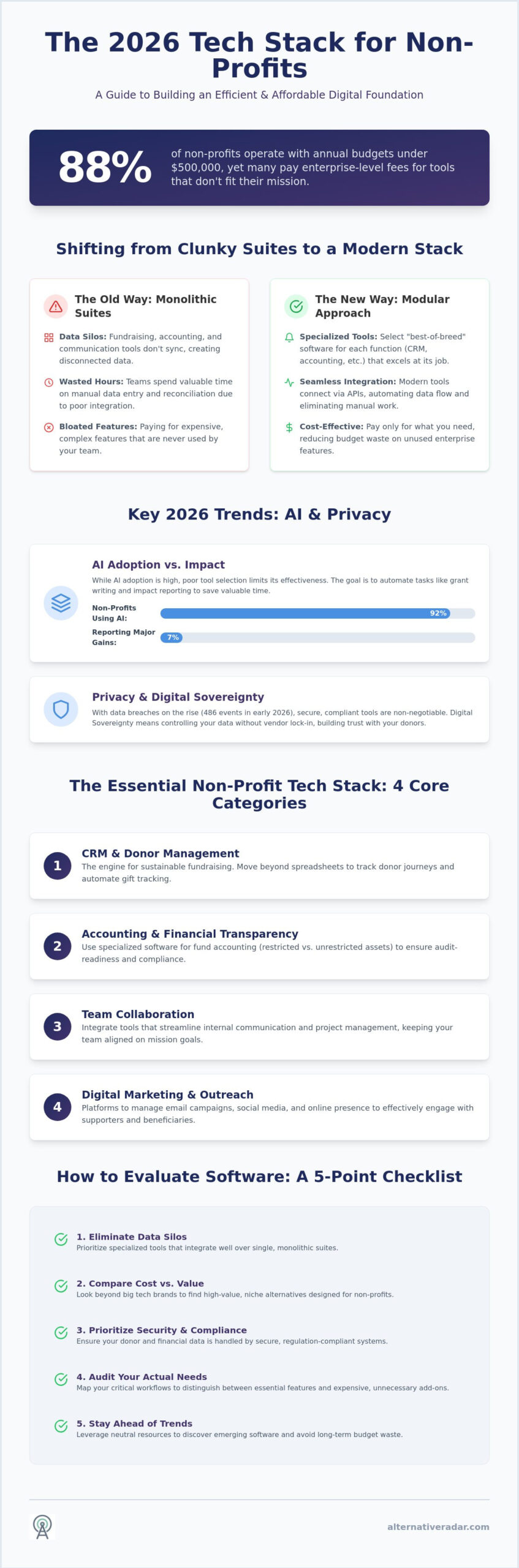
The 2026 environment for charities has moved past the era of monolithic, “do-everything” suites. Modern organizations now prefer a modular approach, selecting specialized software for non-profit organizations that integrates seamlessly through APIs rather than struggling with a single, rigid platform. This evolution in Nonprofit technology allows teams to build a custom stack that fits their specific mission requirements. By choosing best-of-breed tools, leaders avoid the common pitfall of paying for bloated features they’ll never use.
Don’t let “free” legacy software fool you. While initial licensing costs might be zero, the long-term price often appears in the form of manual data entry and broken integrations. If your staff spends ten hours a week moving data between spreadsheets because your accounting tool won’t talk to your donor database, that “free” tool is actually costing you thousands in lost productivity every year. Prioritizing data portability ensures you aren’t trapped by vendor lock-in, giving you the freedom to move your data if a more efficient solution emerges.
The Problem with “One-Size-Fits-All” Solutions
Generic business software often fails to account for the unique compliance needs of mission-driven work. A standard CRM tracks sales leads but lacks the specialized fields required for tracking restricted grants or recurring donor segments. Outdated systems hide their true costs in several ways:
- Legacy systems require complex implementation and dedicated technical staff.
- Generic tools often demand expensive consultants for basic custom reports.
- Disconnected silos force manual reconciliation, increasing the risk of human error.
When your software for non-profit organizations demands a technical expert for basic updates, it’s time to switch to a more accessible alternative.
Modern Trends: AI and Privacy in the Non-Profit Sector
AI is now a practical tool for streamlining grant applications and impact reporting. While 92% of non-profits use AI, only 7% report major improvements, usually due to poor tool selection. Automation can scan grant requirements and draft responses based on historical data, saving weeks of effort. Simultaneously, privacy-first software is essential for trust. With 486 reported data breach events in the U.S. during early 2026, choosing secure, GDPR-compliant tools is a non-negotiable priority.
Beyond general administrative security, maintaining the integrity of digital evaluations is becoming a priority for organizations that offer remote training or certifications. To protect your assessment process from new forms of technological interference, you can check out Aiseptor and its network-layer integrity platform.
Digital Sovereignty for non-profits in 2026 means maintaining complete control over your organization’s data and digital infrastructure without being tethered to a specific vendor’s proprietary ecosystem.
The Essential Non-Profit Tech Stack: 4 Core Categories
Constructing a resilient digital foundation requires a strategic balance between four functional pillars: constituent management, financial transparency, team collaboration, and digital marketing. When these systems are properly integrated, your organization moves away from reactive troubleshooting toward proactive mission delivery. Selecting the right software for non-profit organizations ensures that your internal operations remain as impactful as your external programs.
CRM and Donor Management: Beyond the Spreadsheet
Your donor database serves as the engine for sustainable fundraising. Relying on basic spreadsheets limits your ability to track complex donor journeys and increases the risk of data fragmentation. Modern systems prioritize features like automated recurring gift tracking and advanced segmentation, which are essential for long-term supporter retention. For teams that require complete control over their constituent data, reviewing an open source CRM software comparison is a vital step in maintaining data sovereignty while scaling operations.
Accounting and Financial Transparency
Financial management for charities demands a specific focus on fund accounting to track restricted versus unrestricted assets. Standard business tools often lack the built-in logic required to manage these distinctions effectively, leading to complications during audits or IRS Form 990 preparation. Implementing specialized nonprofit accounting software automates these reporting requirements and ensures full transparency for board members and donors alike. If you need to compare how different platforms handle these unique regulatory needs, you can explore curated comparisons to find the right fit for your budget.
Collaboration and Marketing Tools
Internal efficiency relies on how well your team manages deadlines and coordinates volunteers. Project management platforms like Asana or ClickUp provide the structure needed to track campaign milestones without the overhead of enterprise-level suites. In 2026, the most effective software for non-profit organizations also integrates creative design and outreach. Canva Pro remains a top choice, offering a professional design environment for up to 50 members at no cost to eligible organizations. By pairing these with marketing automation tools like Mailchimp or HubSpot, or utilizing Advocators to find authentic messengers through AI, your team can maintain a consistent digital presence with minimal manual effort.
Comparing Industry Leaders vs. Specialized Non-Profit Alternatives
Many organizations default to household names because they assume “non-profit discounts” automatically make them the most cost-effective choice. In reality, the “Big Tech” tax often manifests as high implementation costs or essential features locked behind premium enterprise tiers. Choosing software for non-profit organizations requires looking beyond the standard catalog to find tools that offer better value without unnecessary complexity. Since 88% of non-profits operate with budgets under $500,000, every dollar spent on bloated software is a dollar taken away from direct mission impact.
Alternative Radar acts as your digital scout in this crowded market. We identify “hidden gem” platforms that offer specialized tiers for charities, often outperforming market leaders in both price and utility. For instance, while mainstream payment processors take a percentage of every gift, platforms like Zeffy provide 100% free fundraising with no processing fees. We focus on these high-value alternatives so you don’t have to spend weeks testing tools that aren’t a fit.
Creative Tools: Breaking the Adobe Monopoly
Adobe Creative Cloud remains the industry standard, but its monthly subscription can be a significant burden for smaller budgets. Many volunteer-led marketing teams find that professional-grade browser-based tools are more than sufficient for their needs. Finding the best free alternatives to photoshop allows your team to create high-quality social media assets and campaign flyers without the steep learning curve or the recurring overhead. Consider these factors when evaluating creative software:
- Browser-based accessibility for remote volunteers.
- Collaborative features that allow multiple editors on one project.
- Availability of non-profit templates for rapid asset creation.
Team Communication: Finding the Right Slack Alternatives
Slack is a powerful tool, but its free version limits message history, which can be a major hurdle for long-term projects. Privacy is also a growing concern. With nearly 500 reported data breach events in the U.S. during early 2026, charities handling sensitive volunteer or beneficiary data must prioritize security. Evaluating Slack alternatives helps you find platforms that balance ease of use with robust data protection. Some organizations find that open-source, self-hosted options provide better software for non-profit organizations by ensuring complete data sovereignty, while others prefer agile SaaS tools built specifically for 2026 remote-work standards.
Objective comparison is your best defense against budget waste. By analyzing the true cost of ownership, including transaction fees and add-on modules, you can build a tech stack that empowers your team rather than draining your bank account.
How to Evaluate Non-Profit Software: A 5-Point Checklist
Selecting the right software for non-profit organizations isn’t just about finding a discount. It’s about ensuring the tool matches your operational reality. A poorly chosen platform becomes a burden that drains your team’s energy and budget. Use this functional framework to filter your options before committing to a new subscription.
- Step 1: Define Workflows. Distinguish between mission-critical “must-have” features and “nice-to-have” extras. Don’t pay for a complex donor analytics suite if your primary need is simple event ticketing.
- Step 2: Audit Data Silos. Identify where your data currently lives. If your fundraising platform doesn’t integrate with your accounting tool, you’re signing up for hours of manual reconciliation.
- Step 3: Calculate TCO. The sticker price is only the beginning. Factor in implementation fees, staff training time, and any specialized technical support you might need to hire.
- Step 4: Assess Proficiency. Be honest about your team’s technical skills. A powerful but complex tool will fail if your volunteers find the interface intimidating or confusing.
- Step 5: Verify Compliance. Ensure the software meets data privacy standards like CCPA and supports your state’s charitable solicitation registration requirements.
If you’re ready to start your search with vetted data, you can compare high-value software alternatives that match these specific evaluation criteria.
Calculating the Real ROI of Your Tech Stack
Return on investment for a charity is measured in time reclaimed for the mission. If a new automation tool saves your program coordinator ten hours a week, the value of that time likely outweighs the subscription cost. Better user experience (UX) also directly impacts volunteer retention. When tools are intuitive, volunteers feel more effective and less frustrated, which leads to longer engagement. Technical debt represents the long-term cost of choosing an easy, low-quality software solution today that will eventually require a total system overhaul as your organization expands.
Ensuring Long-Term Scalability
Your software for non-profit organizations must grow alongside your donation volume. Look for platforms that offer open API access, which allows you to plug in new tools as your needs evolve. While “Big Tech” brands offer name recognition, specialized niche software often provides better stability because it’s built specifically for your sector’s unique workflows. Evaluate the developer’s roadmap to ensure they’re keeping pace with 2026 standards for security and AI-assisted management. Choosing a stable, niche alternative today prevents the need for a painful data migration three years down the road.
Future-Proofing Your Mission with Alternative Radar
Objective comparison serves as the most effective defense against the budget waste common in non-profit tech procurement. When you rely solely on brand recognition, you often end up paying for enterprise features that your team will never use. Choosing software for non-profit organizations requires a strategy that prioritizes utility and long-term viability over marketing promises. Alternative Radar acts as your digital scout, filtering through the noise to provide clear, logic-based comparisons that save you time and preserve your restricted funds.
The 2026 digital landscape moves fast. Tools that were industry standards two years ago may now be lagging in critical areas like AI-assisted grant management or advanced donor privacy. We monitor these shifts so you don’t have to. By providing a centralized location for free, open-source, and premium competitors, we empower you to build a tech stack that is both lean and powerful. Our goal is to ensure that your technology serves your mission rather than becoming a mission in itself.
Leveraging Alternative To Logic
Modern non-profit leaders use a specific logic when searching for replacements to expensive legacy systems. It’s not just about finding a cheaper version of the same tool; it’s about finding a platform that solves the specific pain points of 2026, such as data silos and complex compliance requirements. Using community-driven insights helps you avoid software that is losing developer support or failing to keep pace with security standards. You can explore our full database to discover smarter software alternatives that match your organization’s specific scale and technical proficiency.
The Path Forward: Smart Tech for Big Impact
The 2026 non-profit tech philosophy centers on agility over brand name. A successful organization isn’t defined by the size of its software budget but by the efficiency of its workflows. Encourage a culture of continuous digital improvement within your team. This doesn’t mean switching tools every month; it means staying informed about high-value alternatives that could reclaim hours of staff time. As you move forward, prioritize tools that offer transparent pricing and robust API access. By making informed, objective choices today, you ensure that your software for non-profit organizations remains a catalyst for impact for years to come. Stop following the market leaders and start leading with the right tools for your specific mission.
Optimize Your Mission for 2026 and Beyond
Success in today’s digital landscape requires a shift from expensive, generic suites to specialized, high-value tools. Building a modular stack allows your organization to remain agile while ensuring that every dollar spent directly supports your impact. By prioritizing data sovereignty and seamless integrations, you’ll eliminate the manual administrative burdens that often hinder growth. The right software for non-profit organizations should feel like a force multiplier, not a financial drain.
Alternative Radar acts as your independent digital scout, providing objective, expert-led comparisons that cut through the noise of standard marketing catalogs. As a Dutch-owned curator, we focus on identifying the “hidden gem” free and open-source alternatives that offer professional-grade functionality without the enterprise price tag. Don’t settle for the default choice when a more efficient solution is within reach.
Explore the best software alternatives for your non-profit on Alternative Radar and take the first step toward a leaner, more effective tech strategy. Your mission is too important to be limited by outdated or overpriced technology.
Frequently Asked Questions
What is the best free software for small non-profit organizations?
Zeffy stands out as a top choice because it offers 100% free fundraising with no platform or processing fees. Small organizations also benefit from Wave for basic accounting and Canva Pro, which is free for eligible entities with up to 50 members. These tools provide a high-quality foundation for software for non-profit organizations without requiring a massive initial investment or deep technical expertise for setup.
Can non-profits use open-source software for donor management?
Yes, non-profits can use open-source platforms like CiviCRM to maintain complete control over their constituent data. This approach eliminates recurring license fees and prevents vendor lock-in, which is a major advantage for data-sensitive groups. However, you’ll need technical staff or a consultant to manage the installation, hosting, and security updates, as these tools aren’t plug-and-play like standard SaaS options.
How do I get non-profit discounts on major software brands?
Most major brands offer dedicated NGO programs that require verification of your 501(c)(3) or equivalent status. For example, HubSpot provides a 40% discount, while Mailchimp offers 15% off for verified non-profits. You can also access discounted software for non-profit organizations through clearinghouses like TechSoup, which provides deeply reduced rates for products like QuickBooks and Microsoft 365, often costing as little as $15 monthly.
Is there a non-profit alternative to Microsoft Office 365 or Google Workspace?
LibreOffice and OnlyOffice are excellent alternatives if you want to move away from the dominant cloud ecosystems. OnlyOffice provides a collaborative cloud environment that mirrors the functionality of Google Workspace without the same data privacy concerns. For organizations prioritizing security, Proton offers encrypted email and storage solutions that are often preferred by humanitarian groups working in high-risk environments where data protection is paramount.
What security standards should non-profit software meet in 2026?
Your software must comply with GDPR and CCPA standards to ensure donor trust and legal safety. In early 2026, the U.S. recorded 486 data breach events affecting the sector, making SOC 2 Type II compliance and multi-factor authentication (MFA) essential requirements. Always verify that your chosen platform uses end-to-end encryption for sensitive beneficiary data and maintains regular third-party security audits to protect against evolving threats.
How much should a mid-sized non-profit spend on software annually?
Spending typically ranges from 2% to 5% of an organization’s total operating budget, though this fluctuates based on your growth stage. Since 88% of non-profits have budgets under $500,000, most mid-sized groups prioritize integrated tools that reduce the need for additional administrative staff. Focus on the total cost of ownership, including implementation and training, rather than just the monthly subscription price listed on a website.
What are the risks of using free software for non-profit accounting?
The primary risk is the lack of true fund accounting, which is necessary for tracking restricted versus unrestricted grants. Generic free tools often miss the audit trails required for IRS Form 990 reporting, potentially leading to compliance issues or legal penalties. While these platforms save money upfront, they can create significant manual work during tax season if they don’t support non-profit-specific financial structures natively.
Can non-profits use AI software for grant writing and donor outreach?
AI is currently used by 92% of non-profits for tasks like grant prospecting and automating personalized donor acknowledgments. These tools can scan grant requirements to draft initial responses or analyze donor behavior to predict the best times for outreach. While AI streamlines the drafting process, you should always have a human staff member review the output to ensure accuracy and maintain an authentic mission voice.